
Isaac Asimov’s assertion about the “cult of ignorance” in the United States, where the false equivalence of ignorance and knowledge undermines democracy, is disturbingly evident in many elected U.S. leaders. This trend, marked by anti-intellectualism and the rejection of expertise, is not only a historical thread, but also a contemporary issue with serious consequences. When political leaders prioritize personal beliefs or populist rhetoric over evidence-based decision-making, the nation’s progress is stymied.
“There is a cult of ignorance in the United States, and there always has been. The strain of anti-intellectualism has been a constant thread winding its way through our political and cultural life, nurtured by the false notion that democracy means that “my ignorance is just as good as your knowledge.” – Issac Asimov, Newsweek January 21, 1980
One glaring example is the response to the COVID-19 pandemic, during which several federal leaders publicly rejected scientific consensus and medical expertise. President Donald Trump, for instance, consistently downplayed the severity of the virus, promoted unproven treatments like hydroxychloroquine, and suggested bizarre remedies such as injecting disinfectant. His administration’s frequent clashes with public health experts, including Dr. Anthony Fauci, showcased a dangerous preference for misinformation over evidence-based policy. This rejection of expertise delayed critical responses, contributing to the unnecessary loss of lives and eroding public trust in institutions.
Climate change denial is another prominent example of Asimov’s warning in action. Despite decades of scientific research and warnings about the catastrophic effects of global warming, U.S. federal leaders like Senator James Inhofe have openly dismissed the issue. Inhofe’s infamous act of bringing a snowball to the Senate floor in 2015 to mock climate change science epitomized the rejection of intellectual rigor in favor of simplistic and misleading arguments. Under President Trump, the United States withdrew from the Paris Climate Accord in 2017, a decision that disregarded global consensus and expert recommendations. This move not only hampered international climate action, but also showcased a willingness to prioritize political posturing over long-term environmental sustainability.
Education policy also reflects this strain of anti-intellectualism. Federal and state leaders have fueled culture wars over curricula, targeting topics like evolution, climate science, and systemic racism. Florida Governor Ron DeSantis, for example, has led efforts to restrict discussions of race and gender in schools, framing them as “woke indoctrination.” His administration’s actions, including banning Advanced Placement African American Studies, reflect a fear of critical thinking and a broader trend of politicizing education. Such measures not only undermine intellectual growth, but also perpetuate ignorance by denying students access to nuanced perspectives.
Another aspect of this “cult of ignorance” is the weaponization of populist rhetoric. Politicians like Marjorie Taylor Greene and Lauren Boebert frequently champion “common sense” over expertise, dismissing intellectual rigor as elitist. Greene’s baseless claims about space lasers causing wildfires or her rejection of vaccine science exemplify how some leaders amplify misinformation to appeal to their base. This rhetoric undermines trust in institutions, promotes conspiratorial thinking, and fosters a climate where ignorance is celebrated over informed debate.
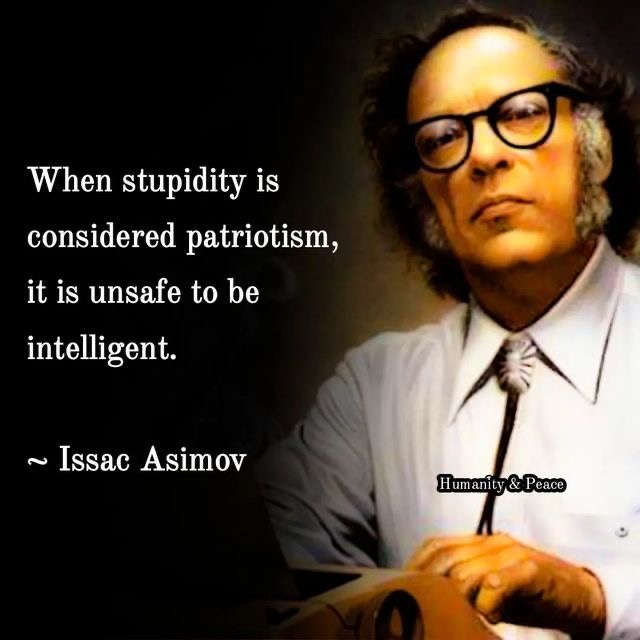
The Trump administration’s broader approach to governance further illustrates Asimov’s critique. From rejecting intelligence assessments on foreign interference in elections to downplaying the impact of climate policies, the administration often sidelined expertise in favor of politically convenient narratives. This pattern was not limited to one administration. Leaders across political spectrums have, at times, embraced anti-intellectualism, whether through denial of scientific consensus, opposition to educational reform, or a reluctance to address systemic issues.
Asimov’s warning resonates because it touches on the core principle that democracy requires an informed citizenry and leaders willing to engage with complex realities. Yet, when leaders dismiss expertise and elevate ignorance to a virtue, they erode the foundations of democratic governance. The COVID-19 pandemic, climate change denial, and educational censorship demonstrate how the conflation of ignorance with knowledge can have dire consequences for public health, global stability, and intellectual progress.
Reversing this trend demands a renewed commitment to intellectual integrity and informed leadership. Politicians must prioritize evidence-based policymaking, foster trust in expertise, and resist the allure of populist rhetoric that sacrifices long-term progress for short-term gains. Only by respecting knowledge and promoting critical thinking can the United States counteract the “cult of ignorance” Asimov so aptly described and ensure a democratic future guided by reason and understanding.
 The Rowanwood Chronicles
Hello from the UK
Thank you for your post. In 2020 the authorities rebranded the ‘flu which was why the ‘flu almost disappeared from the statistics to be replaced by COVID 19.
As to “injecting disinfectant”, those who ridiculed Trump were quite happy to be injected with a novel vaccine, rushed out in a year, rather than being trialled for 10-15 years as usual. I don’t think they realised they were guinea pigs. Such is the cult of ignorance in the USA.
LikeLike