
It began in the aftermath of the Trump years – a nation divided, fractured at its very core. The United States, once a symbol of strength and unity, had unraveled under the weight of its own polarization. Years of escalating political infighting, economic instability, and growing regional tensions had pushed the great experiment of American democracy to its breaking point. When the collapse came, it was not with a bang, but with a slow, inevitable unraveling.
In the early 2030s, the federal government, weakened by years of partisan gridlock and financial crises, failed to contain the growing unrest. States, long at odds over issues of governance, resources, and ideology, began asserting their independence. California, Texas, and other powerful states declared their sovereignty, severing ties with Washington, D.C., and leaving the remnants of the federal government powerless. What was once a union of fifty states dissolved into chaos.
As the world watched in shock, two nations quietly stepped forward: Canada and Mexico. Both had been America’s neighbors and partners, but now, they saw an opportunity, and a necessity, to reshape the continent.
The Canadian Annexation
To the north, Canada extended a cautious but determined hand to the crumbling states along its border. The former states of Michigan, Minnesota, North Dakota, and Montana, facing economic collapse and a bitter winter with no central government to guide them, sought refuge under Ottawa’s governance. Canada, ever pragmatic, offered them integration in exchange for loyalty to its parliamentary system and adoption of its healthcare and social policies.
The Pacific Northwest—Washington, Oregon, and northern California—quickly followed. Their progressive politics and environmental priorities aligned well with Canada’s ethos. Vancouver and Seattle became twin metropolises, and the region flourished under Canadian stewardship. The newly expanded Canada, now stretching as far south as the Sierra Nevada, became an economic powerhouse, blending American innovation with Canadian stability.
Mexico’s Revival
To the south, Mexico reclaimed lands it had lost centuries earlier. Texas, Arizona, New Mexico, and southern California were among the first to fall into its orbit. For these states, heavily influenced by Hispanic culture and history, the transition was both practical and symbolic—a return to roots.
Mexico, long underestimated on the global stage, rose to meet the challenge. The integration of these territories revitalized its economy, spurred technological innovation, and solidified its status as a regional superpower. Cities like Los Angeles and Austin, while retaining their unique identities, became hubs of a new Mexican-led cultural renaissance. Spanish replaced English as the dominant language in much of the region, and Mexico’s influence spread northward.
A Continent Redefined
By the 2040s, the map of North America had been redrawn. Canada and Mexico had divided the former United States almost evenly, with a handful of independent city-states like New York and Chicago remaining as neutral enclaves. The continent was no longer dominated by a single superpower but by two distinct and rising nations, each shaped by the remnants of the United States they had absorbed.
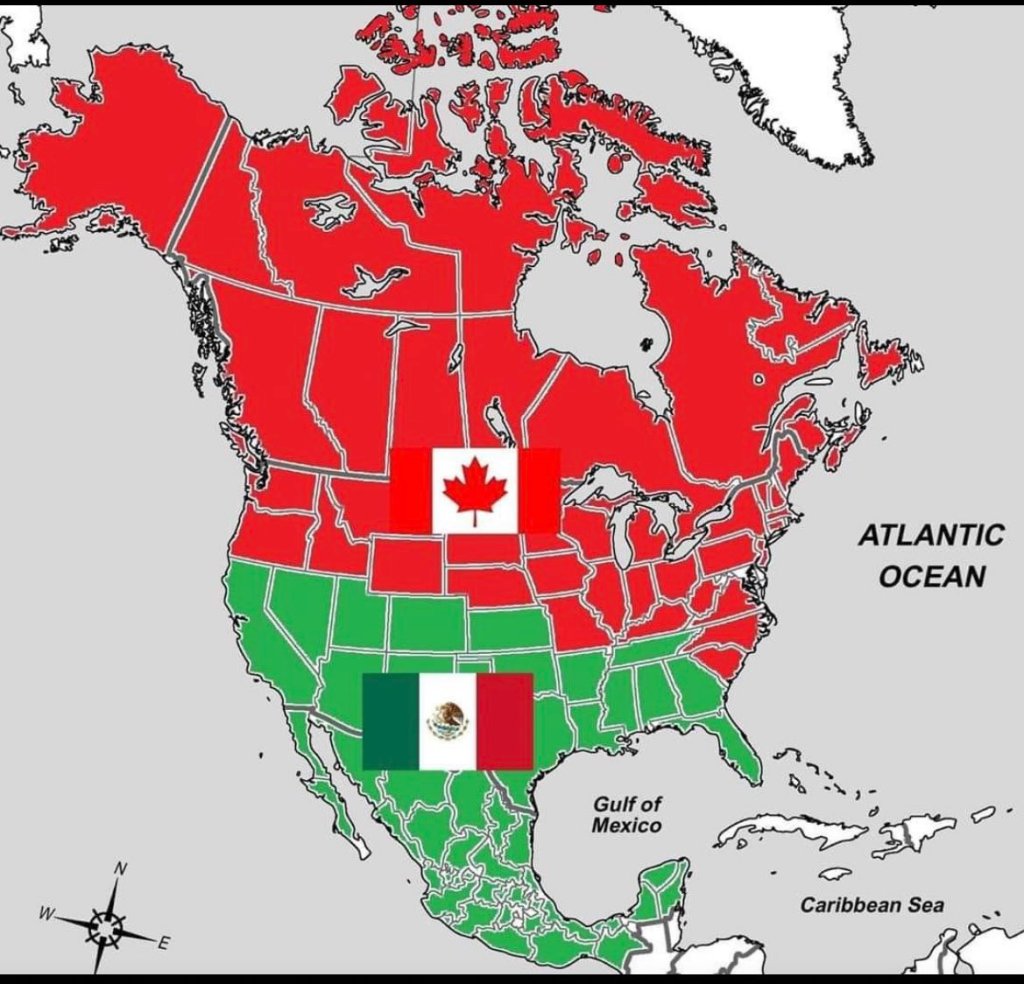
Canada, now stretching from the Arctic to the Rockies and the Great Lakes to the Pacific, became a beacon of progressive governance and environmental stewardship. Mexico, infused with the energy of its newly integrated territories, grew into a vibrant economic and cultural force, bridging Latin America with the former United States.
The world adapted to this new reality. China and the European Union moved to fill the void left by America’s collapse, but Canada and Mexico ensured North America remained a critical player on the global stage. Though the stars and stripes had fallen, the legacy of the United States lived on—in the governments, cultures, and people of its successor states.
And so, the great American experiment ended, not in triumph or tragedy, but in transformation, a testament to the resilience of a continent and the enduring power of reinvention.
 The Rowanwood Chronicles