
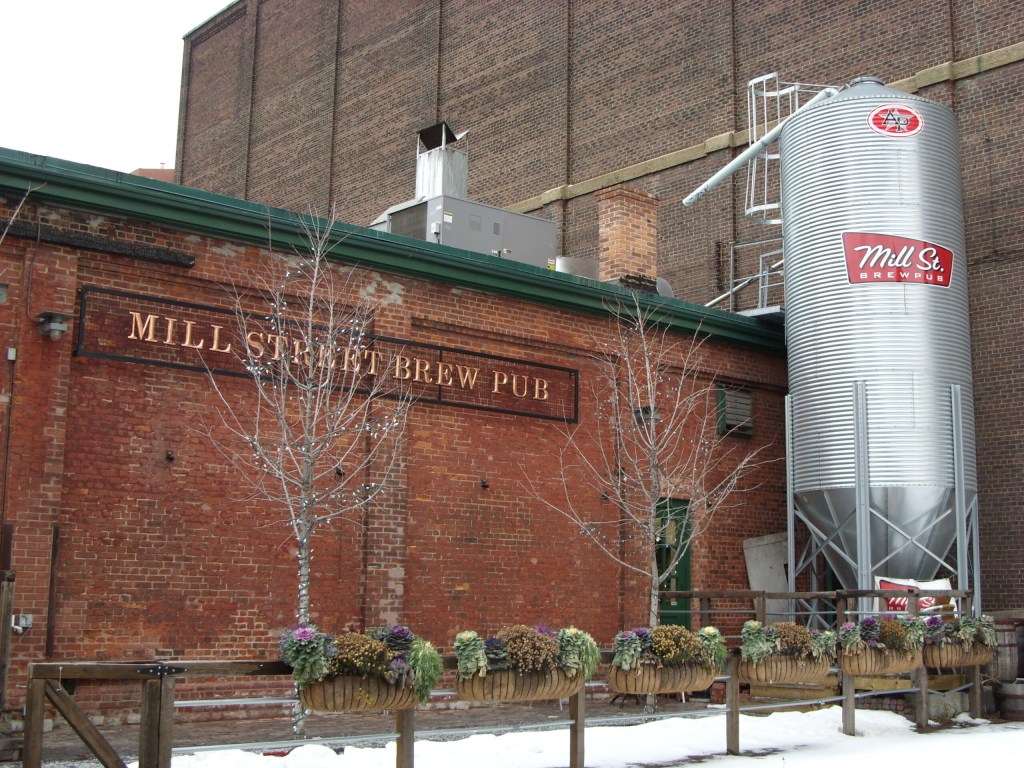
Fans of Mill Street Brewery are in shock after Labatt announced it was shutting down the North York brewery, and shifting production to its industrial-scale facility in London, Ontario. Thirty-nine workers will lose their jobs, and it’s unclear if many of Mill Street’s small-batch beers will survive. The three remaining brewpubs—in Toronto, Ottawa, and Pearson Airport—will continue to operate, but anyone who’s followed the beer industry knows what’s coming next. This is just another chapter in a long and predictable story.
When Labatt, itself owned by global behemoth AB InBev, acquired Mill Street a decade ago, craft beer lovers were divided. Some saw it as an opportunity for Mill Street to grow with the backing of a major player. Others saw it for what it really was: the beginning of the end. This wasn’t a rescue mission—it was an extraction.
We’ve seen this play out before. Lakeport Brewing, once a Hamilton-based success story built on discount beer, was scooped up by Labatt in 2007 for $201 million. Just three years later, Labatt shut down the brewery, put 143 people out of work, and moved production to London. More tellingly, when potential buyers showed interest in taking over the plant, and keeping it running, Labatt refused. The brewing equipment was dismantled, ensuring that no one else could compete.
Sapporo’s 2006 acquisition of Sleeman Breweries led to a similar fate for Sleeman’s Halifax operation, which was shuttered in 2013. The difference? Unlike Labatt, Sapporo allowed the equipment to be sold off, helping fuel the rise of Collective Arts Brewing in Hamilton, but the lesson remains the same: when a craft brewery is acquired by a major player, it’s no longer a craft brewery – It’s a brand.
Mill Street was never going to be an exception. It started with real craft credentials—a small brewery in Toronto’s Distillery District, a reputation for eco-conscious brewing, and flagship beers like Tankhouse Ale and Organic Lager that set it apart in the early 2000s. By the time Labatt took over, it had already expanded significantly, adding brewpubs and scaling up production. That growth made it an attractive acquisition target, but it also meant Mill Street was now operating in the corporate world, where efficiencies trump tradition and scale wins over local identity.
Now, as production consolidates in London, the brewery’s original spirit is all but gone. Sure, the remaining brewpubs will still pour Mill Street beer, just as other corporate-owned brewpubs do with “craft” labels that are little more than marketing exercises. But the North York brewery’s closure isn’t just about job losses—it’s the final confirmation that Mill Street, as craft beer fans knew it, no longer exists.
If you’re surprised, you weren’t paying attention. Once an independent brewery sells to a major corporation, it’s only a matter of time before the “craft” part disappears. This isn’t a betrayal—it’s just business as usual.
 The Rowanwood Chronicles