It’s a strange sight to behold – the old bear, once feared across continents, now leaning heavily on the dragon, who circles with a slow, calculating grace. Russia, once the hammer of the East, has been brought to heel by a grinding war in Ukraine, and while the West cuts ties and imposes sanctions, China, with the patience of a millennia-old civilization, sees opportunity, not just to profit, but perhaps to reshape history.
There’s a sense of irony that hangs over this moment. In 1860, the Qing dynasty signed the Peking Accord under duress, ceding vast swathes of land to the Russian Empire. That territory, now known as the Russian Far East, includes strategic regions like Vladivostok and the Amur Basin, lands that had once been part of China’s imperial periphery. The Chinese state, pragmatic in diplomacy, but deeply historical in self-conception, has never fully forgotten these losses. While official maps no longer lay claim to those regions, nationalist narratives in China occasionally whisper about redrawing what was once erased.
Fast forward to today, and the tables have turned. The war in Ukraine has battered Russia’s economy, and severed its connections to Europe. In desperation, Moscow has tilted eastward, selling gas, oil, and influence to Beijing at discount prices. This is not a partnership of equals. Russia needs Chinese markets, Chinese currency, and Chinese technology. China, meanwhile, gains leverage with every shipment of discounted crude, and every signed memorandum that ties the Russian economy tighter to the yuan. Where once they competed in Central Asia and the Arctic, now Russia finds itself the junior partner in a relationship it once dominated.
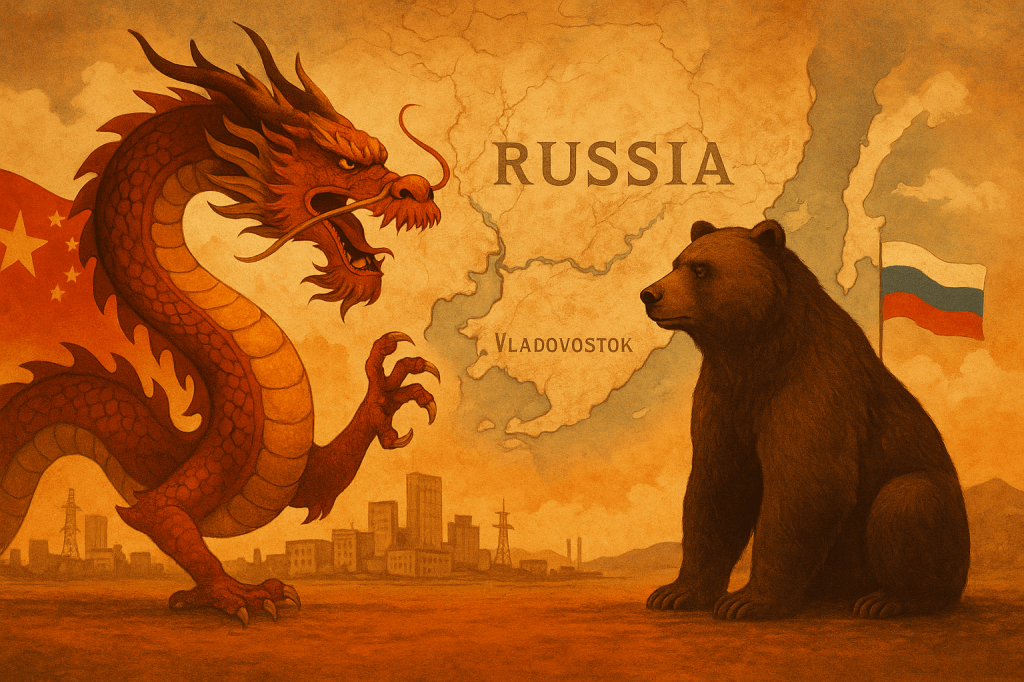
But China’s strategy isn’t conquest, it’s saturation. In the underpopulated stretches of Siberia and the Russian Far East, Chinese traders, laborers, and companies are embedding themselves quietly, but firmly. Towns along the border increasingly do their business in yuan, and many look more to Harbin or Heihe, cities in China’s Heilongjiang Province, than to Moscow. Infrastructure projects, often funded with Chinese capital, and executed by Chinese firms, are weaving a new economic fabric, one that binds these regions more to Beijing than to the Kremlin.
This isn’t a territorial war. China doesn’t need tanks to reverse the Peking Accord. It just needs time, capital, and a weakened Russia with few other friends. What we may be witnessing is not the formal return of lost lands, but something more subtle and enduring; a slow-motion annexation by way of economy, trade, and cultural seepage. A kind of imperial inversion, done not with gunboats, but with invoices and supply chains.
In geopolitics, history never dies, it just waits for the moment when the balance tilts. With every sanctioned ruble, and every Chinese-funded deal, the echoes of the 19th century grow louder. Russia may not yet realize it, but the dragon is already at the gates. Not to conquer, but to reclaim, softly, surely, and without ever having to fire a shot.
 The Rowanwood Chronicles