
As Australia prepares for the 2025 federal election on May 3, the national mood carries a distinctly restive undercurrent. While the major parties, the governing Labor Party under Anthony Albanese and the Liberal-National Coalition led by Peter Dutton, continue to dominate the headlines and stage debates, there is an unmistakable stir among the electorate. It’s not just about who will win, but about how Australians want to be represented in the years ahead. And this year, more than any in recent memory, the answer may lie in a growing movement determined to disrupt the traditional two-party stranglehold on power.
This discontent didn’t arise overnight. Over the past two decades, the combined vote share for Labor and the Coalition has gradually eroded. In the 2022 election, only 15 of the 150 seats in the House of Representatives were won on first preferences, down significantly from 46 in 2019. This decline in first-choice support reflects a broadening desire for alternatives, and the cracks in the old foundations have only widened since then. Australians are increasingly looking beyond the major parties to a field of independents and minor parties who promise to speak to the concerns long ignored: climate change, political integrity, housing, Indigenous rights, and gender equity among them.
At the forefront of this insurgency are the so-called “teal” independents, many of whom are professional women with strong credentials, campaigning for climate action and a more accountable, less adversarial form of politics. In 2022, they claimed several safe Liberal seats in wealthy urban electorates, sending a clear signal that voters were no longer content with business as usual. Now, in 2025, these candidates and their supporters are back, energized and better organized, facing off not only against the majors, but also against newly formed, sometimes opaque groups like “Repeal the Teal” and “Better Australia.” These groups claim neutrality, but have drawn scrutiny for shadowy funding, and messaging strategies that mirror traditional conservative talking points.
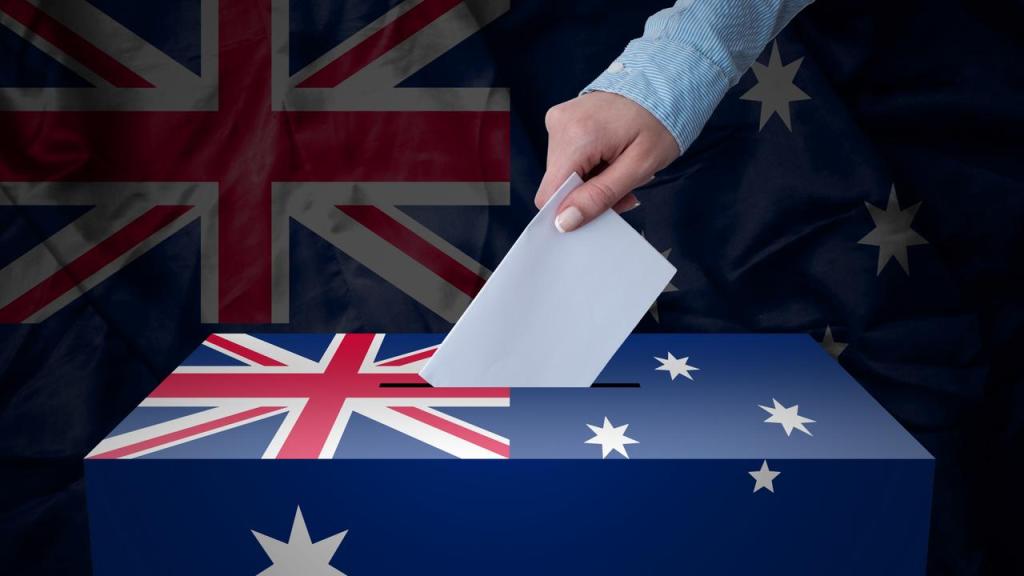
What makes this electoral fluidity possible is Australia’s unique and, in some ways, underappreciated voting system. In the House of Representatives, voters use preferential voting, where they rank candidates in order of preference rather than picking just one. If no candidate achieves a majority in the first count, the one with the fewest votes is eliminated and their ballots redistributed based on second choices, and so on, until someone crosses the 50 percent threshold. This system rewards candidates who may not be first on everyone’s list but are broadly acceptable to most voters, an ideal scenario for strong independents or minor party contenders.
The Senate, meanwhile, uses proportional representation via the single transferable vote. Voters can either rank individual candidates or select a party group, and the allocation of seats is determined by how many votes each candidate or party garners relative to a calculated quota. This system allows smaller parties, be they progressive Greens, libertarian groups, or issue-focused movements, to punch above their weight. It’s why the Senate has consistently been more diverse and less dominated by the major parties, and it’s increasingly becoming a model for what many Australians would like the lower house to reflect as well.
The major parties are far from blind to these shifts. Both Labor and the Coalition are attempting to reframe themselves in ways that respond to this moment of political flux, but their efforts are often read as reactive rather than visionary. Labor has enjoyed diplomatic and trade wins in its relationship with China, but is grappling with domestic fatigue around housing and healthcare. The Coalition, for its part, has doubled down on culture war rhetoric, and economic orthodoxy, hoping to rally its base. In taking this approach, it risks looking out of touch with a population more worried about rising rents than ideological crusades.
Nowhere is this tension more visible than in Australia’s growing Chinese-Australian communities, whose votes may swing marginal electorates. Both major parties are courting this demographic carefully. The ALP points to its restored ties with Beijing as a diplomatic success; the Coalition pushes national security fears. Yet neither approach may be enough to capture the full complexity of voter identity and aspiration in a country as diverse, and as impatient for change, as modern Australia.
A hung parliament is not only possible; many analysts consider it likely. If that happens, power will shift dramatically toward the crossbench: the independents and minor parties who are no longer content to be “preferences”, but now aspire to real leverage. For some, this signals instability. For others, it is a long-overdue correction, a rebalancing of a political system that has for too long treated voter discontent as an aberration instead of a force.
In the end, the 2025 election will be more than just a contest of parties. It will be a referendum on a political system straining under the weight of modern expectations. Voters are not just deciding who governs, they’re redefining howAustralia should be governed. If the results reflect the momentum of the past three years, then the two-party system may not collapse overnight, but it will be forced to make room for a future that looks far more plural, more negotiated, and perhaps, finally, more representative.
 The Rowanwood Chronicles