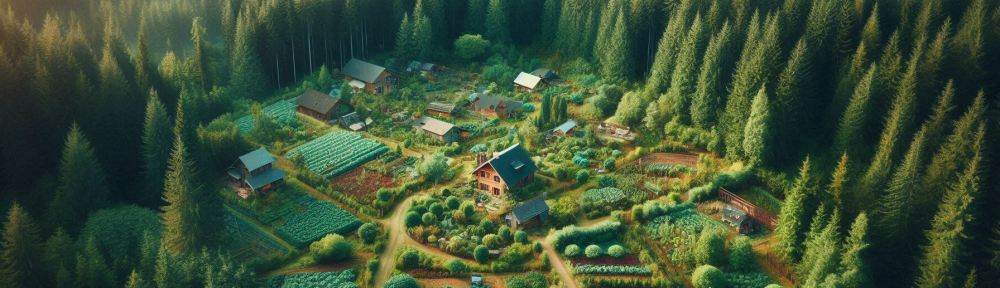
Tucked into the gently rolling landscape near Ottawa, where Canadian Hardiness Zone 5 cradles forests through cold winters and warm, green summers, a 15-acre hobby farm hums with quiet purpose. At first glance, it seems like a peaceful retreat, 11 acres of mixed forest, 4 acres of open land, but beneath the stillness lies a powerful, invisible engine of climate action.
This isn’t just a hobby farm. It’s a carbon sink, a micro-forest sanctuary, and a quietly defiant response to the global climate crisis.
The land is a mosaic of native species, maple, black cherry, beech, oak, and poplar stand shoulder to shoulder with pine, fir, and spruce. Half the forest is allowed to run wild, a dense tangle of trees and undergrowth where time and nature make their own rules. The other half is gently managed with selective thinning and nurturing to promote health and resilience. Together, they form a thriving biome that plays a vital role in absorbing and storing carbon dioxide from the atmosphere.
In a world scrambling to limit greenhouse gas emissions, this modest forest is making a real difference.

Tree Math: Carbon Accounting for a Better Future
According to forest carbon research by Natural Resources Canada and other experts, mixed temperate forests like this one can sequester between 2.5 and 6.0 tonnes of CO₂ per acre per year, depending on age, species, and management.
Here, the forest has been evaluated more precisely:
• The 5.5 acres of managed forest, with its encouraged regrowth and carefully tended canopy, sequesters an estimated 5.5 tonnes of CO₂ per acre per year.
• The 5.5 acres of wild, dense forest, with its thick stands of aging trees and self-regulating ecosystems, sequesters a more modest, but still powerful 3.5 tonnes of CO₂ per acre.
Together, that means this forest is pulling approximately 49.5 tonnes of CO₂ out of the atmosphere every year. That’s not just a number – it’s a force.
It’s the equivalent of:
• Offsetting the annual carbon emissions of 10 passenger vehicles
• Neutralizing the electricity use of about 7 Canadian homes
• Canceling out the emissions of nearly 250 propane BBQ tanks or over 110,000 smartphone charges
Each year, the trees breathe in carbon, storing it in wood, roots, and soil. They do this without fanfare. They don’t ask for credit, but they are doing the slow, essential work of saving the planet – tree by tree.
Rooted in Regeneration: Permaculture and Agroforestry
Beyond the forest, the remaining four acres of the property form a living laboratory for regenerative land use, guided by the principles of permacultureand agroforestry.
Here, perennial fruit and vegetable beds are woven through flowering hedgerows and small windbreaks of nut and berry trees. Apple, plum, and pear trees grow beside hardy perennial crops like rhubarb, asparagus, and sun chokes. Herbs spiral outward in patterns that mimic natural ecosystems, encouraging pollinators and providing continuous yield with minimal intervention.
This is no ordinary garden, it’s a climate-positive food forest in the making. Carefully designed guilds of plants mimic the structure of natural woodland ecologies. Deep-rooted plants draw nutrients from the subsoil. Groundcovers protect against erosion. Legumes fix nitrogen. Every element supports another. Even fallen branches and leaf mulch are repurposed into hugelkultur mounds, which retain water and build soil carbon over time.
Together, the forest and farm create a system that captures carbon, regenerates soil, and produces food, not in spite of nature, but in deep collaboration with it.
A Local Action With Global Implications
Climate action often feels like something that happens elsewhere, in government chambers, UN conferences, or corporate boardrooms. But on this hobby farm, the frontlines are right here, in bark and branches, under loamy soil and perennial cover. While politicians debate net-zero goals and global emissions caps, these 15 acres are already doing their part.
And the story doesn’t end with sequestration. The whole property becomes a model, not of scale, but of intentionality. It proves that one person, on one piece of land, can be part of the solution.
A Blueprint for the Future
If every small landowner in Ontario set aside just part of their land for forest preservation, regenerative farming, or agroecological food production, the collective carbon sink would grow exponentially. The 49.5 tonnes of CO₂ absorbed here could be multiplied by thousands of similar efforts. This hobby farm is not just saving the world, it’s showing others how to do it too.
So next time someone says the climate crisis is too big for individuals to affect, point them to this patch of trees and garden beds outside Ottawa. Tell them about the forest that quietly pulls nearly 50 tonnes of CO₂ from the sky every year. Tell them about the permaculture orchard that feeds people and soil alike. Tell them about the hobby farm that’s making a difference.
Because real change doesn’t always look like a protest march or a giant wind turbine. Sometimes, it looks like a sapling taking root in Zone 5, and being given the time and space to grow.
 The Rowanwood Chronicles