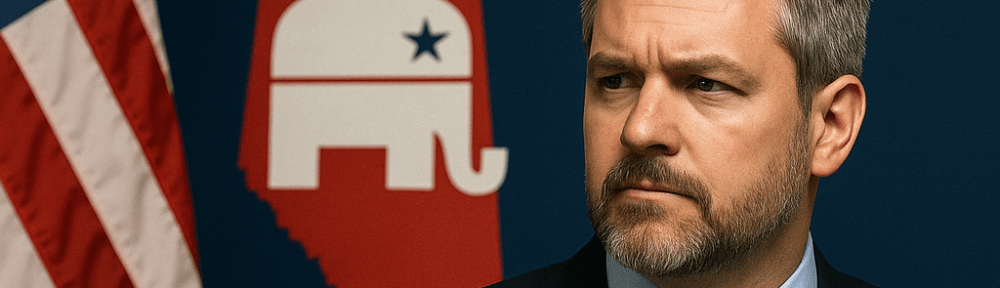
The emergence of the Republican Party of Alberta (RPA) on the political stage is more than just another footnote in the long tale of Western alienation, it’s a calculated, ideologically driven attempt to redefine Alberta’s place not just within Canada, but in the broader North American political culture. At its centre stands Cameron Davies, a seasoned conservative strategist whose own political evolution mirrors the rightward lurch of the party he now leads.
The RPA was officially registered with Elections Alberta in January 2024, marking the latest effort to unite various hard-right and sovereigntist factions that have cycled through Alberta politics over the past decade. It inherited the legacy of groups like the Wildrose Independence Party and Wexit Alberta, which had captured the imagination of disillusioned voters but failed to sustain momentum. The new branding, “Republican” in name and nature, signals a stark ideological shift. It’s not just about independence anymore; it’s about importing the ethos of American-style conservatism, down to the MAGA-hued slogans and policy choices.
When Cameron Davies was acclaimed as leader in April 2025, the party’s intentions crystallized. Davies, a former backroom operator for the Wildrose and United Conservative Party (UCP), is best known for his role in the controversial “kamikaze” campaign during the 2017 UCP leadership race. That episode, which sought to undermine Brian Jean in favour of Jason Kenney, resulted in Davies being fined $15,000 for obstructing an election investigation. Though bruised by scandal, he remained a prominent figure in conservative circles until he publicly resigned from the UCP in 2025, accusing it of corruption, entitlement, and ideological betrayal.
His resignation letter read like a manifesto, a rejection of institutional politics in favour of what he described as grassroots conservatism, though critics might call it a hard-right insurgency. Davies’ departure was both strategic and symbolic. He positioned himself as the torchbearer of the “real right” in Alberta, unencumbered by the compromises of power that had come to define Danielle Smith’s increasingly centrist UCP government.

Under Davies’ leadership, the RPA has embraced a platform that reads like it was drafted in a red-state Republican think tank. There’s the call for a binding referendum on Alberta independence, followed by a non-binding vote on joining the United States. There’s strong rhetoric about parental rights, religious freedom, and gun ownership, coupled with opposition to “woke” policies like diversity, equity, and inclusion (DEI) programs. Carbon taxes, public healthcare, federal immigration policies—these are all painted as signs of moral and fiscal decline, to be swept away by a new order rooted in faith, family, and “freedom.”
If this sounds familiar, it’s because it is. Davies has openly fashioned himself in the mold of American populist leaders. His social media presence references his military background (“Marine”), his patriotism, and his adherence to traditional values. He speaks of Canada, especially under Liberal governments, in the kind of dire terms more commonly heard on Fox News than in Canadian legislatures. For Davies, Ottawa is not just a political rival; it is a moral adversary, and Alberta must be rescued from its grasp.
There is no hard evidence yet of direct ties between Davies and the machinery of the American right, no funding pipelines, no visits to CPAC (yet), no endorsements from U.S. figures. But the ideological alignment is unmistakable. The RPA’s aesthetics, policy priorities, and culture-war messaging are all deeply influenced by the Make America Great Again (MAGA) movement. It is a party that sees itself less as a provincial player and more as a cultural movement, seeking to spark a broader populist awakening.
Davies’ recent moves show that this isn’t just rhetorical posturing. In May 2025, the RPA signed a Memorandum of Understanding with The Independence Party of Alberta, forming a loose coalition aimed at consolidating the separatist vote. The message is clear: there is no room anymore for fragmented protest parties. To mount a serious challenge to the UCP and, by extension, the federal order, the independence movement must speak with one voice, and Davies intends to be that voice.
The question now is whether the Republican Party of Alberta will become a formidable political force, or simply another flare in Alberta’s long-burning bonfire of right-wing discontent. The UCP has already learned, painfully, what happens when the right fractures. The Wildrose-PC split in the early 2010s handed the NDP a surprise victory in 2015. That memory is still fresh, and it was precisely what motivated the formation of the UCP as a big-tent conservative party in 2017.
Yet that tent is fraying. Many rural voters feel the UCP has compromised too much on issues like education, healthcare privatization, and provincial sovereignty. The RPA, with its unapologetically radical platform, offers them an alternative, a place where the message isn’t diluted by political pragmatism. Davies has a keen understanding of this tension, and he’s betting that enough Albertans are tired of half-measures and ready to blow the whole system up.
But winning a few headlines and gaining traction in the echo chamber of social media is one thing; winning seats is another. The RPA currently has no MLAs. Its organizational infrastructure is limited. Unless a high-profile defection occurs or it pulls off an upset in a by-election, the party remains on the fringe. Moreover, its overtly American positioning, especially the proposal to join the U.S., may strike even sympathetic voters as unserious or dangerously naive.
Canadians, after all, are not Americans. While cultural conservatism resonates in parts of Alberta, many still value universal healthcare, peacekeeping diplomacy, and the Charter of Rights and Freedoms. The RPA’s invocation of U.S.-style populism could ultimately alienate more voters than it attracts, especially if it becomes associated with the chaos and polarization of American politics.
Still, it would be unwise to dismiss Cameron Davies and the RPA out of hand. They are tapping into something very real: a deep and growing disillusionment with traditional politics, a sense of cultural siege, and a yearning for bold, even revolutionary change. Whether that can be translated into electoral success remains uncertain, but the message is loud and clear: the populist right in Alberta is no longer content to sit on the sidelines. And under Davies’ leadership, it’s ready to speak with an American accent.
 The Rowanwood Chronicles