
The morning sun hangs low over the Atlantic, glinting off the towers rising in Georgetown, Guyana’s modest, but fast-transforming capital. A decade ago, few would have imagined this small South American nation, wedged between Brazil, Venezuela, and Suriname, would be at the center of a geopolitical and environmental drama with global stakes. Guyana is flush with oil – Black Gold. The kind that redraws maps, tilts economies, and ignites old rivalries. For Venezuela, long mired in economic freefall and domestic strife, it is an irresistible provocation.
Let’s be clear, what’s happening in Guyana is one of the most remarkable economic stories in the Western Hemisphere. Since ExxonMobil discovered vast offshore reserves in 2015, production has accelerated with almost reckless speed. By next year, output is projected to hit 900,000 barrels a day, and it could top 1.3 million before the end of the decade. For a country of under 800,000 people, that is transformative wealth, and unlike its oil-rich neighbours, some of whom squandered such windfalls, Guyana is making a bold promise; to become a net-zero emitter of greenhouse gases by 2050, even as it becomes a fossil fuel giant.
On the surface, this seems contradictory. How can you drill for oil while committing to climate leadership? Guyana’s government argues that its forest cover, nearly 85% of the national territory, is a massive carbon sink. It also claims that the revenues from oil will fund sustainable development, clean energy projects, and climate resilience. Whether this can be done without falling into the corruption, debt, and inequality traps that have cursed so many petro-states remains to be seen. So far, international financial institutions are cautiously optimistic. The government is under intense scrutiny, and the pressure to deliver transparency and social equity is mounting.
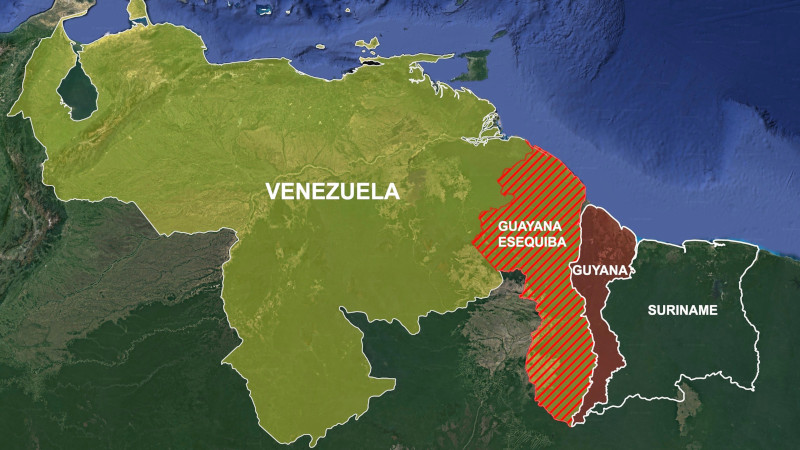
Guyana’s newfound wealth has stirred a long-simmering conflict with its neighbor to the west – Venezuela. The heart of the matter is the Essequibo region, a vast, resource-rich area that makes up nearly two-thirds of Guyana’s landmass. Venezuela has claimed it ever since the 1899 arbitration award, backed by the United States and Britain, granted the territory to what was then British Guiana. For over a century, the dispute remained largely symbolic, flaring up occasionally, but never seriously threatening borders.
Now, the stakes are very real. In 2023, Venezuela’s President Nicolás Maduro ramped up the rhetoric, holding a referendum in which voters overwhelmingly backed a proposal to annex Essequibo. Caracas argues that the arbitration was flawed and that the entire region was unlawfully taken. The timing, of course, is not coincidental. As Guyana’s oil fields, many lying off the Essequibo coastline, begin to pump billions into government coffers, Venezuela sees an opportunity to redirect domestic attention from its own failures, and tap into a nationalist cause with broad appeal.
Guyana, for its part, has responded not with sabre-rattling, but with legal precision. It brought the case before the International Court of Justice, which ruled in 2023 that it had jurisdiction. Earlier this year, in May 2025, the ICJ went further, ordering Venezuela to halt its plans to conduct elections in the disputed territory, a direct rebuke to Maduro’s annexation agenda. Venezuela has ignored the court, as it has ignored much of international law in recent years, and tensions are rising on the ground.
This is no longer a war of words. Just this month, Guyanese soldiers patrolling the border were attacked multiple times in under 24 hours. These were not large-scale military incursions, but they are warnings, probing gestures, testing the resolve of a much smaller neighbor. Guyana has responded by strengthening its military posture and drawing closer to its Western allies, including the United States and Brazil. The regional implications are grave: any escalation could destabilize the northern tier of South America, drag in other powers, and endanger vital shipping routes and energy flows.
As someone who has watched the ebb and flow of South American politics for decades, I see in this moment both peril and possibility. Guyana stands on a razor’s edge: it could become a model of how a small nation leverages its natural wealth responsibly, or it could descend into conflict, corruption, and dependence. Venezuela’s claim is, in essence a gamble, hoping that the world is too distracted to enforce international norms, and that might still makes right. Yet Guyana is not alone, and the legal, diplomatic, and moral momentum is on its side.
Whether that will be enough is another question entirely. Oil has always been more than a commodity in this region of the world. It is a force that reshapes nations and, sometimes, breaks them. For Guyana, the challenge now is not only to survive Venezuela’s ambitions, but to thrive in spite of them, and perhaps, just perhaps, to chart a new course for oil-rich states in the 21st century.
 The Rowanwood Chronicles
Pingback: Carriers, Claims, and Crude: Why the Caribbean Is Becoming 2025’s Most Dangerous Flashpoint | The Rowanwood Chronicles