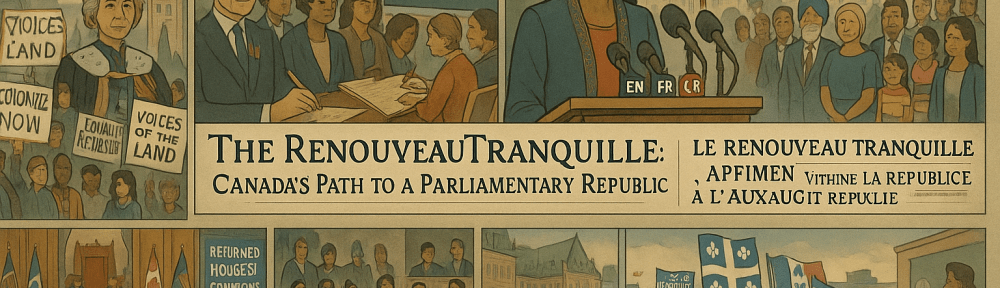
With the King and Queen in Ottawa, I thought I might just post this small Republican fantasy, laid out for all to read.
Prologue: The End of the Crown
In the year 2032, following a decade of public debate, constitutional conferences, and grassroots engagement, Canada formally transitioned from a constitutional monarchy to a parliamentary republic. The catalyst was a national referendum, driven by rising republican sentiment in Quebec, a resurgent Western populism demanding proportional representation, and an Indigenous-led movement for political sovereignty within the Canadian state.
The result was overwhelming: 68% of Canadians voted in favour of replacing the monarchy with a democratically elected head of state, establishing a fully Canadian republic with a new constitution rooted in reconciliation, regional balance, and democratic renewal.
A President for All Canadians
The new President of Canada is elected by ranked-choice ballot every seven years, with a non-renewable term. The position is ceremonial, but symbolically powerful: a national unifier who replaces the King and Governor General, chosen by the people rather than inherited title. Quebec supported the reform overwhelmingly. For the first time, the Canadian state acknowledged its dualistic identity: one anglophone and one francophone society within a shared democratic framework. Official bilingualism was strengthened. The first President, a Métis jurist from Saskatchewan, addressed the country in Cree, French, and English during their inaugural speech.

The Two Houses of Parliament
A. The House of Commons
Reformed to use Mixed Member Proportional Representation (MMP):
• 60% of MPs are elected directly in ridings.
• 40% are elected from regional party lists to reflect actual vote share.
This addressed a central grievance of Western provinces, especially Alberta and Saskatchewan, who had long seen their votes “wasted” under the old system. Under MMP:
• Western-based parties gained consistent, proportional representation.
• Coalition governments became the norm, requiring negotiation and respect across regions.
B. The Senate of Canada
Recast as an Elected Council of the Federation:
• Each province and territory elects equal numbers of Senators, regardless of population, to ensure regional parity.
• Senators serve staggered eight-year terms.
• Legislation must pass both Houses, but the Senate cannot permanently block Commons bills, only delay and revise.
Crucially, Indigenous Peoples were granted 20 permanent Senate seats:
• These seats are chosen by First Nations, Métis, and Inuit national councils, not political parties.
• Their mandate: to protect Indigenous rights, oversee federal treaty obligations, and act as stewards of land, climate, and cultural legislation.
Indigenous Representation in Governance
For the first time in Canadian history, Indigenous Nations are formally recognized as constitutional partners. Their rights are not granted by the Crown, they are affirmed by co-sovereignty agreements embedded in the Constitution.
• Twenty seats in the House of Commons are permanently reserved for national Indigenous representatives, elected by pan-Indigenous vote.
• Twenty Senate seats, as noted, are selected by national Indigenous councils and rotate among Nations.
• All legislation affecting land, language, or treaty obligations must be reviewed by an Indigenous-Led Standing Committee.
This gave concrete form to the nation-to-nation vision long promised under UNDRIP.
Quebec’s Role in the Republic
• With the monarchy gone, Quebec’s national identity was affirmed in law: it was recognized as a distinct society, with its own civil code, cultural protections, and immigration quotas.
• French became the co-equal language of the state, not merely a translation.
• The Republican Constitution of Canada acknowledged the right of Quebec to self-determination, but also embedded it in a new federal partnership of equals, making secession less urgent and less attractive.
Quebec found itself more powerful inside the republic than outside the monarchy-bound confederation it had long resented.
A More Responsive and Inclusive Democracy
The post-monarchy Canada is:
• More representative, with diverse voices in Parliament.
• More cooperative, with minority governments requiring negotiation.
• More just, with Indigenous peoples at the table, not petitioning from the outside.
• More regionally balanced, with the West and Quebec no longer sidelined.
• More future-focused, with a Senate that values long-term planning over short-term headlines.
A Canada Reimagined
By 2040, the republican Canada is no longer simply a continuation of its colonial past. It is a democratic partnership of peoples, Indigenous, settler, immigrant, Quebecois, and regional, bound not by allegiance to a Crown, but by shared stewardship of land, rights, and future generations.
It was not a revolution. It was a quiet rebirth, a new chapter written in many voices, with none silenced, and none above the law.
 The Rowanwood Chronicles