
Canada is finalizing a long-term commitment to its next-generation fighter fleet. While the Lockheed Martin F-35A Lightning II has dominated the headlines and procurement process, many analysts and defence strategists continue to argue for a more balanced approach that reflects Canada’s non-aggressive, defence-oriented military posture. Enter the JAS 39 Gripen E, Sweden’s cost-effective and resilient multirole fighter.
In this article, we compare the F-35A and Gripen E across key domains, and propose a strategic mixed-fleet solution tailored to Canada’s unique geography, alliances, and policy values.
F-35A vs Gripen E: A Comparative Analysis
| Feature | F-35A Lightning II | JAS 39 Gripen E |
|---|---|---|
| Origin | United States | Sweden |
| Role | Stealth multirole strike & ISR | Agile, cost-effective air defense |
| Stealth | 5th-gen stealth with internal weapons bays | Low-observable 4.5-gen fighter; external weapons only |
| Sensors | Fusion: AESA radar, DAS, EOTS, HMD | AESA radar, IRST, electronic warfare suite |
| Speed & Agility | Mach 1.6, less agile | Mach 2.0, supercruise, high agility |
| Operating Cost | ~$35,000/hr | ~$8,000 – $10,000/hr |
| Maintenance | Complex, centralized logistics | Modular, road-capable, easy maintenance |
| Interoperability | Deep NATO/NORAD integration | Flexible, sovereign-capable system |
| Best Suited For | High-end coalition warfare | Domestic sovereignty & intercept missions |
The F-35A excels in stealth, sensor fusion, and networked warfare. It’s optimized for first-strike and multi-domain operations in complex allied theatres. The Gripen E, by contrast, is designed for national airspace protection, low-cost deployment, and high survivability through speed and agility.
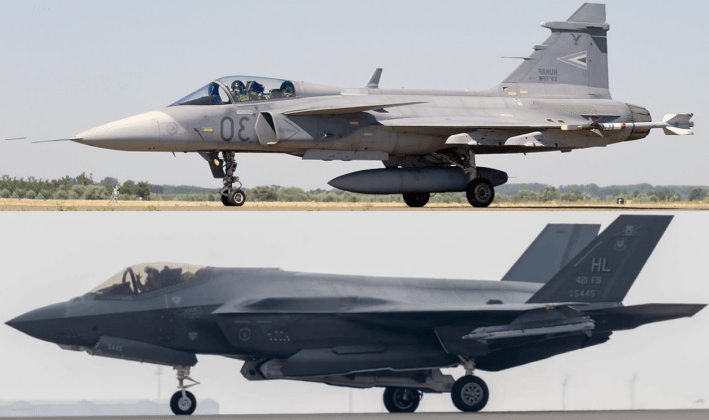
For most countries, the choice between them is binary. But for Canada, a mixed fleet provides the best of both worlds.
Canada’s Defence Posture: Defence, Not Offence
Canada’s 2017 defence policy, Strong, Secure, Engaged (source), emphasizes:
- Sovereignty protection, particularly in the Arctic
- Fulfillment of NORAD and NATO responsibilities
- Commitment to peacekeeping and allied security, not aggression or projection
This makes a single-type, stealth-heavy force both expensive and strategically limiting. The F-35A’s sophistication comes with high costs and logistical burdens. The Gripen’s versatility and affordability make it ideal for Canada’s domestic priorities, especially Arctic response and cost-effective patrols.
The Ideal Fleet Mix: 48 F-35A + 36 Gripen E
A proposed balanced force of 84 aircraft could look like this:
- 48 F-35A Lightning II – Two combat squadrons for NATO/NORAD + First-strike SEAD missions
- 36 JAS 39 Gripen E – Two intercept/sovereignty squadrons for Cold Lake & Bagotville + Pilot training
This mix satisfies Canada’s allied obligations while keeping operational costs under control and increasing resilience and redundancy.
Mission-by-Mission Alignment
| Mission Type | Aircraft Best Suited |
|---|---|
| NATO expeditionary combat | F-35A |
| Arctic sovereignty patrols | Gripen E |
| NORAD intercepts | Gripen E (routine), F-35A (high threat) |
| Peacekeeping air policing | Gripen E |
| First-strike SEAD missions | F-35A |
| Pilot training | Gripen E (cost-effective) |
Additional Benefits of a Mixed Fleet
- Economic efficiency: Gripen costs 3–4x less to operate, allowing more flying hours and Arctic readiness.
- Strategic autonomy: Saab offers greater technology transfer and offset potential, unlike the F-35 program.
- Operational resilience: Gripens can operate from rural or improvised runways in the North.
- Supplier diversification: Reduces geopolitical and logistical risk from relying on a single supplier (U.S.).
Potential Challenges & Mitigations
| Concern | Mitigation |
|---|---|
| Dual logistics systems | Segmented basing and dedicated maintenance crews |
| Interoperability | Gripen is NATO-compatible and can integrate via standard datalinks |
| Training duplication | Gripen used for advanced pilot training and tactical development |
Final Word
A dual-fighter strategy is neither nostalgic nor redundant, it is forward-thinking. By balancing cutting-edge stealth with efficient sovereignty defence, Canada can build an air force that is:
- Strategically aligned with its defensive posture
- Economically sustainable over decades
- Technologically capable of high-end conflict
- Operationally flexible across vast geography
This isn’t just a compromise, it’s a model of how Canada can lead by example in blending technology, sovereignty, and peacekeeping into a cohesive air defence strategy.
Sources
- Lockheed Martin – F-35 Lightning II Overview
- Saab Group – JAS 39 Gripen E Features
- U.S. GAO – F-35 Sustainment Report
- Government of Canada – Strong, Secure, Engaged
Tags: #CanadianDefence #F35 #Gripen #NORAD #NATO #ArcticDefence #MilitaryPolicy #Peacekeeping #AirPower
 The Rowanwood Chronicles