In the ever-evolving landscape of Canadian agriculture, a quiet revolution is taking place; one that blends innovation, resilience, and sustainability. At the heart of this shift is agrivoltaics, the practice of integrating solar energy production with agricultural activities on the same land. In a country where arable land is precious and climate resilience is no longer optional, agrivoltaics offers a compelling vision of how farmers can feed both people and power grids. And unlike many experimental technologies, agrivoltaics is already proving itself on the ground, from Alberta’s prairies to Ontario’s rolling farmland.
The principle behind agrivoltaics is deceptively simple. Instead of choosing between land for crops or solar panels, farmers are using both, strategically placing elevated or spaced-out solar panels to allow for the continued cultivation of crops or the grazing of livestock beneath them. The benefits are multifaceted: improved land-use efficiency, supplemental income from energy generation, lower evaporation rates, enhanced biodiversity, and in some cases, even better crop yields. What once might have seemed like a fringe idea is now a serious pillar in the conversation about Canada’s agricultural and energy future.

Alberta, often associated with its energy sector, has become a surprising hotspot for agrivoltaic innovation. In Strathmore, east of Calgary, a project involving Beecube, UKKO, and local landowners demonstrates how solar farms can coexist harmoniously with apiculture. Here, solar panels provide shelter for bees while the surrounding wildflowers benefit from reduced water loss thanks to the panel shade. This model is not only sustainable but financially shrewd; the land generates solar income while continuing to support honey production, which in turn supports pollination in surrounding agricultural operations.
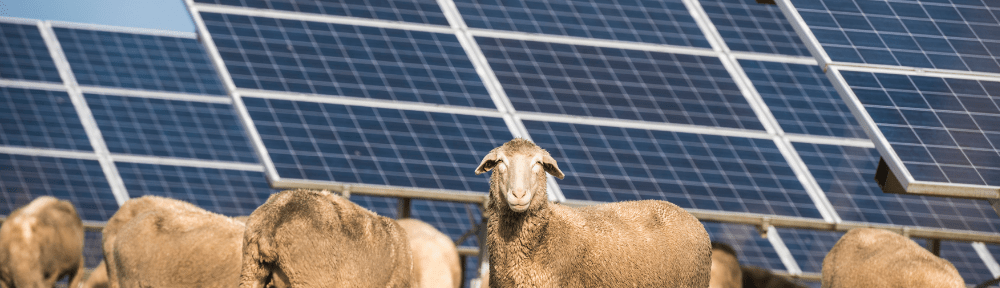
Meanwhile, in Bon Accord, Alberta, sheep graze under solar panels installed by the municipality. This partnership reduces the need for mechanical mowing, cutting emissions and maintenance costs, while simultaneously supporting local agriculture. Although challenges such as predator management and animal health persist, the project has shown that dual land-use can be both productive and community-minded.
Further south in Lethbridge, the Davidson family farm installed a 2 MW solar array over four hectares of their land. Their early results are promising: water use decreased, yields of shade-tolerant crops like lettuce and spinach improved, and the system helped buffer temperature extremes; an increasingly important advantage as Alberta experiences hotter, drier summers. The financial returns from the energy production are steady and predictable, offering farmers some insulation from commodity price swings.
Ontario has also emerged as a stronghold of agrivoltaic leadership, particularly in the east of the province. At Kinghaven Farms, a thoroughbred horse breeding operation near King City, solar panels quietly generate over 1.8 MW of energy across five different installations. Yet the land remains active agriculturally, supporting bees and pasture for livestock. This is no boutique operation, it’s a model of scalable, pragmatic sustainability, supported in part by Ontario’s long-standing feed-in-tariff and net metering frameworks.
Arnprior’s solar project, spearheaded by EDF Renewables, adds another layer of ecological complexity. The site combines solar power generation with pollinator-friendly vegetation and sheep grazing. With over 50 sheep maintained on-site, the project saves upwards of $30,000 annually on vegetation management. Moreover, the carefully chosen native flora creates a haven for butterflies, bees, and other beneficial insects, turning what could have been a sterile industrial site into a vibrant ecosystem.
The push for agrivoltaics has even begun to intersect with reconciliation and Indigenous economic development. In Perth, Ontario, Golden Leaf Agrivoltaics has launched a partnership with local Indigenous communities to design systems that blend traditional agricultural knowledge with renewable energy. This initiative is as much about cultural renewal as it is about sustainability, offering a space where land stewardship and technological advancement meet on equal footing.
Across these projects, several themes emerge. First, agrivoltaics is not a one-size-fits-all solution. What works in the dry expanses of southern Alberta may not translate directly to the wetter, colder climates of northern Ontario or Quebec. The underlying philosophy, making land work smarter, not harder, holds universal appeal. Second, success depends on collaboration: between farmers and engineers, municipalities and private firms, and, increasingly, energy utilities and Indigenous governments. Agrivoltaics is as much about social innovation as it is about technical design.
Critically, agrivoltaics helps solve one of the thorniest problems in modern planning: land-use conflict. As pressure mounts to deploy renewable energy at scale, particularly in provinces phasing out coal or expanding electric vehicle infrastructure, prime farmland is at risk of being repurposed for solar and wind farms. Agrivoltaics offers a middle ground, enabling land to serve multiple purposes without sacrificing food security.
There are challenges, of course. Start-up costs can be high, regulatory frameworks inconsistent, and skepticism remains among some traditional growers. Yet as demonstration projects continue to yield data, and dollars, those barriers are gradually eroding. Agrivoltaics is no longer a theoretical solution; it is a practical, proven tool for a climate-challenged, energy-hungry world.
In Canada, where vast geography too often isolates best practices, agrivoltaics represents a unifying opportunity. It merges rural and urban priorities, economic pragmatism with ecological restoration. With the right policies, education, and incentives, Canada could lead the world in this field, not just in acreage, but in imagination.
Sources
CBC News – BeeCube/UKKO agrivoltaics project
Organic Agriculture Centre of Canada – Renewable Energy Integration
Compass Energy Consulting – Agrivoltaics in Ontario
Sun Cycle Farms – Agrivoltaic Demonstration Projects
Golden Leaf Agrivoltaics – Community and Indigenous Engagement
 The Rowanwood Chronicles