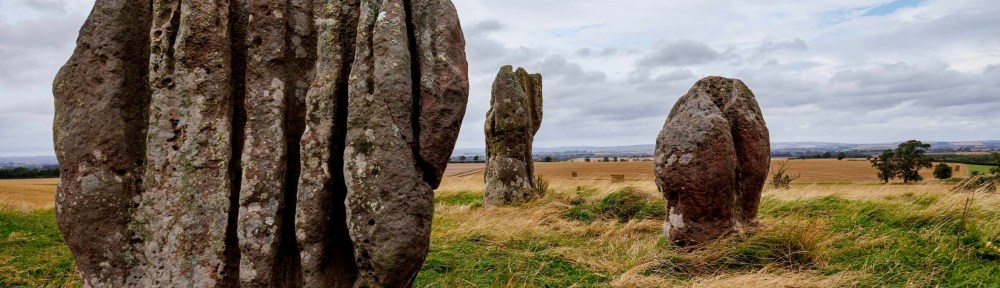
The Duddo Five Stones, nestled atop a gentle rise in north Northumberland, are a compelling testament to prehistoric endeavours in the British Isles. Erected during the Early Bronze Age, roughly 4,000 years ago, these stones comprise five extant monoliths, though archaeological surveys from the 1890s revealed empty sockets for two additional stones and confirmed an original complement of seven. Inhabitants of that period fashioned these curious markers from local soft sandstone, now distinguished by deep vertical grooves, so pronounced that the stones are sometimes spoken of as the “Singing Stones,” a nod to the haunting whistles that breeze through their fissures.
Despite their modest size compared to the monumental rings of Wiltshire, the Duddo Stones rise to heights between 1.5 m and 2.3 m and form a circle approximately 10 m in diameter. The largest stone, over two metres tall, has been likened to “a clenched fist rising menacingly out of the rough turf,” while others resemble giant decaying teeth. Weathered both by time and legend, the stones bear cup-marks and grooves that spark speculation, were these carved by ritual, or simply products of centuries of erosion?

In the heart of the circle lies evidence of its most solemn function: a central pit, excavated in the late 19th century, that contained charcoal and cremated human bone, suggesting funerary or ritual use. A later investigation unearthed fragments of pottery, perhaps a cremation vessel, further hinting at ancient rites performed upon this exposed Northumbrian hill. Such findings align with the broader traditions of Bronze Age Britain, where stones were placed to commemorate the dead, mark sacred boundaries, and orient events within a celestial calendar.
Indeed, solar and lunar alignments are often proposed for stone circles. In Duddo’s case, the stones occupy an eminence offering sweeping views of the Cheviot Hills to the south and Lammermuir Hills to the north, and may well align with midwinter sunrises or solstitial events. This deliberate positioning underlines a shared cosmological purpose with contemporaneous sites such as Stonehenge and Avebury, where built environments reflect ancient understandings of the cosmos.
Any comparison to Stonehenge or Avebury must acknowledge scale. Those iconic sites, part of a UNESCO World Heritage complex, were grand ceremonial landscapes, featuring massive sarsen lintels, henges, and extensive rituals spanning centuries. Yet Duddo’s significance should not be measured in tonnage alone. The world of early Bronze Age Northumberland had its own spiritual horizons. Stone placement here demonstrates ingenuity in local engineering, community organisation, and a relationship with the landscape that mirrored the aims of their southern counterparts.
Moreover, Duddo may be Northumberland’s best‑preserved stone circle, admired by archaeologists for its dramatic hill‑top setting and intact character. Accessibility is simple: a short permissive path from the B6354 guides visitors to this serene site, free to all, but weather and muddy fields. The site evokes reverence and reflection, a place where wind and sky merge timelessly with carved stone.
In a cultural landscape often dominated by southern giants, the Duddo Five Stones deserve equal attention. They speak of regional expressions of Bronze Age spirituality, mortuary practice, and astronomical concern. While lacking the architectural complexity of Stonehenge or the vast scale of Avebury, they nonetheless resonate with ancestral agency, standing quietly yet powerfully within a broader tapestry of prehistoric monumentality. To relegate Duddo to a mere footnote is to impoverish the understanding of Britain’s Bronze Age mosaic. It is no lesser these many millennia later, just more intimate, more quietly potent, and every bit as integral to prehistoric Britain’s story.
 The Rowanwood Chronicles