
When King Charles II created the post of Astronomer Royal in 1675, alongside the founding of the Royal Observatory at Greenwich, it was more than just a courtly appointment. The role was charged with solving one of the most pressing scientific problems of the age: finding longitude at sea. Over the centuries, its holders have included some of the most brilliant minds in science. John Flamsteed, the first Astronomer Royal, painstakingly mapped the stars to guide navigation. Edmond Halley predicted the return of his famous comet. Nevil Maskelyne brought precision to seafaring with The Nautical Almanac. Sir George Biddell Airy fixed Greenwich as the Prime Meridian. In the 20th century, Sir Frank Watson Dyson’s solar eclipse observations confirmed Einstein’s General Relativity, and Martin Rees became one of the world’s most eloquent science communicators.
For 350 years, however, the title, one of the most prestigious in British science, was held only by men. That changed on 30 July 2025, when His Majesty King Charles III appointed Professor Michele Dougherty as the 16th Astronomer Royal, making her the first woman ever to hold the office.
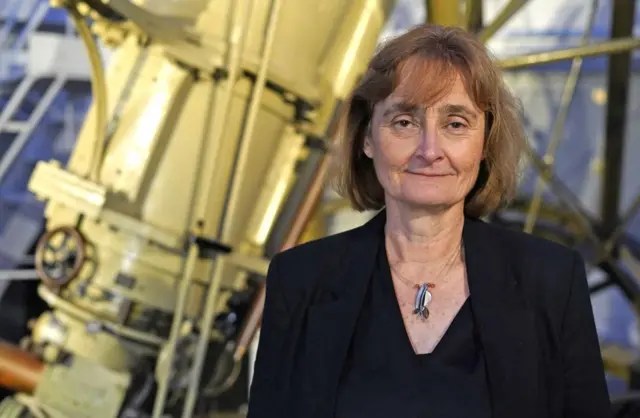
Dougherty’s appointment was no token gesture. Born in South Africa and now Professor of Space Physics at Imperial College London, she has built an extraordinary scientific career. She led the magnetometer team on NASA’s Cassini–Huygens mission, which revealed towering plumes of water erupting from Saturn’s icy moon Enceladus; findings that ignited the search for life beyond Earth. Today, she leads the magnetometer investigation for ESA’s JUICE mission to Jupiter’s moons, launched in 2023, and bound for Ganymede to probe its suspected subsurface ocean.
Her leadership extends well beyond planetary science. Dougherty is Executive Chair of the UK’s Science and Technology Facilities Council, overseeing major research infrastructure and funding. She is also the President‑elect of the Institute of Physics. In each of these roles, she has championed ambitious science, argued for investment in research, and worked to make science accessible to the public.
Asked about her appointment, Dougherty expressed both surprise and pride. She acknowledged the symbolic significance of being the first woman in a position historically reserved for men, while insisting her selection was based on the strength of her record, not her gender. Still, she hopes her visibility in such a revered role will inspire girls and young women to pursue careers in STEM.
The Astronomer Royal no longer runs an observatory; the role is now honorary, a recognition of exceptional achievement and a platform for public engagement. Holders advise the monarch on astronomical matters and serve as ambassadors for British science. It is a role steeped in history and weighted with symbolic gravitas.
In that context, Dougherty’s appointment is more than a personal accolade. It signals the enduring relevance of astronomy in the 21st century and Britain’s commitment to scientific leadership. She inherits a legacy stretching from the age of sail to the age of space exploration. As she takes up the mantle, she has said her mission is clear: to enthuse the public about the wonders of the universe and to show how space science enriches life here on Earth.
 The Rowanwood Chronicles