
The rise of high-speed fibre internet has done more than just make Netflix faster and video calls clearer, it has opened the door for ordinary people to run powerful technologies from the comfort of their own homes. One of the most exciting of these possibilities is self-hosted artificial intelligence. While most people are used to accessing AI through big tech companies’ cloud platforms, the time has come to consider what it means to bring this capability in-house. For everyday users, the advantages come down to three things: security, personalization, and independence.
The first advantage is data security. Every time someone uses a cloud-based AI service, their words, files, or images travel across the internet to a company’s servers. That data may be stored, analyzed, or even used to improve the company’s products. For personal matters like health information, financial records, or private conversations, that can feel intrusive. Hosting an AI at home flips the equation. The data never leaves your own device, which means you, not a tech giant, are the one in control. It’s like the difference between storing your photos on your own hard drive versus uploading them to a social media site.
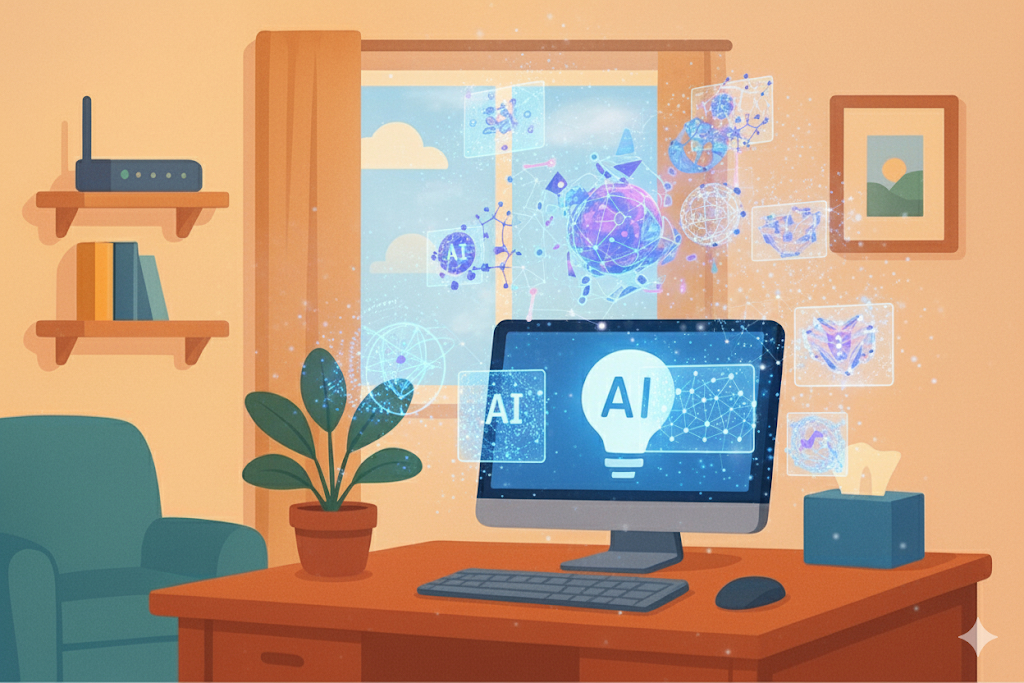
The second benefit is customization. The AI services offered online are built for the masses: general-purpose, standardized, and often limited in what they can do. By hosting your own AI, you can shape it around your life. A student could set it up to summarize their textbooks. A small business owner might feed it product information to answer customer questions quickly. A parent might even build a personal assistant trained on family recipes, schedules, or local activities. The point is that self-hosted AI can be tuned to match individual needs, rather than forcing everyone into a one-size-fits-all mold.
The third reason is independence. Relying on external services means depending on their availability, pricing, and rules. We’ve all experienced the frustration of an app changing overnight or a service suddenly charging for features that used to be free. A self-hosted AI is yours. It continues to run regardless of internet outages, company decisions, or international disputes. Just as personal computers gave households independence from corporate mainframes in the 1980s, self-hosted AI promises a similar shift today.
The good news is that ordinary users don’t need to be programmers or engineers to start experimenting. Open-source projects are making AI more accessible than ever. GPT4All offers a desktop app that works much like any other piece of software: you download it, run it, and interact with the AI through a simple interface. Ollama provides an easy way to install and switch between different AI models on your computer. Communities around these tools offer clear guides, friendly forums, and video tutorials that make the learning curve far less intimidating. For most people, running a basic AI system today is no harder than setting up a home printer or Wi-Fi router.
Of course, there are still limits. Running the largest and most advanced models may require high-end hardware, but for many day-to-day uses: writing, brainstorming, answering questions, or summarizing text, lighter models already perform impressively on standard laptops or desktop PCs. And just like every other piece of technology, the tools are becoming easier and more user-friendly every year. What feels like a hobbyist’s project in 2025 could be as common as antivirus software or cloud storage by 2027.
Self-hosted AI isn’t just for tech enthusiasts. Thanks to fibre internet and the growth of user-friendly tools, it is becoming a real option for everyday households. By bringing AI home, users can protect their privacy, shape the technology around their own lives, and free themselves from the whims of big tech companies. Just as personal computing once shifted power from corporations to individuals, the same shift is now within reach for artificial intelligence.
 The Rowanwood Chronicles