
Update – With Eric Adams now out of the 2025 New York City mayoral race, new polls show Zohran Mamdani maintaining a strong lead. Across Marist, Emerson, and Quinnipiac data, Mamdani holds steady in the mid-40s while Andrew Cuomo edges up to around 30 percent, suggesting Adams’ exit has done little to change the race’s overall direction.
Mainstream Democrats continue to treat left-of-center politics with caution, even as voter dissatisfaction, economic pressures, and social inequality push many Americans toward structural change. The tension has been evident in national interviews, where figures such as Vice President Kamala Harris offer measured support for progressive candidates like Zohran Mamdani, the insurgent Democratic nominee for mayor of New York City. That lukewarm endorsement reflects deeper structural and ideological dynamics: a party historically rooted in pragmatism and centrism struggles to reconcile its identity with the rising energy of its progressive wing.
Several factors explain this cautious stance. U.S. electoral politics favors moderation. The geography of swing states, the power of suburban and independent voters, and the design of the electoral college create incentives for Democrats to avoid appearing “radical.” Progressive policies, ranging from universal healthcare to rent freezes and free transit, often poll well in the abstract but face skepticism once voters consider costs, trade-offs, and feasibility. Party strategists worry that pursuing bold policies could alienate moderate or older voters, threatening general election viability.
Institutional pressures reinforce this cautious posture. The Democratic Party relies on a coalition that includes centrist politicians, business-aligned donors, and interest groups, many of whom prefer incremental reforms over systemic change. Media framing amplifies this risk, as ambitious proposals are often labeled “socialist” or “extreme,” creating a political environment in which party leaders hesitate to embrace bold policies fully. Even when polling shows popular support for measures such as stricter rent control or climate investment, strategic reticence prevails because of narrative risk and fear of electoral backlash.
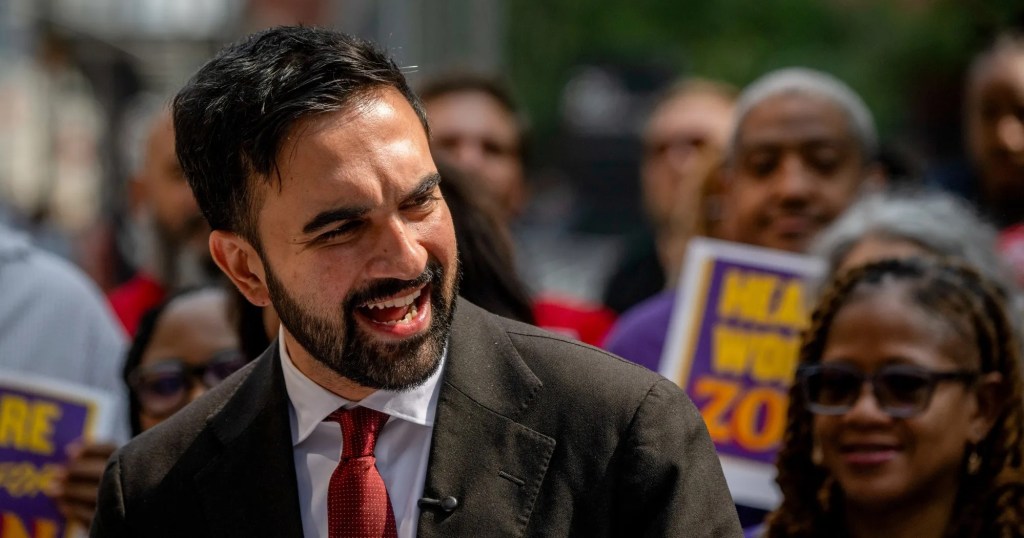
The 2025 New York City mayoral race brings these dynamics into sharp relief. Zohran Mamdani, a democratic socialist from Queens, has built a platform around rent freezes, affordable housing, free bus service, and major public investment. For many progressives, his rise demonstrates that bold left-of-center policies can mobilize voters in one of the nation’s largest and most visible cities. For establishment Democrats, however, his candidacy raises questions about the party’s future direction and internal cohesion.
Polling indicates Mamdani enters the fall campaign as the clear front-runner. A Quinnipiac University survey of likely voters showed him at 45 percent, compared to Andrew Cuomo at 23 percent, Curtis Sliwa at 15 percent, and Eric Adams at 12 percent. (Adams has since dropped out of the race.) An AARP New York/Gotham Polling survey reported similar results, with Mamdani at 41.8 percent. Marist College and the New York Times/Siena College polls echo this pattern, consistently placing him near or above 45 percent. Two-way scenarios narrow the margin, Marist found Mamdani at 49 percent versus Cuomo’s 39 percent, but the general trend underscores his advantage. Mamdani’s support is strongest among younger voters, renters, and those most concerned about housing affordability and cost-of-living pressures, while Cuomo performs better with older voters and those prioritizing experience or safety.
A Mamdani victory could produce significant ramifications for the Democratic Party. Symbolically, it would validate progressive policy as electorally viable and energize activists nationwide. It could encourage ambitious policy proposals in housing, transit, and climate, pressuring other Democrats to adopt a more leftward orientation to remain relevant. The victory would also likely sharpen internal tensions, forcing a confrontation between centrists who favor incremental change and progressives advocating systemic reform.
National polling underscores the opportunity for such a shift. Surveys indicate widespread support for policies associated with progressive Democrats. Measures like a $15 minimum wage, universal pre-K, expanded childcare, and climate investment enjoy majority backing, even among some independents and moderate Republicans. Younger voters, in particular, consistently favor progressive positions, with many willing to endorse structural change across a range of economic and social issues. Yet a gap remains between policy support and ideological self-identification. Many Americans back specific policies without labeling themselves progressive or wanting the party to move sharply left, reflecting ambivalence about broader systemic change. Framing, trade-offs, and cost perceptions significantly influence these attitudes.
The interplay of local victories and national trends will shape the Democratic Party’s evolution. Mamdani’s success could embolden progressive candidates elsewhere and accelerate the adoption of left-of-center policy agendas. At the same time, his tenure would face significant constraints, including state law, budget limits, opposition from landlords and businesses, and the need to deliver tangible results. Failures or perceived missteps could reinforce centrist arguments that progressive policies are impractical, deepening intra-party divides.
Thus, the Democratic Party stands at a crossroads. Mainstream leaders remain cautious due to electoral risk, institutional pressure, and fear of alienating moderates. Nationally, public support for progressive policies is significant, particularly among younger voters and urban constituencies, but the party must balance ambition with pragmatism. The 2025 New York mayoral race offers a high-profile test of whether progressive governance can gain legitimacy and influence broader party strategy. A Mamdani victory could shift the party leftward and validate systemic reform, while setbacks or backlash could reinforce centrist control, illustrating the fragility and contested nature of the party’s ideological trajectory.
The Democratic Party’s future may hinge on its ability to reconcile grassroots enthusiasm for progressive change with the practical demands of governance and national electoral strategy. The outcome in New York may not only determine local policy, but also signal the direction of American liberal politics in the coming years.
 The Rowanwood Chronicles