
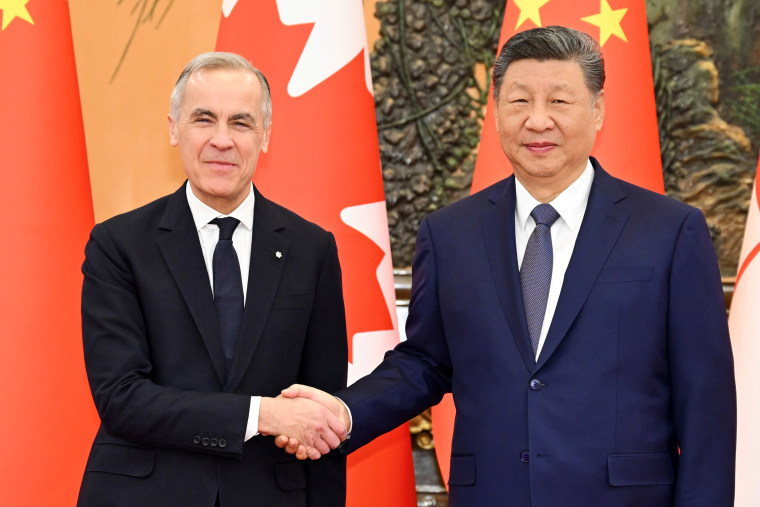
The announcement of a preliminary trade agreement between Canada and the People’s Republic of China marks a consequential inflection point in the global economic architecture. After years of diplomatic estrangement rooted in the 2018 detention of Huawei’s chief financial officer and attendant reprisals, Ottawa and Beijing have agreed to reduce bilateral trade barriers through a calibrated package of tariff concessions. Canada will permit up to 49,000 Chinese-made electric vehicles to enter its market annually at a reduced tariff of 6.1 percent, a return to pre-friction levels from the 2020s. In exchange, China will sharply cut its punitive tariffs on Canadian canola seed from combined rates near 85 percent down to about 15 percent, while lifting discriminatory levies on key exports such as canola meal, lobsters, crabs, and peas. These changes are expected to unlock roughly $3 billion in new Canadian export orders and signal a thaw in a protracted trade dispute.
This agreement emerges against a backdrop of intensifying US-China economic competition and a United States increasingly inclined toward protectionist measures. The United States maintains significant tariffs on Chinese electric vehicles and other strategically sensitive sectors, rooted in concerns about industrial policy, technological transfer, and national security. Canada’s decision to diverge from a more restrictive approach reflects both structural economic imperatives and evolving geopolitical realities. With roughly three-quarters of Canadian exports traditionally destined for the United States and less than four percent for China, Ottawa’s longstanding dependence on the US market has been a defining feature of its trade strategy. The latest negotiation illustrates a deliberate pursuit of diversification in the face of unpredictable US policy shifts.
At the heart of this emerging alignment is a sober recognition of China’s dominant position in the global electric-vehicle and clean-technology ecosystem. China accounts for a majority share of global EV production, lithium-ion battery cell manufacturing, and solar panel capacity, a lead that Western policymakers have struggled to counteract through subsidies or industrial policy alone. By integrating Chinese EVs into the Canadian market through a regulated tariff-quota system, Ottawa positions itself to benefit from more competitive prices and accelerated adoption of low-emission vehicles, even as domestic industry voices warn of competitive displacement.
The divergence between Ottawa and Washington on trade policy toward China carries deeper strategic significance. Historically, Canada has aligned closely with US economic and security policy, particularly within the framework of the United States–Mexico–Canada Agreement (USMCA). Canada’s recalibration suggests a growing willingness among middle powers to pursue “interest-based” engagement with Beijing that does not hew strictly to US strategic preferences. This trend is symptomatic of a broader fracturing in the global trade order, in which rising geopolitical competition has weakened the coherence of multilateral frameworks once anchored by US leadership. According to recent geopolitical scholarship, trade flows and global value chains increasingly reflect shifting alignments, with countries navigating between competing spheres of influence amid overlapping crises and supply chain stresses.
For the United States, this development presents a diplomatic quandary. A unified North American stance on trade with China amplified US leverage in negotiations with Beijing. Canada’s independent course potentially dilutes that leverage and underscores the limits of expectation that allied economies will subordinate their economic interests to US strategic imperatives. Washington’s initial reaction has been measured but critical, framing Canada’s move as “problematic” even as it acknowledges Ottawa’s sovereign right to pursue its own agreements. Such rhetoric highlights the tension between aligning with US China-policy goals and defending national economic interests in a volatile global environment.
At a structural level, the Canada–China deal exemplifies a broader reconfiguration of global trade relationships in an era of geopolitical competition. The traditional model of a US-centric trade order is giving way to a more multipolar economic landscape in which regional power centers and bilateral arrangements exert greater influence. Emerging trade partnerships, whether in clean technology, agriculture, or energy cooperation, reflect pragmatic calculations by states seeking stability, market access, and technological advantage. The interplay between geopolitical alignment and economic policy suggests that future trade patterns will be shaped less by universal norms and more by strategic hedging, selective engagement, and competitive statecraft.
In this context, the Canada–China agreement serves as both a practical economic arrangement and a geopolitical signal. It indicates an era in which middle powers aspire to greater autonomy in foreign economic policy, navigating between competing great powers and recalibrating long-standing alliances to safeguard national interests within a fragmented system of global trade.
 The Rowanwood Chronicles