
The United Federation of Planets (UFP) in Star Trek is more than just a fictional interstellar government, it’s a lens through which we can explore the complexities of governance, culture, and morality. As an amalgamation of over 150 member planets, each with distinct identities, the Federation represents humanity’s highest aspirations: unity, cooperation, and progress. However, beneath its utopian veneer lies a tapestry of contradictions, challenges, and ethical dilemmas that reflect the very nature of politics and society.
Culturally, the Federation embodies a post-scarcity society where poverty, hunger, and economic inequality have been eradicated. This transformation, driven by technologies like replicators, allows individuals to pursue self-fulfillment rather than survival. Captain Picard famously encapsulates this ethos in Star Trek: First Contact, stating that humanity works to “better ourselves and the rest of humanity.” Yet, this idealism is not without critique. Characters like Quark, the ever-pragmatic Ferengi bartender from Deep Space Nine (DS9), often mock Federation citizens as naive and soft, sheltered by their comfortable post-scarcity lives, and ignorant of the struggles faced by more commerce-driven cultures, or from living within the hierarchical Dominion.
The Federation’s diversity and multiculturalism are central to its identity. As a multi-species alliance, it strives to respect and integrate a variety of cultural traditions. Vulcan logic, Klingon honor, Bajoran spirituality – these are just a few examples of the unique perspectives that coexist within the Federation. Yet, this inclusivity is not without tension. The Next Generation episode “The Measure of a Man” highlights the Federation’s struggle to define universal principles in a diverse galaxy, as it debates whether the android Data qualifies as a sentient being. Similarly, DS9 delves into the cultural friction between the Federation’s secular humanism and Bajoran spiritualism, particularly during Bajor’s efforts to join the Federation. While the Federation promotes unity, it sometimes risks imposing its ideals, creating an undercurrent of what some might call “soft imperialism.”
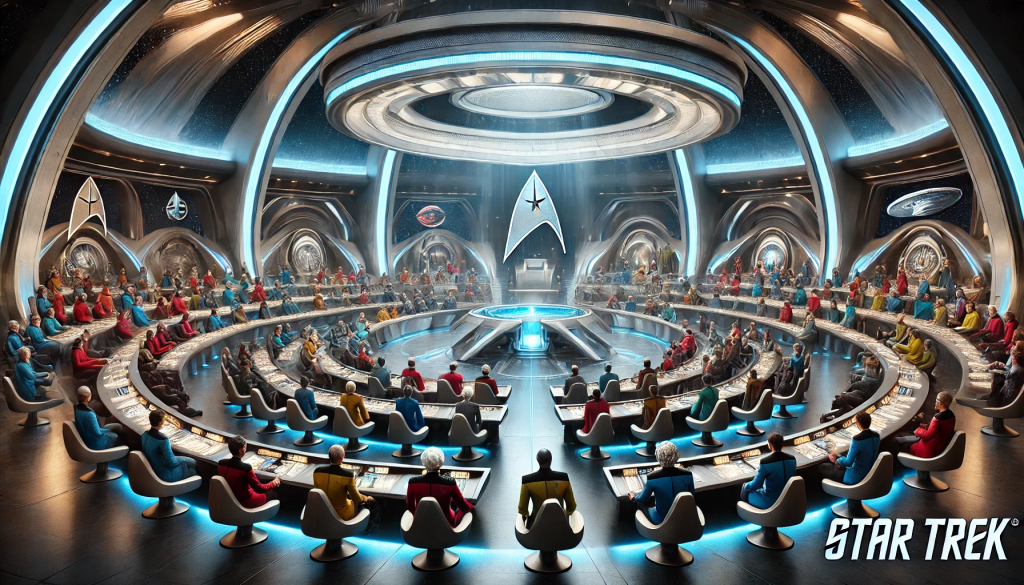
Politically, the Federation operates as a parliamentary democracy, with the Federation Council serving as its legislative body. Member planets retain autonomy over their internal affairs, while the Council oversees interplanetary law and diplomacy. The President, based in Paris on Earth, functions as the head of state. This balance between centralized governance and local autonomy is a strength, but it also leads to conflict. In Deep Space Nine, Bajor’s hesitation to join the Federation stems from fears of losing cultural identity to Earth-centric norms, a recurring critique that the Federation, despite its claims of equality, often reflects Earth’s values more than those of its alien members.
Ethics play a central role in Federation politics, often taking precedence over realpolitik. The Prime Directive, which prohibits interference with the natural development of pre-warp civilizations, exemplifies this commitment to morality. However, its strict application frequently leads to moral quandaries. In the Next Generation episode “Pen Pals,” Captain Picard grapples with whether to save a planet facing natural destruction, knowing that intervention would violate the Directive. These dilemmas reveal the challenges of maintaining an ethical stance in an imperfect galaxy.
Yet, the Federation’s ideals are not invulnerable. Darker elements, such as Section 31, a covert intelligence agency introduced in DS9, operate outside the bounds of Federation law to protect its interests. This shadowy organization embodies the tension between the Federation’s noble aspirations and the harsh realities of interstellar politics. Similarly, the Dominion War in DS9 exposes the Federation’s capacity for militarization, challenging the perception of Starfleet as a purely exploratory and diplomatic force.

What makes the Federation compelling is its dual nature: it is both a beacon of hope and a reflection of humanity’s flaws. In Star Trek VI: The Undiscovered Country, the Federation negotiates peace with the Klingon Empire, showcasing its dedication to diplomacy even after decades of hostility. Yet, this same Federation harbors internal threats, as seen in the DS9 episodes “Homefront” and “Paradise Lost,” where a Starfleet admiral attempts a coup in response to Changeling infiltration. These stories remind us that even the most enlightened institutions are vulnerable to fear and corruption.
Ultimately, the Federation is not just a backdrop for Star Trek’s adventures; it is a character in its own right, embodying the complexities of governance, diversity, and ethical leadership. Its triumphs inspire us to imagine a better future, while its flaws remind us that such a future is not achieved without struggle. By exploring these themes, Star Trek offers not just escapism, but a profound commentary on the challenges and possibilities of building a just and inclusive society.
 The Rowanwood Chronicles