
I read a fair amount of science fiction, as can clearly be seen from the content of this blog. My first introduction to speculative fiction, beyond C.S. Lewis, was the works of E.E. “Doc” Smith, loaned to me by a fellow classmate during my early teens. I devoured every book by this author I could find, reading without judgement, just enjoying the galactic adventure. Like I have said many times about my annual reading of Frank Herbert’s Dune, it’s not the story that changes, but the perspective that the additional year gives me.
E.E. “Doc” Smith is an undeniable cornerstone of science fiction, particularly in shaping the grand, sweeping narratives of the space opera subgenre. His works, from the Lensman to the Skylark series, established many of the storytelling conventions that would define science fiction for generations. Yet, these same works are deeply entwined with the patriarchal and often misogynistic norms of their time, offering a fascinating lens through which to examine the cultural attitudes of the early-to-mid 20th century. Smith’s legacy is both a celebration of speculative ambition, and a study in the limitations of its era.
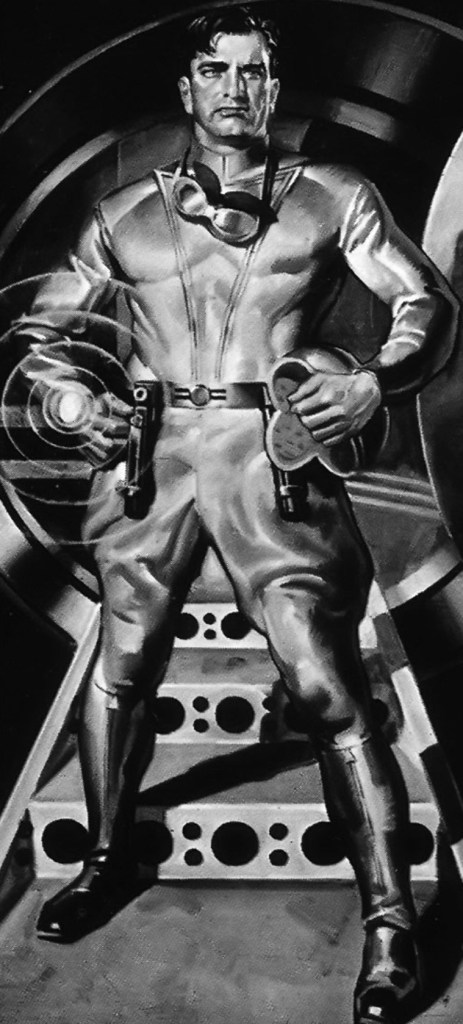
The Lensman series, perhaps Smith’s most iconic work, epitomizes the space opera’s blend of high-stakes interstellar conflict and moral idealism. Published between 1934 and 1950, these novels follow the genetically perfected heroes of the Galactic Patrol, led by the stalwart Kimball Kinnison, in their battle against the shadowy forces of Boskone. While the series broke ground in envisioning a universe of sprawling galactic civilizations, its treatment of gender roles reveals a narrower imagination. Female characters, such as Clarissa MacDougall, are largely confined to nurturing or supportive roles, their significance often framed in relation to male protagonists. Even Clarissa’s ascension to the ranks of the Lensmen – a notable exception – feels more like a narrative anomaly than a redefinition of gender dynamics. The series reflects its time, portraying men as protectors and leaders while relegating women to emotional or domestic spheres.
Similarly, the Skylark series, begun in 1928, offers an early blueprint for the modern space opera, chronicling the scientific and exploratory exploits of Richard Seaton and his morally ambiguous rival, Marc “Blackie” DuQuesne. Once again, women – characters like Dorothy Seaton and Margaret Spencer – are predominantly relegated to roles as love interests, hostages, or secondary figures. Though occasionally resourceful or intelligent, their contributions are overshadowed by the male protagonists’ heroics. These dynamics reinforce traditional gender hierarchies, with men as agents of innovation and action while women serve as symbols of emotional stability or moral guidance.
In the Family d’Alembert series, co-written with Stephen Goldin during the 1960s and 1970s, there is a slight shift in representation. Yvette d’Alembert, part of a circus-trained secret agent duo, emerges as a rare competent female protagonist. Yet even her capabilities are often contextualized by her physical appeal and partnership with her brother Jules. By this time, feminist movements were beginning to reshape societal norms, but science fiction, especially that rooted in the pulp tradition, lagged in reflecting these changes. Yvette’s portrayal, while an improvement, still clings to the vestiges of earlier patriarchal frameworks.
Smith’s later works, such as Subspace Explorers (1965), continue to explore grand themes like telepathy, space exploration, and societal advancement, but the underlying gender dynamics remain unchanged. Female characters with psychic abilities feature in the narrative, yet their roles are secondary, reinforcing the notion that leadership and innovation are male domains.

These patterns are not mere quirks of individual stories but reflections of a broader societal framework. Smith’s fiction mirrors the rigid gender roles of early-to-mid 20th-century society, a time when women were often confined to domestic or secondary positions. His male protagonists, embodying traits of strength, rationality, and dominance, contrast sharply with the nurturing and emotional roles assigned to women. While Smith does not explicitly demean women, the systemic sidelining of female characters speaks to the cultural misogyny of the era. His works helped establish many tropes that would define space opera, but they also reinforced a male-centric vision of the genre that took decades to challenge.
Despite these limitations, Smith’s influence on science fiction is profound. His imaginative depictions of intergalactic civilizations, advanced technologies, and epic storytelling inspired luminaries such as Isaac Asimov, Arthur C. Clarke, and even George Lucas. Modern readers, however, often critique his works for their outdated gender dynamics and lack of diversity. These critiques, while valid, do not diminish the historical significance of his contributions. Instead, they offer an opportunity to reevaluate his legacy in light of the genre’s ongoing evolution.
E.E. “Doc” Smith’s works remain a double-edged artifact of science fiction history: a testament to the boundless creativity of speculative fiction, and a reminder of the cultural constraints of its time. By recognizing these dual aspects, we can celebrate his role in shaping the genre while continuing to push for more inclusive and equitable narratives in speculative storytelling.
 The Rowanwood Chronicles