
At the beginning of Pride month, I thought I would write about how the gender revolution continues to challenge the patriarchy.
Transgender, non-binary, and intersex individuals are at the forefront of dismantling the patriarchy by challenging the rigid binary system of gender that has long served as a foundation for patriarchal control. Their very existence calls into question the assumption that gender is biologically fixed and limited to male and female, revealing instead that gender is a spectrum shaped by culture, society, and personal identity. By stepping outside these traditional categories, they expose the arbitrary nature of the binary and the oppressive structures that enforce it.
This disruption strikes at the heart of patriarchy, which relies on the dominance of men and the subjugation of women, while erasing those who exist outside these categories. Trans, non-binary, and intersex people decenter masculinity as the default and destabilize the hierarchy that assigns privilege based on adherence to rigid gender roles. By refusing to conform, they challenge the power structures that define worth and authority through this binary lens, opening the door to more equitable understandings of identity and power.
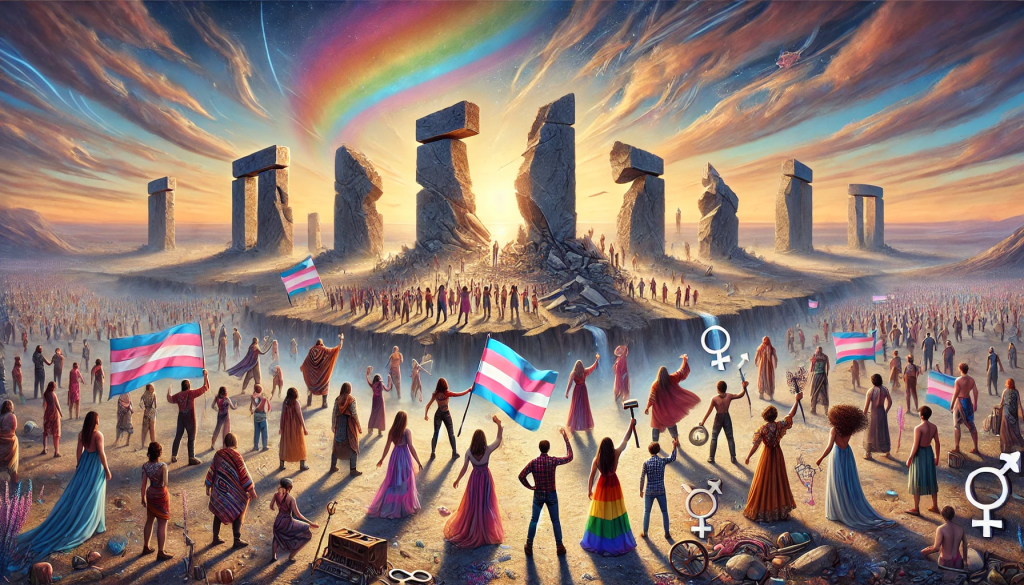
Their visibility also reshapes the cultural landscape, introducing new norms that value authenticity and inclusivity over conformity. The push for gender-neutral pronouns, inclusive policies, and equitable representation shifts societal expectations and disrupts patriarchal systems that thrive on control and standardization. These changes are not superficial; they represent a fundamental reimagining of how society organizes itself, centering individuality and respect over outdated binaries.
Furthermore, the activism of trans, non-binary, and intersex people often intersects with other struggles, including race, class, and disability justice. Their work highlights the interconnectedness of oppressive systems, fostering solidarity across movements and reinforcing the need for an intersectional approach to dismantling patriarchy. By challenging the binary, they do more than fight for their own liberation; they open pathways for others to envision a world free from the constraints of outdated gender norms.
In living authentically and advocating for change, trans, non-binary, and intersex individuals offer a radical critique of the status quo and a hopeful vision for the future. Their courage and resilience are reshaping how we think about gender, identity, and power, and in doing so, they are helping to dismantle one of the most deeply entrenched frameworks of oppression.
 The Rowanwood Chronicles