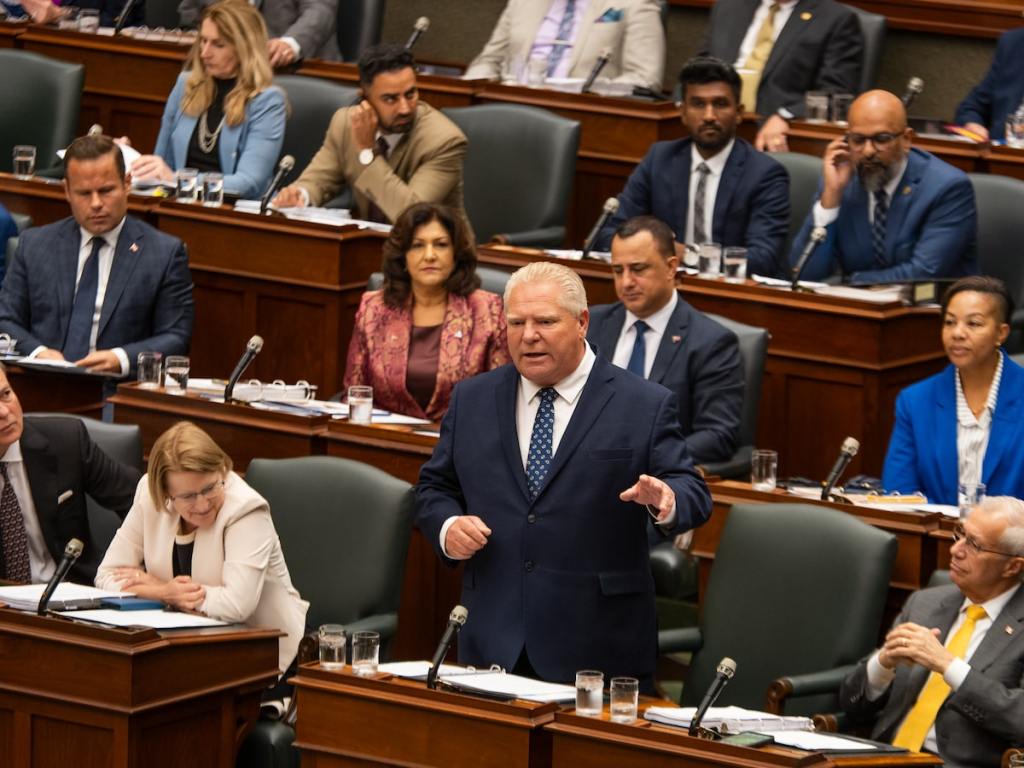
The Thin Edge of Reassurance

There is a particular moment when a society changes course, and it rarely announces itself with drama. It arrives instead in the language of reassurance. It speaks of precaution, of complexity, of being proactive. It tells us that nothing is wrong, and that everything is necessary.

The recent announcement from the Toronto Police Service fits comfortably within that tradition. A new counter-terrorism unit. A task force with a name designed to evoke safety. Officers visibly deployed with patrol rifles at places of worship, public spaces, and the quiet arteries of civic life that most people pass through without a second thought. The explanation is measured. There is no specific threat. There is only a more complicated world.

This is how the thin edge of the wedge is introduced. Not as a rupture, but as an adjustment.

One does not need to deny the existence of risk to question the response. The world has indeed become more fractured, more performative in its anger, more capable of translating ideology into violence at unpredictable points. Yet it is precisely in such moments that restraint becomes the harder and more necessary discipline. The temptation, always, is to meet uncertainty with visibility, to substitute the appearance of control for its reality.

A rifle carried openly in a public square is not a neutral object. It is a statement about the relationship between the state and the citizen. It alters the emotional texture of a place. It suggests that danger is not only possible, but imminent enough to justify escalation. Over time, that suggestion becomes background noise. What was once exceptional becomes ordinary. And once it is ordinary, it becomes permanent.

History does not tend to reverse these shifts.

The language will evolve. Terrorism will broaden into extremism, extremism into threat, threat into disruption. Each step will be defensible in isolation. Each will be accompanied by statistics, briefings, and the steady insistence that this is about safety, not power. Meanwhile, the infrastructure of response continues to grow. More units, more tools, more reasons to use both.

This is not an argument against policing. It is an argument about boundaries.

If the state is to claim expanded authority in the name of protection, then the mechanisms that hold it accountable must expand with equal force and, crucially, with genuine independence. At present, that balance remains uneven. Oversight bodies exist, but they are too often constrained by mandate, by proximity, or by a structural deference to the institutions they are meant to scrutinize.

Canada does have civilian oversight in the form of the Special Investigations Unit, and at the national level through the Civilian Review and Complaints Commission for the RCMP. These bodies perform important work. But they are not designed, in their current form, to meet the moment that is emerging. Their processes are often slow, their visibility limited, and their independence, while formal, is not always experienced as absolute by the public they serve.

What is required now is something more deliberate and more robust.

A truly independent review body must be constructed with a mandate that is both narrow and uncompromising. Any police action that results in bodily harm or death should automatically trigger its jurisdiction. No discretion. No internal filtering. The threshold must be clear and universally applied.

Its structure must be insulated from policing culture. Investigators should not be drawn primarily from former police ranks, where professional habits and informal loyalties can follow. Instead, the body should be multidisciplinary. Legal scholars, forensic specialists, civil liberties experts, and community representatives should form its core. Expertise must replace familiarity.

Its authority must extend beyond investigation into consequence. Findings should not end as recommendations. They must carry binding weight, whether in the form of disciplinary action, referral for prosecution, or mandatory policy change. Without consequence, oversight becomes theatre.

Transparency must be the default, not the exception. Reports should be public, timely, and written in language that does not obscure more than it reveals. Where information must be withheld, the reason should be explicit and reviewable. Trust cannot survive behind closed doors.

Finally, and most importantly, this body must be accountable not to the institutions it reviews, but to the public through the legislature. Its legitimacy must flow upward from citizens, not sideways from the systems it oversees.

This is not a radical proposal. It is a proportional one.

If society is being asked to accept a more visible, more assertive form of policing in everyday life, then it is entirely reasonable to demand a correspondingly stronger assurance that when harm occurs, it will be examined without bias, without delay, and without compromise.

The thin edge of the wedge is not dangerous because of what it does today. It is dangerous because of what it makes easier tomorrow. It lowers the threshold for the next decision, and the next after that, until the cumulative effect is no longer easily recognized.

A rifle on a street corner may be explained. A pattern is harder to justify.

The question, then, is not whether the current measures are defensible. Many will argue that they are. The question is whether the safeguards surrounding them are sufficient for where this path leads. On that point, caution is not only prudent. It is necessary.

A society that expands its capacity for force without equally expanding its capacity for accountability does not become safer. It becomes more confident in its own power, and less certain of its limits.

That is the wedge worth watching.

What the City Leaves Behind

There is a particular moment in any city when policy stops being abstract and becomes physical. In Ottawa, that moment is currently sitting at the end of the driveway. It is tied in black plastic, slumped against blue bins that no longer belong to the city, and, in some neighbourhoods, multiplying by the day.

What residents are experiencing is not a simple service disruption, nor the familiar irritation of a missed pickup. It is the visible seam of a system being reassembled in real time. Ottawa has not merely adjusted its waste collection. It has split it, outsourced part of it, and redrawn the rhythms of the rest. Recycling has been handed off to a producer responsibility regime, with private contractors now circling neighbourhoods on their own schedules. Garbage and organics remain municipal, but even here, routes have been rewritten, days reassigned, and the underlying logistics recalibrated for a future state that, for now, does not quite exist.

In theory, this is all defensible. The shift of recycling costs to producers aligns with broader environmental policy trends across Ontario. Route optimization reflects a growing city attempting to impose order on its own expansion. From a distance, it reads as modernization. From the curb, it feels like abandonment.

The problem is not the destination. It is the transition. In the quiet arithmetic of municipal planning, the system appears to have been designed for equilibrium, not for change. The result is a temporal gap, a stretch of days, in some cases weeks, where collection cycles fall out of sync with lived reality. Households that were accustomed to a predictable cadence now find themselves bridging intervals that can extend far beyond what their homes, garages, or sensibilities can reasonably contain.

And so the bags appear.

At first, they are tentative. One extra, perhaps two, placed beside the bin with the unspoken hope that the truck will take them anyway. When it does not, something shifts. The boundary between compliance and improvisation dissolves. A neighbour adds another bag. Someone else follows. Within days, the street tells a different story than the policy document. What was meant to be a temporary misalignment begins to look, and feel, like systemic failure.

There is a behavioural truth here that cities ignore at their peril. Waste is not just a logistical problem. It is an emotional one. People will tolerate complexity. They will even tolerate inconvenience. What they will not tolerate is the sense that the system has ceased to see them. When garbage accumulates beyond control, it signals a breakdown not only of service, but of reciprocity. The city asks for compliance, sorting, timing, restraint. In return, it must offer reliability. When that exchange falters, even briefly, the social contract begins to fray.

Ottawa attempted to soften the transition by loosening limits, allowing more bags at the curb, acknowledging in policy what it could not yet deliver in practice. But this, too, reveals a deeper misreading. The issue is not how many bags can be placed out. It is how long they must be held in the first place. Storage, especially in urban and suburban contexts, is finite. Time is the variable that matters. Extend it too far, and the system backs up into kitchens, garages, and eventually, onto the street.

What we are witnessing, then, is not simply a messy rollout. It is a case study in how cities manage change. Ottawa has chosen to pursue efficiency through structural reform, but in doing so, it has exposed a common blind spot. The transition state, the weeks or months where the old system has ended and the new one has not yet stabilized, is treated as a technicality rather than as a lived condition. Yet it is precisely in this interval that public trust is most vulnerable.

The irony is that the long-term vision may well succeed. Routes will stabilize. Contractors will find their rhythm. Residents will adapt to new days and new expectations. The bags will disappear, and with them, the immediate memory of disruption. But something quieter will remain. A recognition, perhaps unspoken, that the city’s systems are less seamless than they appear, and that when they change, they do so with a degree of indifference to the domestic realities they shape.

Good policy often fails not because it is wrong, but because it arrives without sufficient regard for the human scale at which it must operate. Ottawa’s waste transition is a reminder that infrastructure is not just what moves through a city, but what accumulates when it does not.

And for a few weeks this spring, what has accumulated is not just garbage, but a question. Not whether the new system will work, but whether the city understands what it asked of its residents while it learned how.

Ontario’s Quiet Turn Toward Political Secrecy

The Ontario government has introduced a proposal that would fundamentally alter the province’s access to information regime. The amendments under consideration would exclude records held by the premier, cabinet ministers, and their political offices from the scope of the province’s Freedom of Information law. At the same time, the proposal would lengthen the time government institutions have to respond to information requests and apply the new rules retroactively to requests already in the system. Taken together, these measures would mark a sharp departure from the principles that have guided public access to government records in Ontario for more than three decades.

Access to information legislation exists for a simple reason. Democratic governments exercise power on behalf of the public, and the public therefore has a right to understand how decisions are made. Ontario’s Freedom of Information and Protection of Privacy Act was built around that principle. While certain categories of information have always been protected, particularly cabinet deliberations and personal privacy, the general premise has remained clear: records created in the conduct of public business belong, ultimately, to the public.

The proposed amendments would carve out a new and sweeping exception. Records located in the offices of the premier and cabinet ministers would no longer be subject to access requests. In practical terms, that means that political offices at the centre of provincial decision making could become zones of administrative opacity. Documents relating to policy discussions, communications with stakeholders, or advice provided by political staff could simply fall outside the reach of the law.

The implications are not merely theoretical. Many of the most significant investigative revelations in Ontario politics have emerged through freedom of information requests directed at ministerial offices and related records. Journalists and public interest groups have relied on those requests to understand how decisions were shaped, who was consulted, and what information was available to decision makers at critical moments. Removing political offices from that framework would inevitably narrow the public record.

The proposal’s retroactive component raises an additional concern. Retroactive secrecy sits uneasily within a legal framework designed to promote transparency. When governments change the rules governing access to information after requests have already been filed, the effect is not merely administrative. It risks creating the perception that the rules are being rewritten to shield particular controversies or decisions from scrutiny.

The extension of response timelines from thirty days to forty five business days may appear modest by comparison, yet it reinforces the same broader trend. Access delayed is frequently access denied, particularly in an environment where timely disclosure is essential for public debate. Journalists working to inform citizens about active political controversies depend on the timely release of records. Lengthening the process reduces the practical value of the information that is eventually disclosed.

Governments routinely argue that greater confidentiality is necessary for effective decision making. Cabinet discussions require a degree of privacy. Political staff must be able to offer candid advice. Those principles have long been recognized within the existing law. The problem arises when the zone of confidentiality expands so far that it begins to swallow the principle of public accountability itself.

Ontario’s access to information system has never been perfect. Delays, redactions, and bureaucratic caution have always limited the flow of records. Yet the framework established a basic expectation that the machinery of government would operate under a presumption of openness. The proposed amendments would move the province in the opposite direction, concentrating greater informational power within the political executive while reducing the public’s ability to examine how decisions are made.

Transparency laws are not technical administrative instruments. They are structural features of democratic governance. When access to information narrows, the distance between citizens and the institutions that govern them inevitably grows. The current proposal therefore represents more than a routine legislative adjustment. It signals a shift in the balance between political authority and public oversight, one that risks weakening a cornerstone of democratic accountability in Ontario.

🌍 Five Things We Learned This Week

📅 Saturday, March 8 → Friday, March 13, 2026


⚖️ 1. International Women’s Day Sparks Global Demonstrations

March 8 marked International Women’s Day, with marches, political rallies, and policy announcements across dozens of countries. Demonstrations focused on issues such as equal pay, reproductive rights, education access, and women’s political representation.

Why it matters:

  • One of the world’s largest annual civic mobilizations
  • Increasing pressure for gender-equity legislation
  • A major platform for labour and social justice campaigns

🏅 2. 2026 Winter Paralympics Begin in Italy

The Winter Paralympic Games officially opened in Milan and Cortina d’Ampezzo and entered their first full week of competition. More than 600 athletes from over 50 countries are competing in alpine skiing, para-hockey, biathlon, and other adaptive sports.

Why it matters:

  • One of the largest international adaptive-sport events
  • Growing global recognition of Paralympic athletes
  • Increasing investment in inclusive sport programs

🌌 3. Strong Solar Winds Trigger Northern Lights Displays

Fast solar winds from the Sun increased geomagnetic activity this week, producing bright aurora displays across northern regions of North America and Europe. Observers in parts of Canada and the northern United States reported strong viewing conditions.

Why it matters:

  • The Sun is approaching the peak of its 11-year solar cycle
  • Auroras may become more frequent in the coming year
  • Strong solar storms can affect satellites and power grids

🌍 4. Middle East War Continues to Disrupt Regional Air Travel

The ongoing conflict in the Middle East continued to disrupt aviation across the region this week, forcing airlines to reroute or cancel flights and operate reduced schedules. Major aviation hubs reported delays and reduced capacity as airlines avoided conflict zones.

Why it matters:

  • Major impact on global aviation routes
  • Energy markets and shipping lanes remain volatile
  • The conflict is now affecting international travel and logistics

❄️ 5. World Speed Skating Championships Conclude in the Netherlands

The World Allround Speed Skating Championships took place in Heerenveen, Netherlands, bringing together many of the world’s best skaters for a demanding multi-distance competition that determines the sport’s most complete athletes.

Why it matters:

  • One of the sport’s most prestigious annual championships
  • Key preparation for Olympic-level competition
  • Continues the Netherlands’ role as a global centre of speed skating

🌟 The Big Picture

The second week of March illustrated the diverse forces shaping the global moment: civic activism, international sport, space-weather phenomena, geopolitical conflict, and major cultural events all unfolding simultaneously across the planet.

Water Is Not a Commodity

Across the industrial world there has been a long and sometimes quiet struggle over the ownership of essential infrastructure. Electricity grids, railways, telecommunications networks, and pipelines have all passed through cycles of public construction and private acquisition. Yet among these, water occupies a fundamentally different category. It is not merely an economic input or a commercial service. It is a precondition for life, public health, and social stability. When a society debates the governance of water systems, it is not arguing about a typical utility. It is debating the stewardship of a shared biological necessity.

Ontario now finds itself at the edge of such a debate.

Recent legislative changes, most notably those contained within Bill 60 – Fighting Delays, Building Faster Act, 2025, create new mechanisms through which municipal water and wastewater systems may be transferred into corporate governance structures. The government’s stated intention is administrative efficiency and infrastructure financing. Ontario’s rapidly growing population requires substantial investment in water infrastructure, and municipalities are under increasing fiscal pressure to expand treatment capacity, pipelines, and pumping stations. From a narrow administrative perspective, the argument is straightforward. Corporate utilities can borrow capital more flexibly and operate with financial tools unavailable to traditional municipal departments.

But efficiency arguments alone cannot settle the deeper question.

Public utilities exist because certain services are too fundamental to leave entirely to the logic of markets. Water systems in Canada were built during the twentieth century precisely because the private delivery of drinking water had repeatedly proven unreliable, inequitable, and sometimes dangerous. Municipal ownership was not an ideological experiment. It was the result of a century of public-health lessons learned through epidemics, contamination events, and uneven private provision.

Ontario’s own history contains one of the most sobering reminders of that truth. The tragedy of Walkerton Water Crisis demonstrated with painful clarity that water governance demands uncompromising accountability. The response in the years that followed was not to dilute public oversight but to strengthen it. Ontario built one of the most rigorous drinking water regulatory regimes in the world, premised on the principle that safe water is a public responsibility.

That principle deserves careful protection.

The concern raised by critics of the new legislative framework is not that privatization will occur immediately. Rather, the concern lies in the structural pathway that corporatization creates. When water utilities are moved out of direct municipal governance and into corporate entities, the nature of decision-making changes. Boards replace councils. Rate structures become financial instruments. Infrastructure planning is evaluated increasingly through the lens of return on investment rather than the broader calculus of community welfare.

None of these shifts automatically produce privatization. Yet they move the system closer to the institutional architecture within which privatization becomes possible.

The international experience provides numerous examples of this progression. In several jurisdictions, the path toward private water delivery began not with outright sales of infrastructure but with the creation of corporate utilities, public-private partnerships, and long-term concession agreements. Over time, financial pressures and political incentives often pushed these arrangements further toward private control. Once essential infrastructure is embedded within corporate governance frameworks, the distinction between public service and commercial utility can gradually blur.

The risk is not merely ideological. It is practical.

Water systems require long-term investment horizons measured in decades. Pipes laid beneath city streets may remain in service for half a century. Treatment plants operate for generations. Public ownership aligns naturally with these timelines because governments exist to steward infrastructure across electoral cycles. Private entities, even well-regulated ones, operate under shorter financial expectations. Shareholder value and quarterly performance rarely align with the slow maintenance rhythms of buried municipal infrastructure.

There is also the matter of democratic legitimacy. Municipal water systems today are ultimately accountable to elected councils. Citizens can vote out the officials responsible for water policy. Rate increases, infrastructure investments, and service priorities are debated in public forums. Corporate governance, by contrast, places these decisions within boardrooms whose members are not directly accountable to voters.

Water policy should not be insulated from democratic oversight. It should be anchored within it.

None of this denies the real financial pressures facing municipalities. Ontario’s growing cities must build enormous quantities of new water infrastructure to support housing construction and economic expansion. Financing models will need to evolve. Innovative approaches to capital investment may be necessary. Yet innovation in financing should not be mistaken for a justification to weaken public ownership.

The core principle should remain simple and clear.

Water systems belong to the communities that depend on them. The reservoirs, aqueducts, pumping stations, and treatment plants that sustain modern cities were built with public resources over generations. They represent a shared civic inheritance. Their purpose is not to generate profit but to safeguard public health and ensure universal access to a basic human necessity.

Public utilities exist precisely because some services are too important to treat as commodities. Water is foremost among them.

Ontario’s policymakers would therefore be wise to proceed with caution. Legislative frameworks designed for administrative flexibility can sometimes produce unintended consequences decades later. Once governance structures shift, reversing course becomes difficult. Infrastructure systems have a way of locking in the institutional assumptions under which they were built.

The question facing the province is therefore larger than the technical design of utility corporations. It is about the kind of stewardship Ontarians expect for the most essential resource in their society.

A civilized state recognizes that certain responsibilities cannot be outsourced. Among them is the simple but profound duty to ensure that every citizen can turn on a tap and trust what flows from it.

Water, quite simply, should remain in the hands of the people.

More Than a Clock Change: What BC’s Decision Signals for Canada

There are political decisions that change a nation’s trajectory, and then there are political decisions that change the clock on the microwave twice a year.

British Columbia’s long-gestating move to end seasonal time changes belongs to the second category. And yet, like so many small administrative reforms, it reveals more about governance, coordination, and federalism than its modest subject suggests.

When David Eby says the issue is about “making life easier for families” and “reducing disruptions for businesses,” he is not wrong. Twice a year, millions of people reset schedules, disrupt sleep cycles, confuse meeting times, and briefly destabilize routines. The economic cost is diffuse but real. The human irritation is universal.

But the British Columbia story is not simply about clocks. It is about interdependence.

A Province Ready, A Continent Not
British Columbia passed legislation in 2019 to adopt permanent daylight saving time. The public consultation showed strong support. The mechanics were prepared. The legal framework exists. Yet implementation stalled because BC tied its decision to the U.S. Pacific Northwest, particularly Washington, Oregon, and California.

Why? Because Vancouver and Seattle function less like distant cities and more like adjacent economic zones. A two-hour time gap for part of the year would complicate trade, transportation, markets, and daily cross-border life. So BC waited on American congressional action that never arrived.

That is the quiet absurdity of modern federalism. A provincial legislature can pass a law. A neighbouring state legislature can pass a similar law. And both remain inert because a third legislative body, thousands of kilometres away in Washington, D.C., controls the clock.

BC’s renewed political framing signals impatience with that paralysis.

Canada’s Patchwork Time Regime
Canada does not have a single national time policy. Provinces decide.

Saskatchewan effectively does not change clocks. Yukon moved to permanent time in 2020. Ontario passed legislation that would end seasonal changes, but only if Quebec and New York follow suit. Nova Scotia has debated similar moves.

In other words, the legislative scaffolding already exists across multiple provinces. What is missing is synchronization.

This is the core tension. Canadians dislike changing clocks. Legislatures have responded. Yet every province that is economically entangled with a neighbour hesitates to move unilaterally.

BC’s decision, if implemented regardless of U.S. action, would break that coordination norm. It would demonstrate that a province can absorb the temporary inconvenience of cross-border time divergence in exchange for internal consistency.

That matters.

The Real Policy Question No One Likes to Debate
There is also a deeper issue that remains politically underexplored. Ending clock changes is popular. Choosing which time to keep is less so.

Permanent daylight saving time means brighter winter evenings and darker winter mornings. In northern latitudes, those mornings become very dark indeed. Sleep researchers often argue permanent standard time aligns better with human circadian rhythms. Politicians prefer the marketing appeal of longer evening light.

BC chose permanent daylight saving time.

The choice is not trivial. It reflects a cultural preference for after-work daylight over morning biological alignment. It favours consumer time over solar time.

That debate is barely visible in the political messaging, but it exists beneath the surface.

What This Means for Canada
If BC proceeds, several things follow.

First, Ontario’s conditional legislation becomes harder to justify. The argument that “we must wait for everyone” weakens once one major province decides not to.

Second, public debate will intensify in provinces that have already prepared legislative tools but lack political momentum.

Third, the federal government may find itself facing pressure for coordination, even if timekeeping remains a provincial power. A national conversation could emerge not because Ottawa initiated it, but because provincial asymmetry forces it.

Will the rest of Canada follow immediately? No.

Will BC’s move increase the probability of broader change within five years? Very likely.

Clock policy is rarely transformative. But it is revealing. It exposes how deeply integrated provincial economies are with the United States. It demonstrates the limits of legislative autonomy in a continental marketplace. And it shows that even mundane administrative reforms require geopolitical choreography.

In the end, this is not about daylight. It is about governance friction.

And as with so many small reforms, once one jurisdiction proves that the sky does not fall when the clocks stop changing, others tend to follow.

The Waiting Room Is the System

For generations, the emergency department waiting room has served as the visible face of a health-care system under strain. Rows of plastic chairs, muted televisions, exhausted families, and the slow churn of triage have become so familiar that they are almost invisible. Yet the waiting room is not merely a physical space. It is a diagnostic instrument. It tells us, with brutal honesty, where the rest of the system has failed.

The emerging concept of the “virtual waiting room,” in which low-acuity patients wait at home until summoned, does not eliminate this reality. It relocates it. The crowd disappears from the hallway but not from the system. The queue still exists, only now it is distributed across living rooms, workplaces, parked cars, and smartphones. This is not a cure. It is a reframing.

And yet, reframing matters.

From Place to Process
Emergency care was designed for immediacy: heart attacks, strokes, trauma, catastrophic events. Over time it has become the safety net for everything else. When primary care is unavailable, after-hours clinics are full, or social supports collapse, the emergency department becomes the default portal into the system. It is open, universal, and legally obligated to see everyone. No other part of health care operates under those conditions.

Virtual queue systems acknowledge a hard truth: the emergency department is now as much a scheduling problem as a clinical one.

By allowing some patients to wait remotely, hospitals are quietly shifting from a place-based model to a process-based model. Care is no longer defined by where you sit but by your position in a digital flow. Airlines made this transition decades ago. Banking followed. Retail perfected it. Health care, notoriously conservative, is now being pushed in the same direction by necessity rather than enthusiasm.

Comfort Is Not Capacity
Letting patients wait at home is humane. It reduces exposure to illness, lowers stress, and restores a sense of control. For parents with sick children, elderly patients, or those with chronic pain, this is not a trivial improvement. It is a meaningful one.

But comfort should not be confused with capacity.

A virtual waiting room does not create new nurses, physicians, or beds. It does not shorten diagnostic turnaround times or speed inpatient admissions. It simply redistributes discomfort away from the hospital campus. The operational bottleneck remains exactly where it was: inside the system.

If anything, success may make the underlying shortage easier to ignore. A hallway filled with stretchers is politically alarming. An invisible queue dispersed across thousands of homes is not.

The Consumerization of Urgent Care
These systems also reflect a broader cultural shift. Patients increasingly expect transparency, updates, and predictability. Knowing “you are number 12 in line” reduces anxiety even if the wait itself is unchanged. Digital notifications mimic familiar consumer experiences, transforming the emergency department from a chaotic black box into something resembling a service platform.

This is not trivial psychology. Perceived fairness and information availability strongly influence satisfaction. People tolerate long waits better when they understand them.

However, consumer expectations carry risks. Health care is not retail. Medical priority must override first-come, first-served logic. The danger is not that hospitals will abandon triage, but that public expectations will drift toward transactional thinking: if I checked in earlier, why am I not seen sooner?

Equity at the Edge
Every digital solution introduces a new boundary between those who can access it and those who cannot. Reliable phones, language proficiency, technological confidence, stable housing, and transportation all become hidden prerequisites.

Ironically, the populations most dependent on emergency departments are often the least equipped to navigate digital intake systems. Seniors, recent immigrants, low-income individuals, and people experiencing homelessness may be excluded by design even when inclusion is the stated goal.

Future emergency care will have to confront this paradox directly: the tools that improve efficiency can also deepen inequity.

The Quiet Admission of Primary-Care Failure
Perhaps the most significant implication of virtual waiting rooms is what they implicitly concede. Many low-acuity emergency visits occur because patients have nowhere else to go. Family physicians are scarce, after-hours coverage is limited, and walk-in clinics are overwhelmed or disappearing. The emergency department has become the only guaranteed point of access.

Managing these visits more comfortably does not address why they occur.

In this sense, virtual waiting rooms are less an innovation in emergency medicine than a coping mechanism for primary-care shortages. They are downstream adaptations to upstream failures.

What the Future Actually Looks Like
If current trends continue, emergency care will likely evolve into a hybrid system with several distinct layers:

Pre-arrival digital screening and queueing
Patients initiate contact online or by phone before leaving home.
Dynamic routing
Some cases redirected to urgent-care centres, virtual consults, or next-day clinics.
Distributed waiting
Patients wait wherever they are safest and most comfortable.
Rapid in-hospital processing
Physical presence reserved for diagnostics and treatment rather than idle waiting.
Integration with community care
Follow-up arranged before discharge to prevent repeat visits.

This model treats the emergency department less as a room and more as a node in a network.

The Risk of Normalizing Crisis
There is a subtle danger in making dysfunction more tolerable. Systems that operate in chronic crisis can persist indefinitely if the pain is managed rather than resolved. A comfortable queue is still a queue. An efficient workaround can delay structural reform for years or decades.

Policy makers may view virtual waiting systems as evidence that hospitals are adapting successfully, reducing the urgency to invest in workforce expansion, long-term care capacity, mental-health services, or primary care access. The technology becomes a pressure valve that prevents political explosion.

A Humane Stopgap, Not a Destination
Despite these concerns, the move toward remote waiting should not be dismissed. It reflects compassion as well as pragmatism. If patients must wait, allowing them to do so in dignity is unquestionably better than forcing them into crowded corridors for hours on end.

The deeper question is whether society will mistake this improvement for a solution.

Emergency departments were never meant to be the front door to the entire health system. Virtual waiting rooms acknowledge that they have become exactly that. The future of emergency care will not be determined by how efficiently we manage the queue, but by whether we can reduce the need for the queue at all.

Until then, the waiting room will endure. It will simply be everywhere instead of somewhere.

Amalgamation? Lessons Niagara Cannot Afford to Ignore

There is a recurring belief in Canadian municipal politics that scale solves problems. If governance feels messy, make it larger. If coordination is difficult, centralize it. If local voices disagree, fold them into a single chorus and call it harmony. The proposal to merge the municipalities of the Regional Municipality of Niagara into one city rests squarely on this assumption: that bigger government will behave more rationally, more efficiently, and more strategically than a collection of smaller ones.

History suggests otherwise.

Niagara is not a fragmented city waiting to be assembled. It is a region of distinct places bound together by geography, not by a single urban heartbeat. Niagara Falls lives on tourism and spectacle. St. Catharines functions as an educational, service, and industrial hub. Welland carries a canal town identity shaped by manufacturing and working-class roots. Niagara-on-the-Lake trades on heritage, agriculture, and controlled growth. The lakefront communities of west Niagara look toward Hamilton, not the Falls. Rural townships measure success in acres preserved, not towers approved.

To govern these places as though they share identical needs is not efficiency. It is administrative wishful thinking.

The Ottawa Example: A Warning, Not a Blueprint
Advocates of amalgamation frequently point to the creation of the modern Ottawa from the former Regional Municipality of Ottawa–Carleton as proof that diverse municipalities can be fused into a single functional city. What is often omitted is that the fusion solved technical coordination problems while creating enduring political ones.

Ottawa gained unified transit planning, standardized services, and the ability to execute large infrastructure projects. It also inherited a permanent rural-urban divide that shapes every budget, planning decision, and election cycle. Farmers in the outer wards pay for light rail they will never ride. Suburban taxpayers argue they subsidize downtown priorities. Former municipalities continue to organize politically along pre-2001 boundaries, a quarter century later.

Amalgamation did not erase local identity. It merely removed the local governments that once represented it.

Niagara would face this tension in amplified form. Ottawa, despite its diversity, had a dominant employment core and a single metropolitan labour market. Niagara has several centres and multiple economic logics. Tourism, agriculture, manufacturing, retirement living, cross-border trade, and suburban commuting do not pull in the same direction.

Power Will Flow Somewhere
Every amalgamation produces a gravitational centre, whether intended or not. Decisions must be made, staff must be housed, budgets must be prioritized. In a single Niagara city, influence would inevitably concentrate in the largest population centres, most likely St. Catharines or Niagara Falls. Smaller municipalities would not disappear, but their ability to shape outcomes would diminish.

This is not a moral failure. It is mathematics.

Residents of smaller towns would still vote, but their votes would be diluted across a much larger electorate. Local issues that once dominated council agendas would become minor items competing with region-wide priorities. A zoning dispute that matters deeply to a village could be invisible in a chamber preoccupied with housing targets or tourism infrastructure.

Democracy at scale becomes less intimate and more transactional.

Coordination Without Erasure
None of this suggests the status quo is perfect. Niagara does suffer from fragmented planning, duplicated administration, and occasional municipal rivalry. Regional transit integration demonstrates that cooperation can produce tangible benefits without dissolving local governments. Shared services for policing, utilities, and infrastructure can achieve economies of scale while preserving local autonomy.

The real strategic question is not whether Niagara needs to function more cohesively. It is whether cohesion requires uniformity.

A region can behave like a federation rather than a unitary state. Strong regional planning frameworks, binding growth strategies, and pooled services can align municipalities without forcing them into a single institutional mold. This approach accepts that diversity is not a problem to be engineered away but a reality to be governed intelligently.

Bigger Is Not the Same as Better
Large cities do not automatically make better decisions. They simply make larger ones. When those decisions are wrong, the consequences are correspondingly bigger. A misjudged development strategy, infrastructure investment, or tax policy applied across a half-million residents can entrench problems for decades.

Small municipalities, for all their limitations, retain the ability to experiment, adapt, and reflect local priorities quickly. They function as laboratories of governance. Amalgamation replaces this patchwork of experimentation with a single policy regime that must suit everyone and will inevitably fit some poorly.

Uniformity feels orderly from a distance. Up close, it can be suffocating.

The Strategic Path Forward
If Niagara seeks a more prosperous and coherent future, the priority should be integration of function rather than consolidation of identity. Build region-wide systems where scale truly matters: transit, major infrastructure, environmental management, economic promotion. Preserve local decision-making where place matters most: land use, community character, local services, cultural priorities.

The lesson from Ottawa is not that amalgamation fails or succeeds. It is that it solves some problems while creating others that cannot easily be reversed. Once municipalities disappear, recreating them is practically impossible.

Niagara does not need to become one city to act like a mature region. It needs governance arrangements that respect the fact that it is not one place, and never has been.

Bigger government can coordinate more. It cannot care more, listen better, or understand the nuances of twelve different communities at once. Those qualities arise from proximity, not scale.

Small Nations, Shared Games: A Commonwealth Investment in the Future

For much of its modern history, the Commonwealth Games has drifted toward the logic of other mega-events: large cities, escalating costs, and a quiet assumption that only wealthy hosts need apply. Yet the Commonwealth itself is not a club of large powers. It is, numerically and culturally, a network dominated by small and developing states. Reimagining the Games so they are hosted by the smallest members, but financed collectively according to national GDP would not be charity. It would be strategic infrastructure policy disguised as sport.

Such a model would transform the Games from a periodic spectacle into a rotating development engine, deliberately directed toward places where capital investment produces the greatest long-term return.

Infrastructure Where It Matters Most
Small Commonwealth countries often face the same structural constraints: limited transport networks, fragile energy systems, housing shortages, and vulnerability to climate shocks. These are not failures of governance so much as arithmetic. When a nation of a few hundred thousand people must finance major infrastructure alone, projects either stall or never begin.

A GDP-weighted funding model would change that equation. Large economies such as CanadaAustraliaUnited Kingdom, and India could contribute proportionally without significant domestic strain, while host nations gain assets that would otherwise take generations to afford.

Crucially, these investments would not need to be limited to stadiums. Modern Games planning increasingly integrates:
• Airport and port expansion
• Renewable energy grids
• Water and sanitation upgrades
• Telecommunications networks
• Public transit
• Resilient housing

In developing contexts, these are not ancillary benefits. They are transformational foundations for economic growth.

Tourism as a Permanent Industry, Not a Seasonal Gamble
For many small states, tourism is already the primary economic engine. Hosting the Games would accelerate that sector by compressing decades of branding and infrastructure development into a single cycle.

Consider nations such as BarbadosMalta, or Seychelles. Global exposure from a major sporting event can reposition a country from niche destination to household name. Improved airports, hotels, and transport systems continue generating revenue long after the closing ceremony.

Unlike industrial mega-projects, tourism infrastructure scales naturally to local economies. A new terminal, cruise port, or transit corridor does not become obsolete. It becomes the backbone of a sustainable service economy.

Climate Resilience Disguised as Event Planning
Many of the Commonwealth’s smallest members sit on the front lines of climate change. Sea-level rise, stronger storms, and water insecurity are existential threats. Yet climate adaptation projects are expensive and often struggle to secure financing.

A collectively funded Games could prioritize resilient design as a requirement rather than an afterthought:
• Elevated and storm-resistant construction
• Microgrids powered by renewables
• Flood-resistant transport corridors
• Emergency response infrastructure
• Water security systems

In effect, the Commonwealth would be financing survival infrastructure under the politically palatable banner of sport.

Ending the Prestige Arms Race
Large hosts often overspend to signal global status, producing stadiums that struggle to find post-event uses. Small states cannot afford that kind of extravagance. Their constraints encourage practicality.

Facilities would likely be:
• Modular or temporary
• Scaled to local demand
• Designed for schools and community use
• Integrated into existing urban plans

The result could be the most sustainable version of a mega-event yet attempted, precisely because the host nation lacks the capacity for waste.

A More Meaningful Commonwealth
The Commonwealth frequently struggles to define its contemporary purpose beyond historical ties. A shared funding model for the Games would provide a concrete expression of mutual responsibility.

Citizens in wealthier countries would see tangible outcomes from their contributions: functioning infrastructure, stable partners, and strengthened trade relationships. Smaller nations would experience membership as materially beneficial rather than symbolic.

This is not altruism alone. Stability in vulnerable regions reduces migration pressures, disaster response costs, and geopolitical volatility. Development is cheaper than crisis management.

A Distributed Model for the Future
Logistical challenges are real, but not insurmountable. Events could be distributed across neighboring islands or regions, supported by temporary accommodations such as cruise ships and regional transport networks. Modern broadcasting reduces the need for centralized mega-venues, allowing the Games to function as a multi-site festival rather than a single urban takeover.

Such flexibility aligns with the geography of many small Commonwealth states, particularly in the Caribbean and Pacific.

Strategic Optimism
A Commonwealth Games hosted by its smallest members and funded by all according to capacity would represent a quiet, but profound shift in global thinking. It would suggest that international gatherings need not be competitions for prestige but opportunities for targeted development.

The return on investment would be measured not in medal tables but in decades of improved mobility, energy security, tourism revenue, and climate resilience.

In a world where large institutions often struggle to demonstrate relevance, this model would do something radical: it would build things that last, in places that need them most.

And in doing so, the Commonwealth would rediscover a purpose suited not to its past, but to its future.

The Eighth Silence: On the Emergence of a New Human Species

We now know that least eight human species walked the Earth roughly two hundred thousand years ago. Homo sapiens shared the planet with Homo neanderthalensis, Homo heidelbergensis, Homo floresiensis, Homo naledi, Denisovans, and others whose fossil traces remain incomplete or disputed. These populations overlapped in time, geography, and in some cases behavior. They hunted similar prey, shaped stone tools, buried their dead, and adapted to radically different ecological niches. None of them understood themselves as species. That distinction would only become visible after most of them were gone.

Paleoanthropology has repeatedly demonstrated that human evolution is not a clean sequence, but a braided stream. Species diverged, converged, interbred, and vanished in patterns that resist simple narratives of progress. Genetic evidence now confirms that Homo sapiens did not replace other humans through isolation alone, but through partial interbreeding followed by demographic dominance. The boundary between species was porous, unstable, and context-dependent. Speciation, as it occurred in the human lineage, was neither tidy nor immediately legible to those living within it.

Homo sapiens itself emerged slowly, marked less by sudden anatomical novelty than by shifts in cognition, social organization, and symbolic capacity. Early sapiens were not obviously superior in strength or survival skills. Their eventual dominance appears to have been driven by abstract reasoning, cooperative flexibility, and the ability to operate within increasingly complex symbolic systems. These advantages were invisible in the short term and decisive only over long spans of time. Dominance, in evolutionary terms, is always clearer in retrospect.

The modern assumption that human evolution has effectively ceased rests on a misunderstanding of how evolution operates. Evolution does not stop when a species becomes culturally complex. It accelerates when environments change faster than inherited adaptations can comfortably track. The current human environment has shifted more dramatically in the last century than during any comparable period since the emergence of symbolic cognition. This shift is not merely technological. It is cognitive, perceptual, and ecological.

People today live in a world shaped more by complex systems and ideas than by the physical environment. Day-to-day survival increasingly depends on dealing with symbols like money, rules, screens, and data instead of direct human contact or practical tasks in the real world. We often respond to information rather than people, and to problems that are spread out over time and distance and filtered through technology.

These conditions are very different from the ones human brains evolved for. As a result, the gap between how we are wired and how we now live is not a small issue, but a basic feature of modern life.

Within this context, neurodivergent humans are typically framed as statistical outliers within Homo sapiens. Their traits are classified as disorders or deficits, defined by deviation from neurotypical norms of social intuition, emotional regulation, sensory processing, and attentional control. These norms are treated as universal human baselines rather than historically contingent adaptations. Paleoanthropology offers no support for this assumption. Across the human lineage, variation in cognition has been the raw material of adaptation, not an error to be corrected.

Species are not defined solely by reproductive isolation. While this criterion is useful in some contexts, it fails to capture the complexity of speciation in organisms with overlapping ranges, long generation times, and strong cultural mediation. Human evolution in particular demonstrates that species can remain genetically compatible while diverging behaviorally, cognitively, and ecologically. Neanderthals and sapiens interbred, yet maintained distinct adaptive strategies for tens of thousands of years. Genetic permeability did not prevent species distinction. It accompanied it.

A more functional definition of species emphasizes adaptive coherence. A species can be understood as a population that shares a stable strategy for engaging with its environment, reinforced across generations by ecological fit, social organization, and assortative reproduction. By this definition, neurodivergent humans exhibit early markers of speciation. Their traits do not appear randomly or independently. They cluster into a coherent cognitive architecture that interacts with contemporary environments in systematically different ways.

Common features of this architecture include altered sensory thresholds, atypical dopamine regulation, nonlinear associative thinking, heightened pattern recognition, reduced dependence on social reward, and the capacity for sustained focus detached from immediate interpersonal feedback. These traits are often treated as impairments because they conflict with institutions designed around neurotypical cognition. However, from an evolutionary perspective, impairment is inseparable from context. Traits that are maladaptive in one environment may be advantageous in another.

Paleoanthropological evidence suggests that early Homo sapiens may themselves have appeared cognitively unusual relative to contemporaries. Increased abstraction, symbolic behavior, and reduced reliance on immediate sensory cues may have seemed inefficient or socially disruptive in environments favoring embodied skill and direct coordination. What later proved adaptive was not immediately recognized as such. Divergence is often misclassified as dysfunction until selection pressures reveal its utility.

The contemporary environment amplifies this dynamic. Technological systems magnify cognitive differences rather than smoothing them. Pattern recognition scales. Hyperfocus compounds. Reduced sensitivity to social signaling becomes an advantage in machine-mediated contexts. Neurodivergent humans increasingly occupy niches where their cognitive architecture is not merely tolerated but essential. These niches are expanding, not contracting.

At the same time, cultural mechanisms delay recognition of divergence. Diagnostic frameworks emphasize normalization. Educational and occupational systems reward masking. Neurodivergent individuals are pressured to simulate neurotypical behavior to survive socially and economically. Masking functions as a short-term adaptation, allowing individuals to pass within the dominant species. It does not eliminate divergence. It obscures it.

Crucially, neurodivergent humans are now able to find one another across distance, forming communities, collaborations, and reproductive pairings that were historically unlikely. Assortative mating among neurodivergent individuals is increasing, even when unacknowledged. Over time, such patterns reinforce divergence by stabilizing cognitive traits across generations. Paleoanthropology suggests that similar processes operated in the emergence of earlier human species, long before reproductive isolation became absolute.

This argument does not imply hierarchy or inevitability. Evolution does not produce winners in a moral sense. It produces strategies that persist or fail under specific conditions. Multiple human species once coexisted. Their fates were shaped by climate instability, technological shifts, competition, and chance. Coexistence was unstable, but not impossible. Replacement was not intentional. It was emergent.

The ethical discomfort provoked by the idea of a new human species is itself revealing. Modern societies are deeply invested in the concept of a singular humanity progressing linearly toward improvement. Speciation disrupts this narrative. It suggests that difference is not a temporary deviation but an enduring feature of human evolution. The impulse to medicalize or suppress divergence reflects fear of fragmentation rather than scientific caution.

Extinction, when it occurs, rarely announces itself. Species disappear not through catastrophe alone but through gradual mismatch. They persist as long as their adaptive strategies align with prevailing conditions. When those conditions shift, decline appears ordinary until it becomes irreversible. Paleoanthropology repeatedly shows that the disappearance of human species was likely experienced by those living through it as continuity, not collapse.

The greatest constraint on human evolution in the present era may not be genetic but cultural. Systems optimized for a single cognitive profile suppress variation precisely when environmental volatility demands it. By narrowing the range of acceptable cognition, contemporary societies risk reducing humanity’s adaptive capacity at a moment of unprecedented change.

If a new human species is emerging, it will not announce itself in language or law. It will be identified through diagnoses, productivity metrics, and behavioral correction. Its members will be told they are defective versions of something else. History suggests that this is not how defectiveness appears. It is how divergence appears when judged by the standards of the outgoing form.

Evolution is always legible in hindsight and opaque in the present. Species are named after they dominate or after they vanish. Those living through transitions rarely recognize their significance. If neurodivergent humans represent the early formation of a new human species, the evidence will not be found in declarations of identity but in the slow accumulation of adaptive coherence.

Humanity has never been singular for long. The silence surrounding this possibility may simply be the eighth time it has forgotten that fact.