
There is a recurring belief in Canadian municipal politics that scale solves problems. If governance feels messy, make it larger. If coordination is difficult, centralize it. If local voices disagree, fold them into a single chorus and call it harmony. The proposal to merge the municipalities of the Regional Municipality of Niagara into one city rests squarely on this assumption: that bigger government will behave more rationally, more efficiently, and more strategically than a collection of smaller ones.
History suggests otherwise.
Niagara is not a fragmented city waiting to be assembled. It is a region of distinct places bound together by geography, not by a single urban heartbeat. Niagara Falls lives on tourism and spectacle. St. Catharines functions as an educational, service, and industrial hub. Welland carries a canal town identity shaped by manufacturing and working-class roots. Niagara-on-the-Lake trades on heritage, agriculture, and controlled growth. The lakefront communities of west Niagara look toward Hamilton, not the Falls. Rural townships measure success in acres preserved, not towers approved.
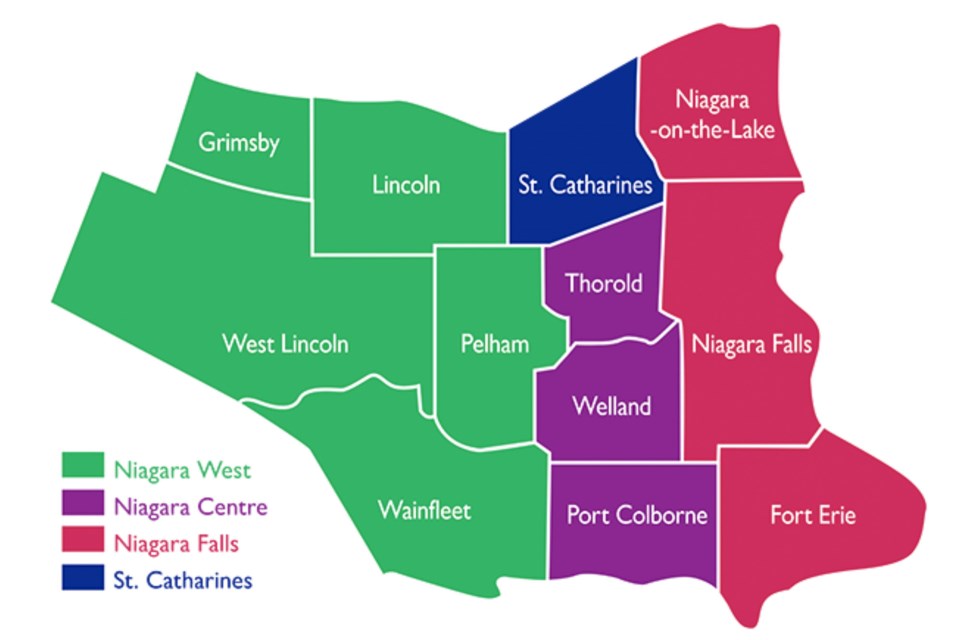
To govern these places as though they share identical needs is not efficiency. It is administrative wishful thinking.
The Ottawa Example: A Warning, Not a Blueprint
Advocates of amalgamation frequently point to the creation of the modern Ottawa from the former Regional Municipality of Ottawa–Carleton as proof that diverse municipalities can be fused into a single functional city. What is often omitted is that the fusion solved technical coordination problems while creating enduring political ones.
Ottawa gained unified transit planning, standardized services, and the ability to execute large infrastructure projects. It also inherited a permanent rural-urban divide that shapes every budget, planning decision, and election cycle. Farmers in the outer wards pay for light rail they will never ride. Suburban taxpayers argue they subsidize downtown priorities. Former municipalities continue to organize politically along pre-2001 boundaries, a quarter century later.
Amalgamation did not erase local identity. It merely removed the local governments that once represented it.
Niagara would face this tension in amplified form. Ottawa, despite its diversity, had a dominant employment core and a single metropolitan labour market. Niagara has several centres and multiple economic logics. Tourism, agriculture, manufacturing, retirement living, cross-border trade, and suburban commuting do not pull in the same direction.
Power Will Flow Somewhere
Every amalgamation produces a gravitational centre, whether intended or not. Decisions must be made, staff must be housed, budgets must be prioritized. In a single Niagara city, influence would inevitably concentrate in the largest population centres, most likely St. Catharines or Niagara Falls. Smaller municipalities would not disappear, but their ability to shape outcomes would diminish.
This is not a moral failure. It is mathematics.
Residents of smaller towns would still vote, but their votes would be diluted across a much larger electorate. Local issues that once dominated council agendas would become minor items competing with region-wide priorities. A zoning dispute that matters deeply to a village could be invisible in a chamber preoccupied with housing targets or tourism infrastructure.
Democracy at scale becomes less intimate and more transactional.
Coordination Without Erasure
None of this suggests the status quo is perfect. Niagara does suffer from fragmented planning, duplicated administration, and occasional municipal rivalry. Regional transit integration demonstrates that cooperation can produce tangible benefits without dissolving local governments. Shared services for policing, utilities, and infrastructure can achieve economies of scale while preserving local autonomy.
The real strategic question is not whether Niagara needs to function more cohesively. It is whether cohesion requires uniformity.
A region can behave like a federation rather than a unitary state. Strong regional planning frameworks, binding growth strategies, and pooled services can align municipalities without forcing them into a single institutional mold. This approach accepts that diversity is not a problem to be engineered away but a reality to be governed intelligently.
Bigger Is Not the Same as Better
Large cities do not automatically make better decisions. They simply make larger ones. When those decisions are wrong, the consequences are correspondingly bigger. A misjudged development strategy, infrastructure investment, or tax policy applied across a half-million residents can entrench problems for decades.
Small municipalities, for all their limitations, retain the ability to experiment, adapt, and reflect local priorities quickly. They function as laboratories of governance. Amalgamation replaces this patchwork of experimentation with a single policy regime that must suit everyone and will inevitably fit some poorly.
Uniformity feels orderly from a distance. Up close, it can be suffocating.
The Strategic Path Forward
If Niagara seeks a more prosperous and coherent future, the priority should be integration of function rather than consolidation of identity. Build region-wide systems where scale truly matters: transit, major infrastructure, environmental management, economic promotion. Preserve local decision-making where place matters most: land use, community character, local services, cultural priorities.
The lesson from Ottawa is not that amalgamation fails or succeeds. It is that it solves some problems while creating others that cannot easily be reversed. Once municipalities disappear, recreating them is practically impossible.
Niagara does not need to become one city to act like a mature region. It needs governance arrangements that respect the fact that it is not one place, and never has been.
Bigger government can coordinate more. It cannot care more, listen better, or understand the nuances of twelve different communities at once. Those qualities arise from proximity, not scale.
 The Rowanwood Chronicles