There is a particular moment when a society changes course, and it rarely announces itself with drama. It arrives instead in the language of reassurance. It speaks of precaution, of complexity, of being proactive. It tells us that nothing is wrong, and that everything is necessary.
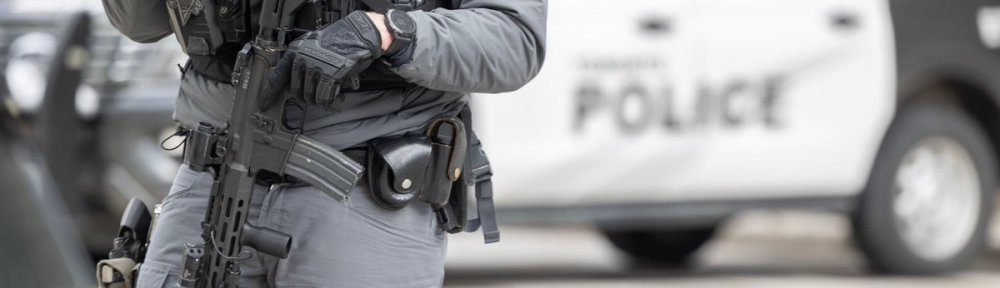
The recent announcement from the Toronto Police Service fits comfortably within that tradition. A new counter-terrorism unit. A task force with a name designed to evoke safety. Officers visibly deployed with patrol rifles at places of worship, public spaces, and the quiet arteries of civic life that most people pass through without a second thought. The explanation is measured. There is no specific threat. There is only a more complicated world.
This is how the thin edge of the wedge is introduced. Not as a rupture, but as an adjustment.
One does not need to deny the existence of risk to question the response. The world has indeed become more fractured, more performative in its anger, more capable of translating ideology into violence at unpredictable points. Yet it is precisely in such moments that restraint becomes the harder and more necessary discipline. The temptation, always, is to meet uncertainty with visibility, to substitute the appearance of control for its reality.
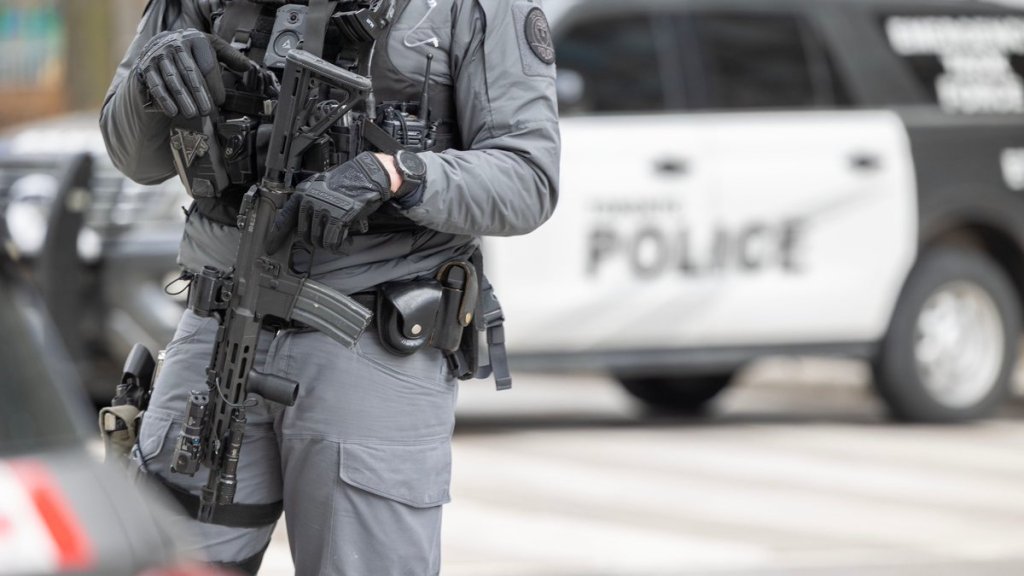
A rifle carried openly in a public square is not a neutral object. It is a statement about the relationship between the state and the citizen. It alters the emotional texture of a place. It suggests that danger is not only possible, but imminent enough to justify escalation. Over time, that suggestion becomes background noise. What was once exceptional becomes ordinary. And once it is ordinary, it becomes permanent.
History does not tend to reverse these shifts.
The language will evolve. Terrorism will broaden into extremism, extremism into threat, threat into disruption. Each step will be defensible in isolation. Each will be accompanied by statistics, briefings, and the steady insistence that this is about safety, not power. Meanwhile, the infrastructure of response continues to grow. More units, more tools, more reasons to use both.
This is not an argument against policing. It is an argument about boundaries.
If the state is to claim expanded authority in the name of protection, then the mechanisms that hold it accountable must expand with equal force and, crucially, with genuine independence. At present, that balance remains uneven. Oversight bodies exist, but they are too often constrained by mandate, by proximity, or by a structural deference to the institutions they are meant to scrutinize.
Canada does have civilian oversight in the form of the Special Investigations Unit, and at the national level through the Civilian Review and Complaints Commission for the RCMP. These bodies perform important work. But they are not designed, in their current form, to meet the moment that is emerging. Their processes are often slow, their visibility limited, and their independence, while formal, is not always experienced as absolute by the public they serve.
What is required now is something more deliberate and more robust.
A truly independent review body must be constructed with a mandate that is both narrow and uncompromising. Any police action that results in bodily harm or death should automatically trigger its jurisdiction. No discretion. No internal filtering. The threshold must be clear and universally applied.
Its structure must be insulated from policing culture. Investigators should not be drawn primarily from former police ranks, where professional habits and informal loyalties can follow. Instead, the body should be multidisciplinary. Legal scholars, forensic specialists, civil liberties experts, and community representatives should form its core. Expertise must replace familiarity.
Its authority must extend beyond investigation into consequence. Findings should not end as recommendations. They must carry binding weight, whether in the form of disciplinary action, referral for prosecution, or mandatory policy change. Without consequence, oversight becomes theatre.
Transparency must be the default, not the exception. Reports should be public, timely, and written in language that does not obscure more than it reveals. Where information must be withheld, the reason should be explicit and reviewable. Trust cannot survive behind closed doors.
Finally, and most importantly, this body must be accountable not to the institutions it reviews, but to the public through the legislature. Its legitimacy must flow upward from citizens, not sideways from the systems it oversees.
This is not a radical proposal. It is a proportional one.
If society is being asked to accept a more visible, more assertive form of policing in everyday life, then it is entirely reasonable to demand a correspondingly stronger assurance that when harm occurs, it will be examined without bias, without delay, and without compromise.
The thin edge of the wedge is not dangerous because of what it does today. It is dangerous because of what it makes easier tomorrow. It lowers the threshold for the next decision, and the next after that, until the cumulative effect is no longer easily recognized.
A rifle on a street corner may be explained. A pattern is harder to justify.
The question, then, is not whether the current measures are defensible. Many will argue that they are. The question is whether the safeguards surrounding them are sufficient for where this path leads. On that point, caution is not only prudent. It is necessary.
A society that expands its capacity for force without equally expanding its capacity for accountability does not become safer. It becomes more confident in its own power, and less certain of its limits.
That is the wedge worth watching.
 The Rowanwood Chronicles