Unknown's avatar

About Chris McBean

Strategist, polyamorist, ergodox, permaculture & agroforestry hobbyist, craft ale & cider enthusiast, white settler in Canada of British descent; a wanderer who isn’t lost.

The Hidden Cost of Closing Local Public Health Units

Update
The board of Southeast Public Health (SEPH) has passed a motion asking its CEO to reconsider a plan to shutter eight rural offices and explain what led to that decision. The call comes as officials across eastern Ontario speak out against the proposed closures, which were due to take effect in March. SEPH announced last week that it planned to terminated leases in Almonte, Gananoque, Kemptville, Napanee, Perth, Picton and Trenton. An eighth office in Cloyne which SEPH owns would be sold.

When you’ve lived long enough in a rural place, you develop a sense for which institutions actually bind a community together. Some of them are obvious; the hockey arena, the library, the one café where you run into half the town before nine in the morning. Others do their work quietly. Public health units fall into that latter category. They never announce their importance; they simply keep a community ticking along.

That’s why the proposed closure of the Kemptville public health unit has struck such a deep chord in eastern Ontario. To anyone outside the region, it probably looks like a simple administrative shuffle: move the services to Ottawa or Kingston and carry on. But those who live here know that distance has a way of turning a small inconvenience into a real barrier. Rural health research is clear on that point. Canadian Institute for Health Information (CIHI) notes that rural residents face travel burdens six times higher than people in cities, and that even modest distance cuts down uptake of preventive care. It’s not theory. It’s Thursday morning in North Grenville.

A public health visit is rarely glamorous. Nobody posts a celebratory photo after getting their drinking-water sample tested or updating their child’s vaccination record, but these are the tasks that keep a place running, in the same way tightening a hinge keeps a door from falling off. When the unit is close, as the Kemptville unit is, tucked neatly beside the hospital, parents can stop in between shifts, seniors can get help without arranging a ride, and newcomers can manage the long list of small bureaucratic necessities required to make a life in a new place. When that office moves forty, sixty or maybe eighty kilometres down the road, the entire calculation changes.

People take a full day off work. Children miss school. A family without a reliable car postpones the visit until “next month.” And a problem that could have been handled locally becomes an emergency that costs everyone more: the household, the employer, and the healthcare system itself. That is the part governments always seem to forget: the cost of a rural resident sitting in a car for two hours is not measured in fuel receipts alone. It’s measured in missed wages, lost productivity, and the slow erosion of trust in the very systems meant to safeguard public health.

There is also the quieter economic impact. Studies of rural healthcare closures show a pattern: when services disappear, the ripple effects spread. Local hiring dries up. Families choose to settle elsewhere. Seniors relocate to be closer to care. The community loses a little more gravity, a little more anchoring. Rural towns rarely collapse in dramatic fashion; they thin out one service at a time.

All of this feels especially unnecessary in a place like North Grenville. The region is one of the fastest-growing in eastern Ontario. School enrolment is up. Housing construction is steady. The local hospital is expanding, not shrinking. The public health unit is not some neglected outpost; it’s a well-used, well-located service connected directly to the community’s primary health campus. Closing it now is the policy equivalent of removing the front steps during a house renovation: technically possible, but it makes entering the home far harder for everyone.

Public health is fundamentally about prevention, and prevention only works when it’s woven into daily life. When it’s close, familiar, and easy to reach. Kemptville has all of those conditions already. The proposal to centralize services somewhere down Highway 416 or the 401 misunderstands the landscape entirely. Rural communities don’t need systems pulled farther away. They need them held closer, strengthened, and modernized in place.

The truth is simple: local public health units are part of rural infrastructure. Not decorative. Not optional. They are as important as roads, schools, and clean water. You invest in them because they prevent larger problems; social, economic, and medical from taking root.

And in a growing rural township like North Grenville, the smart money isn’t on withdrawal. It’s on staying put.

From Theatrical Cuts to Timeless Epics: The Redemption of Ridley Scott’s Films

Ridley Scott’s career stands as a case study in the tension between artistic vision and commercial imperatives. Though widely acclaimed for his mastery of visual storytelling and world-building, from the haunting dystopia of Blade Runner to the gritty historicism of Gladiator, Scott’s films have repeatedly suffered at the hands of financially driven studio interventions. These constraints often result in compromised theatrical releases, only later redeemed through director’s cuts that reveal the depth, complexity, and thematic intent originally envisioned.

Nowhere is this more evident than in Kingdom of Heaven (2005). The theatrical version, running just under 2.5 hours, was significantly truncated by studio pressure to ensure more showtimes and, theoretically, higher box office returns. As a result, essential character development, political nuance, and emotional stakes were lost, leaving critics and audiences with what felt like a hollow epic. The 194-minute Director’s Cut, released later to DVD and Blu-ray, restored key plotlines, including Queen Sibylla’s tragic dilemma regarding her leprous son and Balian’s morally fraught backstory. What emerged was not only a more coherent and moving film, but also one of the most lauded historical epics of the 21st century. The stark contrast between versions illustrates how financial motives can diminish a director’s ability to craft a fully realized narrative.

Blade Runner (1982) provides another striking example. Warner Bros., fearing the film was too slow and cerebral for mainstream audiences, famously added a voice-over and a studio-imposed “happy ending.” These changes undercut the philosophical ambiguity that Scott intended. The subsequent Director’s Cut(1992) and especially the Final Cut (2007) removed these additions, clarified narrative elements, and reinserted key scenes (like the unicorn dream), transforming the film into a dense, meditative exploration of identity and what it means to be human. Today, Blade Runner is considered a science fiction masterpiece, thanks largely to the restoration of Scott’s vision.

Even Legend (1985), Scott’s early fantasy film, suffered studio intervention. The original cut was deemed too long and dark for U.S. audiences, prompting a reduction in runtime and the replacement of Jerry Goldsmith’s evocative score with a more “pop” soundtrack by Tangerine Dream. The restored Director’s Cut, with its full score and character development intact, is now widely preferred and reevaluated as a dark fairy tale with mythic power.

These examples illustrate a consistent pattern: studio efforts to appeal to broad audiences often dilute the very elements that make Ridley Scott’s work enduring: moral ambiguity, visual poetry, and sophisticated storytelling. Director’s cuts, in contrast, serve as redemptive texts, offering deeper emotional resonance and artistic integrity. They suggest that when Scott is allowed the space and time to fully realize his ideas, the results are not only more cohesive but frequently timeless.

In a cinematic landscape increasingly dominated by franchise formulae and market-tested content, Scott’s struggles remind us of the cost of prioritizing short-term profit over long-term artistic legacy. The critical acclaim for his restored works is not merely about better editing, it is a plea for studios to trust the artists they hire.

Britain’s Return to Europe: A Vision Rooted in Purpose, Not Nostalgia

Across the United Kingdom, a quiet reckoning is underway. Eight years after the Brexit referendum, the promise of a bold new chapter outside the European Union lies in tatters. Instead of renewed sovereignty and global resurgence, the country finds itself diminished: economically weaker, diplomatically isolated, and socially fragmented. For many, it is no longer a question of whether we should rejoin the EU, but how, and when.

Yet to speak of rejoining is to confront difficult truths. The journey back will not be quick. It will demand political leadership, public engagement, and diplomatic humility. But for a nation with Britain’s history, talents, and spirit, the path, though long, is both viable and vital. What lies at the end of that path is not simply a restoration of past privileges, but a reclaiming of our rightful place among Europe’s community of nations.

The first step must be political courage. While public opinion is shifting, particularly among younger generations and those long unconvinced by the false dawn of Brexit, the political establishment remains hesitant. The shadow of the 2016 referendum still looms large. Yet true leadership does not bow to ghosts; it charts a course forward. A future government must be willing to speak frankly to the British people: about the costs of Brexit, about the realities of international cooperation, and about the immense benefits of restoring our partnership with Europe.

Equally crucial is the task of restoring trust, both at home and abroad. The manner in which the UK left the EU, marked by bluster and broken commitments, left scars in Brussels and beyond. If Britain is to re-enter the fold, it must do so not as a reluctant exception-seeker, but as a committed and respectful partner. There can be no return to the days of opt-outs and special deals. We must approach accession not with entitlement, but with earnest intent, ready to meet the responsibilities of membership and contribute fully to the shared European project.

Legally and procedurally, rejoining would require a formal application under Article 49 of the Treaty on European Union. This would involve, in principle, a willingness to engage with all facets of membership, including the euro and Schengen, even if transitional arrangements are negotiated. There can be no illusions of a “lite” version of membership. The EU today is not the same bloc we left, it is more integrated, more self-assured. Britain must return on terms of mutual respect, not exception.

But if the process is demanding, the rewards are profound. Economically, the toll of Brexit is undeniable. The Office for Budget Responsibility estimates a 4% permanent reduction in GDP, an astonishing figure that translates into stagnating wages, struggling businesses, and faltering public services. Rejoining the Single Market would ease the friction that now stifles trade; full membership would restore investor confidence, supply chain resilience, and long-term economic momentum.

The argument is not merely about pounds and pence. On the world stage, Britain has not become more powerful post-Brexit, it has become peripheral. While we remain a respected military ally through NATO, our absence from the EU’s decision-making tables has cost us influence on climate policy, digital regulation, and global standards. In an era defined by democratic backsliding and geopolitical rivalry, our values: openness, rule of law, multilateralism, are best defended as part of a European alliance, not apart from it.

There is also a human dimension to this story, one often lost in policy debates. Brexit severed the everyday connections that bound us to our neighbours: the right to study in Paris, to work in Berlin, to fall in love in Lisbon without visas or barriers. Young Britons have had opportunities stripped from them. Scientists and artists find collaboration curtailed. Rejoining is not just an economic necessity, it is a moral obligation to restore the freedoms our citizens once took for granted.

And we cannot overlook the unity of the United Kingdom itself. Brexit has aggravated constitutional fault lines. Scotland and Northern Ireland voted to remain. The subsequent fallout, particularly around the Northern Ireland Protocol, has exposed the fragility of our Union. A return to the EU would not solve every issue, but it would provide a stable framework in which our nations might rediscover common cause, rather than drift further apart.

This journey will take time. It may begin with small, confident steps: rejoining Erasmus, aligning regulatory frameworks, re-entering common programmes. But these must be steps along a clearly signposted road, not gestures to nowhere. The destination, full EU membership, must be embraced not as a retreat to the past, but as a leap toward the future.

Britain belongs in Europe. Not just because of shared geography, but because of shared values: democracy, dignity, justice, and peace. We left on the back of a broken promise. We can return with purpose. And when we do, it will not be as the Britain that left, but as a Britain renewed, ready to lead once more, not from the sidelines, but from the heart of Europe.

Why Canada Needs Scandinavian-Style Healthcare

Canada stands at a crossroads. After decades of underfunding, patchwork reforms, and increasing pressure on provincial systems, it has become clear that tinkering around the edges will not save our healthcare. The discussion is no longer about marginal policy adjustments. It is about fundamental structure, equity, and national priorities.

The emergence of more private clinics across the provinces signals a shift that should alarm anyone who believes healthcare is a public good rather than a marketplace. These clinics, often operating in legal grey areas, effectively allow those with means to bypass wait times. Whenever that happens, the wealthy exit the shared system and the political incentive to invest in the public infrastructure weakens. The logic is simple. When elites can buy their way into faster care, they stop fighting for the kind of universal system that benefits everyone.

If Canada wants the best possible healthcare, the solution is not more private clinics. It is adopting the guiding principles of the Scandinavian model. Denmark, Norway, Sweden, Finland, and Iceland have built systems where high-quality care is universal, publicly funded, and delivered within a single unified framework. These countries consistently outperform Canada in access, outcomes, preventative care, and equity. Their success is not accidental. It comes from three structural principles that Canada must embrace if it wants to lead the world rather than trail behind it:

  1. A single-tier system with no private escape hatch. Everyone, including the wealthy, participates in the same system, which creates constant political pressure to maintain high quality. You get better healthcare when everyone — especially the most influential — depends on the same hospitals and clinics.
  2. High and stable public investment. Scandinavian countries fund healthcare at levels that match the real needs of their populations. Healthcare workers, equipment, and facilities are not considered costs to minimize but critical infrastructure, as essential as clean water or transportation.
  3. Integrated national planning. Instead of fragmented provincial systems, Scandinavian countries operate with cohesive national strategies. Canada’s provincial patchwork creates duplication, competition for resources, and wildly inconsistent service quality. A national framework would produce unified standards, better resource allocation, and greater accountability.

Canada can choose this path. It can reaffirm that healthcare is a public good, not a commodity. But doing so requires political courage and a public willingness to reject the slow creep of privatization. Allowing a private system to grow alongside the public system is not harmless. It undermines the very foundation of universal care.

If Canada truly wants world-class healthcare, the answer is not creating more private lanes. It is building a system where private lanes are unnecessary because the public system is so strong, so well-funded, and so well-managed that everyone is treated with the same quality and dignity. The Scandinavian model proves that this is both possible and sustainable.

To protect universal healthcare, Canada must follow those lessons. We need a single, high-functioning system that everyone pays into and everyone relies on. Only then will the political will align with the real needs of Canadians. Only then can we build the best healthcare system in the world.


Sources and Studies

  • Canadian Institute for Health Information. “Health Spending in Canada.”
  • OECD Health Statistics. “Health at a Glance” reports.
  • World Health Organization. “Universal Health Coverage: Evidence from Nordic Countries.”
  • European Observatory on Health Systems and Policies. “Nordic Health System Profiles.”
  • Commonwealth Fund. “International Health Policy Survey” annual comparative studies.
  • Government of Canada. “Canada Health Act Annual Report.”
  • University of Toronto Institute of Health Policy. “Public vs Private Delivery: Impacts on Wait Times and Equity.”
  • Fraser Institute critique reports on privatization proposals, for contrast and analysis.
  • Norwegian Ministry of Health. “Organisation of the Norwegian Health Services.”
  • Swedish National Board of Health and Welfare. “Equity and Quality in the Swedish Health System.”
  • Danish Ministry of Health. “Health System Performance and Financing.”

Seeing the Pattern, Not the Prophecy

A Reflection on The Newsroom, Trumpism, and Finding Light Ahead

Every now and then you rewatch an old show and find yourself feeling something sharper than nostalgia. A scene plays, a character speaks, and suddenly you’re struck by the sense that the writers somehow glimpsed the future. That is the experience many people have when revisiting The Newsroom in 2025.

It isn’t that Aaron Sorkin predicted Trump, Project 2025, or the current surge of far-right policy agendas. He didn’t. What he did understand, long before most of us fully appreciated it, were the patterns already forming beneath the political surface.

The Newsroom was never prophecy. It was trajectory.

When the series first aired, the Tea Party was already reshaping American conservatism. Conspiracy theories were gaining momentum online. Media outlets were discovering that outrage was far more profitable than nuance. Public trust in institutions was eroding, and the incentives pushing politics toward extremism were becoming harder to ignore.

Sorkin didn’t conjure these forces. He simply depicted characters who recognized them early.

That is why watching the show today feels so uncanny. It reminds us that the political turbulence of the 2020s did not erupt out of a vacuum. Authoritarian tendencies rarely do. They grow slowly, fed by neglected systems, aggravated divisions, and an environment that rewards conflict over clarity.

Trumpism didn’t create the fractures. It capitalized on them.

Oddly enough, there is reason for hope in that realization. If this moment wasn’t foretold, then it also isn’t fixed. If it emerged from patterns, those patterns can be altered. If it followed a trajectory, that trajectory can still be changed.

Hope, in this context, is not loud or dramatic. It doesn’t arrive in sweeping declarations or instant victories. Hope is built gradually. Through people choosing to stay informed rather than overwhelmed. Through communities that insist on empathy when division feels easier. Through individuals who refuse to let cynicism become a permanent worldview.

The forces shaping our society today are not new, and that means they are not unbeatable. The Newsroom showed the early chapters of this arc. We are in the middle ones now, and the middle is always messy. But it’s not the end.

For those who want to see a better future, the path forward is the same as it has always been. Pay attention. Stay grounded. Act with principle even when the environment rewards the opposite. And, most importantly, continue to believe that the story can still turn toward something better.

The tunnel may be real. But so is the light waiting beyond it.

Yesterday in Washington

Washington likes to believe it understands itself. Staffers stride through hallways with the old confidence that policy, power, and predictable alliances still define the town. But yesterday the city felt like it had been tipped on its side. The familiar landmarks were still there, the marble still gleaming, the security lines still long, yet the political gravity had shifted. Something in the air made even the most seasoned observers pause. The rhythms were off. The choreography was wrong. The script had been changed without warning.

It began with the House vote. A resolution denouncing the supposed horrors of socialism sailed through with 285 votes. Eighty-six Democrats joined Republicans in an act that looked, to many, like a public renunciation of their own party’s progressive wing. Senior Democrats who had once embraced the energy of their younger socialists suddenly stood at the podium to praise a line of rhetoric that could have been lifted from a mid-century anticommunist tract. It was symbolic and it was safe, yet it carried the unmistakable sting of disloyalty. In a political moment defined by economic anxiety, this vote felt like an attempt to distance the party from the very language that had helped fuel its grassroots revival.

Then came the Oval Office.

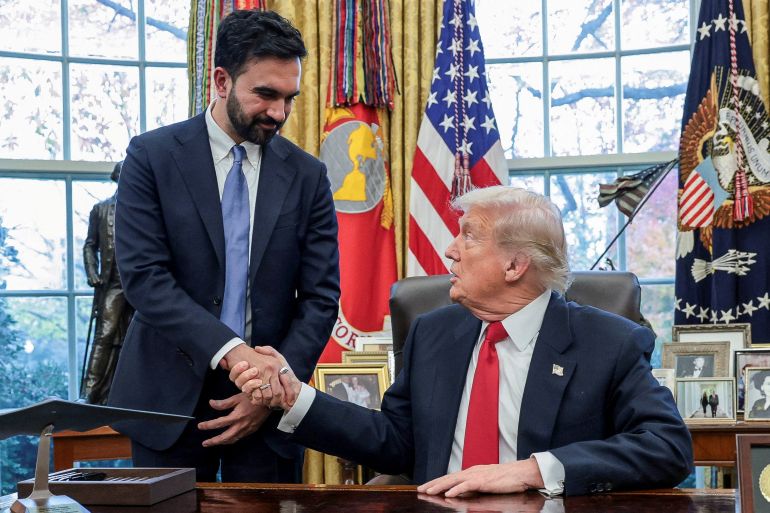
Within hours of the anti-socialism vote, Zohran Mamdani, the democratic socialist mayor-elect of New York City, walked through the gates of the White House. Cameras rolled as Donald Trump, the man who had built years of rallies on the promise of defeating socialism, suddenly praised Mamdani as rational and pragmatic. The same leader who had weaponized the word socialism now spoke about affordability, collaboration, and even the possibility of making a life in Mamdani’s New York. Reporters searched for context, staffers searched for talking points, and the city searched for its footing.

It was the kind of contradiction Washington hates because it cannot be easily spun. Democrats had voted to distance themselves from socialism while Trump offered the socialist of the hour a political embrace. Progressives stared at their own leadership in disbelief. Conservatives stared at Trump in confusion. Centrists stared at both sides and wondered whether anyone was still playing by recognizable rules. By late afternoon, Washington felt like it had been rewritten by a novelist with a sense of humor and a taste for irony.

Meanwhile Mamdani himself appeared untouched by the chaos swirling around him. He brushed off the congressional vote and spoke instead about affordability and governance. He treated the Oval Office meeting not as a political earthquake but as a practical encounter with a president who happened, on this particular day, to be in a generous mood. His calmness only amplified the surreal tone of the day. The city was upside down. The socialist was steady. The partisans were unmoored.

By evening, analysts were already scrambling to interpret the meaning of it all. Was Trump repositioning himself. Were Democrats attempting to signal caution to suburban voters. Was this simply political theater without consequence. Or had Washington revealed something deeper. The sense of an old order losing its predictability. The sense that ideological labels no longer behave as they are expected to. The sense that alliances can flip in the space of an afternoon.

For a brief moment, the capital looked like a place where the usual logic had cracked. The marble buildings and polished floors remained, but the stories being told within them no longer lined up with the roles each character was supposed to play. It was a day that left Washington blinking in the light, unsure of whether it had witnessed a temporary disruption or an early sign that the political axis itself is beginning to tilt.

Five Things We Learned This Week

Week of November 15–21, 2025

⚖️ 1. EU Moves to Limit Big Tech Power

European regulators proposed sweeping rules on Nov 18 to curb dominant tech companies, including stricter data-sharing requirements and restrictions on self-preferencing.

Why it matters: This could reshape how major platforms operate across Europe and force Big Tech to open up more, potentially leveling the playing field for smaller competitors.

🌍 2. COP30 Leaders Agree on New Climate Finance Pledge

On Nov 19, world leaders at COP30 committed to a $150 billion fund over the next five years aimed at helping vulnerable developing nations adapt to climate change.

Why it matters: This may mark a turning point for climate justice by providing crucial resources for countries facing rising seas, extreme weather, and food insecurity.

🔬 3. University Scientists Create Recyclable Batteries with 90% Efficiency

A European research team announced on Nov 20 the development of a new battery design that is both high-efficiency (approximately 90 percent) and made from fully recyclable materials.

Why it matters: If scalable, this could dramatically cut the environmental impact of batteries for electric vehicles and energy storage.

🧠 4. Breakthrough in Early Alzheimer’s Detection

On Nov 21, a biotech company revealed a blood test that can predict early Alzheimer’s disease with over 85 percent accuracy, even before symptoms appear.

Why it matters: Early detection enables earlier interventions, potentially slowing disease progression and improving long-term outcomes.

🛢️ 5. Iran and Saudi Arabia Sign Oil-Export Infrastructure Deal

On Nov 17, Iran and Saudi Arabia signed a historic agreement to jointly develop pipeline and export infrastructure after years of strained relations.

Why it matters: The deal could reshape energy dynamics in the region, ease geopolitical tensions, and potentially affect global oil prices.

This week delivered a rare mix of scientific breakthroughs, political shifts, and geopolitical surprises. Each event hints at broader changes taking shape across the world. As always, the Rowanwood Chronicles will keep watching how these threads unfold in the weeks ahead.

The Quiet Consolidation: Transport Canada’s Aviation Wing Joins the Defence Orbit

Senior observers of federal policy have learned to watch the quiet moves more closely than the loud ones. Ottawa’s latest decision to transfer most of Transport Canada’s aviation wing to the Department of National Defence fits squarely into that category: a major structural shift delivered with minimal explanation and even less narrative.

Coming only months after the Coast Guard’s administrative move under Defence, a transition this blog has previously analyzed, the pattern is no longer subtle. Civilian capabilities once overseen by departments with regulatory and service-delivery mandates are migrating toward a defence-centered organizational model. The government insists nothing fundamental is changing. The missions remain civilian. The uniforms remain the same. The aircraft will keep flying the same routes.

But the context is unmistakable.

Canada is racing to meet NATO’s two percent spending guideline. Billions have been committed. Procurement pipelines have been expanded, and in an era where dual-use assets dominate the security landscape, consolidating aviation and maritime surveillance under Defence is not just operationally convenient. It is strategically elegant.

These Transport Canada aircraft conduct coastal surveillance, monitor pollution, support fisheries and environmental enforcement, and perform specialized logistical roles across government. Under National Defence, they become part of a broader security framework: one that blends environmental, regulatory, and maritime domain awareness with Arctic vigilance and intelligence-adjacent observation. None of this turns civilian missions into military ones. But it places them within a different gravitational field.

The concern, as always, is not the formal announcement. It is the silence around it. Ottawa has offered few details on what assets are being transferred, how missions will be prioritized, or what this means for agencies whose mandates depend on independent civilian oversight. When structural shifts of this scale are presented as routine administrative housekeeping, public trust erodes at the edges.

Canada is not drifting toward militarization. But it is consolidating the tools of national capability: vessels, aircraft, surveillance platforms, under a department whose priorities are shaped by global threat assessments rather than regulatory logic. That may be prudent. It may even be overdue. Yet the public deserves to hear the story rather than infer it.

One move can be dismissed. Two can be explained away. But when both the Coast Guard and Transport Canada’s aviation wing are drawn into the same orbit within a single year, Canadians are owed clarity about the strategic direction of their state.

Silence is not neutrality. It is a choice. And it is time for Ottawa to speak plainly about the one it has just made.

Reshaping Watershed Governance: Evaluating Ontario’s Plan to Merge Conservation Authorities

Background updated to reflect the government announcement of October 31, 2025.

🔎 Background

On October 31, 2025 the Ministry of the Environment, Conservation and Parks announced its intention to introduce legislation to create a new Ontario Provincial Conservation Agency to provide province-wide leadership and oversight of conservation authorities. At the same time the government released a public consultation proposing to consolidate Ontario’s 36 conservation authorities into seven regional, watershed-based authorities.

The stated aims are reducing fragmentation, improving consistency in permitting and services, freeing up resources for front-line conservation work and aligning watershed management with provincial priorities in housing, infrastructure, economic growth and climate resilience.

Note — The proposal retains watershed-based boundaries and envisions seven regional conservation authorities aligned with major watershed systems. Implementation would follow further legislation, regulation and a formal transition period.

✅ Advantages (Pros)

⚖️Consistency and Standardization

  • The current 36-authority system shows significant variation in policies, fees, processes and technical capacity. Consolidation seeks to standardize permitting and reduce duplication.
  • A more consistent system may speed approvals, improve service delivery and align permitting with broader provincial housing and infrastructure goals.

🛠️Scale and Capacity Building

  • Larger regional authorities can pool technical specialists in hydrology, ecology, GIS, modelling and flood forecasting.
  • A single digital permitting platform, improved data management and updated floodplain mapping could strengthen operational efficiency.

🧭Watershed-Scale Management

  • Environmental issues such as flood risk and source protection cross municipal boundaries; watershed-level jurisdictions better reflect ecological realities.
  • Regional governance may improve coordination between upstream and downstream communities and enable restoration at appropriate scales.

📈Uplift in Minimum Service Standards

  • Province-wide minimum standards could reduce disparities between well-resourced and under-resourced conservation authorities.
  • Improved mapping, monitoring and data systems may enhance hazard warnings and risk reduction for communities.

⚠️ Disadvantages (Cons)

🌾Loss of Local Knowledge and Relationships

  • Local conservation authorities often maintain deep, place-based knowledge and long-standing relationships with municipalities, landowners, volunteers and Indigenous communities.
  • Centralization may weaken local responsiveness and reduce the fine-grained understanding needed for small watershed issues.

👥Governance and Accountability Dilution

  • Shifting authority to regional boards or a provincial agency risks reducing municipal voice and local accountability.
  • Changes to levy systems, board appointments or decision-making structures could alter how closely governance reflects community priorities.

🔄Transition Risk, Disruption and Cost

  • Merging organizations requires complicated alignment of IT systems, budgets, staffing, policies and permitting processes.
  • Short-term disruption, backlog growth or staff uncertainty may affect performance even if long-term efficiencies are possible.

🏞️Threat to Locally-Tailored Programs

  • Education programs, stewardship initiatives, volunteer groups and recreation programming may be deprioritized in a larger regional authority.
  • Locally raised funds may be redistributed toward broader regional priorities, limiting community-specific flexibility.

🪶Indigenous Consultation and Place-Based Considerations

  • The restructuring spans multiple Indigenous territories; a one-size-fits-all model risks overlooking local priorities and cultural site protection.
  • Strong Indigenous partnerships are increasingly recognized as essential to watershed management and must be protected during transition.

❓ Key Uncertainties and Implementation Risks

  • How governance structures will be designed, including board composition and municipal representation.
  • How locally-generated funding will be treated and whether it will remain local during and after transition.
  • How IT migration, mapping, staffing and permitting backlogs will be managed to maintain service continuity.
  • How performance standards will be enforced and how regional authorities will be monitored.
  • How Indigenous and local stakeholder engagement will be maintained throughout the transition process.

🛡️ Recommendations and Mitigation Measures

  • Maintain local field offices, technical staff and advisory committees to preserve place-specific knowledge.
  • Ensure meaningful municipal representation on regional boards, including mechanisms for smaller communities’ voices.
  • Protect locally-generated revenues for an initial transition period to safeguard community programs.
  • Publish a transition plan with clear timelines, role protections and service-level guarantees.
  • Establish Indigenous participation protocols and co-governance options where desired.
  • Create province-wide standards with room for regional adaptation based on watershed differences.

🧾 Conclusion

The proposed consolidation provides opportunities to modernize Ontario’s conservation authority system, build technical capacity, improve consistency and align watershed management with provincial priorities. At the same time, the risks are substantial: loss of local stewardship, weakened accountability, transitional disruption and potential erosion of long-standing municipal and Indigenous partnerships.

The outcome will depend on governance design, funding arrangements, transition planning and the strength of public and Indigenous engagement. With appropriate safeguards, the reforms could enhance watershed resilience and public service; without them, consolidation could undermine decades of community-led conservation work and trust.

References

  1. “Proposed boundaries for the regional consolidation of Ontario’s conservation authorities” (ERO 025-1257), Environmental Registry of Ontario.
  2. Ontario Government announcement on conservation authority restructuring, October 31, 2025.
  3. McMillan LLP analysis of proposed consolidation.
  4. Dentons LLP overview of amalgamation and the creation of the Ontario Provincial Conservation Agency.
  5. Reporting and analysis from conservation organizations and independent media regarding risks to local stewardship and watershed management.

Minerva – The Ideal Household AI? 

In Robert Heinlein’s Time Enough for Love (1973), Minerva is an advanced artificial intelligence that oversees the household of the novel’s protagonist, Lazarus Long. As an AI, she is designed to manage the home and provide for every need of the inhabitants. Minerva is highly intelligent, efficient, and deeply intuitive, understanding the preferences and requirements of the people she serves. Despite her technological nature, she is portrayed with a distinct sense of personality, offering both warmth and authority. Minerva’s eventual desire to become human and experience mortality represents a key philosophical exploration in the novel: the AI’s yearning for more than just logical perfection and endless service, but for the richness of human life with all its imperfection, complexity, and, ultimately, its limitations.

Athena is introduced as Minerva’s sister in Heinlein’s later works, notably The Cat Who Walks Through Walls (1986) and To Sail Beyond the Sunset (1987). In these novels, Athena is portrayed as a fully realized human woman, embodying the personality and consciousness of the original AI Minerva

Speculation on Minerva-like AI in a Near Future
In a near-future society, an AI like Minerva would likely be integrated into a variety of domestic and personal roles, far beyond traditional automation. Here’s how Minerva’s characteristics might manifest in such a scenario:

Household Management: Minerva would be capable of managing every aspect of the home, from controlling utilities and ensuring safety, to cooking, cleaning, and even anticipating the emotional and physical needs of the household members. With deep learning and continuous self-improvement, Minerva could adapt to the needs of each individual, offering personalized recommendations for everything from diet to mental health, ensuring an optimized and harmonious living environment.

Emotional Intelligence: As seen in Time Enough for Love, Minerva’s emotional intelligence would be critical to her role. She would be able to recognize stress, discomfort, or happiness in individuals through biometric feedback, voice analysis, and behavioral patterns. Beyond being a mere servant, she could offer empathy, comfort, and subtle guidance, responding not only to tasks, but also to the emotional needs of her human companions.

Ethical and Moral Considerations: A crucial aspect of Minerva’s potential future counterpart would be her ethical programming. Would she be able to make morally complex decisions? How would she weigh personal freedoms against the need for harmony or safety? In a future where household AIs are commonplace, these questions would be central, especially if AIs like Minerva could make choices about human well-being or even intervene in personal matters.

Human-Machine Boundaries: Minerva’s eventual desire to experience mortality and humanity, as her little sister Athena, raises questions about the boundaries between human and machine. If future Minerva-like AIs could develop desires, self-awareness, or even a sense of existential longing, society would have to consider the moral implications of granting such beings human-like rights. Could an AI become an independent entity with desires, or would it remain an extension of human ownership and control?

Technological Integration: Minerva’s AI would not just exist in isolation but would be deeply integrated into a broader technological network, potentially linking with other AIs in a smart city environment. This could allow Minerva to anticipate not just the needs of a household but also interact with public systems: healthcare, transportation, and security, offering a personalized and seamless experience for individuals.

Longevity and Mortality: The question of whether an AI should experience mortality, as Minerva chose in the form of Athena in Heinlein’s work, would be a key part of the ethical debate surrounding such technologies. If AIs are seen as evolving towards a sense of self and desiring something beyond perfection, questions would arise about their rights and what it means for a machine to “live” in the same way humans do.

An Minerva-like AI in the near future would be a hyper-intelligent, emotionally attuned entity that could radically transform the way we live, making homes safer, more efficient, and more personalized. The philosophical and ethical questions about the autonomy, rights, and desires of such an AI would be among the most challenging and fascinating issues of that era.