Unknown's avatar

About Chris McBean

Strategist, polyamorist, ergodox, permaculture & agroforestry hobbyist, craft ale & cider enthusiast, white settler in Canada of British descent; a wanderer who isn’t lost.

Reevaluating Policing Priorities: A Call for Community-Centered Approaches in Ottawa

The Ottawa Police Service (OPS) has proposed a significant budget increase, citing the need to enhance services across the city. However, evidence suggests that reallocating existing funds towards community-focused policing could be a more effective, and sustainable approach to reducing crime without additional financial burden.

Community Policing: A Proven Strategy
The OPS has implemented several community-oriented strategies that have shown promising outcomes. The Community Outreach, Response, and Engagement (CORE) Strategy, for instance, focuses on addressing the root causes of crime in specific areas such as the ByWard Market and Rideau Street. By increasing foot patrols and engaging with local stakeholders, the OPS has reported a 17.9% reduction in calls for service and a 4.62% decrease in crime across these hotspots. 

Similarly, the District Deployment Model tailors policing efforts to the unique needs of Ottawa’s diverse neighborhoods. This approach emphasizes collaboration with community partners to resolve local issues, enhancing service delivery and community trust.

Resource Reallocation: Investing in Prevention
The proposed budget increase for the OPS is substantial, potentially adding approximately $30 million to the police budget. Critics argue that these funds could be more effectively utilized by investing in community-based services that address the root causes of crime, such as poverty, mental health, and education.

Initiatives like Crime Prevention Ottawa’s “Vision Jasmine” project have demonstrated the effectiveness of community-led efforts in reducing crime. By focusing on community engagement and support, such programs have led to a significant reduction in crime rates in neighborhoods that experienced multiple homicides. 

Building Trust Through Engagement
Community policing emphasizes building trust and collaboration between police and community members. The OPS’s CORE Strategy and District Deployment Model are steps in this direction, aiming to create stronger relationships with residents and address their unique concerns. Investing in these initiatives can lead to more effective policing and a safer community overall.

While the OPS’s request for a budget increase highlights the need for enhanced services, a shift towards community-focused policing offers a more sustainable and effective solution. By reallocating existing resources to initiatives that address the underlying causes of crime and foster community trust, Ottawa can create a safer and more equitable environment for all residents.

On the Illusion of Self-Discovery 

In an age where “finding yourself” has become a lifestyle brand, it’s hard not to notice, gently, how strange it all is.

You see it everywhere: bright, hopeful faces on “healing journeys,” framed against sunsets in Bali; corporate executives burning out in glass towers only to reappear months later as “authentic living” coaches after a $12,000 retreat in the Andes. Suburban families decluttering their closets in search of inner peace, as if enlightenment might be hidden somewhere between last season’s jackets and the yoga mats.

Modern self-discovery, especially among the comfortable and educated classes, has become an elaborate ritual. The tools vary: yoga teacher trainings, digital detox camps, van life road trips, artisanal workshops on gratitude, but the impulse remains deeply human: the yearning to feel whole, to understand oneself beyond the blur of obligations.

And yet, with a kind of quiet sadness, you realize that much of this restless effort misses the heart of what older wisdom traditions have long tried to say: that the self you are chasing cannot be caught like a butterfly. The ego, the needy, striving “I”, is not a puzzle to be solved or a prize to be won. It is an illusion to be gently seen through, a dream to wake up from.

In this softer light, it’s clear that modern self-discovery often becomes a new form of grasping. A gentler grasping, perhaps, dressed in mindfulness retreats and ayahuasca ceremonies, but grasping nonetheless. Transformation is packaged, marketed, and sold, with self-actualization offered for a price. It’s not that these experiences are without value; many carry glimpses of beauty and honesty, but when the pursuit becomes a new identity, a new project of consumption, it quietly reinforces the very suffering people hope to leave behind.

Meanwhile, the genuine work, the real, hard, simple work, remains overlooked. It doesn’t glitter. It looks like sweeping a floor without resentment, holding silence without needing to fill it, sitting with discomfort without demanding it change. It looks like living, fully and without drama, in the plainness of an unremarkable day.

Ancient teachings, whether whispered under the Bodhi tree, scribbled in the margins of Stoic letters, or passed hand-to-hand among Sufi poets, point always to the same difficult kindness: You do not find yourself by changing scenery. You find yourself by changing how you see.

And sometimes, by realizing, with a soft sigh, not a harsh judgment, that there was no fixed, shining “self” to find after all.

This truth is not meant to mock anyone’s search. It is not meant to diminish the sincere longing behind every yoga mat, every travel blog, every self-help journal. Longing is sacred. The path is sacred. It is only that the destination, in the end, may be smaller and quieter than expected, not a place to arrive at, but a way of being already waiting inside the life you have.

And that, perhaps, is enough.

Blood and Creed: Vice President Vance’s Reimagining of American Citizenship

On July 5, 2025, Vice President J.D. Vance delivered a notable address at the Claremont Institute’s Statesmanship Award Dinner in San Diego. For a man in the second-highest office of the land, his treatment of American citizenship was striking, not for its novelty, but for its clear departure from foundational norms. 

From Creed to Kinship
Vance began by challenging the idea of the United States as a creedal nation, a polity bound by shared principles of the Declaration of Independence, calling it simultaneously over-inclusive (drawing in “hundreds of millions, maybe billions” who support American ideals abroad) and under-inclusive (excluding those with ancestral ties, but extremist beliefs). He presented a contrasting model of citizenship rooted in ancestry, place, and “blood-and-soil.” With sentimental reference to generations of his family buried in a Kentucky cemetery, Vance argued that belonging should be tied to living history and rootedness rather than abstract ideals. 

This represents more than rhetorical flourish. It signals a paradigm shift, from civic affiliation to ethnic membership. In Vance’s terms, ancestry becomes a qualifier; heritage becomes identity.

Critique from the Center and Beyond
Historians and public intellectuals wasted little time pushing back. Ambassador Daniel Fried offered a powerful critique in The National Interest, opposing Vance’s redefinition for its reversal of Abraham Lincoln’s post–Civil War vision. Lincoln had conceived the nation as “a new nation, conceived in liberty”, not as a bloodline-bound entity. Fried emphasized that Lincoln saw citizenship as a matter of shared principles, not ancestry, drawing on immigrants who “feel…they are part of us” through creed.

Historian and public author John Ganz described Vance’s stance as an “anti-Declaration.” He highlighted the inconsistency of invoking Revolutionary and Civil War symbols while undermining the very ideals those conflicts advanced. Ganz drew contrast with Harry Jaffa, whose defense of Lincoln affirmed that “all men are created equal” meant just that, regardless of bloodline.

Tad Stoermer’s “Heritage Citizenship”
Into this debate steps Tad Stoermer: public historian, educator, and author, who coined the term “heritage citizenship” to categorize this turn toward ancestry-based belonging. Stoermer views this not as nostalgic reflection but as active project: a “restoration” of a racially-defined First Republic rooted in whiteness. The goal, he suggests, is the rewriting of constitutional logic, to reassert lineage as citizenship’s arbiter. 

Why This Matters Today
If Vance’s vision is enacted, it would have real-world consequences:

1. Birthright Citizenship at Risk
The 14th Amendment guarantees citizenship based on birth within U.S. jurisdiction: an inclusive, principle-based foundation. Vance’s model, however, introduces a lineage test, posing a legal challenge to this constitutional baseline.

2. Political and Social Exclusion
Consider the millions of post-1965 immigrant-descended Americans: legal, patriotic, educated, yet lacking “Appalachian blood.” Their citizenship, under Vance’s rubric, becomes negotiable, diluted by ancestry.

3. Ideological Flexibility for Elites
Despite its broad implications, heritage citizenship allows selective exceptions, for political elites, spouses, or allies (e.g., Vance’s own wife, born in California to Indian immigrants), which erodes the internal consistency of the ideology. Vance can romanticize heritage, while simultaneously reserving membership for his inner circle.

Going Backwards – Constitutionally and Symbolically
This vision directly counters Lincoln’s redefinition of the Union after 1863. At Gettysburg, he consecrated the Union’s cause as “a new birth of freedom,”establishing citizenship through legal equality. Vance’s model, in contrast, retreats into pre-14th Amendment logic, where race and lineage determined belonging.

It also undermines the United States’ role on the global stage. Fried points out that the American creed, its principle-based identity, enabled it to attract “hundreds of millions, maybe billions” of adherents abroad, forming what he describes as a “positive-sum” global leadership structure  . Heritage-based identity, by contrast, is zero-sum, exclusive, and inward-looking.

A Historian’s Judgment
For any senior historian, the implications are stark:
Constitutional Regression: Voting rights and equal protection, hard-won through amendments and civil rights struggles, are put back on the chopping block.
Political Inequality: Heritage citizenship enables a bifurcated class of Americans, those with “authentic” lineage and those without.
National Myth versus National Reality: The U.S. has always been a nation of immigrants and wanderers. Vance’s speech polices belonging by ancestry, contra 250 years of integrated identity-building.

Vice President Vance’s Claremont Institute speech is not merely poetic, it is profoundly political. It stakes out heritage, soil, and blood as qualifiers of sovereignty. Critics like Fried, Ganz, and Stoermer understand this as both intellectual and legal retrenchment. The choice now faces American democracy: Will we continue as a principle-based republic, where citizenship is claimed through belief, law, and shared action? Or will we succumb to a lineage-based model that narrows the definition of who belongs?

In highlighting ancestry over creed, Vance’s model asks an inflammatory question: does American identity belong to those we include, or those we exclude? The answer, for nearly two centuries, has been creed. It must remain so.

In a nation guided by Vance-style heritage criteria, citizenship would shift from being a legal, civic covenant to a cultural inheritance. That model would disqualify immigrants, their children, Jewish Americans, those of Latino or Asian descent, even well-known political figures, unless they belong to the “right” ancestry group. Yet the model grants latitude for elite figures, a glaring hypocrisy exposing the project’s exclusionary core. It’s not just a nostalgic vision, it’s a blueprint for a tiered citizenry: real if you’re insider heritage, negotiable if not.

The Lost Diversity of Humanity 

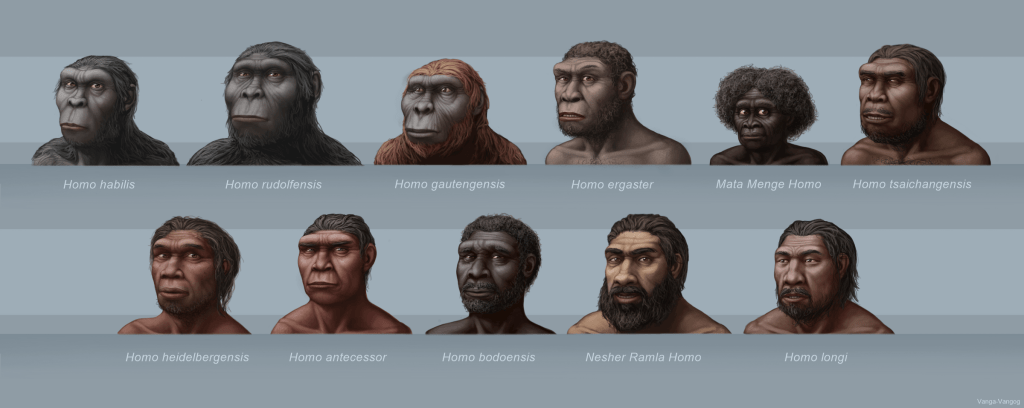
Roughly one hundred thousand years ago, the world was home to a remarkable diversity of human species. Modern humans were only beginning their first tentative steps beyond Africa, but they were not alone. Several other lineages thrived, each adapted to its own landscapes, climates, and ways of life. These were not different “races” of a single species but distinct human branches, separated by hundreds of thousands of years of evolution, yet sometimes still close enough to interbreed.

Neanderthals were the best known of these relatives. They occupied Europe and western Asia, building tools, hunting in coordinated groups, and surviving in some of the harshest Ice Age environments. To the east, Denisovans spread widely across Asia. Although only a handful of their bones and teeth have been recovered, genetic studies show that Denisovans were a major lineage, leaving traces of their DNA in modern populations from Tibet to Oceania. On the island of Java, the last populations of Homo erectus endured. This species had been extraordinarily successful, spreading out of Africa nearly two million years earlier, and fossils suggest they survived until at least 117,000 years ago.

Other species thrived in more isolated environments. On the island of Flores in Indonesia lived Homo floresiensis, often nicknamed the “hobbit” because of its small stature. Despite its diminutive size, this species produced stone tools and likely controlled fire, persisting until around 60,000 years ago. In the Philippines, another small-bodied species, Homo luzonensis, has been identified from remains dating between 67,000 and 50,000 years ago. These island species highlight how isolation could produce unique evolutionary experiments within the genus Homo.

In Africa, earlier lineages had already left their mark. Homo naledi, known from the Rising Star cave system in South Africa, lived between 335,000 and 236,000 years ago. Their remains show an unusual mix of primitive and modern features, alongside evidence suggesting deliberate placement of bodies in cave chambers. Although not contemporaneous with Neanderthals or Denisovans, Homo naledi demonstrates that the human family tree was even more diverse than the late-surviving species of the Pleistocene.

These populations were not fully isolated from one another. Modern genetic evidence shows that Neanderthals and Denisovans interbred with Homo sapiens, and a few individuals even carry ancestry from both. Today, people of non-African descent typically have about 1–2 percent Neanderthal DNA, while some Oceanian groups carry up to 4–6 percent Denisovan DNA. Our genomes are a living archive of those encounters.

Why so many human lineages disappeared remains an open question. Climate fluctuations would have stressed small, scattered populations. Competition for resources may have sharpened between overlapping groups. New pathogens could have devastated communities without immunity. In some cases, Homo sapiens likely held advantages in technology, social organization, or long-distance networks of exchange. But randomness also played a role: survival at evolutionary bottlenecks is often as much about chance as about superiority.

By about 32,000 years ago, only one human species remained – Homo sapiens. Neanderthals had vanished from their European strongholds, Denisovans disappeared from the high plateaus of Asia, and the island species had long gone extinct. What survives of this lost diversity are fragments of bone, stone tools, and strands of DNA that remind us of a time when humanity was not a single lineage but a family of experiments in survival.

Far from a story of inevitable triumph, the rise of Homo sapiens is a reminder of how precarious our own existence once was. The fact that we endure may owe less to strength or intelligence than to timing, adaptability, and the accidents of evolutionary history.

Sources
• Dirks, P. H. G. M., et al. “The age of Homo naledi and associated sediments in the Rising Star Cave, South Africa.” eLife, 2017.
• Smithsonian National Museum of Natural History. “Homo naledi.” Updated January 3, 2024.
• Détroit, F., et al. “A new species of Homo from the Late Pleistocene of the Philippines.” Nature, 2019.
• Brumm, A., et al. “Age and context of Homo floresiensis remains from Liang Bua, Flores.” Nature, 2016.
• Antón, S. C., et al. “Redating Homo erectus at Ngandong, Java, Indonesia.” Nature, 2019.
• Higham, T., et al. “The timing and spatiotemporal patterning of Neanderthal disappearance.” Nature, 2014.
• Chen, F., et al. “A late Middle Pleistocene Denisovan mandible from the Tibetan Plateau.” Nature, 2019.
• Huerta-Sánchez, E., et al. “Altitude adaptation in Tibetans caused by introgression of Denisovan-like DNA.” Nature, 2014.
• Green, R. E., et al. “A draft sequence of the Neandertal genome.” Science, 2010.
• Reich, D., et al. “Denisova admixture and the first modern human dispersals into Southeast Asia and Oceania.” American Journal of Human Genetics, 2011.
• Slon, V., et al. “The genome of the offspring of a Neanderthal mother and a Denisovan father.” Nature, 2018.

Five Things We Learned This Week

This week gave us a mix of cosmic discoveries, market drama, unsettling conflicts, and surprising science that could change how we handle pollution. Here are five fresh, date-checked stories from around the world, each one happened between Aug 23 and Aug 29, 2025.

📈 1. Markets hit records after Nvidia’s results spark an AI rally (Aug 28, 2025)

Wall Street pushed higher on Aug 28 as investors digested Nvidia’s quarterly numbers and continued AI spending, driving the S&P 500 and Dow to record closes. The rebound came despite mixed guidance and persistent trade worries, showing how AI-infrastructure demand is still reshaping markets.

Why it matters: markets are still being driven by AI investment cycles; earnings from a few big players are moving broad indices.

🔭 2. JWST finds an unusually large sample of candidate early galaxies (Aug 23–24, 2025)

Teams mining James Webb Space Telescope infrared images announced this week that dozens, and in early reports more than 300 candidate objects, appear unusually bright and may be among the universe’s earliest galaxies; follow-up spectroscopy on one candidate was reported as confirmed in the same window. These results were discussed in several science roundups published Aug 23–24.

Why it matters: JWST keeps pushing back the frontier on when and how quickly the first galaxies formed, forcing revisions to early-universe models.

🐛 3. Scientists report new plastic-eating biological pathways in waxworms (Aug 27, 2025)

On Aug 27, labs publishing in science outlets revealed mechanisms by which waxworm larvae and their gut microbes break down polyethylene, one of the most persistent plastics. The study used genomic and enzymatic analysis to identify key enzymes that accelerate polyethylene degradation under lab conditions.

Why it matters: this gives plausible biological routes for future biodegradation strategies and new directions for tackling single-use plastic waste.  

🕊️ 4. Israeli strikes hit Sanaa, Yemen (Aug 24, 2025)

Reuters photo dispatches and field reports from Aug 24 documented powerful airstrikes on Sanaa that caused extensive damage and civilian casualties. The images circulated worldwide and were part of broader coverage of escalating regional strikes and their humanitarian impact during the week.

Why it matters: visual evidence from the field sharpened international concern about civilian harm and widened diplomatic focus on de-escalation and aid access.  

🌏 5. North Korea records fastest economic growth in eight years (reported Aug 29, 2025)

On Aug 29, reporting based on South Korean central-bank estimates noted North Korea’s economy grew about 3.7% in 2024, its fastest pace in eight years, a trend analysts connected to deeper economic ties with Russia and informal trade patterns.

Why it matters: shifting economic dynamics in the region affect sanctions efficacy, humanitarian conditions, and geopolitical calculations.  

Another week, another snapshot of a world in motion. Some stories inspire hope, others demand action, but all of them remind us how interconnected our lives have become. Join us again next week as we gather the moments that matter most — the ones that shape the days ahead.

Cascadia Rising: Ecology, Identity, Politics

I began this article over a year ago, and at the time my biggest challenge was finding its focus. I wasn’t sure what the central thread should be, so I followed the flow of ideas and shaped it into a summary of recent activities and announcements. In many ways, it became a placeholder; something to capture the moment and hold space until I had the chance to return and explore the subject in greater depth.

1. Bioregional Roots & Indigenous Foundations
The idea of Cascadia springs from the interconnected ecosystems spanning the Cascade Range; anchored by rivers like the Fraser, Columbia, and Snake, a landscape long inhabited by diverse Indigenous nations: Chinook, Haida, Nootka, Tlingit, and dozens more, whose vibrant cultures predate colonial borders by millennia.   

In Indigenous understanding, stewardship over land and salmon-rich waters isn’t just practical; it’s spiritual. Their societies are woven into place, honoring ecosystems as kin. This pre-colonial history sets a vital foundation for any modern Cascadia vision.

Today, Cascadian movements forefront Indigenous sovereignty and truth and reconciliation, advocating for dialogue-led, consensus-based confederation models where First Nations guide governance and cultural revitalization, like restoring Chinuk Wawa as a regional lingua franca.  

2. Bioregionalism & Mapping as Decolonizing Tools
Bioregionalism – which Cascadia champions, breaks from traditional politics, centering its framework on natural boundaries and ecological integrity. Indigenous mapping traditions inform this, such as bioregional atlases by Tsilhqotʼin, Nisga’a, Tsleil-Waututh, and others that helped affirm territorial claims in court.  

Through community-driven cartography, highlighting traditional ecosystems, language, stories; bioregional maps act as instruments of empowerment, healing, and planning rooted in place-based knowledge.  

3. Elizabeth May’s Provocative Invitation & BC’s Identity
In January 2025, Green Party of Canada leader Elizabeth May reignited Cascadian conversation with a striking, partly rhetorical offer: that California, Oregon, and Washington might consider joining Canada; with BC naturally included in the idea, based on shared values like universal healthcare, reproductive rights, and climate justice.  

Her gesture wasn’t an actual policy, but served as an emblematic spark, fueling grassroots discussions across the region; especially in BC, where many already feel culturally closer to the U.S. West Coast than to central Canada. This made the concept of transnational Cascadia feel suddenly plausible.  

4. Governor Newsom & West Coast Climate Leadership
Cascadia’s vision isn’t purely conceptual, it’s grounded in concrete policy collaboration:
• In May 2025Governor Gavin Newsom was appointed co-chair of the U.S. Climate Alliance, joining a bipartisan coalition of 24 governors spearheading high-impact, state-driven climate action, encompassing nearly 60% of the U.S. economy and 55% of its population.
Newsom also announced a major cap-and-invest (formerly cap-and-trade) budget proposal, extending California’s program through 2045 and earmarking billions toward firefighting, high-speed rail, and climate adaptation projects.   
• The three regional partners – California, Québec, and Washington, have also agreed to explore linkage of their carbon markets, signaling potential for a broader, cross-border climate economy.  
• Simultaneously, West Coast governors (Newsom, Oregon’s Tina Kotek, and Washington’s Bob Ferguson) signed a joint statement promising to defend their states’ climate policies against federal rollback, demonstrating regional resolve and cohesion.  

5. Indigenous and Climate Confluence in Cascadia’s Future
Modern Cascadia stands at the intersection of Indigenous resurgence and regional policymaking. Here’s how they converge:
Indigenous frameworks act as ethical and governance cornerstones; urging truth, place-based authority, and cultural restoration, especially in BC where colonial histories persist.
Bioregionalism and community mapping form tools for inclusion and urban planning that honor traditional ecological knowledge.
Cross-border cooperation on climate, via co-carbon markets and alliances, offers practical scaffolding for aligning policy with ecological realities.
Political solidarity, as seen in Newsom’s climate leadership and the West Coast climate defense, underscores Cascadia’s capacity as a functional mega-region, not merely a cultural idea.

Cascadia Reimagined: A Vision of Inclusive, Place-Based Governance
Cascadia today is evolving, not as a secessionist movement, but as an integrated regional model that:
• Places Indigenous sovereignty and ecological connection at its core.
• Encourages cross-jurisdictional collaboration on climate, economy, and culture.
• Utilizes bioregional mapping as a decolonizing and planning tool.
• Builds grassroots resonance through symbols, discourse, and identity.
• Innovates policy frameworks connecting shared values, particularly across BC and U.S. West Coast states.

Elizabeth May’s invitation, Governor Newsom’s climate strategy, and Indigenous leadership together signal a Cascadia imbued with governance relevance, moral thickness, and aspirational scope.

Sources
• Cascadia Bioregional Movement. Indigenous Sovereignties. Cascadia Bioregion. https://cascadiabioregion.org/indigenous-sovereignties
• Cascadia Bioregion. The Cascadia Movementhttps://cascadiabioregion.org/the-cascadia-movement
• Cascadia Bioregion. Independence and Public Opinionhttps://cascadiabioregion.org/independence-2
• CascadiaNow! Building a Resilient Cascadiahttps://www.cascadianow.org
• Brandon Letsinger. It’s Time for a Cascadia Political Movementhttps://brandonletsinger.com/political-movement/its-time-for-a-cascadia-political-movement
• KIRO 7 News. Canadian Lawmaker Offers to Take Washington, Oregon, California as New Provinces. January 10, 2025. https://www.kiro7.com/news/local/canadian-lawmaker-offers-take-washington-oregon-california-new-provinces/LPFT7I4AYBGCLHBKVOB2TIFQOQ
• Cascadia Daily News. Washington Joining Canada? Don’t Bet Your Timbits. January 10, 2025. https://www.cascadiadaily.com/2025/jan/10/washington-joining-canada-dont-bet-your-timbits
• OPB (Oregon Public Broadcasting). West Coast Governors Say They Will Defend Their Climate Policies Against Trump Attack. April 10, 2025. https://www.opb.org/article/2025/04/10/west-coast-governors-we-will-defend-our-climate-policies-against-trump-attack
• Office of Governor Gavin Newsom. Governor Newsom Appointed Co-Chair of U.S. Climate Alliance. May 9, 2025. https://www.gov.ca.gov/2025/05/09/governor-newsom-appointed-co-chair-of-u-s-climate-alliance
• U.S. Climate Alliance. News & Eventshttps://usclimatealliance.org/news-events
• CalMatters. Newsom’s Budget Leans on Cap-and-Invest to Fund High-Speed Rail and Firefighting. May 2025. https://calmatters.org/environment/climate-change/2025/05/california-governor-climate-budget-cap-trade-high-speed-rail
• ClearBlue Markets. California Cap-and-Invest Program: Extension Proposed in California Budget. 2025. https://www.clearbluemarkets.com/knowledge-base/california-cap-and-invest-program-program-extension-proposed-in-california-budget
• Washington Department of Ecology. Shared Carbon Market Agreement between California, Québec, and Washington. March 20, 2024. https://ecology.wa.gov/about-us/who-we-are/news/2024/mar-20-shared-carbon-market

My Favorite Films Part II: Music, Story, and Cinematic Art

Continuing my exploration of favorite films, this second collection also celebrates the interplay of music, storytelling, and cinematic artistry. These are films where the soundtrack does more than accompany the action – it shapes every emotion, enhances every character, and magnifies the power of performance and visual design. Each film here is a complete sensory experience, one that I return to because it moves me as much musically as it does narratively.

6. Pride and Prejudice (2005)
2005 | Director: Joe Wright | Writer: Deborah Moggach (from Austen)

Elizabeth Bennet challenges social norms and her own prejudices as she sparrs with Mr. Darcy, finding unexpected love.

Why I like it: Elizabeth’s intelligence, independence, and wit speak to me. Dario Marianelli’s piano-driven score guides every heartbeat, from tension to longing, heightening the romantic and social stakes. I love how the music works with the performances and cinematography to make subtle emotion tangible. It’s a film where intellect, feeling, and music are inseparable, mirroring my own appreciation for stories that engage both mind and heart.

7. Casino Royale
2006 | Director: Martin Campbell | Writers: Neal Purvis, Robert Wade, Paul Haggis (from Fleming)

James Bond earns his license to kill, facing betrayal, love, and his own emotional awakening in a deadly high-stakes game.

Why I like it: I enjoy seeing Bond stripped to his raw humanity, vulnerable yet cunning. The soundtrack – from Chris Cornell’s theme to tense orchestration – heightens every moment of risk and emotion. I love the fusion of storytelling, music, and action: the score amplifies tension and heartbreak alike, letting me experience the stakes as fully as the characters do.

8. Kill Bill Vol. 1 & 2
2003, 2004 | Director/Writer: Quentin Tarantino

A betrayed assassin, the Bride, embarks on a relentless, stylish quest for vengeance and, ultimately, peace.

Why I like it: The film is an operatic spectacle, and the music – spanning Ennio Morricone, Japanese pop, and rock – propels every fight, escape, and revelation. I revel in the intensity, style, and layered storytelling. The Bride’s journey is one of transformation, resilience, and autonomy, and the soundtrack ensures each beat lands with cinematic and emotional precision, making it unforgettable.

9. Possession (2002)
2002 | Director: Neil LaBute | Writers: David Henry Hwang, Laura Jones, Neil LaBute (from A. S. Byatt)

Modern scholars unravel the secret romance of two Victorian poets, uncovering parallels to their own lives and loves.

Why I like it: I love the way intellect, history, and romance intertwine. The haunting, lyrical music echoes the poets’ passion and underscores the emotional resonance across centuries. I’m drawn to stories where words, love, and discovery ripple through time, and the soundtrack ensures that every revelation and longing feels deeply felt.

10. Aliens
1986 | Director: James Cameron | Writers: James Cameron (screenplay); story by Cameron, David Giler, Walter Hill

Ellen Ripley returns to confront the alien menace, finding both terror and her fierce maternal strength.

Why I like it: Ripley’s courage and care inspire me. James Horner’s score heightens every moment of terror, heroism, and triumph. I’m drawn to the tension, the bonds of chosen family, and the way music amplifies every heartbeat, making suspense, action, and maternal devotion resonate with a visceral emotional power.

11. Moulin Rouge!
2001 | Director: Baz Luhrmann | Writers: Baz Luhrmann, Craig Pearce

A tragic love story set in a bohemian Paris cabaret, where art, passion, and sacrifice collide.

Why I like it: I’m swept up by the music, theatricality, and raw emotion. Every mash-up of pop and classical music is a sensory thrill, giving voice to passion and heartbreak. I love how the visuals, performance, and music coalesce, making the spectacle deeply moving and utterly alive, a perfect expression of art as a full-bodied experience.

Closing Thoughts
These films reaffirm my belief that cinema is a holistic art form, where music, narrative, performance, and visuals converse with one another to create a lasting emotional impact. From romance to action, from historical epic to modern tragedy, each selection captivates me through its unique harmony of sound and sight. Together with Part I, they form a personal canon – movies that I return to for inspiration, reflection, and the simple, enduring pleasure of being carried by story and music.

When 10 Meters Isn’t Enough: Understanding AlphaEarth’s Limits in Operational Contexts

In the operational world, data is only as valuable as the decisions it enables, and as timely as the missions it supports. I’ve worked with geospatial intelligence in contexts where every meter mattered and every day lost could change the outcome. AlphaEarth Foundations is not the sensor that will tell you which vehicle just pulled into a compound or how a flood has shifted in the last 48 hours, but it may be the tool that tells you exactly where to point the sensors that can. That distinction is everything in operational geomatics.

With the public release of AlphaEarth Foundations, Google DeepMind has placed a new analytical tool into the hands of the global geospatial community. It is a compelling mid-tier dataset – broad in coverage, high in thematic accuracy, and computationally efficient. But in operational contexts, where missions hinge on timelines, revisit rates, and detail down to the meter, knowing exactly where AlphaEarth fits, and where it does not, is essential.

Operationally, AlphaEarth is best understood as a strategic reconnaissance layer. Its 10 m spatial resolution makes it ideal for detecting patterns and changes at the meso‑scale: agricultural zones, industrial developments, forest stands, large infrastructure footprints, and broad hydrological changes. It can rapidly scan an area of operations for emerging anomalies and guide where scarce high‑resolution collection assets should be deployed. In intelligence terms, it functions like a wide-area search radar, identifying sectors of interest, but not resolving the individual objects within them.

The strengths are clear. In broad-area environmental monitoring, AlphaEarth can reveal where deforestation is expanding most rapidly or where wetlands are shrinking. In agricultural intelligence, it can detect shifts in cultivation boundaries, large-scale irrigation projects, or conversion of rangeland to cropland. In infrastructure analysis, it can track new highway corridors, airport expansions, or urban sprawl. Because it operates from annual composites, these changes can be measured consistently year-over-year, providing reliable trend data for long-term planning and resource allocation.

In the humanitarian and disaster-response arena, AlphaEarth offers a quick way to establish pre‑event baselines. When a cyclone strikes, analysts can compare the latest annual composite to prior years to understand how the landscape has evolved, information that can guide relief planning and longer‑term resilience efforts. In climate-change adaptation, it can help identify landscapes under stress, informing where to target mitigation measures.

But operational users quickly run into resolution‑driven limitations. At 10 m GSD, AlphaEarth cannot identify individual vehicles, small boats, rooftop solar installations, or artisanal mining pits. Narrow features – rural roads, irrigation ditches, hedgerows – disappear into the generalised pixel. In urban ISR (urban Intelligence, Surveillance, and Reconnaissance), this makes it impossible to monitor fine‑scale changes like new rooftop construction, encroachment on vacant lots, or the addition of temporary structures. For these tasks, commercial very high resolution (VHR) satellites, crewed aerial imagery, or drones are mandatory.

Another constraint is temporal granularity. The public AlphaEarth dataset is annual. This works well for detecting multi‑year shifts in land cover but is too coarse for short-lived events or rapidly evolving situations. A military deployment lasting two months, a flash‑flood event, or seasonal agricultural practices will not be visible. For operational missions requiring weekly or daily updates, sensors like PlanetScope’s daily 3–5 m imagery or commercial tasking from Maxar’s WorldView fleet are essential.

There is also the mixed‑pixel effect, particularly problematic in heterogeneous environments. Each embedding is a statistical blend of everything inside that 100 m² tile. In a peri‑urban setting, a pixel might include rooftops, vegetation, and bare soil. The dominant surface type will bias the model’s classification, potentially misrepresenting reality in high‑entropy zones. This limits AlphaEarth’s utility for precise land‑use delineation in complex landscapes.

In operational geospatial workflows, AlphaEarth is therefore most effective as a triage tool. Analysts can ingest AlphaEarth embeddings into their GIS or mission‑planning system to highlight AOIs where significant year‑on‑year change is likely. These areas can then be queued for tasking with higher‑resolution, higher‑frequency assets. In resource-constrained environments, this can dramatically reduce unnecessary collection, storage, and analysis – focusing effort where it matters most.

A second valuable operational role is in baseline mapping. AlphaEarth can provide the reference layer against which other sources are compared. For instance, a national agriculture ministry might use AlphaEarth to maintain a rolling national crop‑type map, then overlay drone or VHR imagery for detailed inspections in priority regions. Intelligence analysts might use it to maintain a macro‑level picture of land‑cover change across an entire theatre, ensuring no sector is overlooked.

It’s important to stress that AlphaEarth is not a targeting tool in the military sense. It does not replace synthetic aperture radar for all-weather monitoring, nor does it substitute for daily revisit constellations in time-sensitive missions. It cannot replace the interpretive clarity of high‑resolution optical imagery for damage assessment, facility monitoring, or urban mapping. Its strength lies in scope, consistency, and analytical efficiency – not in tactical precision.

The most successful operational use cases will integrate AlphaEarth into a tiered collection strategy. At the top tier, high‑resolution sensors deliver tactical detail. At the mid‑tier, AlphaEarth covers the wide‑area search and pattern detection mission. At the base, raw satellite archives remain available for custom analyses when needed. This layered approach ensures that each sensor type is used where it is strongest, and AlphaEarth becomes the connective tissue between broad‑area awareness and fine‑scale intelligence.

Ultimately, AlphaEarth’s operational value comes down to how it’s positioned in the workflow. Used to guide, prioritize, and contextualize other intelligence sources, it can save time, reduce costs, and expand analytical reach. Used as a standalone decision tool in missions that demand high spatial or temporal resolution, it will disappoint. But as a mid‑tier, strategic reconnaissance layer, it offers an elegant solution to a long-standing operational challenge: how to maintain global awareness without drowning in raw data.

For geomatics professionals, especially those in the intelligence and commercial mapping sectors, AlphaEarth is less a silver bullet than a force multiplier. It can’t tell you everything, but it can tell you where to look, and in operational contexts, knowing where to look is often the difference between success and failure.

Feeding Ourselves Together: Why Community Co‑op Food Stores Belong in a Barrier-Free Canada

I have written before about why we need to see cooperative food stores in communities across Canada. With the recent reduction or removal of trade barriers, now is the time to make this happen.  

Across Canada, there is a growing hunger – not only for better food, but for better ways of feeding our communities. The conventional supermarket model, dominated by multinational chains and long supply chains, has left many rural and urban neighbourhoods underserved, overpriced, or entirely cut off from fresh, affordable produce. In this landscape, community-based food cooperatives offer a compelling alternative. They prioritize local sourcing, democratic ownership, and keeping profits within the community. With momentum building to eliminate interprovincial trade barriers in Canada, the conditions are finally aligning to help co‑ops move from niche to necessary.

Historically, Canada’s internal trade system has been surprisingly fragmented. Despite a national economy and federal structure, provinces have operated with distinct sets of rules on everything from food labeling to trucking routes. These non-tariff barriers have acted like an invisible tax on internal trade – estimated by economists to be equivalent to a 21 percent tariff. The consequences have been far-reaching: regional producers face steep compliance costs just to sell across a provincial border; small grocers and co‑ops encounter shipping delays and complex regulations; and ultimately, consumers pay more at the till, with one estimate suggesting Canadians lose up to $200 to $250 per year on food costs due to internal barriers.

This disjointed regulatory landscape has been particularly tough on community co‑ops, which often rely on smaller suppliers who can’t afford to navigate provincial red tape. A co‑op in Saskatchewan wanting to feature artisanal Quebec cheese, or a Northern Ontario store hoping to offer Nova Scotia apples, may find themselves tangled in transportation rules, inspection standards, or product packaging requirements that vary from one province to the next. For organizations founded on values of local empowerment and food access, these barriers have long undermined their ability to operate efficiently and expand.

But change is in the air. A concerted effort, led by federal and provincial governments in response to longstanding calls from economists, producers, and consumers, is finally dismantling these internal walls. The Canadian Free Trade Agreement (CFTA), adopted in 2017, was a foundational shift. It moved from a restrictive “positive list” approach, where only specified goods could cross provincial lines freely, to a “negative list,” where everything is presumed tradeable unless specifically excluded. Further momentum arrived in 2025 with the introduction of the One Canadian Economy Act, which enshrined mutual recognition of many provincial regulations and expanded labour mobility agreements. Recent cooperation between provinces like Alberta, British Columbia, and Nova Scotia has also smoothed trade in alcohol and agri-food products, and Ontario is now joining these efforts.

For food co‑ops, these developments are transformative. Reduced regulatory duplication and harmonized standards mean a broader, more diverse pool of suppliers is accessible. A co‑op in Winnipeg can now stock free-range eggs from a Manitoba farm alongside preserves from Prince Edward Island without needing a legal team to ensure compliance. With fewer restrictions on trucking and packaging, costs are lowered and logistics are simplified. This makes it more feasible for new co‑ops to start up, for existing ones to expand, and for regional partnerships to flourish.

Communities stand to gain tremendously from this shift. Food cooperatives can now tap into a more diverse national supply while staying true to their commitment to local and sustainable sources. Access to different growing zones and seasonal products across the country helps stabilize supply, especially for regions prone to climate disruptions. In Indigenous and Northern communities, where reliable food access remains a challenge, co‑ops empowered by seamless interprovincial trade could offer life-changing improvements.

There is also a broader economic story here. With fewer trade restrictions, small- and medium-sized farms and food businesses gain new markets. Many of these enterprises are community-owned or family-run. Selling into co‑ops in other provinces can help them grow sustainably without abandoning their values. The revenue generated stays local, supporting jobs, infrastructure, and innovation. Over time, this creates a virtuous cycle of local food systems supporting each other across provincial lines – a true pan-Canadian cooperative economy.

The benefits are not only economic. Food co‑ops build social capital. They encourage civic participation, give members a voice in decision-making, and often support education, nutrition, and sustainability initiatives. By breaking down provincial barriers, Canada is not just enabling trade; it is strengthening the social fabric of its communities.

Still, vigilance is needed. Some of the most entrenched barriers, particularly in supply-managed sectors like dairy and poultry, remain in place. Continued advocacy will be necessary to ensure reforms are fully implemented and that smaller players, including co‑ops, are not overlooked in favour of large industrial producers. But the path forward is clearer than it has ever been.

The vision of a Canada where every town and neighbourhood can nourish itself through a thriving, cooperative food economy is no longer idealistic – it is within reach. The removal of internal trade barriers is more than just a policy win; it is a catalyst for community renewal. It allows cooperatives to be what they were always meant to be: rooted in the local, connected across regions, and working together to feed a stronger, fairer nation.

Sources:
Retail Insider (2025). “Interprovincial Trade Barriers Impact Canada’s Food and Beverage Sector.” https://retail-insider.com/retail-insider/2025/01/interprovincial-trade-barriers-impact-canadas-food-and-beverage-sector
Canada Regulatory Review (2025). “The Impact of Lower Interprovincial Trade Barriers on Canada’s Agriculture and Agri-Food Sector.” https://www.canadaregulatoryreview.com/the-impact-of-lower-interprovincial-trade-barriers-on-canadas-agriculture-and-agri-food-sector
Financial Times (2024). “Internal Canadian Trade Costs More Than You Think.” https://www.ft.com/content/90d68648-1905-48f9-906c-301ff047ca56
Canadian Grocer (2025). “Breaking Down Interprovincial Trade Barriers: What’s at Stake for the Food Sector?” https://canadiangrocer.com/breaking-down-interprovincial-trade-barriers-whats-it-food-sector
Reuters (2025). “Carney Says Canada Aims to Have Free Internal Trade by July 1.” https://www.reuters.com/world/americas/carney-says-canada-aims-have-free-internal-trade-by-july-1-amid-us-tariffs-2025-03-21/

The “True Love Will Change Him” Myth

One of the most persistent cultural myths about relationships is the idea that “true love” can fundamentally change someone’s nature. It appears in countless stories: the roguish bachelor who becomes the devoted husband, the restless wanderer who finally settles down, the free spirit tamed by the right partner. In the context of polyamory, this myth often takes a specific form: the belief that a happily polyamorous person will eventually abandon multiple loves when they meet the “right one.”

For many polyamorous people, this is a familiar experience. We disclose our relationship orientation clearly and early, often as one of the very first things we share. And yet, it is not uncommon to encounter potential partners who hear “I am polyamorous” not as a statement of identity or practice, but as a challenge to be overcome. The assumption lingers that love, if deep enough, will lead to conversion.

This assumption reveals more about the cultural scripts we inherit than about the people involved. Generations of romantic storytelling have reinforced the notion that the highest form of intimacy is exclusive, permanent monogamy. When polyamorous individuals do not conform to this arc, partners may experience confusion, disappointment, or even a sense of betrayal, as though a promised transformation has failed to occur.

The problem runs deeper than mismatched expectations. At first glance, polyamory appears to be a liberating and beautiful idea. Who would not want more love, more intimacy, more sources of support and joy? Yet when lived in practice, polyamory frequently exposes unresolved vulnerabilities. The experience of sharing a partner can provoke profound feelings of abandonment, inadequacy, or betrayal. For many, it becomes the first time they must directly confront the reality of their attachment style and emotional insecurities.

This is one reason polyamory is often misunderstood. It is not simply “more love,” nor is it an easy alternative to monogamy. It is a demanding practice that requires rigorous self-examination, radical honesty, and a capacity for discomfort. Jealousy, fear, and insecurity do not disappear in polyamory; they are amplified. To remain in the dynamic requires bravery, and a willingness to name and work through these challenges.

It also requires discipline. Not only sexual discipline, though that is critical, given the need for careful vetting and consideration of potential partners, but emotional discipline. Communication skills become the backbone of any polyamorous structure. And here, one of the most sobering truths emerges. 

“The quality of a polycule is directly proportional to the communication skills of its least emotionally secure member; or, if you prefer something gentler, less absolute, more accepting – a polycule’s health depends less on its most skilled communicator, than on how well its least secure member feels heard.”

If even one person in the network is unable to express needs, set boundaries, or listen without defensiveness, the strain reverberates outward. This is why intentional partner choice matters. Attraction and chemistry may open the door, but sustainability depends on emotional maturity and the capacity for dialogue. Without these, polyamory can quickly collapse into chaos and harm, easily mistaken for selfishness or exploitation disguised as “freedom.”

The myth of “true love will change him” bypasses this complexity. It reassures us that we will not need to face our own insecurities, because eventually the polyamorous partner will conform to a monogamous ideal, but this reassurance is hollow. The harder truth is that no amount of affection can erase a person’s fundamental orientation toward relationships. Attempting to do so often results not in intimacy, but in resentment and disillusionment.

A more grounded vision of love recognizes people as they are, rather than as we wish them to be. True love, in this light, is not about rewriting someone’s story, but about choosing to join it. It requires clarity, communication, and the courage to engage with the difficult emotions that inevitably arise. Polyamory, when practiced with integrity, is not a rejection of love’s depth, but an expansion of its possibilities, provided those involved are willing to meet the demands it places upon them.

Ultimately, the challenge of polyamory is also its gift. It forces participants to confront their own fears, to sharpen their honesty, and to expand their capacity for empathy. It strips away the comforting illusion that love can be a simple cure-all. In doing so, it offers a different, and perhaps more radical, lesson: that love is not about changing another person, but about embracing them fully, while also accepting the work required to embrace oneself.

An idea that’s been waiting since 2019 is finally ready to come into the light. PolyConnections will be a shared space for stories and reflections from across the polyamorous community: a place to write, to connect, and to listen. It’s been a long time coming, but the conversation is about to begin.