Unknown's avatar

About Chris McBean

Strategist, polyamorist, ergodox, permaculture & agroforestry hobbyist, craft ale & cider enthusiast, white settler in Canada of British descent; a wanderer who isn’t lost.

Analyzing Canada’s Supply Management System Amidst USMCA Renegotiations

With Donald Trump hinting at renegotiating the USMCA, the Bloc Québécois (BQ)’s preemptive demand to shield Canada’s supply-managed agricultural sectors seems like a calculated play. By insisting on taking these industries off the negotiating table, the BQ underscores the strategic importance of supply management—not just as economic protectionism, but as a cornerstone of national food security, quality, and safety.

At its core, supply management is more than a regulatory framework; it’s a defense mechanism against market forces that could devastate domestic agriculture. Take Wisconsin, for example: its dairy production alone eclipses Canada’s entire industry and could flood the Canadian market with cheaper, lower-standard products. This wouldn’t just undercut prices; it could dismantle the domestic sector entirely. Ironically, Wisconsin’s overproduction creates its own woes, driving down prices, shrinking herd sizes, and perpetuating a vicious cycle of instability.

Such risks aren’t hypothetical. In Latin America, we’ve seen nations struggle as free-market producers prioritize export profits over feeding local populations. Meanwhile, neighboring countries flooding markets with cheap imports have obliterated subsistence farming. The BQ isn’t just safeguarding Quebec’s dairy industry but advocating for all “feather” producers—chicken, turkey, ducks, and eggs. So, how does Canada’s supply management system stack up?

The Case for Supply Management
Supply management ensures Canadian farmers enjoy stable, predictable incomes, shielding them from global market volatility. This financial security allows small family farms to invest confidently, fostering sustainability. For consumers, it means consistent prices for essentials like milk and eggs, steering clear of drastic price swings.

Canada’s system enforces stringent safety and environmental standards, ensuring high-quality products. By prioritizing local production, it strengthens food security, keeping supply chains domestic and reliable. The system also promotes production diversity, mitigating risks like disease outbreaks in large industrial operations.

By controlling production, supply management prevents market gluts that can tank prices. This is a lifeline for small and medium farms, which form the backbone of rural economies. Without these protections, small farms might collapse under pressure from industrialized mega-farms or cheap imports, eroding Canada’s agricultural landscape.

The Critiques of Supply Management
The most frequent criticism is higher prices. Supply management fixes prices above global market levels, meaning Canadians pay more for staples like dairy and eggs. These costs hit low-income households hardest, intensifying inequality in access to basic foods.

Canada’s import controls complicate international trade negotiations. Concessions made during CETA and USMCA talks—allowing limited foreign access to Canadian dairy markets—highlight the friction. These restrictions may limit Canada’s leverage in future trade deals, potentially hindering economic growth.

Critics argue that supply management’s guaranteed income structure discourages competition and innovation. Farmers have little incentive to improve efficiency or diversify, unlike in competitive markets where survival hinges on adaptability. This lack of dynamism could leave Canadian agriculture trailing behind global advancements.

Balancing Tradition and Change
Canada’s supply management system has achieved much: protecting farmers, ensuring food security, and sustaining rural economies. Yet, it faces mounting pressure to adapt. Rising consumer demands for affordability, evolving trade landscapes, and the push for innovation all challenge the status quo.

The Bloc Québécois’ stance reflects a broader debate about how Canada defines the future of its agriculture. Can we strike a balance between protecting domestic producers, ensuring our food security, and embracing global trade? The answer will shape not just the nation’s economy, but its food systems for generations to come.

The Case for Nurse Practitioners in Canadian Leadership Roles

Canada’s healthcare system, founded on the principles of universal access and fairness, remains a cornerstone of the nation’s social fabric. As a system that treats all citizens equally, free from the influence of private insurers, it exemplifies the values of equity and solidarity. However, despite these strengths, the Canadian healthcare system faces significant challenges, many of which stem from outdated management practices and an evolving healthcare landscape. These issues highlight the need for changes that can improve both cost-effectiveness and patient-centered care, ensuring the system remains sustainable and responsive to the needs of all Canadians.

A key area for reform is the current model of leadership within healthcare systems. Medical doctors (MDs), who are critical to patient care, are often placed in executive management roles, a practice that can lead to inefficiencies. While MDs possess exceptional expertise in clinical medicine, their training typically does not prepare them for the complex demands of system management or strategic decision-making. As a result, healthcare systems may miss opportunities to optimize operations and reduce costs. This misallocation of skills can contribute to administrative bottlenecks, inefficient resource distribution, and, ultimately, higher healthcare expenses.

To address these challenges and ensure that Canada’s healthcare system remains both effective and sustainable, it is time to reconsider the traditional leadership structure. One promising solution lies in empowering nurse practitioners (NPs) to take on leadership roles within healthcare organizations. NPs, as advanced practice nurses, are already deeply involved in patient care and bring a wealth of experience in managing illnesses, prescribing treatments, and leading care teams. Their training, which focuses on holistic, patient-centered care, is well-suited to the evolving demands of Canada’s healthcare system, where preventative care, wellness, and population health are becoming increasingly important.

By elevating NPs to leadership positions such as Clinical Directors, Canadian healthcare systems could achieve several benefits. First, NPs represent a cost-effective alternative to MDs in management roles. Their salaries are typically lower, allowing healthcare organizations to redirect the savings towards improving clinical services, investing in technology, and addressing social determinants of health. This would allow the Canadian healthcare system to better meet the growing demand for services without compromising care quality.

Moreover, NPs’ patient-centered approach aligns well with the goals of Canada’s public healthcare system. Their emphasis on preventative care and wellness can help drive the system towards more proactive, rather than reactive, care models. This shift not only helps manage costs but also improves access to care, especially in underserved areas, where NPs are already providing essential services. Empowering NPs to lead could also help address the physician shortage, particularly in rural and remote communities where healthcare access is often limited.

Another significant advantage of promoting NPs to leadership positions is their ability to foster collaboration and innovation within healthcare teams. NPs excel in creating multidisciplinary environments that prioritize communication and teamwork—skills that are critical for reducing staff burnout and improving employee retention in a healthcare workforce that is under increasing strain. By empowering NPs, the system can better support its frontline workers, ensuring that healthcare providers are not only skilled in their clinical roles but also in building a positive and efficient workplace culture.

Despite these advantages, there remains resistance to changing the leadership structure in Canadian healthcare. Some may argue that NPs lack the formal medical education of MDs, but this perspective overlooks the fact that NPs’ training is often better suited to the management and collaborative tasks required in today’s healthcare landscape. While MDs offer invaluable expertise in specialized medical fields, NPs’ holistic approach and focus on system-wide efficiency are precisely what is needed to ensure that Canada’s healthcare system can continue to meet the needs of its diverse population.

While Canada’s healthcare system remains one of the most equitable in the world, it is clear that reforms are necessary to ensure its continued success. By shifting leadership to include more nurse practitioners in management roles, we can foster a healthcare environment that is more cost-effective, patient-centered, and capable of addressing the challenges of the 21st century. This change is not about diminishing the role of MDs, but rather recognizing that the complexity of modern healthcare requires a broader range of skills and perspectives to ensure optimal outcomes for both patients and healthcare workers.

Indifference – A Reflection on a Personal Conversation

I want to reflect upon a fascinating conversation I had late Christmas night with a dear friend. We ended up talking about personal boundaries, and the ways we protect ourselves emotionally. It was one of those deep, reflective discussions that linger long after the words are spoken.

At some point, I shared a hard lesson I learned from an ex-partner about the concept of indifference. That simple admission opened a door to a much larger, layered conversation about what indifference truly means, how it functions, and the role it plays in our relationships; both with others and with ourselves.

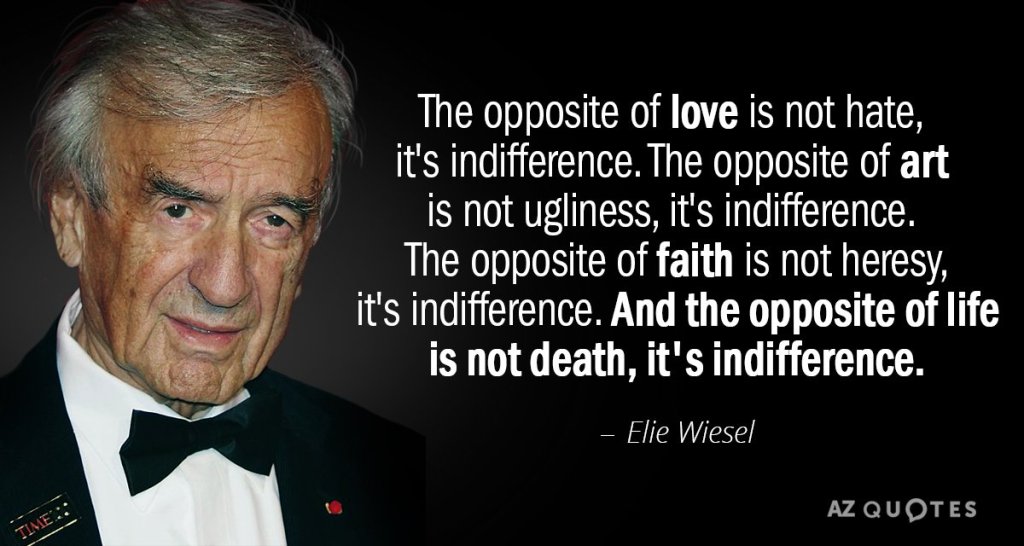
What struck me was how much weight the word indifference carries. It’s such a profound concept when you think about it. Philosophers like Elie Wiesel have said that indifference, not hatred, is the true opposite of love. Love and hate, after all, are both fiery, emotional investments; they require energy, passion, and focus. But indifference? That’s the absence of all of that. It’s an emotional void, a refusal to care.

We talked about how indifference can be more painful than outright hate. At least with hate, you know you’re being seen, felt, acknowledged in some way. Indifference, on the other hand, feels like being erased, like you don’t matter enough to warrant any reaction at all. In relationships, it can create this deep loneliness; a silent, aching space where love or even conflict should be.

But then we got into the darker side of indifference, how it can also be wielded as a kind of weapon. It’s not always passive, you know? Sometimes it’s deliberate, a way to assert control or punish without saying a word. We’ve all seen or felt it in some form: the cold shoulder, the ignored text, the subtle withholding of care or acknowledgment. Those silences and omissions can be sharper than words.

We explored a few examples, like in romantic relationships, when one partner uses indifference to send a cruel, unspoken message: “You don’t matter.” Or in workplaces, where a boss might undermine someone by pretending their contributions don’t exist. That kind of calculated indifference is devastating because it’s so insidious. It leaves the other person questioning their worth.

What’s tricky is that indifference isn’t always malicious. It can be a survival mechanism too, right? Sometimes, detaching and withdrawing emotionally is a way to protect ourselves from toxic dynamics or emotional exhaustion. The question is whether indifference is being used as self-preservation or as a means to harm or manipulate someone else.

Honestly, the more we talked about it, the more I realized how thin the line is between healthy detachment and destructive indifference. I think perhaps that intention is everything, whether it’s about creating space for yourself or shutting someone out entirely.

The whole conversation left me reflecting on my own tendencies and how I’ve used or experienced indifference in my life. It’s a lot to sit with, but also something I feel like I need to understand better.

What do you think? Have you ever found yourself wrestling with indifference, either as a tool or as something you’ve been on the receiving end of? 

Replacing Canada’s Aging Submarine Fleet

Canada is currently debating whether to invest in a new fleet of submarines to replace its aging Victoria-class vessels, which were purchased second-hand from the United Kingdom in the 1990s. These submarines, while functional, are nearing the end of their service life and face increasing maintenance challenges.

With Canada’s Arctic becoming more geopolitically significant due to climate change, which is opening new shipping lanes and increasing resource exploration; submarines capable of operating under ice are crucial for maintaining sovereignty in this region. Without them, Canada risks falling behind nations like Russia and the United States, which have invested heavily in Arctic-capable fleets.

Modern submarines, such as those with Air Independent Propulsion (AIP) or nuclear capabilities, offer enhanced endurance, stealth, and operational flexibility compared to the diesel-electric Victoria-class. Investing in these technologies would modernize Canada’s navy and ensure operational relevance.

The German Type 212CD (Common Design) submarine, developed by ThyssenKrupp Marine Systems, represents a modern and highly capable class of diesel-electric submarines with Air Independent Propulsion (AIP). These submarines are designed for stealth, endurance, and multi-role capabilities, and as a NATO platform, the Type 212CD would seamlessly integrate with allied operations, thus strengthening Canada’s contributions to NATO’s underwater defense network. Germany has a proven track record of delivering submarines on time and within budget. Partnering with an experienced supplier like ThyssenKrupp could help Canada avoid some of the delays and cost overruns seen in its previous defense procurement projects.

The operational performance of the Type 212CD remains speculative until it enters service. However, the proven track record of the Type 212A, combined with the extensive research and development efforts behind the CD variant, suggests it will be a reliable and capable platform for NATO-aligned navies.

With Canada’s “Sea to Sea to Sea” responsibilities, they really need a fleet of nine boats (operations, training, maintenance), but I think they would likely procure six over a decade timeframe. Ultimately, the decision will hinge on Canada’s strategic priorities, financial constraints, and Arctic sovereignty goals. If Canada prioritizes cost-efficiency and rapid acquisition, the Type 212CD could emerge as a leading choice, provided it meets specific Arctic and endurance requirements. 

Dies Natalis Solis Invicti

December 25th, the Dies Natalis Solis Invicti or “Birthday of the Unconquered Sun,” has long been associated with cosmic renewal and light’s triumph over darkness, aligning with the winter solstice. Its significance may stretch back to ancient Persia and found deep resonance in Roman religion, particularly within the mystery cult of Mithras.

Mithraism flourished in the shadowy corners of Roman society, appealing to soldiers, merchants, and officials. Mithras, a god of light and justice, was central to a complex mythology that emphasized cosmic order and renewal. His worship featured the tauroctony, a scene depicting Mithras slaying a sacred bull in a cave, from whose blood life and fertility emerged. This act symbolized victory over chaos and the cycles of life and death, themes reinforced by Mithras’ divine “rock birth” (Petra Genetrix), which emphasized his eternal and unshakable essence.

Mithras’ bond with Sol Invictus, the Roman solar deity, was central to his worship. Together, they were shown feasting after the bull’s defeat, celebrating cosmic renewal and the return of light. This connection tied Mithras to the December 25th celebration, when the days began to grow longer, signifying hope and rebirth for his followers. Worship took place in cave-like Mithraea, where initiates advanced through seven secretive ranks, fostering bonds of loyalty and discipline, particularly among Roman soldiers.

Christianity rose alongside Mithraism, drawing parallels with Mithras in themes of salvation, sacrifice, and divine light. Jesus Christ, like Mithras, came to symbolize victory over darkness, spiritual rebirth, and eternal life. By aligning Christ’s nativity with December 25th, Christianity absorbed and redefined the pagan imagery of the “unconquered sun,” positioning Jesus as the true “light of the world.” This synthesis appealed to Mithraic followers and others drawn to sun worship, securing Christianity’s dominance within the empire.

Mithras endures as a figure of cosmic mystery, his story largely conveyed through art and ritual. From his rock birth to his symbolic feast, he remains a mediator between worlds, forever linked to humanity’s quest for order and light in the face of darkness.

The Social Media Trap: Jonathan Haidt on the Rise of Incels and Australia’s Bold Move

Jonathan Haidt, social psychologist and author of The Anxious Generation: How the Great Rewiring of Childhood Is Causing an Epidemic of Mental Illness, offers a chilling analysis of how social media reshapes the mental and emotional worlds of young people. Platforms like Instagram, TikTok, and Reddit, he argues, magnify feelings of inadequacy and anger, particularly among young men – a demographic increasingly drawn into the online incel (involuntarily celibate) subculture.

Incels, young men frustrated by their lack of romantic and sexual success, gather in online communities where misogyny and nihilism fester. Haidt’s work reveals how these platforms, designed to amplify polarizing content and encourage tribalism, foster a collective victim mentality. Incel forums, he notes, validate resentment, fueling a toxic cycle of blame and self-pity. Over time, the isolation bred by these echo chambers solidifies their radical ideologies, creating fertile ground for dangerous movements like the nihilistic “black-pill” philosophy.

Haidt also points to evolutionary psychology to explain how social media taps into young men’s instincts for competition and conquest. Platforms flood users with hyper-sexualized imagery, gaming rewards, and curated lifestyles, creating a distorted reality that leaves many feeling perpetually inadequate. For incels, these digital illusions exacerbate bitterness, reinforcing their belief that modern dating is “rigged” against them.

Social media’s most insidious effect, Haidt warns, is its relentless culture of comparison. The curated lives of influencers amplify feelings of inadequacy, particularly for those already struggling with self-esteem. This, coupled with social media’s replacement of real-world interactions, deepens isolation and accelerates mental health crises. Haidt describes social media as a “magnifier of human vulnerability,” preying on insecurities and rewarding divisive behavior. For some incels, this descent into despair has culminated in acts of violence, with several high-profile attacks linked to individuals immersed in these toxic communities.

In response to the growing mental health crisis among youth, Australia has taken a bold step: banning social media for individuals under 16. Scheduled to take effect in 2025, the law imposes strict age verification requirements on tech companies, with fines reaching A$49.9 million for violations. Though challenges remain – such as the potential misuse of software to bypass restrictions – Australia’s move signals a growing global recognition of the harm social media inflicts on adolescents.

Haidt’s research underscores the urgency of such reforms. Early and unregulated exposure to social media, he argues, exacerbates anxiety, depression, and social isolation, leaving young people vulnerable to radical ideologies and diminished well-being. Australia’s legislation reflects an attempt to push tech companies toward greater accountability and promote a healthier digital landscape for children.

The rise of the incel phenomenon is not just about misogyny or radicalization; it’s a window into a generation’s broader struggle for connection and purpose in the age of social media. Haidt warns that without systemic change – such as fostering healthier masculinity, reducing online polarization, and regulating tech platforms – society risks losing a generation to the algorithms of despair. Australia’s bold experiment may well serve as a blueprint for addressing these deep-seated issues on a global scale.

The Next James Bond Adventure

With no indication as to when the next James Bond film will arrive, as Amazon Prime Video, the new owners of the intellectual property, continue to bicker with the franchise producer Barbara Broccoli, I figured I’d take a shot at writing the next chapter myself. And honestly, any similarity to real world people is purely coincidental. 

Title: Bond 26 – Selene Ascending 

Outline:
Set in the year 2030, the world is at the dawn of interplanetary expansion, led by tech tycoons who promise a new golden age. Among them is Elias Mercer (E.M.), a magnetic and controversial white Zimbabwean billionaire who has made Erebus Industries the leader in space exploration. While the world sees him as a visionary, Mercer harbors an audacious and dangerous plan: to control humanity’s future in space, starting with the Moon, Mars, and the wealth of the asteroid belt.

James Bond, a rugged, black, 30-something ex-Special Forces operative from a northern working-class English background, (think the Napoleonic character Richard Sharp in a tux), is recruited by MI6 for his unorthodox skills and adaptability. Bond’s charm, wit, and no-nonsense demeanor make him a refreshing and formidable 00 agent.

Act 1: A New Frontier
The film begins with Bond infiltrating a high-tech heist at a cutting-edge mining facility in Cornwall, England, where Erebus Industries agents steal classified plans for a new propulsion technology. Bond manages to retrieve part of the data, revealing that Mercer’s true target is Asteroid 16 Psyche, a metallic asteroid worth trillions of dollars in rare metals. Capturing it would make Mercer unimaginably rich and provide the raw materials to revolutionize space-based manufacturing, giving him complete dominance over off-world technology.

MI6 assigns Bond to investigate Mercer, whose Selene Station, an orbital base around the Moon, is central to his plans. Selene serves as a launch post for Mars missions and the construction site for massive interplanetary spacecraft.

Bond travels to Cairo, Egypt, to meet Dr. Yasmine Naim, a brilliant Egyptian astrophysicist who once worked on Mercer’s asteroid capture project, but left due to his ruthless methods. Yasmine, fiercely intelligent and driven, is initially reluctant to help, fearing Mercer’s reach and influence. Bond’s grit and sincerity earn her trust, and she provides vital intel: Mercer plans to use Selene Station to help reroute 16 Psyche’s orbit into lunar proximity, where he can mine it directly.

Act 2: The High-Stakes Chase
Bond and Yasmine travel to a secret Erebus facility in Tanzania, where Mercer’s team is developing the technology needed to capture and redirect 16 Psyche. In a high-octane sequence, Bond disrupts a test of the asteroid’s propulsion system, escaping with evidence that Mercer’s operation risks catastrophic orbital instability for Earth and the Moon.

As they evade Mercer’s relentless enforcers, Yasmine explains the stakes: capturing 16 Psyche could lead to breakthroughs in space-based manufacturing, such as constructing spacecraft in zero gravity, shielding from deadly solar radiation, and limitless clean energy. However, Mercer’s monopolization of such resources would give him the power to dictate humanity’s entire future in space.

The duo infiltrates Selene Station, smuggling aboard one of Mercer’s supply rockets. The station is a marvel of engineering, with enormous Mars-bound spacecraft under construction and a control hub for 16 Psyche’s propulsion.

Act 3: Battle for the Stars
On Selene Station, Bond and Yasmine uncover Mercer’s endgame: to redirect 16 Psyche into lunar orbit and use its wealth to cement his control over the space economy. However, the asteroid’s trajectory risks destabilizing the Moon’s orbit, triggering devastating tidal effects on Earth.

In a tense showdown, Bond and Yasmine sabotage Selene’s guidance systems. Bond engages Mercer in a brutal zero-gravity fight within the station’s command module. Mercer, armed with a powered exosuit designed for lunar construction, proves a formidable opponent, but Bond’s tactical ingenuity prevails.

Meanwhile, Yasmine uses her expertise to override the station’s systems, sending 16 Psyche back into its original orbit. However, Mercer initiates a self-destruct protocol, planning to take Bond, Yasmine, and hundreds of workers with him. In a desperate race against time, Bond and Yasmine escape in a lunar shuttle, watching as Selene Station is consumed in a fiery explosion.

Epilogue
Back on Earth, Mercer’s empire collapses as his plans are exposed. Bond and Yasmine part ways, her returning to her research, inspired to use her knowledge for the betterment of humanity. Bond returns to MI6, his northern grit and sharp wit ready for whatever challenge lies ahead.

The final scene shows Bond standing on a windswept moor in northern England, a man of Earth prepared to defend it, even among the stars.

We Need to Update the Ontario Cider Regulations

I thoroughly enjoy a good glass of cider, and while I am open to exploring the unknown, I do prefer to imbibe drier beverages, yet I have learned that marketing labels do nothing to differentiate these alcoholic products. The word ‘Dry’ on a can of cider is currently meaningless in Ontario, and the amber liquid contained within can have any amount of sweetness. 

Ontario’s cider industry has seen significant growth in recent years, reflecting an increasing interest among consumers. By 2030, the Ontario Craft Cider Association (OCCA) aims to increase production from the current 6 million to 30 million liters annually, with a projected economic impact of $115 million and the creation of 1,720 jobs. As more Ontarians turn to craft cider, consumers are pushing for greater transparency on what’s inside their favorite cans.

By mandating the inclusion of grams per liter (g/l) sugar content on cider labels, consumers gain valuable insights into the flavor profiles of different ciders. This information allows individuals to select beverages that align with their taste preferences, whether they prefer a drier, more tart cider or one with a sweeter, fruitier profile. Wine sold in Ontario already includes sugar content in the g/l format so with this precedent, all we need is an update to the current provincial labeling regulations. 

Promoting product transparency, while supporting branding efforts, sugar content labeling contributes to the continued growth and diversification of Ontario’s vibrant cider industry.

Sources.
https://thegrower.org/news/ontario-craft-cider-industry-looks-bright-future

Is Ford Coming for Poilievre? 

The idea that Ontario Premier Doug Ford may be positioning himself as a future contender for the leadership of the federal Conservative Party – and ultimately the role of Prime Minister – is worth serious consideration, especially given Ford’s political trajectory and unique approach to conservatism.

Ford’s Political Ambition
Doug Ford has consistently demonstrated a knack for navigating and surviving in the political spotlight. As Premier of Ontario, Ford has carefully cultivated a “common man” image, appealing to a broad swath of voters, including blue-collar workers and suburban families – key demographics for any federal election. His brand of conservatism is less ideologically rigid than Pierre Poilievre’s; Ford focuses on pragmatism and populist messaging, which could make him a strong contender in federal politics.

While Ford has repeatedly stated he is focused on Ontario, his actions suggest he is not averse to expanding his influence. His willingness to work with Prime Minister Justin Trudeau on infrastructure projects and economic initiatives may be positioning him as a centrist alternative to Poilievre’s more hardline, ideological approach. This strategy could help Ford appeal to swing voters in urban areas and ridings that Poilievre might struggle to win.

Tensions with Poilievre
Ford and Poilievre’s relationship has been notably distant. Ford has avoided openly endorsing Poilievre or closely aligning with him, even during the latter’s rise to federal Conservative leadership. This distance hints at a potential rivalry, or at the very least, an unwillingness to be overshadowed by Poilievre on the national stage.

Poilievre’s leadership style, which leans heavily on ideological conservatism and combative rhetoric, may alienate moderate voters – a gap Ford could exploit. Ford’s track record of winning elections in a diverse province like Ontario demonstrates his ability to bridge divides and appeal to a broader electorate, including centrists who might find Poilievre’s approach too polarizing.

Ontario, the Powerhouse of Canadian Politics 
Historically, Ontarians have shown a preference for balancing power between provincial and federal governments, often avoiding having the same political party in charge at both levels. This dynamic could spell trouble for Doug Ford if Pierre Poilievre’s federal Conservatives win the next election. A federal Conservative victory might shift Ontario voters toward the provincial Liberals or NDP in an effort to counterbalance federal policies, particularly if there is dissatisfaction with Conservative governance nationally. Ford’s political calculus must account for this trend, as maintaining his grip on Ontario could become significantly more challenging with a Conservative government in Ottawa. This precarious balance might also incentivize Ford to consider a move to federal politics, especially if he perceives his provincial support waning.

While Ford has not explicitly declared any federal ambitions, the possibility that he could eventually seek Pierre Poilievre’s job cannot be dismissed. His pragmatic approach to conservatism, ability to appeal to diverse voters, and political survival instincts make him a viable alternative for a party looking to broaden its appeal. Whether by design or by opportunity, Ford may very well see himself as Canada’s next Conservative Prime Minister-in-waiting.

Trump’s Transparent Bullying Tactics hold Real Menace  

Donald Trump’s suggestion that Canada could become the 51st state not only reveals a lack of understanding of Canadian sovereignty and identity, but also exposes a broader motivation; the United States’ desire to access Canada’s vast natural resources. Canada is rich in essential resources like fresh water, minerals, oil, and lumber, all of which are increasingly valuable as global demand rises and environmental pressures grow.

Fresh water, in particular, has become a critical resource as many U.S. states face drought and water scarcity. Canada holds about 20% of the world’s freshwater supply, making it an attractive target for U.S. interests. Similarly, Canada’s mineral wealth, including critical minerals like nickel, lithium, and cobalt used in renewable energy technologies, is vital for the U.S. as it seeks to secure supply chains for its green economy. Lumber from Canada’s vast forests has also long been a point of contention, with ongoing trade disputes reflecting the U.S.’s reliance on Canadian wood for construction and manufacturing.

Trump’s suggestion disregards over 150 years of Canadian self-governance, and the deep cultural and political differences between the two nations. Canadians take immense pride in their independence, multicultural heritage, and distinct political system, which are starkly different from those of the U.S. Such remarks alienate an important ally, ignore history and diplomacy, and trivialize the unique relationship between the two countries.

Ultimately, this kind of rhetoric attempts to undermine Canada’s sovereignty, and risks being perceived as a veiled attempt to exploit its natural wealth, rather than as a serious or respectful political proposition. It underscores a broader need for Canada to remain vigilant in safeguarding its resources and asserting its independence on the global stage.