Unknown's avatar

About Chris McBean

Strategist, polyamorist, ergodox, permaculture & agroforestry hobbyist, craft ale & cider enthusiast, white settler in Canada of British descent; a wanderer who isn’t lost.

🗓️ Five Things We Learned This Week

Week of December 27, 2025 – January 2, 2026

Even in the quiet stretch between Christmas and New Year’s, the world did not pause. Across science, politics, climate, conservation, and global systems, this past week offered reminders that change continues — sometimes quietly, sometimes decisively.


✈️ India’s Air Travel Crisis Revealed Systemic Fragility

In the days following Christmas, India’s largest airline faced widespread cancellations and delays after stricter pilot fatigue rules collided with already stretched staffing. By December 30, operations had stabilized, but only after tens of thousands of passengers were affected.

Why it matters: The disruption exposed how regulatory enforcement, labor shortages, and tight scheduling can cascade into national-scale failures — a warning for aviation systems worldwide.


🌍 The United Nations Expanded Climate Adaptation Financing

On December 29, the UN announced a significant expansion of its climate adaptation finance framework, directing additional concessional funding toward countries already experiencing severe climate impacts.

Why it matters: While mitigation often dominates headlines, adaptation funding is where climate policy becomes tangible for vulnerable communities facing floods, drought, and displacement.


🐘 Kenya Reported Its Lowest Elephant Poaching Levels in Decades

Kenyan wildlife authorities confirmed on December 28 that elephant poaching has dropped to historic lows, crediting community-based conservation programs, improved ranger coordination, and aerial surveillance.

Why it matters: This rare conservation success shows that sustained investment, local engagement, and enforcement can reverse even long-running environmental crises.


⚖️ The U.S. Supreme Court Halted a Major Immigration Enforcement Rule

On December 30, the U.S. Supreme Court temporarily blocked the rollout of a new federal immigration enforcement policy, pending further legal review.

Why it matters: The decision reinforces judicial limits on executive power and reshapes the near-term landscape for immigration enforcement, labor policy, and civil rights debates.


🔭 The James Webb Telescope Detected Water Vapor on a Rocky Exoplanet

NASA scientists confirmed between December 31 and January 1 that Webb telescope data shows strong evidence of water vapor in the atmosphere of TRAPPIST-1e, one of the most promising Earth-like exoplanets identified so far.

Why it matters: This finding strengthens the case for studying potentially habitable worlds beyond our solar system and marks another leap forward in observational astronomy.


Closing thoughts: From airline systems and courtrooms to savannas and distant star systems, this week’s stories remind us that progress, risk, and discovery do not respect holiday calendars. Paying attention — even during the quiet weeks — remains an act of civic and intellectual care.

Arctic Gateways: Why Greenland Matters More Than Maps Suggest

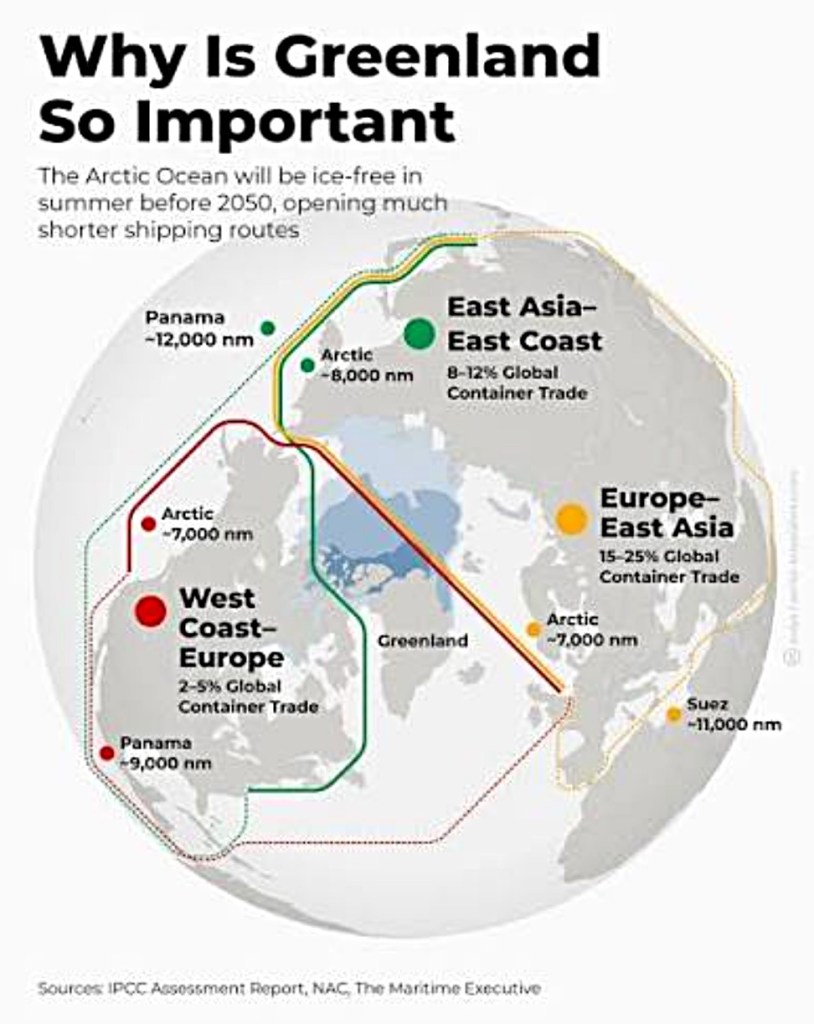
There is a deceptively simple geographic fact that sits quietly beneath much of the current Arctic maneuvering. In the entire Arctic region, there is effectively only one deep-water port that remains reliably ice-free year-round without the benefit of icebreakers, and that port is Nuuk, Greenland. This is not a trivia point. It is a structural constraint that shapes strategy, logistics, and power projection across the high north.

Nuuk’s status is the product of oceanography rather than politics. The West Greenland Current carries relatively warm Atlantic water northward along Greenland’s western coast, keeping the approaches to Nuuk navigable even through winter. By contrast, most other Arctic ports, including those in northern Canada, are either seasonally accessible or require sustained icebreaking support. Russia is often cited as an exception, but ports like Murmansk rely heavily on infrastructure, icebreaker fleets, and state subsidy to maintain year-round access. Nuuk stands apart in that its ice-free condition is natural, persistent, and proximate to the North Atlantic.

From a United States perspective, this matters enormously. American interest in Greenland is not primarily about territory in the nineteenth-century sense. It is about access, logistics, and denial. An ice-free port in the Arctic functions as a fixed node in what is otherwise a hostile operating environment. It enables sustained naval presence, resupply, maintenance, and potentially dual-use civilian and military shipping without the constant friction of ice conditions. In a future where Arctic sea lanes become more commercially viable and militarily contested, control or influence over such a node is strategically priceless.

This helps explain why U.S. engagement with Greenland has intensified well beyond rhetoric. Investments in airports, telecommunications, scientific infrastructure, and diplomatic presence all serve a dual purpose. They embed American interests into Greenland’s development trajectory while ensuring that any future expansion of Arctic activity occurs within a framework friendly to U.S. security priorities. The infamous proposal to “buy” Greenland was widely mocked, but it reflected a blunt articulation of a real strategic anxiety: the United States does not want its primary Arctic foothold to drift politically or economically toward rivals.

Canada’s position is more complex and, in some ways, more constrained. Canada has the longest Arctic coastline of any nation, yet no equivalent year-round ice-free deep-water port in its Arctic territory. This creates a persistent asymmetry. Canadian sovereignty claims rest on presence, governance, and stewardship rather than on continuous maritime access. The North is Canadian not because it is heavily used, but because it is administered, inhabited, and regulated.

As a result, Canada’s northern strategy cannot simply mirror that of the United States. Where Washington focuses on access and power projection, Ottawa must focus on resilience, legitimacy, and long-term habitation. Investments in northern communities, Indigenous governance, search and rescue, environmental monitoring, and seasonal port infrastructure are not secondary to sovereignty. They are sovereignty. Canada’s emphasis on the Northwest Passage as internal waters is inseparable from its need to demonstrate effective control without relying on year-round commercial shipping.

At the same time, the existence of Nuuk as the only naturally ice-free Arctic port creates both a vulnerability and an opportunity for Canada. The vulnerability lies in over-reliance on allied infrastructure. In any future crisis or competition scenario, Canadian Arctic operations would almost certainly depend on U.S. logistics routed through Greenland. The opportunity lies in cooperation. Joint development of northern capabilities, shared situational awareness, and integrated Arctic planning allow Canada to compensate for geographic disadvantages without surrendering policy autonomy.

What this ultimately reveals is that the Arctic is not opening evenly. It is opening selectively, along corridors dictated by currents, ice dynamics, and climate variability. Nuuk sits at the intersection of those forces. It is a reminder that geography still matters, even in an age of satellites and cyber power. For the United States, Greenland is a keystone. For Canada, it is a neighbor whose strategic weight must be acknowledged, managed, and integrated into a broader vision of a stable, governed, and genuinely Canadian North.

In that sense, the conversation about ice-free ports is not really about shipping. It is about who gets to shape the rules of the Arctic as it transitions from a frozen margin to a contested frontier.

Why Canada Should Make Voting Compulsory: Lessons from Australia

Canada prides itself on being a democratic nation, yet voter turnout tells a different story. In the 2021 federal election, just over 62% of eligible Canadians cast a ballot. Compare that with Australia, where voting has been mandatory since 1924, and turnout regularly exceeds 90%. The contrast is striking, and instructive. If Canada is truly committed to representative democracy, it should make voting compulsory.

Australia’s experience shows how dramatically voting laws can reshape political engagement. When the country introduced compulsory voting in 1924, turnout jumped from under 60% to over 91% in just one election. This wasn’t just a statistical change; it was a transformation of civic culture. Elections became more representative, and policy debates began to reflect a broader range of voter concerns. In Australia, “a parliament elected by a compulsory vote more accurately reflects the will of the electorate,” notes the Australian Election Commission. Canada could reap the same benefits.

One of the most compelling arguments for compulsory voting is the way it strengthens democratic legitimacy. When turnout is low, election results can be skewed by the interests of a narrow, often more affluent and ideologically extreme segment of the population. This leads to policies that favour the vocal few rather than the silent majority. By contrast, when everyone must vote, politicians must listen to everyone, including the marginalized and the poor. As historian Judith Brett puts it, “Now that means that politicians, when they’re touting for votes, know that all of the groups, including the poor, are going to have a vote. And I think that makes for a more egalitarian public policy.”

Critics argue that compulsory voting infringes on personal freedom. But Australians have lived with the system for a century, and public support for it remains strong, hovering around 70% since 1967. In fact, in 2022, 77% of Australians said they would still vote even if it weren’t mandatory. This suggests that making voting compulsory doesn’t stifle freedom; it cultivates civic responsibility.

Furthermore, compulsory voting could help counter political polarization in Canada. In voluntary systems, political parties often cater to their most radical base to energize turnout. But in Australia, where turnout is nearly universal, parties are forced to appeal to the political centre. This moderating influence is desperately needed in Canada’s increasingly divided political landscape.

Canada’s current voter turnout rates are simply not good enough. A democracy where one-third of citizens routinely sit out elections is a democracy with a legitimacy problem. If we want politics that are more representative, inclusive, and moderate, then it’s time to follow Australia’s lead. Voting is not just a right, it’s a duty. And like jury service or paying taxes, it should be expected of every citizen.

Source:
• BBC News (2022). “Why Australia makes voting mandatory.” https://www.bbc.com/news/world-australia-61505771
• Australian Electoral Commission. “Compulsory voting.” https://www.aec.gov.au/Voting/Compulsory_Voting/
• Elections Canada (2021). Voter Turnout. https://www.elections.ca/content.aspx?section=ele&dir=turn&document=index&lang=e

Ottawa at 25: The Amalgamation That Never Delivered

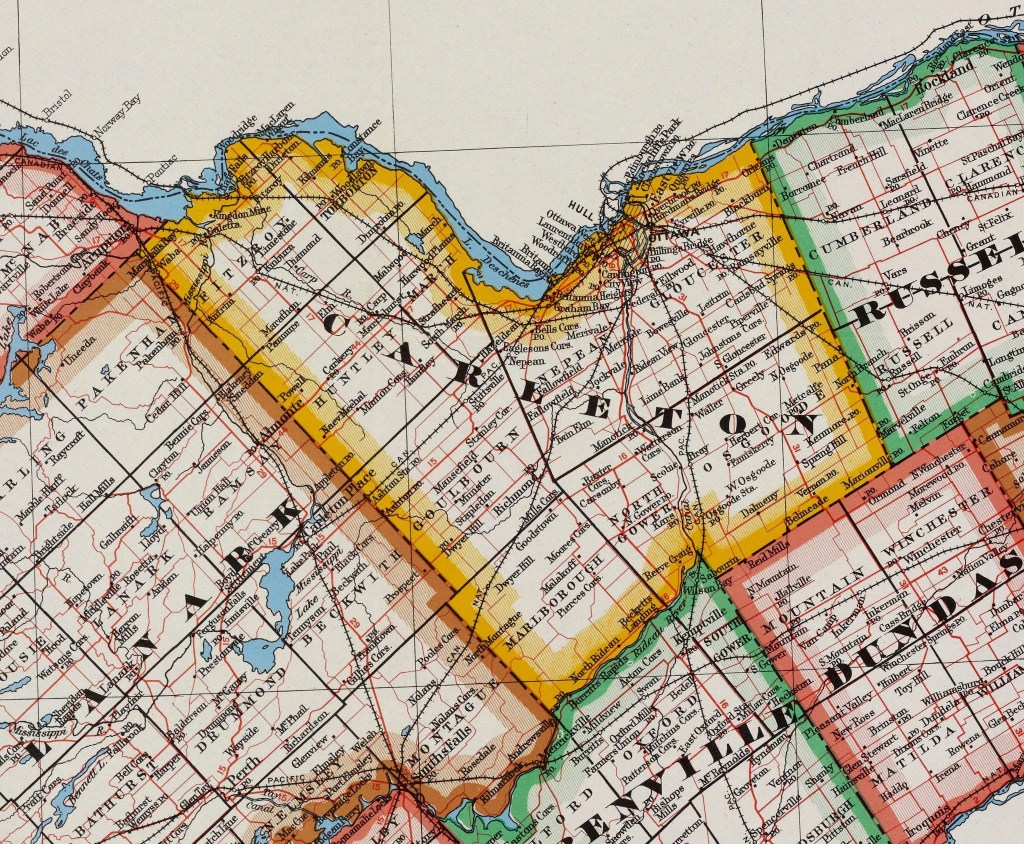
As Ottawa approaches the 25th anniversary of amalgamation this January, the moment invites a frank assessment. In 2001 the provincial government promised that merging 13 municipalities into a single-tier City of Ottawa would streamline governance, cut waste, improve services and stabilize taxes. Amalgamation was sold as modern, efficient and inevitable, a rational response to the untidy patchwork of local governments that once defined the region.

Two and a half decades later the record is far more complicated. Some benefits were real. Many others were aspirational. And for large portions of the city, especially rural and semi-rural communities, amalgamation has been a system that works to them, not for them. Bigger, it turns out, was not better.

The Promise of Better Services – The Reality of Uneven Delivery
The early pitch for amalgamation was simple: unify services and everyone wins. In practice, the outcome has been uneven across geography and income.

Urban residents gained the most. They saw expanded recreation programming, new library access and coordinated planning. Rural areas, by contrast, experienced reduced responsiveness in road maintenance, snow clearing, bylaw enforcement and transit. Communities like West Carleton, Rideau-Goulbourn and Osgoode have spent two decades reminding City Hall that “one size fits all” is not a service model; it is a compromise imposed on communities with profoundly different needs.

The city’s signature public-transit investment – the O-Train LRT system – was supposed to embody the advantages of centralization. Instead it has become a case study in the limits of mega-city governance: severe construction delays, cost overruns, and a nationally publicized public inquiry detailing systemic failures in oversight, transparency and project management. The LRT problems are not merely technical. They illustrate the deeper strain of running a sprawling municipality where accountability is diffused across layers of bureaucracy rather than rooted in local leadership.

The Financial Question: Where Were the Savings?
The financial rationale for amalgamation rested on scale. A bigger city would deliver efficiencies; efficiencies would reduce costs; reduced costs would protect taxpayers.

This never materialized.

Transition costs reached an estimated $189 million. Savings projections were optimistic, not guaranteed. The Transition Board did not promise tax cuts, and indeed taxes did not fall. In many rural and suburban areas they increased sharply, partly due to uniform tax policies that replaced diverse local rates.

Cost pressures accumulated in other ways:
• The city’s share of funding for provincial property-assessment operations has outpaced inflation every year since amalgamation.
• Capital projects, particularly transit, have grown more expensive while their benefits remain unevenly distributed.
• Ottawa now faces an annual transit operating shortfall approaching $140 million, straining a tax base already stretched by road, infrastructure and policing costs.

The efficiencies that were supposed to stabilize municipal finances largely failed to appear. In their place came the financial stresses of a city whose physical footprint rivals Toronto’s but without the provincial funding model Toronto enjoys.

Lost Local Control – And Lost Trust
Perhaps the most significant cost of amalgamation has been the erosion of local governance. Prior to 2001 communities had councils attuned to their unique needs and accountable to residents they lived beside. Today many rural and semi-rural residents feel politically peripheral; listened to, but not heard.

Ward representation cannot replicate local councils. Nor can city-wide policies reflect the distinct rhythms of a village like Manotick, the agricultural economy of Osgoode, or the infrastructure realities of West Carleton. The result has been a steady accumulation of resentment: a sense that rural areas subsidize urban priorities while their own needs remain secondary.

The weakening of local identity has democratic implications. Decision-making concentrated at the centre becomes less transparent, less responsive and harder for residents to influence. The LRT inquiry offered a stark reminder of what can happen when oversight drifts too far from citizens and too far from the specific communities most affected.

A Quarter Century Later: What Has Ottawa Gained – And What Has It Lost?
It would be simplistic to call Ottawa’s amalgamation a failure. Some benefits are undeniable: unified planning, expanded programming, strengthened economic-development strategies and early years of reasonably controlled citywide spending.

But at a structural level, amalgamation has not delivered its central promises. Taxes did not fall. Services did not equalize. Financial pressures did not ease. The governance system is more centralized but not more accountable. And the diversity of Ottawa’s communities – rural, suburban and urban – often exceeds the capacity of a single administrative structure to manage well.

The lesson is not that amalgamation should be reversed. The lesson is that centralized government must be paired with robust local power, transparent decision-making and an honest recognition that “efficiency” cannot override community identity or regional diversity.

As the 25-year mark approaches, Ottawa has an opportunity to look clearly at what was promised, what was delivered and what must change to make this city work fairly for everyone. Amalgamation may be permanent, but its shortcomings do not have to be.

Sources: 
en.wikipedia.org
todayinottawashistory.wordpress.com
app06.ottawa.ca (Rural Affairs Committee reports)
ottawa.ca (Long-Range Financial Plan II and III)
spcottawa.on.ca (WOCRC rural community report)
imfg.org (Single-tier municipal governance studies)
globalnews.ca (Ottawa LRT Public Inquiry)
ottawa.citynews.ca (Transit financial shortfall)
obj.ca (De-amalgamation commentary)

Food Security Is Canada’s Next National Imperative

Canada has long built its agri-food reputation on food safety and quality. Rigorous inspection systems, traceability protocols, and high sanitation standards have made Canadian products trusted both domestically and on the global market. But while these strengths remain critical, they are no longer sufficient. In an era of accelerating climate disruption, geopolitical instability, supply chain fragility, and rising inequality, Canada must now turn its focus to food security – the guarantee that all people, at all times, have reliable access to enough affordable, nutritious food.

Food safety ensures that the food we consume is free from contamination. Food quality ensures it meets certain standards of freshness, nutrition, and presentation. These are the cornerstones of consumer trust. Yet, neither concept addresses the structural risks facing our food system today. Food security asks a different set of questions: Can Canadian households afford the food they need? Can our food system withstand climate shocks, trade disputes, and infrastructure breakdowns? Are our supply chains inclusive, decentralized, and flexible enough to adapt to major disruptions?

Recent events have underscored the fragility of our current system. During the COVID-19 pandemic, disruptions to cross-border trucking and meat processing plants exposed just how centralized and brittle key segments of Canada’s food supply have become. In British Columbia, floods in 2021 cut off rail and road access to Vancouver, leading to supermarket shortages within days. In the North and many Indigenous communities, chronic underinvestment has made access to affordable, fresh food unreliable at the best of times, and catastrophic during crises.

Moreover, food insecurity is rising, not falling. In 2023, over 18 percent of Canadian households reported some level of food insecurity, with that number climbing higher among single mothers, racialized Canadians, and people on fixed incomes. Food banks, once seen as emergency stopgaps, are now regular institutions in Canadian life. This is not a failure of food safety or quality. It is a failure of access and equity – core dimensions of food security.

Part of the problem lies in how Canada conceptualizes its agri-food system. At the federal level, agriculture is still often framed as an export sector rather than a foundational pillar of domestic well-being. Policy is shaped by trade metrics, not food sovereignty. We excel at producing wheat, pork, and canola for overseas markets, but remain heavily reliant on imports for fruits, vegetables, and processed goods. Controlled-environment agriculture remains underdeveloped in most provinces, leaving the country vulnerable to droughts, supply chain blockages, and foreign policy flare-ups.

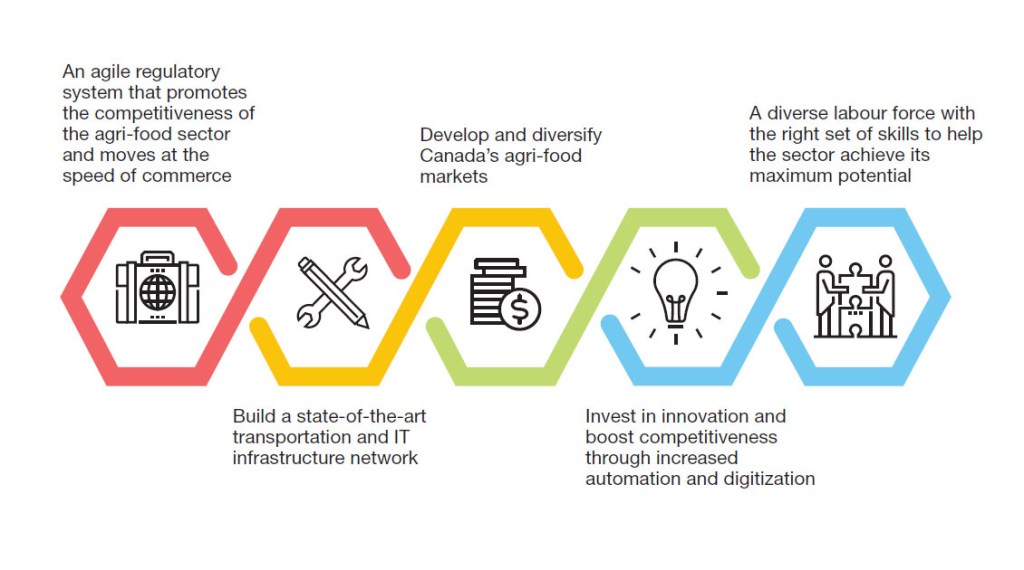
To move toward food security, Canada must first reframe its priorities. This means investing in local and regional food systems that shorten supply chains and embed resilience close to where people live. It means modernizing food infrastructure: cold storage, processing capacity, and distribution networks, particularly in underserved rural and northern communities. It means supporting small and medium-scale producers who can provide diversified, adaptive supply within regional ecosystems. It also means integrating food policy with social policy. Income supports, housing, health, and food access are intertwined. Any serious food security strategy must address affordability alongside production.

Several provinces have begun to lead. Quebec has developed a coordinated framework focused on food autonomy, greenhouse expansion, regional processing, and public education. British Columbia is experimenting with local procurement strategies and urban farming initiatives. But the federal government has not yet articulated a cohesive national food security agenda. The 2019 Food Policy for Canada set out promising goals, but lacked the legislative weight and funding to shift the structure of the system itself.

Now is the time to act. Climate events will increase in frequency and severity. Global trade dynamics are growing more volatile. Technological transformation and consumer expectations are evolving rapidly. A resilient, secure food system cannot be improvised in moments of crisis. It must be designed, invested in, and governed intentionally.

Canada’s record on food safety and quality is a strength to build on. But it is not enough. Food security is the challenge of this decade. Meeting it will require a new policy imagination, one that centres equity, redundancy, and sustainability as the foundations of a food system truly built to serve all Canadians.

On Grown Men and Their Troubling Aversion to Female Heroes

Welcome to the 21st century, where on one hand we have space travel, near-instant communication across the globe, and AI that can write essays about gladiators (I think, based on context). On the other hand, there exists an astonishing subset of adult human males who loudly complain whenever a TV show or movie gives a sword, a spotlight, or even a gladiator’s loincloth to a woman. Yes women leading stories – how utterly terrifying.

Let’s be clear: The House of Ashur is thriving with critics praising its storytelling and performances. Yet its fan numbers are being dragged down by vote-bombing campaigns from folks who apparently believe that Achilla (a fierce female gladiator protagonist) is too much to handle. That reaction isn’t just silly, it’s fish-slapping-ridiculous. These are people who, given a choice between a well-written lead and…..well, literally nothing else, somehow pick nothing elsejust because they don’t want it to be a woman. Really.

You might remember a certain Captain Marvel movie that suffered a similar fate before it was even in theaters. Hundreds of thousands of online ratings were dumped on the film before anyone had seen it, not because the plot was bad, but because the lead was female and some men (yes, mostly male) just couldn’t abide the idea that a woman could be “the big one” for a change. Review bombing became so bad that Rotten Tomatoes had to change their rating rules to stop it.  

Now, it’s easy to laugh – and we should – because the idea of voting against something simply because a woman is at the center is like refusing to eat soup because the spoon is pink. It’s arbitrary. If the story’s good, the gender of the lead doesn’t matter for most people. Ask yourself: would you care if Indiana Jones were a woman if the script were fire? What about James Bond? Samus Aran? Sarah Connor? The answer for most fans is no – those characters are beloved precisely because they’re compelling, not because they fit some old “male lead only” checklist.

When critics sneer at female leads in genre stories, they often don’t realize how absurd it looks from the outside. Complaining that female heroes “ruin” a franchise is like saying new toppings on pizza ruin Italian cuisine. Spoiler alert: there’s pizza with pineapple and it still exists. And it sells! Some people love it, some hate it, and the world keeps spinning.

Part of the “backlash” is rooted in fandom tradition resisting change – a legacy of decades when the default hero was male, yet media evolves. Women commanding the screen is not a threat to masculinity any more than men playing with dolls was a threat to toy sales. And when the backlash is so loud it drowns out the actual audience? That’s not fandom, it’s performance art disguised as insecurity.

Here’s the real kicker: many stories with female protagonists already succeedwithout complaint. Wonder Woman kicked ass at the box office, Xena ruled the ’90s, and modern audiences adore characters like Buffy, Rey, and Furiosa. They weren’t treated like novelty, they were embraced for what they were: interesting heroes with stories worth telling.  

So to the gentlemen (and keyboard gladiators) who can’t stomach a woman front and center: relax. Pop some popcorn, enjoy the spectacle, and if it’s not your cup of tea, fine. But don’t pretend that a female lead is a threat, it’s just a story, not an invasion force. Unless she actually is an invasion force, in which case….. alright, fair. That would be awesome.

In the end, if a story is good, its hero – male, female, gladiator, intergalactic space slug – deserves to be celebrated. Voting against something because of its protagonist’s gender isn’t just outdated, it’s downright comedic. And frankly, Achilla deserves better.

The Ferry That Would Not Settle: Wolfe Island and the Cost of Getting It Wrong

For generations, the Wolfe Island ferry was a quiet, functional piece of public infrastructure. It was not glamorous, and it did not promise innovation. It simply worked often enough that island life could organize itself around its rhythms. That unspoken reliability ended not with a single breakdown, but with a cascade of decisions that treated a critical transportation link as a technology showcase rather than a lifeline.

The roots of the current crisis reach back to the decision to replace the Wolfe Islander III, a vessel launched in 1976 that, despite its age, delivered consistent service. In 2017, the Ontario Ministry of Transportation committed to a new, larger hybrid-electric ferry, the Wolfe Islander IV, built overseas and marketed as a modern, higher-capacity, lower-emissions solution. On paper, it was progress. In practice, it was a project that outran its own ecosystem.

The new vessel arrived in Ontario in 2021, years before the docks, charging infrastructure, and staffing capacity required to operate it were fully in place. This mismatch created an immediate limbo. A ferry designed to function as part of an integrated electric system instead sat idle while shore-side systems lagged behind. Training shortages and labour constraints compounded the delay, turning what should have been a transitional period into a prolonged absence from service.

When the Wolfe Islander IV finally entered full-time operation in August 2024, expectations were high and patience already thin. Those expectations were quickly tested. Within months, the vessel suffered a grounding incident that damaged its hull and propulsion components. What was initially described as minor damage resulted in the ferry being removed from service for an extended period and sent to a Hamilton shipyard for repairs. The older Wolfe Islander III was pressed back into duty, once again carrying the weight of continuity.

The mechanical troubles did not end with that incident. The hybrid-electric design depended on shore-based charging infrastructure that was still incomplete, forcing the vessel to rely heavily on onboard diesel generators. Those generators, never intended for sustained primary operation, became a point of failure. By mid-2025, generator problems again sidelined the ferry. Brief returns to service were followed by further outages, including power system failures that left residents relying on temporary passenger shuttles and improvised arrangements.

These technical failures had predictable human consequences. The Wolfe Islander IV operates on a longer round-trip schedule than its predecessor, reducing the number of daily crossings. For island residents, this change reshaped daily life. Commutes grew longer and less predictable. Medical appointments, school schedules, supply deliveries, and emergency response planning all became more fragile. What had once been an inconvenience during rare outages became a chronic uncertainty.

Concerns around emergency access have been particularly acute. Wolfe Island relies on ferry access for ambulance transport to mainland hospitals. Longer crossing times and unreliable service are not abstract inconveniences in that context. They are measurable risks. Community petitions and advocacy groups emerged not out of nostalgia for the old ferry, but out of a clear understanding that transportation reliability is a public safety issue, not merely a service quality metric.

The deeper problem is not that a new ferry experienced teething issues. Complex infrastructure projects often do. The problem lies in the sequencing of decisions. The vessel was delivered before its supporting systems were ready. Operational assumptions were made about staffing and training capacity that did not hold. A technology-forward design was deployed into an environment that could not yet support it. Each of these choices transferred risk from the project plan onto the community it was meant to serve.

What has unfolded at Wolfe Island is a familiar Canadian infrastructure story. Ambition was not matched by coordination. Procurement timelines were allowed to drift out of alignment with construction and commissioning realities. Accountability became diffuse as responsibility spread across contractors, ministries, and timelines. Meanwhile, residents were left to absorb the consequences of decisions made far from the dock.

The Wolfe Island ferry saga is not primarily about electric propulsion or shipbuilding quality. It is about governance. It is about whether essential public services are designed around the lived realities of the communities that depend on them, or around abstract models of innovation and efficiency. Reliability, once lost, is difficult to regain. Trust follows the same rule.

Until the ferry system is treated first as critical infrastructure and only second as a demonstration project, Wolfe Island will continue to pay the price for a transition that was promised as an improvement and delivered as a disruption. The lesson is not that modernization is a mistake. The lesson is that modernization without readiness is not progress at all.

Sources

U.S. Border Rules: Security Theater at the Expense of the Economy

The United States is poised to implement border-crossing rules that threaten to strangle tourism and business travel under the guise of national security. Under a proposal from U.S. Customs and Border Protection, travelers from Visa Waiver Program countries could soon be required to disclose five years of social media activity, all phone numbers and email addresses used in the past decade, family details, and an array of biometric data including fingerprints, facial scans, iris scans, and potentially DNA. The stated purpose is to prevent threats before travelers set foot on American soil. The practical effect, however, is more likely to be economic self-sabotage than enhanced security.

Officials argue that social media monitoring can identify links to extremist networks and that biometric verification prevents identity fraud. Yet in reality, these measures are deeply flawed. Social media is ambiguous, easily manipulated, and prone to false positives. Connections to flagged accounts are not proof of malicious intent, and online behavior is rarely a reliable predictor of future actions. Biometric data can confirm identity, but it cannot reveal intent, and DNA collection provides little actionable intelligence for border security. What is billed as a comprehensive safety net is, in practice, security theater: a show of vigilance with limited ability to prevent genuine threats.

The economic consequences are far more immediate and measurable. Tourism generates hundreds of billions of dollars annually in the United States, and even modest deterrence can ripple across hotels, restaurants, retail, and transportation. Business travel and conferences may shift overseas to avoid intrusive vetting, while students and skilled professionals may choose alternative destinations for study and employment. The timing is particularly ill-advised: the 2026 FIFA World Cup, expected to bring millions of international visitors, risks diminished attendance and reduced economic activity due to privacy-invading entry requirements.

Beyond lost revenue, the proposal risks damaging the U.S.’s international reputation. Heavy-handed border rules signal that openness and hospitality are subordinate to bureaucratic procedures, potentially discouraging cultural exchange, foreign investment, and global collaboration. In balancing national security and economic vitality, policymakers appear to have prioritized symbolism over substance.

Ultimately, the proposed rules expose a stark imbalance: symbolic security at the expense of tangible economic and diplomatic costs. Public commentary over the next 60 days is the last line of defense against a policy that could chill travel, weaken industries reliant on foreign visitors, and tarnish America’s global image. National security is crucial, but when it comes at the cost of economic self-harm, it ceases to be protection and becomes self-inflicted damage.

🗓️ Five Things We Learned This Week

Week of December 20–26, 2025

Each week, we step back from the churn of daily headlines and look at five developments that help frame what is actually happening in the world. Even in the quiet stretch between holidays, global events continue to unfold across security, economics, climate, and sport.

✈️ 🇺🇸 1. U.S. conducts airstrikes against Islamic State targets in Nigeria

The United States carried out coordinated airstrikes against Islamic State-linked militants in northwest Nigeria on December 25, working alongside Nigerian forces to target insurgent camps. Officials described the operation as part of broader counterterrorism cooperation in West Africa.

Why it matters: The strikes mark a notable escalation of U.S. involvement in regional security efforts and reflect growing concern over extremist expansion in the Sahel and surrounding regions.

⚖️ 📉 2. U.S. stock markets remain resilient through holiday trading

Despite shortened trading weeks around Christmas, U.S. markets remained near record highs between December 24 and 26. Investors continued to focus on artificial intelligence investment, corporate earnings outlooks, and expectations of future interest-rate cuts.

Why it matters: Sustained market confidence during thin holiday trading suggests investors are looking past short-term uncertainty and positioning for longer-term structural growth themes.

🌨️ ❄️ 3. Major winter storm disrupts travel and power across North America

A powerful winter storm swept across eastern Canada and the northeastern United States over Christmas weekend, bringing heavy snow, freezing rain, flight cancellations, and widespread power outages. Several regions declared states of emergency as infrastructure strained under extreme conditions.

Why it matters: Severe winter weather continues to test transportation systems, energy grids, and emergency preparedness, reinforcing concerns about infrastructure resilience in a changing climate.

🏆 🏅 4. Women’s Handball World Championship concludes in Europe

The 2025 Women’s Handball World Championship wrapped up during the holiday week, following weeks of competition hosted jointly by Germany and the Netherlands. Thirty-two national teams participated, drawing growing international attention to the sport.

Why it matters: The tournament highlights the continued rise of women’s international sport and the expanding audience for competitions beyond the traditional global sports calendar.

🏟️ 🎯 5. World Darts Championship advances through holiday rounds

The 2025–26 World Darts Championship continued through its early rounds between December 20 and 26, featuring a 128-player field and a multi-million-pound prize fund. The event remains one of the most watched and commercially successful competitions in the sport.

Why it matters: Darts illustrates how so-called niche sports can build massive global followings, blending entertainment, professionalism, and evolving athlete careers.

Closing thought:
From counterterrorism operations and market confidence to winter storms and international sport, this week reminds us that the world does not slow down for the holidays. The forces shaping 2026 are already in motion — sometimes quietly, sometimes dramatically — even as the calendar turns.

Five Things is a weekly Rowanwood Chronicles feature tracking global developments from Saturday to Friday.

Fantasy as Memory: The Historical Imagination of Guy Gavriel Kay

One of my favourite fiction authors, Guy Gavriel Kay has shaped my reading life from his debut series “The Fionavar Tapestry”, published in the mid-1980s, to his most recent novel “Written on the Dark”, released earlier this year.

Kay does not write fantasy as spectacle or escape, but as remembrance. His work is concerned less with heroes than with consequence, asking what endures after ambition, love, and loss. That focus, and his habit of listening closely to history rather than reshaping it for comfort, is what sets his writing apart from others in the genre.

Guy Gavriel Kay’s writing style is often described as lyrical, restrained, and morally attentive, and that combination is very Canadian in the best sense of the word. His prose is elegant without being ornamental, emotionally resonant without tipping into melodrama, and deeply concerned with how history presses on individual lives.

Lyrical clarity rather than baroque fantasy
Kay’s sentences are musical, but they are rarely flashy. He favours cadence, balance, and carefully chosen imagery over density or excess. Unlike much epic fantasy, he does not bury the reader in invented terminology or ornate description. The beauty of the prose comes from rhythm and precision, not spectacle. This gives his work a reflective, almost classical feel, closer to historical fiction than to high fantasy in the Tolkienian tradition.

History refracted, not replicated
One of Kay’s defining stylistic traits is his use of “quarter-turn” history. His worlds are clearly inspired by specific historical periods and places, Byzantium, medieval Iberia, Tang-era China, Renaissance Italy, but they are never direct analogues. Stylistically, this allows him to write with the emotional authority of history without being constrained by factual retelling. The prose carries a sense of inevitability, consequence, and loss that feels historical, even when the setting is invented.

Melancholy as a narrative tone
Kay’s work is suffused with a quiet melancholy. Triumphs are provisional. Victories are costly. Even moments of joy are shadowed by what will be lost. Stylistically, this appears in his frequent use of memory, foreknowledge, and reflective distance. Characters often understand, sometimes too late, what a moment meant. This gives the writing a sense of adult seriousness and emotional depth that distinguishes him from more action-driven fantasy authors.

Moral complexity without cynicism
Kay is interested in moral ambiguity, but he is not cynical. His style allows multiple perspectives to coexist without collapsing into relativism. Characters act from loyalty, love, fear, faith, and ambition, often all at once. The prose is careful to see people rather than judge them. Even antagonists are given interiority and dignity. This ethical attentiveness is part of what makes his work feel humane and grounded.

Dialogue as character and culture
His dialogue is formal without being stiff, shaped by the social worlds his characters inhabit. People speak with restraint, implication, and subtext. Emotion is often conveyed by what is not said. This stylistic choice reinforces themes of honour, obligation, and social constraint, particularly in courtly or religious settings.

A Canadian sensibility
Although Kay’s settings are global and historical, his sensibility feels distinctly Canadian. There is a preference for understatement, for listening rather than declaring, for complexity over absolutes. Power is treated warily. Empire is examined with sadness rather than nostalgia. The writing resists grand national mythmaking and instead focuses on human cost, compromise, and quiet endurance.

Guy Gavriel Kay writes fantasy for readers who care about language, history, and moral weight. His style is not about escape so much as reflection. He invites the reader to slow down, to attend to memory and consequence, and to sit with beauty that is inseparable from loss. That combination, lyrical restraint, historical gravity, and ethical seriousness, is what makes his voice unmistakable and enduring.