Declutter Before You Croak: Tales from a Swedish-Inspired Senior

By a (mostly) tidy old man who finally let go of his parachute pants. One of the first posts on this blog discussed the hellish landscape of indoor storage facilities, but the feedback was all about the Swedish gentle art of death cleaning, so here is a little more on the subject. 

Let me tell you, nothing makes you contemplate the mess you’ll leave behind quite like trying to find your birth certificate and instead discovering a box labeled “Important Stuff” that turns out to be a fossilized sandwich, a dried-up highlighter, and a cassette tape marked “Elton John – do not toss.” I recently dove headfirst into the wonderful world of Swedish Death Cleaning, and my friends, it has been a wild, liberating, occasionally dusty ride.

The Swedes, bless their tidy souls, have a term for this – döstädning, which roughly translates to “cleaning up before your descendants discover your terrifying taste in novelty mugs.” I started reading a book on the subject by a delightful author named Margareta Magnusson (or “Messie,” as I now lovingly call her), and I’ve never laughed so hard while simultaneously weeping over a collection of mismatched Tupperware lids.

Let me start with the gut punch
Messie says, “If it’s in a box, you’ve already said goodbye.” Now, I don’t know about you, but I’ve got boxes that haven’t seen daylight since Trudeau Senior had brown sideburns. Boxes of university papers, photos of people I’m 80% sure I never dated, and a particularly unnerving ceramic owl that I swear moves at night. After that chapter, I went spelunking through my basement like Indiana Jones, only to emerge three hours later, sweaty, triumphant, and hauling four garbage bags and one guilty conscience.

And then came this gem
“If everything is special, then nothing is.” I stared at my wall of “precious items” and realized I’d given shrine status to an angel made from glass banana split dishes. I’d been treating every doodad like it was a sacred relic. When I started trimming it down, a miraculous thing happened: the few things I kept? They actually meant something. My grandfather’s watch. A photo of my kids at the lake. My first submissive’s collar. The rest? Off to the donation bin, where someone else might actually want a mug shaped like Elvis’s head.

Now don’t get me wrong, I’m not heartless
I had a few hiccups. I kept a concert ticket stub from Elton John’s 1974 Newcastle City Hall concert because “it was the best night of my life.” But then I asked myself, when was the last time I actually looked at it? The memory’s not in the scrap of paper. It’s in the way I still grin when I hear the opening chords of “Funeral for a Friend/Love Lies Bleeding.” So into the recycling bin it went, and I swear, a little weight lifted off my soul.

Here’s another kicker Messie delivered with a smile and a slap
“Saving for ‘someday’ is a waste.”
 I had candle sets still in plastic wrap from 1992. I had a bottle of wine I’d been “saving for a special occasion” that had evaporated into a raisin-flavored mist. So I did what any self-respecting sexagenarian should do, I lit the damn candles, poured a different bottle of wine, and toasted to the fact that I was still upright enough to enjoy it. Honestly, what’s the point of hoarding “the good stuff” for a day that might never arrive? My good china has seen more use in the past two months than in the previous two decades.

Then came the hard truths
Clutter, Messie says, is often about fear or control. Oof. That hit harder than my second marriage. I had outfits “just in case,” knickknacks I didn’t even like, but kept because someone once gave them to me and I didn’t want to hurt their feelings. (Newsflash: They don’t remember.) When I started letting go, I realized decluttering wasn’t just spring cleaning – it was therapy with a trash bag.

And perhaps the biggest takeaway of all
“Decluttering isn’t a chore. It’s a gift.”
Not to you, necessarily, but to the poor sods who’ll have to clean out your place after you go. My kids love me. But do they love me enough to sort through 14 boxes of DVDs, three broken vacuum cleaners, and a mineral collection that hasn’t been seen since the Harper government? Doubtful. So I’ve started pre-editing my legacy. They can have my stories, my recipes, my dad jokes, and that one legendary, home knit Doctor Who scarf. The rest? Poof.

Letting go, it turns out, is loving yourself
And loving your family, as well as loving the fact that you won’t be found crushed under a teetering pile of National Geographics from 1987. When you start decluttering your mess, you start making room for joy, for memories, for now. And if you’re lucky, you’ll inspire someone else to do the same, preferably before the dessert glass angel becomes a family heirloom.

So here’s to Swedish Death Cleaning.
It’s not morbid. It’s not sad.
It’s hilarious, humbling, and oddly heartwarming.
And if it means I finally toss that ancient fondue set? Well…..
Skål, my friends. Skål.

By-Elections Signal Alberta’s Political Crossroads

The results of Alberta’s three provincial by-elections on June 23, 2025, offer more than simple electoral bookkeeping, they reflect shifting political winds across urban and rural divides, growing challenges for the governing United Conservative Party (UCP), and the solidifying leadership of Alberta NDP Leader Naheed Nenshi. While each race had its own dynamics, taken together, they sketch the early contours of the province’s next political chapter.

In Edmonton-StrathconaNaheed Nenshi secured a commanding victory, winning approximately 82% of the vote. This was no surprise, Strathcona has long been an NDP stronghold, but the size of the margin reaffirmed Nenshi’s appeal among urban progressives. More importantly, it granted the former Calgary mayor a seat in the legislature, allowing him to move from campaign trail rhetoric to legislative combat. For the NDP, this is a strategic milestone. Having a leader with Nenshi’s profile and cross-city recognition seated in the Assembly provides the party with both visibility and gravitas as it prepares to challenge Danielle Smith’s UCP in the next general election.

Meanwhile, Edmonton-Ellerslie delivered a more muted result for the NDP. While Gurtej Singh Brar held the seat for the party, the margin narrowed noticeably compared to previous elections. The UCP candidate, Naresh Bhardwaj, ran a stronger-than-expected campaign, capturing a significant share of the vote. This tightening suggests that even in NDP-leaning urban ridings, voter allegiance cannot be taken for granted. It also indicates that the UCP’s message still resonates with parts of the city’s electorate, particularly among working-class and immigrant communities whose support is increasingly contested territory.

The race in Olds-Didsbury-Three Hills played out very differently. As expected, the UCP retained this rural seat, with Tara Sawyer taking over from long-time MLA Nathan Cooper. However, the UCP’s vote share dropped markedly from the 75% it earned in the 2023 general election to around 61%. More striking was the performance of the Republican Party of Alberta (RPA), whose candidate Cameron Davies captured nearly 20% of the vote. The NDP surprisingly edged out the RPA for second place, though rural Alberta remains largely out of reach for them. The RPA’s strong showing, however, is cause for concern within the UCP’s rural flank. Separatist and hard-right discontent, once marginal, is becoming a disruptive force capable of peeling away conservative votes.

Together, these results underline a growing polarization in Alberta politics. The urban-rural split is hardening, with Edmonton increasingly dominated by the NDP and rural ridings remaining UCP strongholds, though now with visible fractures. The UCP retains power, but the by-elections exposed soft spots, especially in its ability to hold urban constituencies and suppress internal dissent from the right. Nenshi’s formal arrival in the legislature sets the stage for a more dynamic opposition, with a leader who brings both charisma and executive experience. His challenge now will be expanding the NDP’s base beyond its urban comfort zone while navigating the complex economic and cultural anxieties shaping Alberta’s electorate.

The by-elections may not have changed the balance of power in the legislature, but they altered the strategic terrain. What was once a contest between entrenched camps now feels more fluid, volatile, and competitive. That should make both major parties pause, and prepare.

Sources
CTV News Edmonton: https://www.ctvnews.ca/edmonton/article/alberta-ndp-leader-nenshi-wins-seat-in-one-of-three-byelections
The Albertan: https://www.thealbertan.com/olds-news/tara-sawyer-wins-olds-didsbury-three-hills-byelection-10853458
The Hub: https://thehub.ca/2025/06/24/a-win-a-warning-and-a-wobble-in-albertas-byelection-results

When the Witness Holds the Gavel: The Constitutional Perils of Reverse Disclosure

Canada’s lower courts are now bearing the brunt of an ill-conceived and constitutionally fraught innovation in sexual assault law: reverse disclosure. Introduced under Bill C‑51 in 2018, this legislative regime forces accused persons to disclose in advance any private communications; such as texts, emails, or social media messages, they intend to use in cross-examination of the complainant. The complainant, in turn, is granted full participatory rights and legal representation to argue against the admissibility of such evidence. While politically expedient and publicly palatable in the wake of the Ghomeshi trial, the legal architecture of reverse disclosure has proven to be unstable, incoherent, and in many cases, plainly unconstitutional.

Trial courts across the country have issued sharply divergent rulings on how these provisions should operate. In some decisions, judges have deemed the mandatory timelines imposed on the defence to be incompatible with the fair-trial rights guaranteed by section 7 of the Charter. Others have questioned the very foundation of the regime, arguing that it unjustly burdens the accused with obligations that reverse the presumption of innocence and compromise the right to full answer and defence. Nowhere else in Canadian criminal procedure is a complainant, essentially a Crown witness, granted standing to challenge what evidence may be used in their own cross-examination. It is a distortion of the adversarial system.

The concept of reverse disclosure is not merely controversial; it is structurally flawed. The defence is no longer free to mount a case in the manner required by the facts and theory of the defence, but is instead placed under the supervision of the court and the complainant’s counsel, long before trial. This undermines not only trial strategy, but also the accused’s right to test the Crown’s case without disclosing defence evidence in advance. Worse still, it creates an asymmetry in which the complainant is effectively briefed on what the defence intends to argue, giving them an opportunity, conscious or not, to shape their testimony accordingly.

This problem is compounded by the legislative vagueness surrounding what constitutes a “private record” and how relevance, prejudice, and privacy should be weighed. The result has been legal uncertainty and procedural chaos. Judges are left to interpret a vague and often contradictory set of provisions, and defence counsel must navigate a landscape where each courtroom may yield different rules and interpretations. This is not how constitutional criminal law is meant to function.

Some courts have gone so far as to strike down portions of the reverse disclosure regime altogether, citing fundamental Charter violations. These judgments are not aberrations, they are warnings. When a regime designed to protect complainants ends up jeopardizing the constitutional rights of the accused, the entire framework must be re-evaluated. The criminal trial must remain a place where the presumption of innocence is more than a platitude, and where the right to a fair trial is not subject to the political winds of the day.

Until the Supreme Court addresses these concerns decisively, lower courts will continue to struggle with reverse disclosure. And in that struggle, justice itself hangs in the balance.

The Church of the Polyamorous Christ

If only this were real!

The Church of the Polyamorous Christ is a spiritual movement that reimagines Christian teachings to fully embrace and affirm polyamorous relationships. At the heart of its manifesto is a simple, profound belief: that the love exemplified by Christ is limitless, far too vast to be contained by monogamy alone. This theology holds that Christ’s message of compassion, acceptance, and radical love applies to all forms of consensual, ethical relationships, including those that involve multiple partners and the full spectrum of LGBTQIA2S+ identities.

A central tenet of the church is the idea that traditional Christian doctrines around marriage and sexuality often fall short of expressing the depth and breadth of Christ’s love. Instead, the church calls for a faith rooted in mutual respect, honesty, and open-hearted communication. It also seeks to dismantle the social and religious stigmas that continue to weigh down non-monogamous relationships, seeing those barriers as obstacles to living out a more inclusive and authentic Christian love.

The Church of the Polyamorous Christ invites its followers to grow spiritually by embracing the beauty and diversity of human connection. It challenges the notion that monogamy is the only valid or moral path, and instead celebrates a theology where diverse expressions of love are understood as sacred reflections of the divine.

And to be clear, this isn’t polygamy in terms of one man with many wives. This is polyamory: a celebration of all genders, all sexualities, and all loving combinations built on trust and consent.

Sounds kind of incredible, doesn’t it?

Now, if only I weren’t a Secular Spiritualist…

Public Drinking: A Study in Trust, Culture, and Control – Ottawa vs. Germany

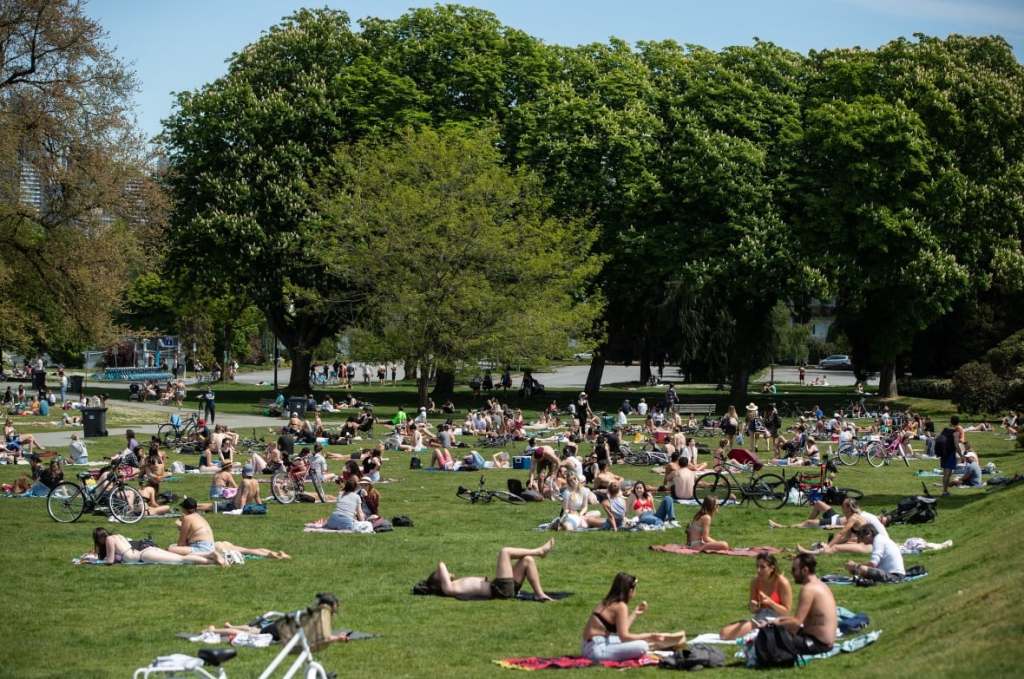
Public drinking reveals much about how societies balance freedom, responsibility, and trust. The stark contrast between Ottawa’s tentative, tightly-controlled 2025 pilot program for alcohol consumption in municipal parks and Germany’s longstanding acceptance of public drinking illustrates deeper social and cultural divides. In short, while Germans operate under a framework of collective behavioral expectations and trust, Canadians, at least in Ottawa, approach public behavior through a lens of institutional caution and control.

In Germany, it is not only legal, but culturally unremarkable to walk through a park or down a street sipping beer or wine. Public drinking is allowed in virtually all spaces: parks, streets, public transport, so long as behavior remains respectful. There is no need for signage, restricted hours, or opt-in zones. Instead, the rules are social: keep your voice down, clean up after yourself, and don’t cause a disturbance. The assumption is that most people, most of the time, can be trusted to enjoy alcohol in public without devolving into chaos. Enforcement is minimal and focused on conduct rather than consumption. The legal framework reflects this confidence in citizens’ capacity for self-regulation.

Ottawa, by contrast, is poised to take a small, hesitant step into public drinking territory. The 2025 summer pilot, if passed by full council, will allow alcohol in select municipal parks during restricted hours and away from certain facilities. Local councillors must “opt in” their parks, and enforcement mechanisms, signage, and safety protocols are emphasized. The premise is that public drinking is potentially risky, necessitating detailed restrictions and contingency planning. The policy does not presume that residents can handle this responsibility; rather, it cautiously tests whether they might.

This divergence is not simply legal, it is philosophical. German norms lean on a social compact that assumes citizens will behave decently in shared spaces. Canadians, or at least Canadian policymakers, appear to lack such confidence. Public drinking is imagined not as an ordinary act, but as a behavior to be fenced in, bounded, and watched. Ottawa’s delay in launching even a pilot underscores a broader cultural tendency: one that privileges regulation over trust, institutional control over social cohesion.

Underlying this is a question of what kind of public life a society envisions. In Germany, a Feierabendbier (after-work beer) on a park bench is an extension of civil society, part of a shared public realm. In Ottawa, such an act still falls outside acceptable norms, even as urban life becomes denser and more diverse. This points to a lingering paternalism in Canadian municipal governance: the belief that citizens must be managed rather than trusted.

Ultimately, the Ottawa-Germany contrast reveals a deeper social reality. Where Germans assume the public is capable and socialized, Canadians assume the public needs structure and limits. That divergence shapes not just laws, but the very character of public space, and what we are allowed to do within it. Public drinking, then, becomes a proxy for how much a society trusts its own people.

Patients Are Not Property: Time to Rethink How We Regulate the Sale and Retention of Primary Care Rosters

In the midst of Canada’s growing primary care crisis, it’s time we take a hard look at how patient rosters are handled, or mishandled, when physicians transition or leave their practices. Across the country, millions of Canadians are without a family doctor. Against this backdrop, we can no longer tolerate a system in which doctors purchase entire rosters of patients only to turn around and drop half of them, not based on clinical need, but lifestyle preference.

This is not a matter of gender. It is a matter of professional accountability and ethical stewardship. Patients are not chattel. They are people, often elderly, immunocompromised, managing multiple chronic conditions, who place their trust in a system that is supposed to protect their continuity of care. When a physician acquires a patient list, they are not buying a gym membership or a book of business. They are assuming responsibility for the long-term health of hundreds, sometimes thousands, of human beings.

Let’s be clear: physicians have every right to structure their practice in a way that supports their well-being. Burnout is real, and work-life balance matters, but that personal balance cannot come at the expense of vulnerable patients being systematically cast adrift.

Professional colleges, including the College of Physicians and Surgeons of Ontario (CPSO), do provide formal mechanisms for a doctor to reduce their patient list. These guidelines exist to allow flexibility, but they were never meant to be a loophole for roster triage based on convenience. If the intention was always to serve only a part-time practice, why was the entire roster purchased? Why was the community not informed in advance? And why are regulatory bodies permitting what amounts to a public harm, wrapped in private contractual terms?

These are not just hypothetical concerns. The abandonment of patients, especially those without alternatives, has ripple effects throughout the entire healthcare system. Walk-in clinics become overwhelmed. Emergency rooms fill with non-emergency cases. Preventable conditions go unmanaged until they become acute, and meanwhile, the public’s trust in the integrity of primary care continues to erode.

If physicians wish to buy a practice, that is a valid path to establishing their career; but there must be clear, enforceable rules to ensure that patient care is not commodified in the process. A few policy options worth considering:

  • Conditional licensing of roster transfers: Require binding disclosure of the incoming physician’s intended working hours and patient capacity before the sale is finalized, with oversight by a neutral third party such as the local health authority.
  • Mandatory transition plans: If a physician intends to offload more than 10% of a newly acquired roster, they should be required to demonstrate how those patients will be supported in finding alternate care – not simply left to fend for themselves – meaning that there is actually an alternative primary caregiver available who is willing and able to add them to their existing roster.
  • Public-interest reviews of large roster changes: Just as utility companies can’t hike rates without justification, physicians shouldn’t be able to restructure public-facing services without transparent public reasoning.

Ultimately, the issue is not about lifestyle choices. It’s about stewardship. Every doctor, upon licensing, accepts a social contract with the people they serve. That contract includes not just the right to treat patients, but the responsibility to do so with equity, consistency, and integrity.

We wouldn’t accept it if a public school principal took over a school and expelled half the students because they only wanted to work mornings. We shouldn’t accept it in primary care either.

Lansdowne Park: A Case Study in Public-Private Partnership Failure

In the heart of Ottawa lies Lansdowne Park, a public asset that has undergone over a decade of controversial redevelopment under the banner of public-private partnerships (P3). Initially hailed as a visionary collaboration between the City of Ottawa and the Ottawa Sports and Entertainment Group (OSEG), Lansdowne has instead become a cautionary tale; an emblem of how private interests can hijack public value, with taxpayers left holding the bill. Despite grand promises of economic revitalization, self-sustaining revenues, and community benefit, the Lansdowne project has consistently failed to deliver on its core goals.

The Origins: Lansdowne 1.0 and the Rise of the P3 Model
The current saga began in 2007, when structural concerns forced the closure of Frank Clair Stadium. In response, the City sought partners to reimagine Lansdowne as a revitalized hub for sports, entertainment, and urban life. The resulting Lansdowne Partnership Plan (LPP), approved in 2010, was a no-bid, sole-source agreement with OSEG. It created a 30-year limited partnership through which OSEG would refurbish the stadium, build retail and residential developments, and share profits with the City through a revenue “waterfall” model.

The City’s share of the original $362 million redevelopment was around $210 million, used for stadium upgrades, a new urban park, parking facilities, and relocating the historic Horticulture Building. OSEG contributed roughly $152 million, not as direct capital, but largely through operational losses rolled back into the project in exchange for an 8% return on equity. The land remained public, but OSEG was granted long-term leases for commercial components, at just $1 per year.

A Financial Model Built on Sand
The P3 structure was sold to the public with the assurance that Lansdowne would eventually pay for itself. Early forecasts predicted a $22.6 million net return to the City. In reality, those profits never materialized. Retail revenues rose steadily, but so did costs. By 2016, OSEG was reporting $14.4 million in losses. As of 2023, the partnership had not returned a cent to municipal coffers. The revenue waterfall prioritized OSEG’s return on equity before any surplus could flow to the City, meaning taxpayers bore the financial risk, while private partners had guaranteed returns.

Worse, the project locked the City into a complex financial structure that made renegotiation difficult. The Auditor General of Ottawa has since criticized the model, citing opaque accounting and a lack of oversight over cost estimates and projections.

Lansdowne 2.0: Doubling Down on a Broken System
Rather than reassess the underlying flaws of Lansdowne 1.0, the City has pressed forward with an even more ambitious sequel: Lansdowne 2.0. Approved by Council in 2023, this next phase proposes to demolish and rebuild the north-side stadium stands, construct a 5,500-seat event centre, and erect two residential towers atop a retail podium. The estimated cost is $419 million, with over $300 million of that funded by the City through new debt.

Despite lessons from the past, the same P3 framework persists. The City continues to rely on OSEG’s management and forecasts, despite repeated underperformance. Recent findings from the Auditor General suggest that construction costs may be underestimated by as much as $74.3 million, bringing the actual cost closer to half a billion dollars.

Community Concerns Ignored
One of the most damning aspects of the Lansdowne saga has been its consistent disregard for community needs. Neither Lansdowne 1.0 nor 2.0 includes affordable housing. This, in the midst of a housing crisis, is a glaring omission. Public green space will be reduced by more than 50,000 square feet in Lansdowne 2.0. Traffic and parking concerns persist, especially given the site’s poor access to Ottawa’s light rail system.

Environmental groups have flagged the project for increasing the urban heat island effect and ignoring climate resilience standards. Ecology Ottawa and other watchdogs note that the loss of mature trees, additional hard surfaces, and energy-intensive stadium lighting run counter to the City’s own climate goals.

Public feedback has been overwhelmingly negative. A survey by the advocacy group Better Lansdowne found that 77% of respondents opposed the new plan. Critics have called for a full reassessment, independent cost-benefit analysis, and alternative development models that prioritize public use and affordability.

The Broader P3 Problem
The Lansdowne project exemplifies the risks inherent in the P3 model. When private partners are guaranteed returns and public entities assume the risk, the result is rarely equitable or efficient. While the private sector pursues profit, as it must, government has a duty to prioritize public interest. In this case, the lines blurred, and profit came first.

Public-private partnerships are often promoted as a way to leverage private investment for public good. Yet in practice, they can enable private actors to extract value from public land and public funds, with minimal accountability. Lansdowne is a textbook case of this imbalance.

Time to Reclaim Public Space
As Ottawa moves forward, the Lansdowne experience should serve as a clear lesson: public infrastructure must be publicly driven. The City needs to step back, reassess its relationship with OSEG, and consider alternative models that place public interest at the centre. This could include establishing a municipal development corporation, returning retail management to the City, and mandating affordable housing in all new residential builds.

If Lansdowne Park is truly to be the “people’s place” as once envisioned, it must serve the city, not subsidize private profit. The future of Ottawa’s public assets depends on getting this right.

Sources
• Ottawa City Council Reports, 2023–2025 – ottawa.ca
• Ottawa Auditor General Report, June 2025 – link2build.ca
• Better Lansdowne Community Survey – betterlansdowne.ca
• Ecology Ottawa – ecologyottawa.ca
• Ottawa Business Journal Archives – obj.ca
• Lansdowne Park Redevelopment History – en.wikipedia.org

OC Transpo: A Two-Decade Decline in Rider-Centric Service

As a long-time Ottawa resident and observer of our city’s public utilities, I’ve witnessed firsthand the transformation of OC Transpo from a model of efficient public transit to a system riddled with challenges. Over the past two decades, a series of missteps, underinvestment, and a departure from rider-focused planning have led to a decline in service quality, reliability, and public trust.

From Transitway Triumph to LRT Troubles
In the 1980s, Ottawa’s Transitway was lauded as a pioneering bus rapid transit system, setting a benchmark for cities worldwide. Its dedicated bus lanes and efficient service made public transit a viable option for many residents. However, the shift towards the Light Rail Transit (LRT) system, particularly the Confederation Line, marked the beginning of a tumultuous era. 

Launched in 2019, the Confederation Line was plagued with issues from the outset. Frequent service disruptions due to door malfunctions, electrical failures, and even derailments became commonplace. These problems not only inconvenienced riders but also necessitated the reallocation of buses to cover LRT routes, further straining the bus network .

Service Cuts and Declining Reliability
In recent years, OC Transpo has implemented significant service reductions, often without adequate public consultation. For instance, in 2021, the agency planned service cuts without seeking rider input, leading to widespread criticism . By 2024, the city had cut $47 million from OC Transpo’s capital budget, removing 117 aging buses without replacements, resulting in a 3.5% reduction in bus service hours . 

These cuts have had tangible impacts on riders. Students, for example, have reported overcrowded trains, erratic service, and high fares, leading to dissatisfaction and calls for meaningful reforms . Community feedback has consistently highlighted issues with reliability and a lack of focus on the city core .   

Financial Strains and Leadership Challenges
The COVID-19 pandemic exacerbated OC Transpo’s challenges. A 38% drop in ridership since 2019 led to a $36 million revenue shortfall . Despite these financial strains, the agency increased fares in 2024, disproportionately affecting seniors and youth riders .  

Leadership changes have also marked this period. The recent departure of General Manager Renée Amilcar underscores the need for a strategic reevaluation of OC Transpo’s direction. Transit advocates have called for a “serious, honest” review of the system to address its myriad issues . 

A Call for a Rider-Centric Vision
To restore public trust and improve service quality, OC Transpo must adopt a rider-centric approach. This includes engaging with the community to understand diverse transit needs, investing in infrastructure to ensure reliability, and providing transparent communication about service changes. Equitable access must be prioritized, ensuring that transit services are affordable and accessible for all demographics.

The challenges facing OC Transpo are significant, but not insurmountable. By focusing on the needs of riders and committing to transparency and accountability, Ottawa can rebuild a public transportation system that serves its citizens effectively and efficiently.

Fields or Fences? The Controversy Around the Planned Prison in Kemptville, Ontario

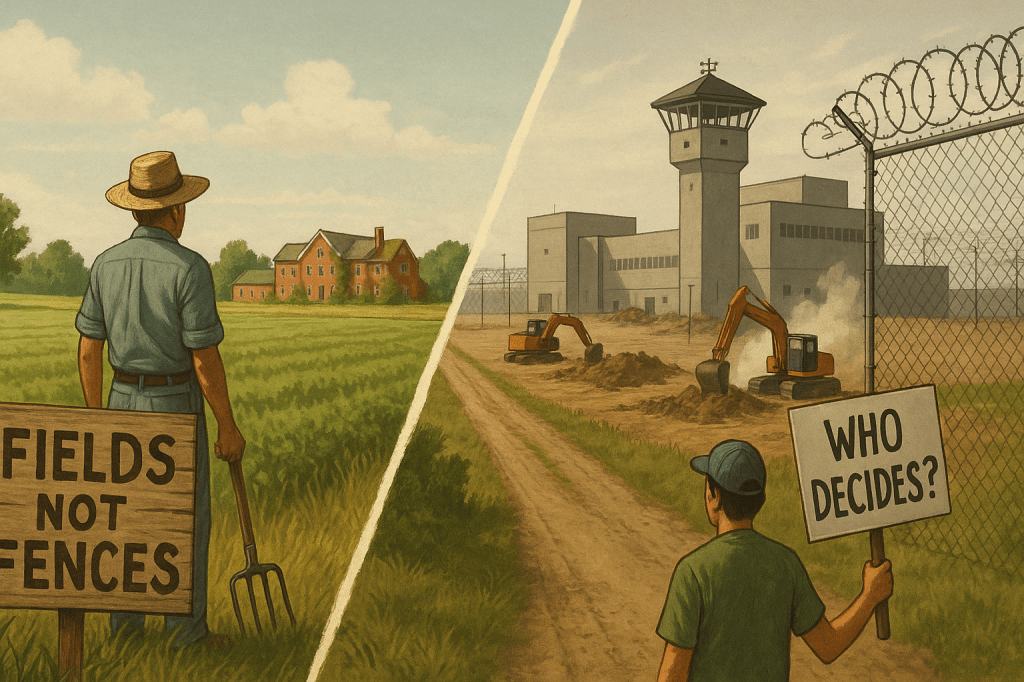
Across a quiet stretch of rural Eastern Ontario, a storm is brewing, not of thunder and rain, but of land use, justice policy, and civic trust. In the town of Kemptville, just 60 kilometers south of Ottawa, the Ontario government has proposed building the Eastern Ontario Correctional Complex (EOCC), a 235-bed provincial jail, on what was once part of the Kemptville College campus; prime agricultural land with deep community roots.

The story of this proposed prison is not only one of construction and policy, but of clashing visions for the future of Eastern Ontario. It is a story of farmland and fences, of children and correctional officers, of infrastructure gaps and political decisions. And perhaps most importantly, it is a story of a community asking why? Why here, and why now?

A Campus Reborn… and a Prison Across the Street

Following the closure of Kemptville College in 2016, the lands were acquired by the Municipality of North Grenville and repurposed into the Kemptville Campus Education and Community Centre. The site now houses educational institutions, youth programs, early learning centres, agricultural innovation hubs, and outdoor experiential learning, drawing hundreds of children and families onto the grounds daily.

Literally across the street, however, the province of Ontario plans to build a modern jail to alleviate overcrowding in Ottawa’s aged and strained Ottawa-Carleton Detention Centre. In 2020, the EOCC was announced without prior consultation with local residents or municipal authorities. Since then, Ontario’s Ministry of the Solicitor General and Infrastructure Ontario have proceeded through environmental, geotechnical, and archaeological assessments, while the procurement process to select a construction partner continues.

In preparation, the province announced a $21.8 million investment in late 2024 to expand the local wastewater treatment facility, an infrastructure boost that would support both the prison and North Grenville’s projected population growth. While this has been framed as a win for the municipality, many in the community see it as paving the way for a facility they never asked for.

Local Voices, Deep Opposition

The backlash has been loud and sustained. The Coalition Against the Proposed Prison (CAPP) has been leading opposition efforts, supported by environmental groups, farmland advocates, and concerned citizens. Their concerns are rooted in what they see as a violation of planning principles: the conversion of 182 acres of prime farmland into a high-security facility in a region ill-equipped for such a purpose.

Their slogan – Fields Not Fences – captures the sentiment. To them, the decision is symbolic of a top-down, opaque approach to governance that neglects local values and long-term sustainability. And perhaps nowhere is this more palpable than on the Kemptville Campus itself.

What About the Kids?

With daycares, high schools, after-school programs, and even an agroforestry centre on the Kemptville Campus, many parents and educators are worried. While there are no official restrictions announced for youth-focused activities, the mere proximity of a medium-security correctional facility raises real questions.

Will the presence of the EOCC, even at a distance, impact perceptions of safety for school trips, outdoor learning, and daycare enrollment? Will families hesitate to send their children to programs just meters away from a working jail? These are not hypothetical concerns, they are being asked by parents, including Mayor Nancy Peckford, whose own children attend the Campus. In public statements, she has pushed the province for assurances, including appropriate setbacks and enhanced communication with the municipality.

The Ministry has agreed to locate the facility as close to Highway 416 as possible, rather than directly beside the campus. It has also committed to design considerations to shield the facility from view, but critics argue that no amount of landscaping can change the fact that children and correctional officers may soon be sharing a road.

Why Not Ottawa?

Perhaps the most confounding part of the province’s decision is its choice to build the jail outside of Ottawa. The provincial rationale, that Eastern Ontario needs more capacity, and that the Kemptville site is government-owned and available, seems less persuasive when weighed against logistical realities. Somehow it feels as if not having to purchase land in Ottawa was the main provincial concern.

Ottawa already hosts the region’s justice infrastructure: courts, legal aid offices, probation services, and public transit. Incarcerated individuals often require court appearances, mental health supports, and visits from family or counsel. Placing a prison in a small town without intercity transit creates additional barriers and isolates the incarcerated even further. It also forces staff to commute from Ottawa, increasing carbon emissions and reducing accessibility.

From an urban planning perspective, this is the antithesis of smart growth. It moves essential services away from existing infrastructure hubs, while forcing a rural community to absorb the impacts, social, environmental, and reputational, of a decision made elsewhere.

The Bigger Picture: Justice, Land, and Power

The Kemptville prison story reveals a broader tension between provincial power and local agency. On one side, a government seeking to modernize correctional infrastructure, reduce Ottawa’s jail overcrowding, and use its own land holdings efficiently. On the other, a community that sees farmland, education, and public trust being sacrificed for a carceral future they do not endorse.

It also reveals the contradictions in Ontario’s approach to land use and justice reform. While it invests in mental health, rehabilitation, and community supports rhetorically, its actions suggest a continued reliance on incarceration, disproportionately impacting Indigenous and racialised people. And while the province claims to value sustainable development, it is choosing to pave over productive farmland at a time when food security and climate resilience are becoming increasingly urgent.

What Comes Next?

Construction of the EOCC has not yet begun. The procurement process is ongoing, and opposition efforts, including a judicial review, are still active. What happens in the next year may determine not only the future of one community, but the direction of Ontario’s justice philosophy.

Will the province revisit its decision in light of sustained resistance? Will it reconsider siting the facility closer to Ottawa, where its infrastructure already exists? Or will it press forward, betting that time and investment will outlast protest?

For now, the fields across from Kemptville Campus remain untouched, but as bulldozers wait in the wings, the people of North Grenville are asking: are we building something we need, or destroying something central to a sustainable community?

Sources

Mr. Carney, Let’s Be Bold and Smart: A Revenue-Neutral Universal Basic Income Is Within Reach

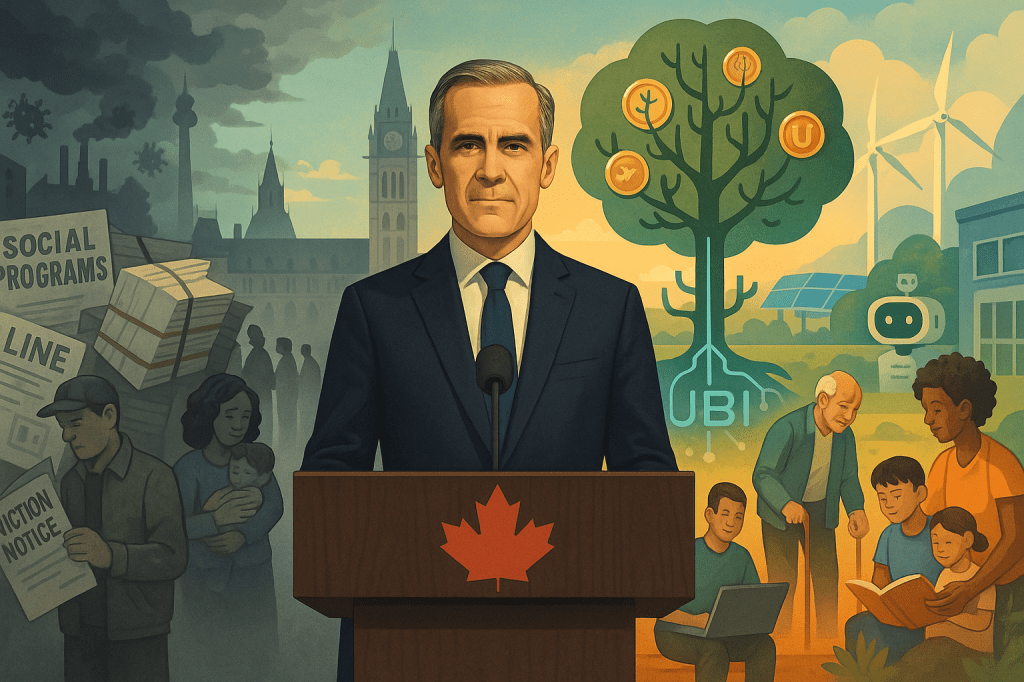
The election of Mark Carney as Canada’s new Prime Minister marks more than a changing of the guard, it signals a chance to transform how we think about economic justice, social policy, and the role of government in a post-pandemic, post-carbon, AI-disrupted world. Yet, if this new Liberal administration wants to do more than manage decline or tinker at the edges, it must champion Universal Basic Income (UBI), and it must do so within this first term.

To skeptics, the usual pushback is cost. “We can’t afford it.” But what if I told you we can, without adding a cent to the deficit?

A bold, revenue-neutral UBI is not only possible, it’s the smart, responsible, and forward-thinking choice. It would simplify our bloated patchwork of social programs, reduce inequality, and stabilize the economy, all while respecting fiscal realities. Carney, with his reputation for monetary prudence and social conscience, is uniquely positioned to make this happen.

The Case for UBI, Now More Than Ever
We live in precarious times. AI and automation are displacing jobs once thought secure. The gig economy has redefined work for an entire generation, offering flexibility but no stability. Climate change is reshaping our industries, economies, and communities. And regional inequalities, from rural depopulation to urban housing crises, are deepening social division.

UBI provides a powerful, simple solution: a no-strings-attached income that ensures every Canadian can meet their basic needs, make real choices, and live with dignity. No complex eligibility criteria. No stigma. Just a stable foundation for all.

This isn’t a call for endless spending. This is a plan for smart reinvestment, one that replaces outdated, fragmented systems with a coherent, efficient, and humane approach.

Revenue-Neutral UBI: A Practical Path
The key to political and economic viability is fiscal neutrality. Here’s how we get there:

Streamline the Social Safety Net
Our current welfare architecture is costly, overlapping, and often punitive. We propose replacing core income support programs, provincial social assistance, EI for low-wage workers, and a range of targeted income-tested tax credits, with a single, universal UBI. This simplification reduces administrative duplication and restores dignity to recipients.

Rethink OAS and GIS
These seniors’ programs already operate as a basic income for the elderly. By integrating them into a universal model, with UBI replacing these benefits for most, but supplemented by needs-based top-ups for seniors with unique medical or housing costs, we ensure fairness without duplication.

Restructure (Not Eliminate) CPP
CPP remains essential as a pension earned through contribution, but some recalibration of contribution thresholds and benefit tiers, alongside UBI, can reduce reliance on inflated public pensions to cover basic needs, while preserving the contributory principle.

Modest, Targeted Tax Reform
To close the revenue loop, introduce a small surtax (e.g., 2%) on individual incomes over $150,000, and slightly increase capital gains inclusion rates. These are not radical measures, they simply ask the wealthiest Canadians to help ensure every citizen has a secure foundation. For 95% of taxpayers, no increase would be necessary.

Numerous economic models (including work by Evelyn Forget, UBC’s Kevin Milligan, and CCPA researchers) show that a well-designed UBI can be nearly or entirely self-funding when paired with smart policy adjustments like these.

Political Opportunity and Liberal Legacy
Prime Minister Carney doesn’t need to look far for historical inspiration. Universal healthcare, bilingualism, the Charter, these were all ambitious Liberal achievements once considered politically risky and fiscally daunting, yet they reshaped Canada.

UBI can be his legacy. It would resonate across voter blocs: rural Canadians seeking stability, urban millennials burdened by debt and housing costs, women and caregivers locked out of full-time work, and gig workers with no safety net. It’s a unifying policy in a fragmented nation.

Moreover, by leading with a revenue-neutral model, Carney can neutralize opposition from deficit hawks and centrists, while winning support from social democrats, Indigenous leaders, environmentalists, and the entrepreneurial class alike.

A Step-by-Step Roadmap

  • Launch a National UBI Task Force in the first 100 days, chaired by experts in economics, social policy, and Indigenous governance.
  • Table a UBI White Paper by the end of Year 1, outlining fiscal models, legal changes, and implementation scenarios.
  • Pilot the program in a representative region (e.g., Northern Ontario, Atlantic Canada, or an urban-rural mix) with independent evaluation.
  • Introduce legislation in Year 3, with phased implementation beginning before the 2029 election.

This is not pie-in-the-sky. This is responsible governance meeting bold vision.

The Values We Must Uphold
UBI is about more than money, it’s about modernizing our social contract. It says to every Canadian: you matter. You are not a cost, a case file, or a problem to manage. You are a citizen with rights, worth, and potential.

Mr. Carney, you’ve spoken eloquently about “values-based capitalism” and “inclusive transitions.” UBI is the policy vehicle that delivers on those values. And by designing it to be fiscally neutral, you can bring the skeptics along without compromising ambition.

Now is the time to lead not just with caution, but with courage. We can afford Universal Basic Income, not in spite of economic constraints, but because of them.

Let’s stop managing poverty. Let’s start guaranteeing security. Let’s build a Canada where no one is left behind.