A Welcome with Questions: What Dr. Kaur’s Arrival Reveals About North Grenville’s Physician Incentive Strategy

Ontario is facing a growing shortage of primary care physicians, leaving millions of residents without regular access to a family doctor. This crisis is particularly acute in rural and small-town communities, where aging populations and physician retirements have widened care gaps. In response, municipalities across the province are adopting innovative strategies to attract, recruit, and retain doctors. These include financial incentive programs, housing and relocation support, flexible practice models, and community integration initiatives aimed at making smaller communities more appealing.

So, the arrival of a new physician in a small Ontario town is typically a cause for celebration. Access to primary care is under increasing pressure across the province, and communities like North Grenville work diligently to recruit and retain family physicians. Thus, when Mayor Nancy Peckford announced the addition of Dr. Pawandeep Kaur to the Rideau Crossing Family Health Centre in Kemptville, it was a moment of optimism.

However, a closer examination of the circumstances surrounding Dr. Kaur’s recruitment reveals complexities that warrant further scrutiny, particularly concerning the application and effectiveness of North Grenville’s Family Physician Incentive Program.

Dr. Lavitt’s Brief Tenure
Dr. Samantha Lavitt joined the Rideau Crossing Family Health Centre in June 2024 as part of the municipality’s North Grenville Primary Care Incentive Program. Her arrival was heralded as a significant step forward in enhancing primary care access for the community. However, less than a year into her tenure, Dr. Lavitt announced her departure, effective June 1, 2025. The reasons for her short stay have not been publicly disclosed, but her brief tenure raises questions about the program’s ability to retain physicians in the community. 

A Seamless Transition – But Not an Expansion
To ensure continuity of care, Dr. Kaur will begin transitioning into Dr. Lavitt’s practice starting April 16, 2025, with a full handover by June 1. This overlap aligns with the College of Physicians and Surgeons of Ontario (CPSO) guidelines, which mandate that physicians provide appropriate arrangements for patient care continuity upon leaving a practice.

While this transition is commendable from a patient care perspective, it is important to note that Dr. Kaur is not an addition to North Grenville’s physician roster, but a replacement. The total number of family physicians in the community remains unchanged.

The Optics of Growth
Mayor Peckford’s announcement welcomed Dr. Kaur as “another new family doctor,” a phrase that suggests an increase in the local healthcare workforce. However, this characterization is misleading, as Dr. Kaur is filling the vacancy left by Dr. Lavitt. The use of the term “new” in this context may create a perception of growth where there is none.

Furthermore, Dr. Kaur’s recruitment is again tied to the township’s Family Physician Incentive Program. This raises questions about the program’s application. Designed to attract new physicians to underserved areas, the program appears, in this instance, to be used to maintain existing capacity rather than expand it. 

A Stepping Stone, or a Sustainable Solution?
The brief tenure of Dr. Lavitt and the subsequent recruitment of Dr. Kaur under the same incentive program highlight potential vulnerabilities in the program’s design. If physicians view the program as a short-term opportunity or a stepping stone to other positions, the community may face ongoing challenges in maintaining stable, long-term primary care services. Perhaps the program’s retention strategies may need reevaluation to ensure sustainable healthcare delivery in North Grenville? 

Moving Forward with Transparency
While Dr. Kaur’s arrival ensures that existing patients continue to receive care, the situation underscores the need for transparency in how recruitment programs are utilized. It is essential to assess whether these programs are achieving their intended goals of expanding healthcare access, and to consider adjustments that enhance their effectiveness in both attracting and retaining physicians.

As North Grenville continues to navigate the complexities of healthcare provision, clear communication and strategic planning will be key to ensuring that the community’s needs are met not just today, but in the years to come.

Sources
• Rideau Crossing Family Health Centre. “Practice Update.” rideaucrossingfhc.ca
• My Kemptville Now. “North Grenville welcomes newest physician.” mykemptvillenow.com
• North Grenville. “North Grenville Enhances Primary Care Access with Arrival of Dr. Lavitt.” northgrenville.ca
• College of Physicians and Surgeons of Ontario. “Physician Information.” register.cpso.on.ca

The Shifting Dream: White Masculinity and their Receding Grip on North America’s Future

For centuries, the mythology of the “American Dream” (and its Canadian cousin) was powered by the image of the self-made white man; rugged, determined, and in control. From the frontier and the factory floor to the boardroom and ballot box, the narrative of national progress was long centered on white male ambition, but in the 21st century, that dominance is waning. Not because others are taking what doesn’t belong to them, but because they are finally accessing what always should have been shared.

Demographically, socially, and economically, North America is being reshaped by waves of migration, changing gender roles, Indigenous resurgence, and increasing racial and cultural diversity. Women, racialized people, queer folks, and immigrants are not just contributing, they are leading. From startup culture and environmental activism to political office and artistic innovation, the stories being told and the power being wielded are increasingly non-white and non-male.

Yet, as these shifts accelerate, many white men are experiencing something they have rarely encountered at a cultural level: loss of centrality. For generations, society reinforced that whiteness and maleness were the default, everything else was “other.” Now, with those defaults being questioned and dismantled, entitlement is showing its teeth. There is a growing chorus of grievance, often manifesting in reactionary politics, internet subcultures, and movements that call for a return to a mythical past when “men were men” and “America was great.”

The trouble is that entitlement doesn’t vanish when equity rises. Many white men have come to see fairness as persecution, mistaking equality for displacement. They are not just angry at being excluded, they are angry that inclusion requires them to share space, status, and resources. This is especially evident in education, employment, and media representation, where more equitable hiring practices, affirmative action, and inclusive storytelling are viewed not as progress but as threats to traditional dominance.

Some of this backlash is economic. Working-class white men, especially those displaced by globalization and automation, have seen their livelihoods and identities eroded. But the narrative they are often sold isn’t one of class solidarity, it’s one of racial and gender resentment. Politicians and pundits have weaponized their frustration, redirecting legitimate grievances toward scapegoats rather than structural inequity.

Still, the future is not about erasure. It is about redefinition. White men, like everyone else, have the opportunity to take part in a broader, more inclusive vision of what it means to thrive in North America. But it requires humility, self-reflection, and a willingness to let go of inherited privilege. The dream hasn’t died, it’s just no longer theirs alone.

If white men can move from entitlement to empathy, from dominance to solidarity, they can be part of a future that is richer, fairer, and more sustainable. If they cling to the fading illusion of supremacy, they will find themselves shouting from the sidelines of a dream that has moved on without them.

Unforced Errors: How the Conservatives Undermined Their Own Campaign

The Conservative Party of Canada (CPC) faced a significant defeat in the 2025 federal election, despite early leads in the polls. Several factors related to their platform and campaign strategy contributed to this outcome.

Ideological Ambiguity and Policy Reversals
Under Pierre Poilievre’s leadership, the CPC attempted to broaden its appeal by moderating positions on key issues. This included adopting a more serious stance on climate change and proposing policies aimed at working-class Canadians. However, these shifts led to confusion among voters about the party’s core principles. The rapid policy changes, especially during the short campaign period, made the party appear opportunistic and inconsistent.  

Alienation of the Conservative Base
The CPC’s move towards the center alienated a portion of its traditional base. This disaffection contributed to the rise of the People’s Party of Canada (PPC), which saw its vote share increase significantly. Many former CPC supporters shifted to the PPC, attracted by its clear stance on issues like vaccine mandates and opposition to carbon taxes. This vote splitting weakened the CPC’s position in several ridings.    

Controversial Associations and Rhetoric
Poilievre’s perceived alignment with hard-right elements and reluctance to distance himself from controversial figures, including former U.S. President Donald Trump, raised concerns among moderate voters. Trump’s antagonistic stance towards Canada, including economic threats and inflammatory rhetoric, made the election a referendum on Canadian sovereignty for many voters, pushing them towards the Liberals.   

Ineffective Communication and Messaging
The CPC’s campaign suffered from inconsistent messaging. While initially focusing on pressing issues like housing, the campaign later shifted to a more negative tone, attacking Liberal policies without offering clear alternatives. This lack of a cohesive and positive message failed to inspire confidence among undecided voters.  

Structural and Demographic Challenges
The CPC continued to struggle with regional disparities, particularly between conservative-leaning western provinces and liberal-dominated urban centers in the east. The party’s inability to appeal to urban and suburban voters, coupled with changing demographics, hindered its ability to secure a national majority.  

Foreign Interference Concerns
Post-election analyses indicated that foreign interference, particularly from Chinese government-linked entities, may have influenced the election outcome. Disinformation campaigns targeted CPC candidates, especially in ridings with significant Chinese-Canadian populations, potentially costing the party several seats.  

The CPC’s defeat in the 2025 federal election can be attributed to a combination of ideological shifts that alienated core supporters, associations with controversial figures, inconsistent messaging, structural challenges, and external interference. These factors undermined the party’s ability to present a compelling and cohesive alternative to the electorate.

The Language of Care: Why Ontario Needs a Client-Centred Health Model

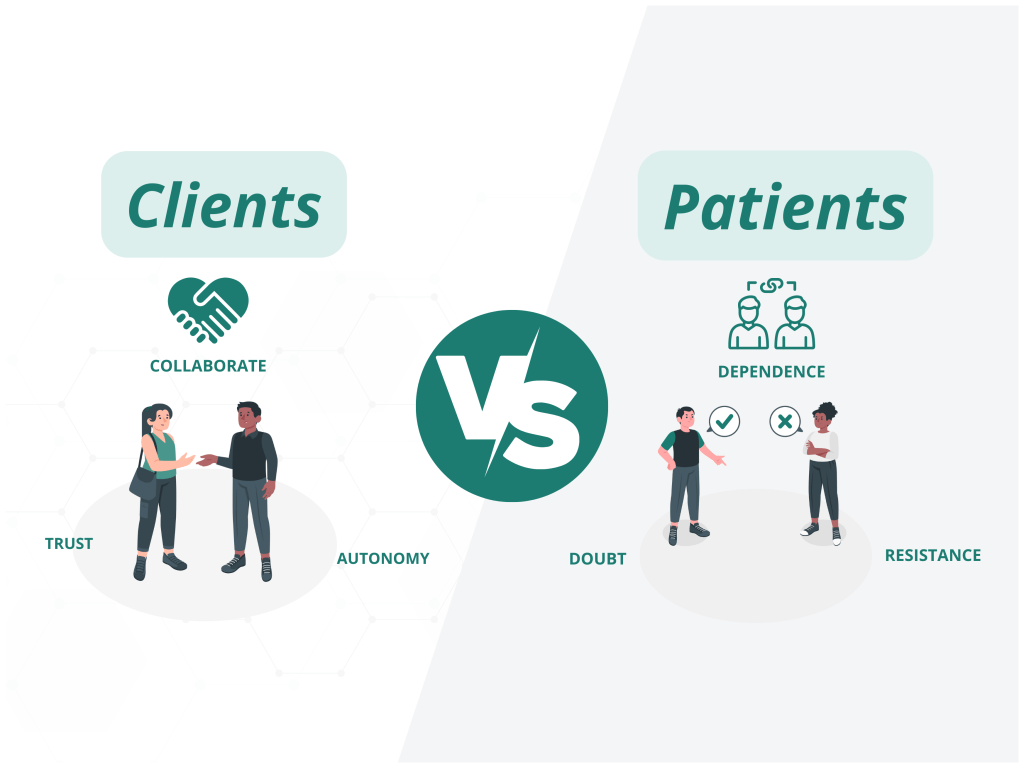
In Ontario, a quiet revolution in healthcare could begin with something as deceptively simple as a change in language. What if, instead of referring to the people they treat as patients, healthcare practitioners embraced the idea that they are working with clients? This shift in terminology is more than cosmetic; it signals a fundamental rethinking of how care is delivered and how relationships between practitioners and the people they serve are structured. Replacing patient with client disrupts the ingrained hierarchy of medicine, and opens the door to a model of care that is more collaborative, respectful, and, ultimately, more effective.

The word patient carries with it centuries of baggage. Rooted in a paternalistic tradition, it positions the healthcare professional as the authority and the person receiving care as a passive recipient. This model might be efficient in a short hospital stay or an emergency room visit, but it often falls short in the real world of chronic illness, mental health, elder care, and preventive services. In these domains, success relies less on technical intervention and more on sustained relationships, shared goals, and mutual trust. Reframing the care recipient as a client changes the dynamic entirely. A client has agency. A client has choices. A client is someone with whom you work, not someone you work on.

This idea is hardly radical in other professions. Lawyers, accountants, architects, and business consultants, all highly educated, tightly regulated professionals serve clients, not patients. These roles are steeped in trust and responsibility, yet they operate from a baseline assumption that the client is an informed actor. Professionals in these fields provide guidance, analysis, and expertise, but they do not presume to make personal decisions on behalf of the people they serve. If such a standard is good enough for legal or financial matters, why should health, arguably the most personal domain of all, be treated differently?

Adopting a client-centred lens has profound implications for healthcare delivery. It reshapes informed consent from a bureaucratic formality into a genuine process of dialogue and understanding. It places a premium on listening, cultural humility, and the social determinants of health. It encourages practitioners to see people not just as carriers of disease or disorder, but as whole individuals navigating complex lives. In Ontario’s increasingly diverse and pluralistic population, this shift is especially urgent. Language, history, trauma, race, and gender identity all influence how people experience healthcare. Treating them as clients creates space for those realities to be acknowledged and respected.

More importantly, research consistently shows that when people are treated as partners in their care, outcomes improve. Chronic disease management, medication adherence, mental health recovery, all benefit from a model in which individuals are active participants rather than passive recipients. Community Health Centres, Nurse Practitioner-Led Clinics, and Indigenous-led health organizations have long embraced this ethos, often with outstanding results. These models recognize that healthcare is not merely about procedures and prescriptions; it’s about relationships and empowerment.

To make this shift from patient to client more than a philosophical exercise, Ontario’s healthcare system must engage in a formal change management process that embeds this transformation into everyday practice. Change at this scale requires more than individual will, it demands structural alignment, leadership buy-in, and sustained cultural development. Medical and nursing schools must be at the forefront, redesigning curricula to emphasize collaborative care, cultural safety, and relational ethics from day one. Teaching hospitals and clinical settings must model this new language and ethos consistently, ensuring that learners observe and internalize client-centred care as the norm, not the exception. Professional colleges, health authorities, and policy-makers need to articulate a unified vision and provide concrete supports; from updated documentation protocols to ongoing professional development. Without a deliberate, system-wide strategy to guide this cultural transition, the risk is that well-meaning practitioners will continue operating in structures that reinforce the very hierarchy we seek to move beyond. True transformation will require education, reinforcement, and accountability across the health system.

Of course, this shift will not be easy. Medical training in Ontario still often reinforces an expert-knows-best mentality. Fee-for-service billing structures reward speed over depth, and systemic pressures, from staffing shortages to rigid bureaucracies, can make relational care feel like a luxury rather than a standard. Some professionals resist the term client, worrying it sounds too commercial or transactional. But in truth, it’s a term of respect. It conveys that the individual has power, and that the practitioner has a duty to serve, not command.

If Ontario is serious about building a more equitable, sustainable, and humane healthcare system, it must begin by reimagining the core relationship between practitioner and person. Words matter. They shape expectations, behaviours, and culture. Shifting from patients to clients could be the first step toward a system that doesn’t just deliver care, but shares it.

Resetting the Relationship: A Vision for a True Indigenous Partnership

As the dust settles from the recent election, there’s a palpable sense that the Liberal Party has been handed not just another mandate, but a historic opportunity; to begin building a new Canadian future rooted in respect, renewal, and real partnership with Indigenous peoples.

This isn’t merely an electoral moment. It’s a constitutional and moral one, and with the planned visit of King Charles III, it’s time to reset the relationship. 

The last decade saw growing national awareness around reconciliation, but also hard truths: court rulings reminding us of Canada’s obligations, tragedies like unmarked graves that brought history into the present, and persistent gaps in housing, healthcare, and infrastructure that continue to shape the daily lives of Indigenous families. The incoming government must now shift the conversation from acknowledgment to architecture. From reconciliation as sentiment to reconciliation as structure.

And that starts with one fundamental premise: Indigenous peoples are not stakeholders. They are nations, governments, and partners. That means our approach must be built not on program delivery, but on rights recognition, not on federal paternalism, but on Indigenous self-determination.

At the core of the Liberal government’s first steps should be a legislative framework for implementing the United Nations Declaration on the Rights of Indigenous Peoples (UNDRIP). While Bill C-15 laid important groundwork, it must now be operationalized across the federal system, with Indigenous consent and co-development embedded in environmental regulation, resource management, and national law. A new generation of legal pluralism is needed, one that supports Indigenous legal systems in areas like child welfare and justice, alongside Canadian institutions.

Health care is another frontline. The federal government has made strides, but now must go further by supporting the creation of a fully Indigenous-governed national health authority. The British Columbia model has shown us what’s possible. Culturally grounded, community-run care is not a luxury, it’s a human right. This includes mental health programs rooted in ceremony and land-based healing, supported through sustained federal investment.

Education is likewise a transformative space. Indigenous-run schools, immersion language programs, and universal post-secondary supports aren’t just policies, they are acts of resurgence. They offer a way forward not just for Indigenous youth, but for Canada itself, by rebuilding cultural foundations dismantled through generations of colonial education.

Meanwhile, the housing and infrastructure crisis in Indigenous communities must be treated with the urgency of a national emergency. No government can speak of reconciliation while children live in overcrowded homes, and communities boil their water for decades. The incoming government must move quickly to fund 25,000 new homes and eliminate every long-term boil water advisory, with planning and implementation led by Indigenous governments themselves.

Yet, reconciliation isn’t only rural. More than half of Indigenous people now live in urban centres. Yet their voices are often excluded from nation-to-nation dialogues. That has to change. The new Liberal government should support Indigenous-led urban governance models, recognizing urban Indigenous peoples not as dislocated citizens but as rightful partners in policy design and delivery.

The question of representation also looms large. If we’re serious about nation-to-nation relationships, then Indigenous peoples must have permanent seats at the table, literally. That could mean Indigenous representation in Parliament or the establishment of a Council of Indigenous Nations with the authority to review federal legislation. Either way, the message must be clear: the age of unilateralism is over. Perhaps a dedicated number of seats in the House of Commons and Senate, similar to the New Zealand system, might see Indigenous voices heard in the legislative process? 

This is the path toward a new Canadian approach, one that accepts the truth of the past but refuses to be limited by it. The Liberal Party has long seen itself as a nation-building force. Reconciliation must be at the center of that vision now. Not as a political issue, not as a file on a minister’s desk, but as the defining project of a generation.

We have the ideas. We have the frameworks. What we need now is the political will to turn commitments into laws, pilot projects into national systems, and partnerships into power-sharing. If we get this right, Canada will not only be more just, it will be stronger, more resilient, and more united than ever before.

Reinforcing Mononormativity at Women’s Expense

Jennyfer Jay’s writing and social media presence offer an intimate, often vulnerable look into her personal experiences navigating contemporary womanhood. Her reflections on casual dating, relationships, and emotional growth resonate with many women grappling with a world that seems increasingly disconnected and transactional. However, despite the sincerity of her storytelling, her work implicitly reinforces mononormative narratives, those that assume monogamy as the only valid or fulfilling form of romantic relationship. This framing not only limits the imagination of what relationships can look like, but paradoxically sets women up for failure in the very dynamics she critiques.

Jay’s essays frequently center on the emotional toll of casual sex and emotionally unavailable men. While these are valid themes, her framing often implies that the natural arc of a woman’s life, and healing, is toward securing emotional commitment from one man. This reinforces the mononormative ideal that stability, validation, and maturity are achieved through exclusive partnership. In her work, men who avoid commitment are treated as broken or selfish, while women who desire commitment are portrayed as evolved or emotionally ready. This binary undercuts the possibility that diverse relationship structures, such as ethical non-monogamy, relationship anarchy, or solo polyamory, might also offer meaningful paths toward emotional growth, security, and connection.

What Jay’s narratives tend to overlook is the systemic nature of the mononormative trap. By valorizing monogamous commitment as the end goal, she leaves little room for women to explore other models of love and companionship without shame. Her reflections, while emotionally resonant, often risk pathologizing women’s unhappiness as stemming from men’s refusal to play their part in the monogamous script, rather than from the script itself. In this way, Jay participates in a cultural feedback loop where women are socialized to desire a particular kind of relationship, and then blamed, or encouraged to blame men, when it fails.

This dynamic is particularly evident in her TikTok content, where Jay sometimes uses the confessional format to speak to younger women about “knowing their worth” or “not settling for less.” While empowering on the surface, the subtext implies that true worth is ultimately validated by a partner who chooses exclusivity. This undermines women who find satisfaction in non-exclusive relationships, or who define emotional success on different terms. Furthermore, it shifts the burden of relational success onto women’s ability to “choose better,” rather than questioning the limiting structures themselves.

To be clear, Jennyfer Jay’s work has value: it opens important conversations, validates emotional experiences, and challenges harmful behaviour, but it is also crucial to interrogate the assumptions it upholds. A deeper, more liberatory feminist approach would challenge the centrality of monogamy altogether, recognizing that love, commitment, and emotional fulfillment need not conform to normative ideals. Without this lens, Jay’s content risks entrenching the very narratives it seeks to critique, leaving women emotionally entangled in systems that do not serve them.

Sources:
• Jennyfer Jay on Medium: https://medium.com/@JennyferJay
• Jennyfer Jay on TikTok: https://www.tiktok.com/@jennyferjay
• Pieper, M. (2020). Mononormativity and Its Discontents. Journal of Contemporary Social Theory.
• Barker, M. (2013). Rewriting the Rules: An Integrative Guide to Love, Sex and Relationships. Routledge.

Wor New Badge Woes – So Ah Asked Me Mate, ChatGPT!

By Big Mac, the OAP Blogger from Byker

So aye, ah’d just settled doon wi’ a cuppa and a bacon sarnie, listenin’ to the wireless, when ah hears this daft bit o’ news, the FA’s enforcin’ a new rule meanin’ clubs might have to tweak their badges for “clarity and digital compliance.” Clarity?! Since when did seahorses need spellcheck?

Wor Toon badge, man. It’s a canny thing. You’ve got ya seahorses lookin’ like they’ve just trotted up the Tyne, that wee castle standin’ proud like it owns the place, and a banner that’s more iconic than wor lass’s Sunday gravy. And now they want to mess wi’ it?

So, ah panicked a bit, not gonna lie. But then ah remembered, ah’ve got a clever mate. He lives in me phone, goes by the name ChatGPT. He’s not local, but he divvint half know his onions. Can write like Shakespeare one minute and solve algebra the next. So ah goes, “Eee, Chat lad, gizza hand wi’ this badge business will ya? Make us four new uns, proper smart, summat that’ll work on TikToks and stripy kits alike.”

Next thing ah know, he whirrs away like a robot in Fenwick’s window and bosh, oot comes four logos! Clean as a whistle, modern, but still keeping the soul of the Toon. They’ve got them seahorses lookin’ like they’ve just bench-pressed a Metro carriage, and the castle’s front and centre like it’s still waitin’ for the Normans. Honestly, it’s like if wor badge went to uni and came back with a graphics degree and a fresh trim.

One’s got a round badge, like a beer mat. Another’s dead sharp, like wor Ian’s elbows in five-a-side. There’s even one wi’ a shield that looks like it could deflect bad VAR decisions. Honestly, I was chuffed. Even me Bro Trev said, “Looks mint that, Mac. Reckon the lads’d wear that on Champions League nights.”

Now, ah divvint know if the club’ll go for one of these, or if they’ll end up asking some bloke in London who’s never tasted stottie cake in his life, but if they do nowt else, they should at least give ChatGPT an honorary season ticket, and a Greggs voucher.

So if ye see any new crests floating aboot on the socials, and they look like they’ve got the heart of the Toon and a bit of AI sparkle, ye kna who sorted it. Me and me clever little digital mate.

Howay the Lads, and Howay the Logos!

Roll Britannia: The Greggs Chronicles

Once upon a time, in the wilds of Tyneside, there emerged a force so powerful, so delicious, that it would one day rival the might of empires. No, not the Romans. We’re talking about Greggs, the humble bakery, turned national obsession that has swept across the UK like gravy on a sausage roll.

It all began in 1939 when a man named John Gregg decided that Newcastle needed something more than coal, fog, and football. So, he did what any visionary would do: he got on a bike and started delivering fresh eggs and yeast to the good people of the North East. Little did he know that his humble yeast rounds would eventually help leaven the British soul.

Fast forward to the 1950s, and the first Greggs shop opened. It sold bread, cakes, and dreams. And by dreams, we mean hot pastries that could scald your mouth, but warm your heart. Greggs soon became a staple of the British high street, which is no small feat considering the fierce competition from fish & chips, kebabs, and aggressive seagulls.

Now, Greggs isn’t just a bakery. It’s a lifestyle. A philosophy. A national institution. While France has the baguette, and Italy has pizza, the UK has the Greggs sausage roll, a flaky, meaty miracle that unites builders, bankers, and students alike. It’s one of the few things in Britain that still works reliably and costs less than a cup of designer coffee.

But let’s not forget innovation. In 2019, Greggs stunned the nation with the Vegan Sausage Roll. Critics laughed. Piers Morgan nearly exploded. But the people? The people lined up. The plant-based pastry launched Greggs into a new orbit, attracting vegans, vegetarians, and confused carnivores who just wanted to see what all the fuss was about.

From there, things escalated. Greggs went viral, won awards, and, brace yourself, teamed up with Primark to launch a fashion line. That’s right: you can now wear your steak bake with pride, even if it’s printed on a hoodie. The combo meal of clothing and carbs is the 21st century’s answer to haute couture.

Let’s be honest: Greggs is taking over the UK one pasty at a time. No town is too small, no train station too remote. There’s probably a Greggs opening inside your kitchen cupboard as we speak. Resistance is futile. You will be fed.

Plans for world domination remain hush-hush, but we all know it’s coming. First, it’ll be Europe, somewhere easy, like Belgium. Then maybe America, where Greggs will stun Starbucks with sausage roll-based frappuccinos. By 2040, the UN will convene in the Greggs Lounge, sipping on baked bean lattes and resolving conflicts over custard slices.

So next time you bite into a cheese & onion bake, know this: you’re not just enjoying a snack. You’re part of a movement. A flaky, buttery, gloriously British movement.

Long live Greggs.

Public Consultation or Box-Ticking Exercise? A Critical Look at a Local Battery Storage Project

Last week, I attended a public consultation in my township concerning the proposed development and operation of a battery storage facility. While I support the idea of more distributed energy systems; including local generation, storage, and distribution, I left the session with more concerns than confidence.

The generational divide in the room was striking. The corporate representatives were mostly in their late 20s or early 30s, while the attending community members were primarily in their 50s and 60s. That’s not a critique of age, but it did highlight a gap in understanding and communication. One representative I spoke with didn’t even know the name of our village or the township they were in, and confused our location with the nearest city. That lack of local awareness is troubling.

When it came to questions about employment, the answers were just as vague. There are no local jobs being created by this facility. Pressed on this point, the company conceded that construction would likely be contracted out to a large regional firm. So much for community economic development.

Technically, this consultation was part of the process required to secure project approval. But calling it a “consultation” is generous. In practice, it was an information session for a project that already has funding and, by all appearances, a green light, once the required Environmental Assessment has been completed and approved. Input from residents was neither requested nor meaningfully incorporated. That’s not consultation—that’s optics.

There was discussion of the township gaining a $300,000 gift from the business, yet when this was explored further, it turns out that the gift is over the 20 year projected life of the facility; so by my calculations that’s $15,000/year for a township with an annual budget of around $4.5 million. 

I also learned that the company developing this project, which is ultimately owned by a private corporation through a series of businesses, partnered with a local First Nation to qualify for the contract. On paper, this is a positive step. I strongly support Indigenous involvement in provincial development, but I couldn’t help but ask: beyond a share of the profits, what is the First Nation partner actually gaining from this deal? Meaningful involvement? Job creation? Capacity building? Those questions went largely unanswered.

Many of the company reps struggled to answer even basic questions. When challenged, they became defensive, admitting they were not properly briefed or that statements about local benefits were merely “possibilities.” That kind of unpreparedness doesn’t inspire public trust.

Let me be clear: I’m not opposed to the project itself. I believe in the need for renewable energy infrastructure, and support the transition to a more decentralized grid. I have no “Not In My Backyard” objections here. My issue is with the process, and with the privatization of what should be a public utility. This kind of infrastructure should be owned and operated by the province for the benefit of its citizens, not by private firms whose primary accountability is to shareholders.

If this is the future of our energy system, we need a better framework, one rooted in public ownership, transparent processes, and genuine community engagement.

Five Things We Learned This Week

Here is the latest edition of “Five Things We Learned This Week” for April 26–May 2, 2025, highlighting significant global developments across various sectors.

🕊️ 1. World Bids Farewell to Pope Francis

An estimated 250,000 mourners gathered in Vatican City to pay their final respects to Pope Francis, who passed away earlier this month. The funeral was attended by numerous world leaders and pilgrims from around the globe, reflecting the Pope’s profound impact on the international community.  

📉 2. U.S. Economy Contracts Amid Tariff Pressures

The U.S. economy experienced a contraction of 0.3% in the first quarter of 2025, marking the first decline since early 2022. This downturn is attributed to a surge in imports ahead of new tariffs introduced by President Trump, leading to a record trade deficit that significantly impacted GDP.  

🧬 3. Discovery of Disintegrating Exoplanet BD+05 4868Ab

Astronomers have identified BD+05 4868Ab, a small rocky exoplanet located 142 light-years from Earth, which is rapidly disintegrating due to extreme heat from its nearby host star. The planet exhibits a comet-like tail of vaporized minerals and is estimated to completely evaporate within 1–2 million years.  

📈 4. FTSE 100 Achieves Record 15-Day Winning Streak

The UK’s FTSE 100 index closed higher for the 15th consecutive day, marking its longest-ever streak of gains. This rally is attributed to easing U.S.-China trade tensions and stronger-than-expected U.S. job data, which boosted investor confidence across global markets.  

🧪 5. ITER Completes World’s Largest Superconducting Magnet System

Engineers at ITER have completed the construction of the world’s largest and most powerful pulsed superconducting electromagnet system. This milestone is a significant step toward achieving sustained nuclear fusion, with the system designed to confine plasma at 150 million °C, enabling ITER to produce 500 megawatts of fusion power from just 50 megawatts of input.  

Stay tuned for next week’s edition as we continue to explore pivotal global developments.