Building a Canadian Economy Rooted in SMEs and Innovation

Canada’s economy has long been shaped by the extraction and export of raw commodities, often at the expense of capturing the greater value that comes from refining and manufacturing. While the federal and provincial governments frequently court large corporations to build processing facilities and high-tech manufacturing plants, this approach has significant drawbacks. Large multinationals tend to demand generous tax incentives, subsidies, and regulatory leniency, often draining public resources with little long-term benefit to local communities. A far more sustainable and equitable path lies in empowering Canada’s small and medium enterprises (SMEs) to lead the charge in developing vertical supply chains and producing high-end, value-added goods. This approach mirrors the model used by Germany, where a thriving network of small and medium-sized enterprises, known as the Mittelstand, drives economic growth, innovation, and export strength.

SMEs represent over 98% of all businesses in Canada and employ the majority of the workforce. These businesses are rooted in their local communities, reinvesting profits, fostering innovation, and creating jobs that benefit Canadians directly. Unlike large corporations, which often export profits abroad or automate local jobs, SMEs are more likely to prioritize long-term regional development. By focusing on this segment of the economy, Canada can avoid the pitfalls of corporate dependency while building a resilient, homegrown industrial base. Germany’s success with the Mittelstand has demonstrated that supporting SMEs can produce world-class companies while spreading economic benefits across regions rather than concentrating wealth in a few urban centers.
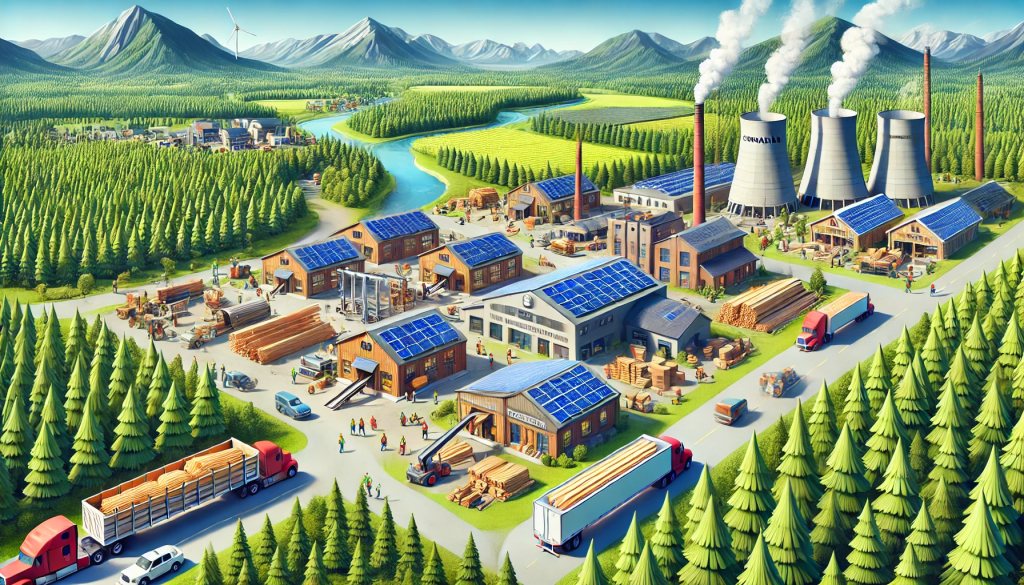
Supporting SMEs to move into value-added production requires targeted investment in several areas. First and foremost, SMEs need better access to funding. While large corporations negotiate multi-million-dollar subsidy deals with governments, small businesses often struggle to secure financing for research, infrastructure, and expansion. By redirecting public funds toward grants, low-interest loans, and cooperative funding models for SMEs, governments can ensure that public money stays within the Canadian economy. For example, small agricultural businesses could use this funding to process raw grain into plant-based protein products, while forestry SMEs could invest in engineered wood production for global markets. Much like Germany’s regional banks that provide financing tailored to small businesses, Canada could establish financial mechanisms that focus on the unique needs of SMEs.

Collaboration is another area where SMEs can thrive, given the right support. Unlike large corporations, which tend to centralize operations, SMEs naturally form networks of local producers, processors, and distributors. These networks could be further strengthened through government incentives for regional industry clusters. For instance, creating hubs where SMEs collaborate on processing critical minerals, manufacturing advanced materials, or producing green technologies would not only increase efficiency but also ensure that economic benefits are widely distributed. These clusters could also partner with universities and research institutions to develop cutting-edge products and processes, bridging the gap between innovation and commercialization.

A key advantage of SMEs is their ability to adapt quickly to changes in market demand and technology, something large corporations often struggle to do. This makes them ideal candidates for leading Canada’s transition to sustainable and green manufacturing. Many small businesses are already pioneering initiatives such as converting agricultural waste into bioplastics or developing renewable energy technologies. Investing in these efforts not only aligns with Canada’s climate goals but also positions the country as a leader in environmentally conscious production. Large corporations, by contrast, often prioritize short-term profits over sustainability, making them less reliable partners in achieving green economic growth.

Workforce development is also critical to supporting SMEs in building vertical supply chains. While large corporations may import expertise or automate jobs, SMEs are more likely to invest in training local workers. Expanding vocational programs and offering targeted apprenticeship opportunities for small businesses can ensure that Canadian workers have the skills needed for advanced manufacturing and value-added production. This approach would build a skilled workforce that remains tied to local communities, further anchoring economic growth. Again, Germany’s dual education system, which integrates apprenticeships with classroom training, offers a valuable model for Canada to emulate.

Focusing on SMEs allows Canada to build a strong national identity around its products. “Made in Canada” can become synonymous with quality, sustainability, and innovation if the country prioritizes small-scale, high-value production over raw commodity exports. Government branding initiatives and export incentives tailored to SMEs can open global markets for uniquely Canadian goods, from artisanal food products to cutting-edge clean technologies. Large corporations, by contrast, tend to dilute the national brand as they integrate Canadian resources into global supply chains, often leaving little trace of their origins.

Prioritizing SMEs over large corporations is not only a more equitable approach but also a more practical one. It minimizes dependency on multinational firms that can relocate at a moment’s notice and maximizes the long-term benefits of economic activity for Canadians. Germany’s Mittelstand has shown how a strong SME sector can build a resilient economy, drive innovation, and maintain global competitiveness. By adopting a similar model, Canada can transform its resource economy into a diversified, high-value manufacturing powerhouse. This strategy isn’t just about economics—it’s about reclaiming control over Canada’s future and ensuring that the wealth generated by its resources benefits the people who live here.

A Tale of Two Resource Economies: Alberta vs. Norway 

When it comes to managing the wealth derived from oil and gas, two regions stand out for their contrasting approaches: Norway (pop. 5.5million) and Alberta (pop. 4.9million). Both have harnessed their natural resources for economic growth, yet their strategies for licensing and managing these resources couldn’t be more different. The way each has handled its wealth offers key lessons in resource management, long-term planning, and the risks of relying too heavily on finite resources.

Norway: A Model of Prudence and Vision
Norway’s approach to managing its oil wealth is often hailed as a textbook example of responsible governance. Since the discovery of significant offshore oil reserves in the 1960s, Norway has been careful in extracting and managing its resources. Central to its success is the Government Pension Fund Global (GPFG), established in 1990 to invest surplus oil revenues for future generations. The Norwegian government adopted the principle of saving the vast majority of oil revenues, putting them into a sovereign wealth fund, which today is worth over $1.5 trillion USD.

But the key to Norway’s success is not just the size of its fund—it’s the disciplined, long-term vision that drives its policy. The fund is managed independently of the national budget, with only around 3% of its value being used each year to support government spending. The idea is to use oil wealth as a means to stabilize the economy, particularly during times of volatility in oil prices, while preserving it for future generations. The fund is diversified across global markets, ranging from equities and bonds to real estate, and is governed by a strict set of ethical guidelines that ensure investments align with environmental and social responsibility.

What stands out most about Norway’s resource licensing is its careful approach to development. The government has been strategic in its licensing policies, issuing permits in a way that balances long-term sustainability with economic growth. By managing resource extraction with an eye on long-term returns, Norway has avoided the so-called resource curse, a phenomenon that has plagued other oil-rich nations.

Alberta: A Cautionary Tale
Alberta, on the other hand, has taken a much less consistent approach to its oil and gas revenues. Since the 1970s, Alberta has been a major player in the global energy market, thanks to its vast reserves of oil sands. The province established the Heritage Savings Trust Fund in 1976, with the goal of saving a portion of its oil wealth for future generations. However, Alberta’s approach to managing this fund has been less disciplined than Norway’s.

The fund, now valued at around $19 billion CAD, has seen inconsistent contributions and, more often than not, withdrawals to cover the province’s operating expenses. This lack of long-term planning has led to missed opportunities for growth. When oil prices have been high, Alberta has relied heavily on resource revenue to fund public services, rather than investing for the future. This short-term approach has left the province vulnerable to the fluctuations in oil prices, with little in the way of a financial cushion to soften the blow during downturns.

Alberta’s resource licensing policies have also been marked by political expediency. The province has often prioritized immediate economic growth over long-term sustainability, leading to environmental concerns and a boom-bust economic cycle. Unlike Norway, which has been cautious in licensing new projects, Alberta has pushed forward with aggressive development, particularly in its oil sands sector. While this has spurred economic activity, it has also raised questions about the environmental costs and the wisdom of rapid, large-scale extraction.

Key Takeaways
The differences between Alberta and Norway are stark. Norway’s long-term vision, driven by a carefully managed sovereign wealth fund, stands in sharp contrast to Alberta’s more reactive, short-term approach. While both have abundant natural resources, it is Norway’s commitment to future generations, disciplined fund management, and cautious resource licensing that has helped it build a sustainable economic model. Alberta, in contrast, offers a cautionary tale of how reliance on resource wealth without long-term planning can leave a province exposed to the volatility of the global energy market.

As the world’s energy landscape continues to evolve, Alberta would do well to study Norway’s example—not just in terms of saving oil wealth but also in fostering a more sustainable approach to resource extraction and development. The future of resource economies will depend on the choices made today.

Universal Basic Income: A Catalyst for Equality and Economic Resilience

I was recently chatting with my youngest brother, who lives in a NE England coastal town, and he asked about Justin Trudeau’s resignation, and what was going to happen next. A Tory at heart, my sibling’s instincts are those of hard work, community service and fewer taxes.  We started to discuss “the next pandemic” and what could be done about the financial stress many people suffered during the COVID-19 event, and I mentioned Universal Basic Income (UBI) as a possible solution and long term game changer. He had never heard of UBI, and so I thought it was time for this post. This one’s for you, Bro! 

Universal Basic Income (UBI) represents one of the most transformative policy ideas of our time, offering a practical solution to poverty, inequality, and the economic challenges of the 21st century. More than just a tool to address immediate financial hardship, UBI is a blueprint for fostering fairness, stability, and shared prosperity.

At its core, UBI guarantees every citizen a regular, unconditional income, free from the inefficiencies and stigmatization of traditional welfare systems. This simple, yet revolutionary concept ensures that no one is left without the means to secure basic necessities such as food, housing, and healthcare. UBI lifts individuals out of poverty, empowering them to make choices that improve their well-being and build resilience against life’s uncertainties.

A Revenue-Neutral Model for UBI
Critics often argue that UBI is financially unsustainable, but innovative approaches like those proposed by UBI Works demonstrate that it can be funded in a revenue-neutral way. The UBI Works model suggests targeted taxation on sectors and activities that can contribute more to public welfare without burdening the average taxpayer. For example, the proposal includes a 4% tax on profits and a 3% tax on remuneration within the financial sector—an industry that benefits significantly from economic activities.

Additionally, UBI Works advocates for closing tax loopholes and tackling tax evasion, ensuring corporations and wealthy individuals contribute their fair share. This model not only provides a sustainable funding mechanism for UBI, but also reinforces principles of fairness in the tax system.

Stimulating Economic Growth and Jobs
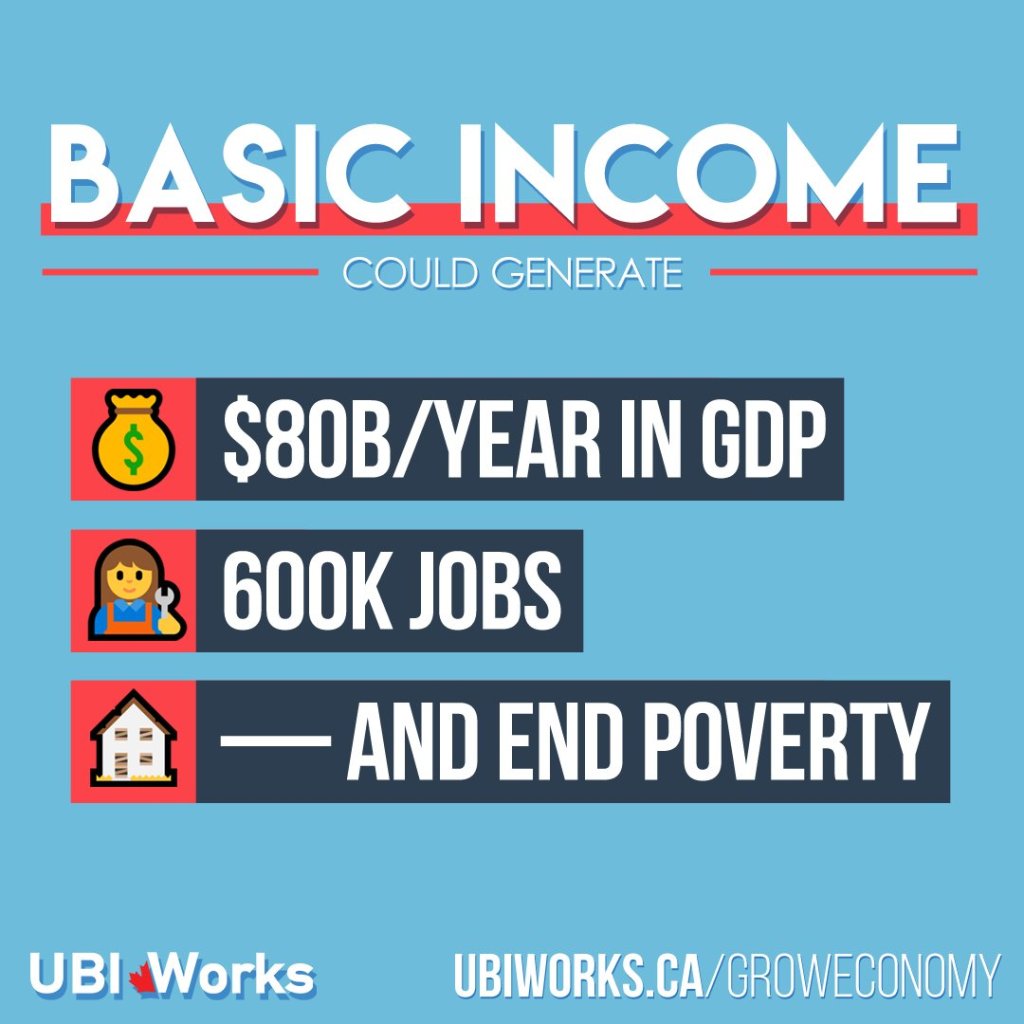
From a supply-and-demand perspective, UBI has the potential to be an economic game-changer. By boosting consumer purchasing power, UBI drives demand for goods and services, spurring business growth and job creation. Research by the Canadian Centre for Economic Analysis projects that a UBI program in Canada could grow the economy by $80 billion annually and add 600,000 jobs, all while eliminating poverty nationwide.

On the supply side, UBI offers workers the flexibility to pursue education, training, or entrepreneurial ventures, aligning their skills with roles they are passionate about rather than accepting exploitative or mismatched jobs out of financial desperation. This not only improves individual well-being but also enhances productivity across the economy.

A Tool for Equity and Resilience
As technological disruption, automation, and globalization continue to reshape labor markets, UBI provides a much-needed safety net. It equips individuals to navigate a rapidly changing economic landscape, enabling them to invest in themselves without the constant fear of financial ruin. At the same time, UBI reduces income inequality and promotes social cohesion by narrowing the wealth gap and fostering a more equitable distribution of resources.

Critically, UBI shifts the focus from reactive welfare systems to proactive empowerment. It eliminates the stigma and inefficiencies of means-tested programs while ensuring everyone benefits from a guaranteed income floor. This universal approach builds trust and unity within society, creating a stronger, more inclusive social fabric.

A Bold Vision for the Future
Universal Basic Income is more than an economic policy—it’s a statement of values. It asserts that every individual, regardless of circumstance, deserves dignity, security, and opportunity. By adopting a revenue-neutral model, UBI proves that fairness and sustainability can go hand in hand.

As the world grapples with inequality, economic volatility, and the social challenges of the 21st century, UBI offers a bold yet practical solution. It envisions a future where poverty is eliminated, opportunity is universal, and every citizen has the means to lead a secure and fulfilling life. UBI is not just a policy—it’s a pathway to a just and prosperous society.