Pride Without the Glitter: Why Canada’s Queer Community is Reclaiming Its Roots

There’s a quiet, but growing conversation taking place within Canada’s queer communities, one that asks whether it might be time to scale back the spectacle of Pride, and get back to what it was really about in the first place. The parades are still colourful, the parties still loud, but something’s shifting. With corporate sponsorship drying up and the political climate growing colder, many in the 2SLGBTQIA+ community are rethinking what Pride should look like in this new era.

For years, Pride events in cities like Toronto, Vancouver, and Montreal have felt less like grassroots activism, and more like mobile advertising campaigns. Walk down the route and you’ll see branded floats from banks, telcos, and beer companies. TD Bank, to name just one example, once earned applause for being an early supporter of queer inclusion, but these days, its giant green float can feel more like marketing than allyship. Many of us, especially those who’ve been around long enough to remember when participating in a Pride parade involved appreciable risk, can’t help but feel the soul has been somewhat bleached out of the rainbow.

Image source: Catalina Vásquez on Behance

Part of the shift is financial. With the Trump-era backlash and culture wars bleeding across the border, some corporations, particularly U.S.-based multinationals, are scaling back their public-facing support of Pride. In 2024, Reuters reported that global brands have “significantly reduced” their LGBTQ-themed campaigns in markets like Canada to avoid conservative backlash. These decisions affect more than just parade floats; they impact grants, community programming, and the broader financial ecosystem that’s supported major Pride festivals for years.

Yet, this isn’t necessarily bad news. In fact, many long-time activists see it as an opportunity to re-centre Pride around the people it’s meant to serve. Before there were glitter canons and wristbands with logos, Pride was a protest. The first Canadian marches, in the wake of the 1981 Toronto bathhouse raids, were acts of raw defiance, calling out police brutality and demanding civil rights. Nobody was handing out swag. No corporations were clambering to associate their brand with queer people. That history matters.

Now, with funding drying up and public support shifting, a new generation of organizers is looking backward to move forward. Smaller Pride celebrations are cropping up across the country that focus less on parade floats and more on community picnics, protest marches, zine fairs, and teach-ins. In places like Peterborough and Hamilton, organizers have made the deliberate choice to scale down the main event in favour of something that feels more connected, less commercial.

We’re at a cultural crossroads. Pride doesn’t need to be louder to be more meaningful. In fact, the moment may call for exactly the opposite. There’s power in returning to the grassroots, not out of nostalgia, but out of necessity. If Pride becomes less about the glitter and more about the grit again, that might just be the most radical thing we’ve done in decades.

Sources
• CBC News (June 2024): “Pride organizers across Canada reassess role of corporate sponsorship”
• Reuters (June 2024): “Global brands rethink LGBTQ marketing amid backlash”
• Xtra Magazine (May 2023): “The Fight Over Pride: Protest or Party?
• The Canadian Encyclopedia (2022): “How the Bathhouse Raids Sparked Toronto Pride”

By-Elections Signal Alberta’s Political Crossroads

The results of Alberta’s three provincial by-elections on June 23, 2025, offer more than simple electoral bookkeeping, they reflect shifting political winds across urban and rural divides, growing challenges for the governing United Conservative Party (UCP), and the solidifying leadership of Alberta NDP Leader Naheed Nenshi. While each race had its own dynamics, taken together, they sketch the early contours of the province’s next political chapter.

In Edmonton-StrathconaNaheed Nenshi secured a commanding victory, winning approximately 82% of the vote. This was no surprise, Strathcona has long been an NDP stronghold, but the size of the margin reaffirmed Nenshi’s appeal among urban progressives. More importantly, it granted the former Calgary mayor a seat in the legislature, allowing him to move from campaign trail rhetoric to legislative combat. For the NDP, this is a strategic milestone. Having a leader with Nenshi’s profile and cross-city recognition seated in the Assembly provides the party with both visibility and gravitas as it prepares to challenge Danielle Smith’s UCP in the next general election.

Meanwhile, Edmonton-Ellerslie delivered a more muted result for the NDP. While Gurtej Singh Brar held the seat for the party, the margin narrowed noticeably compared to previous elections. The UCP candidate, Naresh Bhardwaj, ran a stronger-than-expected campaign, capturing a significant share of the vote. This tightening suggests that even in NDP-leaning urban ridings, voter allegiance cannot be taken for granted. It also indicates that the UCP’s message still resonates with parts of the city’s electorate, particularly among working-class and immigrant communities whose support is increasingly contested territory.

The race in Olds-Didsbury-Three Hills played out very differently. As expected, the UCP retained this rural seat, with Tara Sawyer taking over from long-time MLA Nathan Cooper. However, the UCP’s vote share dropped markedly from the 75% it earned in the 2023 general election to around 61%. More striking was the performance of the Republican Party of Alberta (RPA), whose candidate Cameron Davies captured nearly 20% of the vote. The NDP surprisingly edged out the RPA for second place, though rural Alberta remains largely out of reach for them. The RPA’s strong showing, however, is cause for concern within the UCP’s rural flank. Separatist and hard-right discontent, once marginal, is becoming a disruptive force capable of peeling away conservative votes.

Together, these results underline a growing polarization in Alberta politics. The urban-rural split is hardening, with Edmonton increasingly dominated by the NDP and rural ridings remaining UCP strongholds, though now with visible fractures. The UCP retains power, but the by-elections exposed soft spots, especially in its ability to hold urban constituencies and suppress internal dissent from the right. Nenshi’s formal arrival in the legislature sets the stage for a more dynamic opposition, with a leader who brings both charisma and executive experience. His challenge now will be expanding the NDP’s base beyond its urban comfort zone while navigating the complex economic and cultural anxieties shaping Alberta’s electorate.

The by-elections may not have changed the balance of power in the legislature, but they altered the strategic terrain. What was once a contest between entrenched camps now feels more fluid, volatile, and competitive. That should make both major parties pause, and prepare.

Sources
CTV News Edmonton: https://www.ctvnews.ca/edmonton/article/alberta-ndp-leader-nenshi-wins-seat-in-one-of-three-byelections
The Albertan: https://www.thealbertan.com/olds-news/tara-sawyer-wins-olds-didsbury-three-hills-byelection-10853458
The Hub: https://thehub.ca/2025/06/24/a-win-a-warning-and-a-wobble-in-albertas-byelection-results

Backroom Ontario: How the Ford Government Governs in the Shadows

The Ford government’s recent actions paint a troubling portrait of a leadership increasingly comfortable with obfuscation, procedural shortcuts, and performative consultation. Across multiple files, from environmental policy to Indigenous relations, Queen’s Park has displayed a consistent pattern of backhanded governance, marked by secrecy, evasion, and a disregard for both democratic norms and legal obligations.

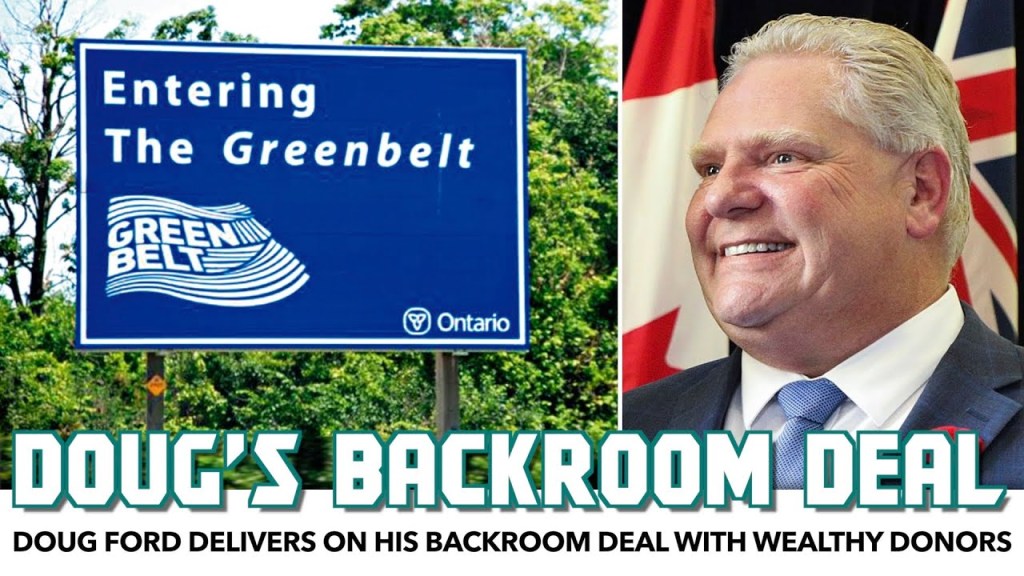
The Greenbelt scandal exemplifies this tendency in sharp relief. Ontario’s Information and Privacy Commissioner recently condemned the Ford government for deliberately making it difficult to track internal decision-making on land development. Staff used code words such as “GB,” “special project,” and most egregiously, “G*” in email subject lines, deliberately sabotaging searchability within the government’s own filing systems. Coupled with the use of private email accounts and a notable absence of meeting minutes or documentation, the evidence suggests not mere carelessness, but a concerted effort to obscure deliberations over one of the province’s most politically explosive issues.

This level of secrecy isn’t just bureaucratic mismanagement, it’s political damage control in real time. The government’s reversal of Greenbelt development plans did little to reassure the public, especially in the absence of any credible explanation or documentation as to how those decisions were made in the first place. When even watchdogs with statutory authority can’t access the paper trail, public accountability becomes a hollow phrase.

Meanwhile, Bill 5, part of the so-called “Unleashing the Economy Act”, reveals an equally unsettling willingness to bypass consultation and oversight in the name of economic development. This omnibus legislation fast-tracks industrial and mining projects across northern Ontario, including the ecologically sensitive Ring of Fire region, by reducing or eliminating requirements for municipal and environmental approvals. Most critically, it sidelines the constitutional duty to consult Indigenous communities.

First Nations leaders, particularly in Treaty 9 territory, were quick to denounce the bill. Chiefs burned environmental documents in protest and staged rallies in Thunder Bay, accusing the province of engaging in “consultation theatre”, informing communities of decisions only after they were made. Even a last-minute amendment to include optional post-passage consultations did little to mollify concerns. The government’s approach sends a clear message: consultation is something to be endured, not engaged.

What ties the Greenbelt and Bill 5 controversies together is not just their shared disregard for transparency and inclusion, but the mechanisms used to enforce that disregard. Whether through technical manipulation of record-keeping systems, suppression of documentation, or legislative sleight-of-hand, the government repeatedly avoids open debate and sidesteps legal and ethical responsibilities. It’s a governance style rooted in control, not collaboration.

These are not isolated incidents. The Ford administration has shown a consistent pattern of centralizing power through Minister’s Zoning Orders (MZOs), a tool meant for rare and urgent cases. Since 2019, the Premier has issued MZOs at an unprecedented rate, frequently overriding municipal decisions, and benefiting well-connected developers. Auditor General reports have raised red flags, and opposition parties have warned that such orders erode local democracy and set dangerous precedents. Still, the pattern continues, unimpeded.

Other examples confirm the trend. In 2018, the Ford government launched a controversial “snitch line” encouraging parents to report teachers who used an updated sex-ed curriculum, a move widely condemned as punitive and authoritarian. In 2019, sudden changes to autism services blindsided thousands of families, leading to mass protests and eventual policy reversals. Yet, even in those reversals, the government refused to acknowledge fault, framing retreats as “adjustments” rather than admissions of flawed policy-making.

This is politics by backchannel, a deliberate erosion of democratic norms dressed in the language of efficiency. Public engagement is reduced to afterthought; opposition voices are ignored or demonized; and when watchdogs raise the alarm, they are met with silence or spin. In each case, the common denominator is the Ford government’s willingness to weaponize the machinery of governance against transparency.

The implications are serious. Trust in institutions erodes when those in power show contempt for the very mechanisms designed to hold them accountable. The duty to consult Indigenous communities is not an optional courtesy, it is a constitutional requirement. Environmental stewardship and municipal autonomy are not bureaucratic hurdles, they are democratic protections. To dismiss them is not just arrogant, but reckless.

Unless reined in, this mode of governance threatens to become normalized. The lesson emerging from Queen’s Park is clear: when political expedience trumps process, communities lose their voice, environmental safeguards are gutted, and Indigenous sovereignty is sidelined. This should alarm all Ontarians, regardless of political stripe.

The Ford government’s backhanded approach may win short-term headlines or developer applause, but the long-term costs, to transparency, legitimacy, and public trust, are steep. If Ontario is to retain even the appearance of responsible government, it must reject this cynical model and restore meaningful consultation, clear record-keeping, and respect for constitutional obligations as non-negotiable principles of provincial governance. Anything less is a betrayal of public service.

Albertans Choose Stability Over Separation: What the Pension Rejection Really Means

When the Alberta government finally released the long-awaited results of a commissioned survey on the Alberta Pension Plan (APP), the findings spoke volumes. Nearly two-thirds of Albertans (63%), rejected the idea of replacing the Canada Pension Plan with a provincial version. The number supporting an APP? Just 10%. That’s not just a policy rejection; it’s a political reality check.

For all the heated rhetoric around Alberta’s place in Confederation, this result reinforces what many longtime observers have suspected: Albertans may be frustrated, but they’re not fools. They know a good thing when they see it, and the CPP, with its portability, investment scale, and intergenerational reliability, is exactly that. The pensions issue cuts across partisan lines and ideological bluster. It’s not about Trudeau or equalization. It’s about people’s futures, and the people have spoken.

What’s more striking is how this undercuts the oxygen feeding Alberta separatism. The idea of a provincial pension plan was floated not just as fiscal policy, but as a marker of provincial autonomy, even sovereignty. It was pitched as a way to “keep Alberta’s money in Alberta.” Yet, when the chips were down, Albertans didn’t bite. The same population that occasionally flirts with separation talk has no appetite for tearing up foundational institutions like the CPP.

Even Premier Danielle Smith, no stranger to courting Alberta-first narratives, quickly distanced herself from the APP following the release of the data. There’s no referendum planned, no legislative push, just a quiet shelving of an unpopular idea. It’s a clear sign that even among the UCP leadership, there’s recognition that the political capital required to pursue this agenda simply doesn’t exist.

The APP result also aligns with a broader trend we’re seeing in regional sentiment polling. Despite pockets of separatist energy, especially in reaction to federal climate policy, most Albertans prefer reform within Canada to rupture. A recent Angus Reid survey found that only 19% of Albertans would “definitely” vote to leave Canada, while three-quarters believed a referendum would fail. The rhetoric is louder than the resolve.

This doesn’t mean western alienation is a myth. Far from it. Economic frustrations, federal-provincial disputes, and the sense of being politically outvoted still resonate deeply in Alberta. But the reaction isn’t revolution, it’s recalibration. What Albertans appear to want is a stronger voice in a better Canada, not a lonely march toward the exits.

There’s a deeper lesson here, too. Identity politics and economic nationalism may be good for stirring the base, but when policies collide with kitchen-table concerns, like pensions, voters choose the pragmatic over the symbolic. Separatism, in Alberta’s case, has become less of a movement and more of a mood. And moods change when the numbers hit home.

At its core, the rejection of the APP is a reaffirmation of Canadian federalism. Not the perfect, polished version dreamed of in civics classes, but the messy, functional, deeply embedded version that shows up in every paycheque and retirement plan. That version still has teeth. And Albertans, whatever else they may say about Ottawa, just voted to keep it.

Five Things We Learned This Week

Here’s the fresh edition of “Five Things We Learned This Week” for June 14–20, 2025, featuring entirely new events—no repeats from earlier editions:

🕊️ 1. Israel‑Iran Exchanges Calm Markets, Not Conflict

• Despite new strikes and missile exchanges during the week of June 14‑20, Reuters reports that markets showed cautious optimism, with volatility easing amid hope for de-escalation  .

• The Federal Reserve maintained a hawkish stance, while the Swiss National Bank cut rates to zero, and the Bank of Japan adopted a dovish tone  .

🦶 2. Ancient New Mexico Footprints Confirm Earlier Human Arrival

• Radiocarbon dating of sediments around the White Sands fossil footprints confirms they are between 20,700–22,400 years old  .

• This consolidates evidence that humans were present in North America well before the previously estimated timelines.

🇺🇸 3. Mass ICE Raids Trigger Protests, National Guard Deploys in LA

• On June 6–9, mass ICE operations in Los Angeles spurred protests and unrest. California activated over 4,100 National Guard troops plus federal forces in response   .

• Over 575 arrests, injuries among police/officers, and journalists were reported, spotlighting tensions around deportation enforcement .

🇹🇭 4. Thai Coalition Government Cracks in Political Crisis

• As of June 18, Thailand’s 8‑minister Bhumjaithai Party exited the ruling coalition, citing scandal and a leaked call—threatening PM Shinawatra’s government  .

• This marks a sharp political shift and potential for early elections amid instability.

💡 5. AI-Driven Tech Fights Mosquito‑Borne Diseases

• Researchers at the University of South Florida unveiled an AI-enabled mosquito trap that identifies and targets disease‑carrying mosquitoes in real time, reported on June 11   .

• The innovation offers a promising, focused approach to reduce transmission of illnesses like Zika and dengue.

These five items—spanning geopolitics, archaeology, civil unrest, national politics, and health tech—are all within June 14–20 and entirely new to this series. Let me know if you’d like full article links or expanded analysis!

Lansdowne Park: A Case Study in Public-Private Partnership Failure

In the heart of Ottawa lies Lansdowne Park, a public asset that has undergone over a decade of controversial redevelopment under the banner of public-private partnerships (P3). Initially hailed as a visionary collaboration between the City of Ottawa and the Ottawa Sports and Entertainment Group (OSEG), Lansdowne has instead become a cautionary tale; an emblem of how private interests can hijack public value, with taxpayers left holding the bill. Despite grand promises of economic revitalization, self-sustaining revenues, and community benefit, the Lansdowne project has consistently failed to deliver on its core goals.

The Origins: Lansdowne 1.0 and the Rise of the P3 Model
The current saga began in 2007, when structural concerns forced the closure of Frank Clair Stadium. In response, the City sought partners to reimagine Lansdowne as a revitalized hub for sports, entertainment, and urban life. The resulting Lansdowne Partnership Plan (LPP), approved in 2010, was a no-bid, sole-source agreement with OSEG. It created a 30-year limited partnership through which OSEG would refurbish the stadium, build retail and residential developments, and share profits with the City through a revenue “waterfall” model.

The City’s share of the original $362 million redevelopment was around $210 million, used for stadium upgrades, a new urban park, parking facilities, and relocating the historic Horticulture Building. OSEG contributed roughly $152 million, not as direct capital, but largely through operational losses rolled back into the project in exchange for an 8% return on equity. The land remained public, but OSEG was granted long-term leases for commercial components, at just $1 per year.

A Financial Model Built on Sand
The P3 structure was sold to the public with the assurance that Lansdowne would eventually pay for itself. Early forecasts predicted a $22.6 million net return to the City. In reality, those profits never materialized. Retail revenues rose steadily, but so did costs. By 2016, OSEG was reporting $14.4 million in losses. As of 2023, the partnership had not returned a cent to municipal coffers. The revenue waterfall prioritized OSEG’s return on equity before any surplus could flow to the City, meaning taxpayers bore the financial risk, while private partners had guaranteed returns.

Worse, the project locked the City into a complex financial structure that made renegotiation difficult. The Auditor General of Ottawa has since criticized the model, citing opaque accounting and a lack of oversight over cost estimates and projections.

Lansdowne 2.0: Doubling Down on a Broken System
Rather than reassess the underlying flaws of Lansdowne 1.0, the City has pressed forward with an even more ambitious sequel: Lansdowne 2.0. Approved by Council in 2023, this next phase proposes to demolish and rebuild the north-side stadium stands, construct a 5,500-seat event centre, and erect two residential towers atop a retail podium. The estimated cost is $419 million, with over $300 million of that funded by the City through new debt.

Despite lessons from the past, the same P3 framework persists. The City continues to rely on OSEG’s management and forecasts, despite repeated underperformance. Recent findings from the Auditor General suggest that construction costs may be underestimated by as much as $74.3 million, bringing the actual cost closer to half a billion dollars.

Community Concerns Ignored
One of the most damning aspects of the Lansdowne saga has been its consistent disregard for community needs. Neither Lansdowne 1.0 nor 2.0 includes affordable housing. This, in the midst of a housing crisis, is a glaring omission. Public green space will be reduced by more than 50,000 square feet in Lansdowne 2.0. Traffic and parking concerns persist, especially given the site’s poor access to Ottawa’s light rail system.

Environmental groups have flagged the project for increasing the urban heat island effect and ignoring climate resilience standards. Ecology Ottawa and other watchdogs note that the loss of mature trees, additional hard surfaces, and energy-intensive stadium lighting run counter to the City’s own climate goals.

Public feedback has been overwhelmingly negative. A survey by the advocacy group Better Lansdowne found that 77% of respondents opposed the new plan. Critics have called for a full reassessment, independent cost-benefit analysis, and alternative development models that prioritize public use and affordability.

The Broader P3 Problem
The Lansdowne project exemplifies the risks inherent in the P3 model. When private partners are guaranteed returns and public entities assume the risk, the result is rarely equitable or efficient. While the private sector pursues profit, as it must, government has a duty to prioritize public interest. In this case, the lines blurred, and profit came first.

Public-private partnerships are often promoted as a way to leverage private investment for public good. Yet in practice, they can enable private actors to extract value from public land and public funds, with minimal accountability. Lansdowne is a textbook case of this imbalance.

Time to Reclaim Public Space
As Ottawa moves forward, the Lansdowne experience should serve as a clear lesson: public infrastructure must be publicly driven. The City needs to step back, reassess its relationship with OSEG, and consider alternative models that place public interest at the centre. This could include establishing a municipal development corporation, returning retail management to the City, and mandating affordable housing in all new residential builds.

If Lansdowne Park is truly to be the “people’s place” as once envisioned, it must serve the city, not subsidize private profit. The future of Ottawa’s public assets depends on getting this right.

Sources
• Ottawa City Council Reports, 2023–2025 – ottawa.ca
• Ottawa Auditor General Report, June 2025 – link2build.ca
• Better Lansdowne Community Survey – betterlansdowne.ca
• Ecology Ottawa – ecologyottawa.ca
• Ottawa Business Journal Archives – obj.ca
• Lansdowne Park Redevelopment History – en.wikipedia.org

Canada’s Strategic Shift: Weighing the Costs and Benefits of Joining Europe’s ReArm Program

Canada’s decision to signal its intention to join Europe’s ReArm initiative marks a significant pivot in its strategic and procurement priorities, with implications that extend well beyond the defense sector. This pan-European effort, catalyzed in the wake of Russia’s invasion of Ukraine and the shifting tenor of transatlantic politics, aims to coordinate defense procurement, scale industrial capacity, and strengthen European security autonomy. For Canada, a non-European NATO member with strong ties to both the U.S. and Europe, alignment with ReArm offers both substantial opportunity and strategic complexity.

At the forefront of the appeal is diversification. Canada has long relied on the United States for upwards of 75% of its military procurement. While the U.S. – Canada defense relationship, particularly through NORAD, remains indispensable, the risks of a politically volatile or inward-focused Washington have grown. Europe’s response, particularly Germany’s ramped-up defense commitments, and the €800 billion EU proposal to stimulate continental arms production, presents an alternative axis of reliability. Canada’s participation could signal to both NATO allies and global partners that it seeks greater resilience in its defense posture.

One of the most concrete areas of cooperation could lie in the domain of submarine procurement. The CBC reports that Canada is exploring options for the German-Norwegian Type 212CD submarine, a next-generation conventional submarine being co-developed by ThyssenKrupp Marine Systems and Kongsberg. This class boasts extended underwater endurance through air-independent propulsion and quiet operation ideal for Arctic patrols, long a capability gap in Canadian naval strategy. The possibility of Canada becoming a formal partner in the 212CD project would not only address its aging Victoria-class fleet but also create industrial synergies through potential domestic assembly and technology transfer agreements.

Beyond submarines, ReArm opens the door to collaborative fighter jet production. Canada’s inclusion in discussions around final assembly of Swedish Saab Gripen fighters suggests that Ottawa is seeking industrial offset opportunities beyond its existing Lockheed Martin F-35 commitments. These talks, while preliminary, reflect a desire to reassert domestic defense manufacturing after years of outsourcing.

Still, the risks are considerable. Aligning procurement strategies with European standards could create friction in interoperability with American systems, particularly relevant given NORAD modernization and Canada’s Arctic commitments. There is also the question of cost. Canada’s new defense policy promises to increase military spending to 1.76% of GDP by 2030, a notable jump, but still short of NATO’s 2% target. Adding ReArm investments could strain the federal budget, and force trade-offs in domestic priorities.

Geopolitically, joining a European initiative risks being interpreted in Washington as a soft decoupling. While this may be overstated, managing the optics with U.S. defense officials will require careful diplomacy. At the same time, any major procurement projects pursued under ReArm would need to be justified as both value-for-money, and strategically essential in a Canadian context.

ReArm represents a chance for Canada to assert greater agency in its defense strategy, while leveraging European innovation and industrial momentum, but this is no risk-free proposition. Ottawa will need to walk a careful line: embracing new partnerships without compromising old ones, and ensuring that each procurement project is grounded in long-term strategic logic, not simply in search of novelty.

Five Things We Learned This Week

Here is the latest edition of “Five Things We Learned This Week” for May 31–June 6, 2025, highlighting significant global developments across various sectors.

🧬 1. Breakthrough in HIV Treatment Using mRNA Technology

Researchers have achieved a significant milestone in HIV treatment by successfully delivering mRNA into white blood cells that harbor hidden HIV. Utilizing specially formulated nanoparticles known as LNP X, the mRNA instructs these cells to reveal the concealed virus, marking a pivotal step toward a potential cure. This advancement opens new avenues for eradicating latent HIV infections that have long evaded traditional therapies.  

🚀 2. China’s Tianwen-2 Asteroid Mission Launches Successfully

On May 28, the China National Space Administration successfully launched the Tianwen-2 mission aboard a Long March 3B rocket. This ambitious endeavor aims to collect samples from the near-Earth asteroid 469219 Kamoʻoalewa and explore the main-belt comet 311P/PANSTARRS. The mission underscores China’s growing capabilities in deep-space exploration and its commitment to advancing planetary science.  

 3. MIT Develops High-Energy Sodium-Air Fuel Cell

Engineers at the Massachusetts Institute of Technology have developed a new type of fuel cell that utilizes a reaction between sodium metal and air. This innovative design offers three times the energy per pound compared to the best current lithium-ion batteries, potentially revolutionizing energy storage for electric vehicles and aviation. The breakthrough could lead to lighter, more efficient power sources, accelerating the transition to cleaner transportation technologies.  

🏆 4. Brittany Force Sets Speed Record at NHRA New England Nationals

At the NHRA New England Nationals, drag racer Brittany Force delivered a remarkable performance, setting a new speed record in the Top Fuel category. Her achievement highlights the ongoing advancements in drag racing technology and the increasing competitiveness of the sport. Force’s success also emphasizes the growing prominence of female athletes in motorsports.  

 5. Major League Soccer Hosts 13 Matches in a Single Day

On May 24, Major League Soccer (MLS) featured an unprecedented lineup of 13 matches across the United States. This action-packed day showcased the league’s depth and the growing popularity of soccer in North America. Fans were treated to a full spectrum of competition, reflecting MLS’s commitment to expanding its reach and enhancing the spectator experience.  

Stay tuned for next week’s edition as we continue to explore pivotal global developments.

Mr. Carney, Let’s Be Bold and Smart: A Revenue-Neutral Universal Basic Income Is Within Reach

The election of Mark Carney as Canada’s new Prime Minister marks more than a changing of the guard, it signals a chance to transform how we think about economic justice, social policy, and the role of government in a post-pandemic, post-carbon, AI-disrupted world. Yet, if this new Liberal administration wants to do more than manage decline or tinker at the edges, it must champion Universal Basic Income (UBI), and it must do so within this first term.

To skeptics, the usual pushback is cost. “We can’t afford it.” But what if I told you we can, without adding a cent to the deficit?

A bold, revenue-neutral UBI is not only possible, it’s the smart, responsible, and forward-thinking choice. It would simplify our bloated patchwork of social programs, reduce inequality, and stabilize the economy, all while respecting fiscal realities. Carney, with his reputation for monetary prudence and social conscience, is uniquely positioned to make this happen.

The Case for UBI, Now More Than Ever
We live in precarious times. AI and automation are displacing jobs once thought secure. The gig economy has redefined work for an entire generation, offering flexibility but no stability. Climate change is reshaping our industries, economies, and communities. And regional inequalities, from rural depopulation to urban housing crises, are deepening social division.

UBI provides a powerful, simple solution: a no-strings-attached income that ensures every Canadian can meet their basic needs, make real choices, and live with dignity. No complex eligibility criteria. No stigma. Just a stable foundation for all.

This isn’t a call for endless spending. This is a plan for smart reinvestment, one that replaces outdated, fragmented systems with a coherent, efficient, and humane approach.

Revenue-Neutral UBI: A Practical Path
The key to political and economic viability is fiscal neutrality. Here’s how we get there:

Streamline the Social Safety Net
Our current welfare architecture is costly, overlapping, and often punitive. We propose replacing core income support programs, provincial social assistance, EI for low-wage workers, and a range of targeted income-tested tax credits, with a single, universal UBI. This simplification reduces administrative duplication and restores dignity to recipients.

Rethink OAS and GIS
These seniors’ programs already operate as a basic income for the elderly. By integrating them into a universal model, with UBI replacing these benefits for most, but supplemented by needs-based top-ups for seniors with unique medical or housing costs, we ensure fairness without duplication.

Restructure (Not Eliminate) CPP
CPP remains essential as a pension earned through contribution, but some recalibration of contribution thresholds and benefit tiers, alongside UBI, can reduce reliance on inflated public pensions to cover basic needs, while preserving the contributory principle.

Modest, Targeted Tax Reform
To close the revenue loop, introduce a small surtax (e.g., 2%) on individual incomes over $150,000, and slightly increase capital gains inclusion rates. These are not radical measures, they simply ask the wealthiest Canadians to help ensure every citizen has a secure foundation. For 95% of taxpayers, no increase would be necessary.

Numerous economic models (including work by Evelyn Forget, UBC’s Kevin Milligan, and CCPA researchers) show that a well-designed UBI can be nearly or entirely self-funding when paired with smart policy adjustments like these.

Political Opportunity and Liberal Legacy
Prime Minister Carney doesn’t need to look far for historical inspiration. Universal healthcare, bilingualism, the Charter, these were all ambitious Liberal achievements once considered politically risky and fiscally daunting, yet they reshaped Canada.

UBI can be his legacy. It would resonate across voter blocs: rural Canadians seeking stability, urban millennials burdened by debt and housing costs, women and caregivers locked out of full-time work, and gig workers with no safety net. It’s a unifying policy in a fragmented nation.

Moreover, by leading with a revenue-neutral model, Carney can neutralize opposition from deficit hawks and centrists, while winning support from social democrats, Indigenous leaders, environmentalists, and the entrepreneurial class alike.

A Step-by-Step Roadmap

  • Launch a National UBI Task Force in the first 100 days, chaired by experts in economics, social policy, and Indigenous governance.
  • Table a UBI White Paper by the end of Year 1, outlining fiscal models, legal changes, and implementation scenarios.
  • Pilot the program in a representative region (e.g., Northern Ontario, Atlantic Canada, or an urban-rural mix) with independent evaluation.
  • Introduce legislation in Year 3, with phased implementation beginning before the 2029 election.

This is not pie-in-the-sky. This is responsible governance meeting bold vision.

The Values We Must Uphold
UBI is about more than money, it’s about modernizing our social contract. It says to every Canadian: you matter. You are not a cost, a case file, or a problem to manage. You are a citizen with rights, worth, and potential.

Mr. Carney, you’ve spoken eloquently about “values-based capitalism” and “inclusive transitions.” UBI is the policy vehicle that delivers on those values. And by designing it to be fiscally neutral, you can bring the skeptics along without compromising ambition.

Now is the time to lead not just with caution, but with courage. We can afford Universal Basic Income, not in spite of economic constraints, but because of them.

Let’s stop managing poverty. Let’s start guaranteeing security. Let’s build a Canada where no one is left behind.

Five Things We Learned This Week

Here is the latest edition of “Five Things We Learned This Week” for May 24–30, 2025, highlighting significant global developments across various sectors.

🧠 1. AI Threatens to Displace Half of White-Collar Jobs

Dario Amodei, CEO of AI firm Anthropic, has warned that artificial intelligence could eliminate up to 50% of entry-level white-collar jobs within the next five years. Tasks such as document summarization, report analysis, and computer coding are increasingly being performed by AI at levels comparable to a smart college student. Amodei predicts that U.S. unemployment rates could reach 20% by 2030 if proactive measures aren’t taken. He advocates for policy interventions, including taxing AI labs, to mitigate potential economic disruptions.  

🏗️ 2. Kmart Announces $500 Million Fulfillment Center in Australia

Kmart has unveiled plans to invest $500 million in constructing a new 100,000 square meter Omnichannel Fulfillment Centre at ESR’s Intermodal Precinct in Moorebank, Australia. Scheduled for completion by the end of 2027, the facility aims to modernize logistics, enhance supply chains, and support Kmart’s $20 billion revenue goal over the next decade. The project is expected to create over 1,300 jobs during its construction and operational phases.  

🇲🇳 3. Political Turmoil Escalates in Mongolia

Mid-May saw the onset of sustained protests in Ulaanbaatar, Mongolia, with demonstrators calling for the resignation of the prime minister over corruption allegations involving his family. On May 21, the ruling Mongolian People’s Party expelled the Democratic Party from the coalition government after several of its lawmakers supported the protests, effectively dissolving the coalition less than a year after its formation.  

🎶 4. Rio de Janeiro Hosts Massive Free Music Festival

The “Todo Mundo no Rio” (Everyone in Rio) music festival transformed Copacabana Beach into a massive stage, attracting over 2.1 million attendees. The event featured performances by international artists and is part of a series of annual megashows promoted by the City of Rio de Janeiro to establish May as a month of cultural celebration.  

🧬 5. Advancements in Gene Editing with CRISPR 3.0

Scientists have developed CRISPR 3.0, a new gene-editing technique that allows for highly precise DNA edits without causing unintended mutations. This advancement holds promise for curing genetic disorders and advancing personalized medicine by enabling more accurate and safer genetic modifications.  

Stay tuned for next week’s edition as we continue to explore pivotal global developments.