Canada’s Non-Timber Forest Products Industry: A Sleeping Giant in the Agrifood Sector

Back in 2010-2012, I was working with clients such as the Canadian Model Forest Network, Agriculture and Agri-Food Canada, and Natural Resources Canada to help define and develop this industry. I thought it was time to update myself on its progress.  

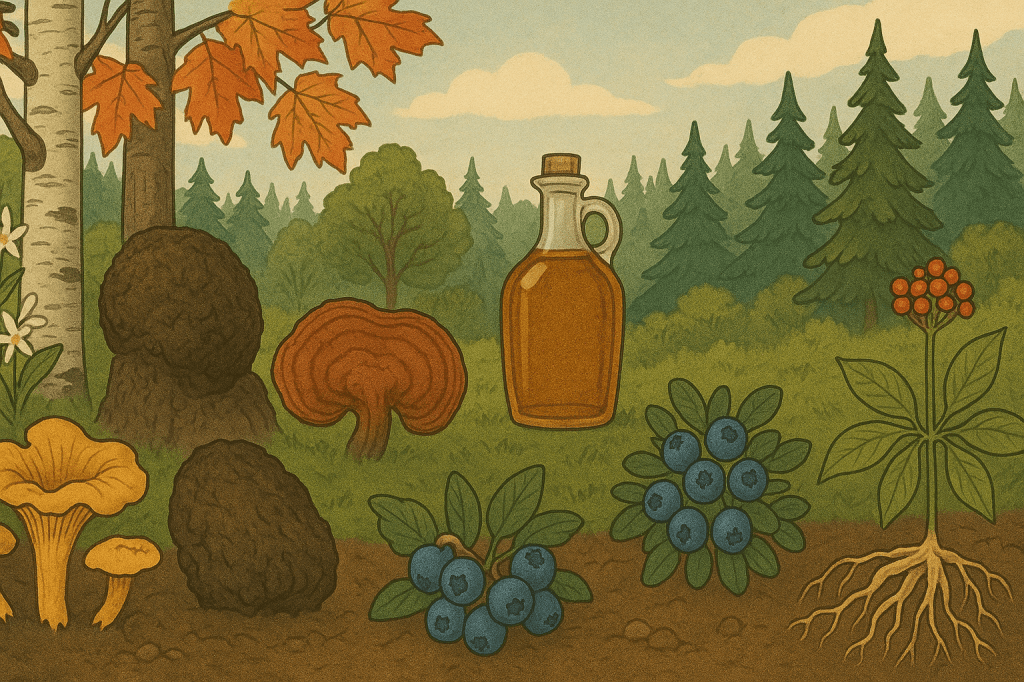
When Canadians think of forests, they typically picture lumber, pulp, and paper. Yet, beyond the timber trade lies an equally vital and dramatically underdeveloped resource sector: non-timber forest products (NTFPs). These include wild mushrooms, berries, medicinal herbs, tree saps, florals, and natural resins; goods that have been harvested for centuries by Indigenous peoples and rural communities, but remain economically marginal in modern Canada. As the agrifood sector seeks to diversify income sources, adapt to climate risks, and respond to consumer demand for sustainable and culturally authentic products, NTFPs represent an untapped reservoir of opportunity.

Canada, after all, is one of the most forested countries on Earth, with over 347 million hectares of forest covering approximately 38% of its landmass. Within these ecosystems is a treasure trove of bioresources, many of which are already enjoying renewed interest in global markets: from functional foods and nutraceuticals to cosmetics and natural health products. The challenge is not whether Canada has the raw materials. It is whether the country can align policy, investment, and Indigenous partnerships to turn these undervalued goods into robust regional economies.

At present, the NTFP sector is dominated by one clear leader: maple syrup. Worth over $1 billion annually, and with Quebec supplying more than 70% of the world’s maple syrup, this industry is the flagship of Canada’s non-timber forest economy. Wild blueberries, predominantly from Quebec, Nova Scotia, and New Brunswick, form another lucrative market, with production values exceeding $300 million in 2023. Yet outside of these headline commodities, the remaining NTFP sector is diffuse, localized, and largely informal. Wild mushrooms like morels, chanterelles, and lobster mushrooms are harvested across British Columbia, Ontario, and the Maritimes, often exported to European and Asian buyers, but little coordinated infrastructure exists to support consistent volumes or traceable quality. Medicinal plants such as chaga, Labrador tea, and devil’s club are well known to Indigenous communities, but underutilized in formal markets.

The potential for growth in this sector is significant. Globally, the market for natural health and functional food products is expanding rapidly. Medicinal mushrooms, in particular, are on track to reach $19 billion by 2030, according to 2024 projections by Global Market Insights. Canada’s forests host many of these species, including chaga, reishi, lion’s mane, and turkey tail, all of which are in high demand in wellness and integrative medicine circles. Similarly, birch sap, a staple in parts of Eastern Europe and Russia, is beginning to attract attention in North America as a low-sugar, antioxidant-rich beverage. There is considerable room for Canadian producers to position their NTFPs in these emerging global niches, especially if backed by origin branding, sustainability certification, and cultural narratives that resonate with eco-conscious consumers.

Despite this promise, the NTFP sector remains constrained by structural barriers. Chief among these is the fragmented and often inconsistent regulatory environment across provinces. Many NTFPs fall outside the scope of forestry tenure agreements and agricultural marketing boards, leaving harvesters in a grey zone with unclear land access rights or commercialization protocols. In some provinces, the rules for harvesting and selling wild mushrooms or herbal plants vary from one jurisdiction to another, complicating efforts to build coordinated value chains. The lack of aggregation infrastructure and cold storage capacity further limits the ability of small-scale producers to move beyond seasonal, informal markets.

Another limiting factor is the scarcity of applied research and product development capacity tailored to NTFPs. Few Canadian universities or government research agencies have dedicated programs for wild plant or fungal product development, and even fewer link with Indigenous knowledge systems in ways that are respectful, reciprocal, and rights-based. Traditional knowledge about the ecological cycles, medicinal uses, and sustainable harvest of forest plants remains vastly underrecognized in Canada’s commercial landscape. Until this knowledge is better integrated and protected through co-management and intellectual property frameworks, the sector will remain vulnerable to exploitation and underperformance.

Equity and land tenure issues must also be addressed. Indigenous communities are among the most active stewards and knowledge-holders of NTFPs, yet they often face structural barriers to entering or scaling in commercial markets. The promise of NTFPs as a tool for Indigenous economic development is well documented, but to realize that potential, governments must ensure clear access rights, provide targeted funding for Indigenous-led enterprises, and support co-governance models that reflect Indigenous sovereignty over forest resources.

Looking ahead, the Canadian NTFP sector needs a concerted strategy. This means intergovernmental coordination to harmonize regulations, investment in processing and aggregation infrastructure, and the development of national standards for quality assurance. Just as importantly, there must be a storytelling effort, one that situates NTFPs not merely as exotic forest goods, but as emblematic of Canada’s commitment to sustainable agriculture, reconciliation, and regional resilience. Products like Labrador tea, spruce tips, and wild fiddleheads should not be relegated to niche farmers’ markets; they should be among Canada’s most proudly exported biocultural goods.

If Canada is to meet its agrifood diversification and climate adaptation goals, the time has come to give non-timber forest products their due. The market is maturing, the environmental case is strong, and the social and economic benefits, particularly for Indigenous and rural communities, are substantial. We must move beyond pilot projects and showcase stands. With vision and investment, Canada’s NTFP industry could blossom from a peripheral activity into a pillar of the national agrifood economy.

Sources
• Natural Resources Canada. (2021). Non-Timber Forest Products in Canada: An Overview. https://www.nrcan.gc.ca/
• Agriculture and Agri-Food Canada. (2023). Statistical Overview of the Canadian Fruit Industry 2023. https://agriculture.canada.ca/
• Global Market Insights. (2024). Medicinal Mushroom Market Size, Share & Trends Analysis. https://www.gminsights.com/
• Indigenous Forestry Initiative. (2023). Case Studies in Indigenous-Led NTFP Enterprises. https://www.canada.ca/en/environment-climate-change/services/indigenous-forestry-initiative.html

Alberta at the Crossroads: Resource Sovereignty and Federal Cohesion

It began with a simple yet startling poll result: one‑third of Albertans said they would consider leaving Canada if the next federal government were Liberal, a figure up from 25 percent in 2001 and drawn from a 219 Ipsos survey that found 33 percent of respondents believing Alberta would be better off as a separate country. In the same year, an Angus Reid Institute study reported that half of Albertans saw separation as a “real possibility,” even if the practical likelihood was judged low. Other surveys have shown support fluctuating between 23 percent and 33 percent, but the headline number – one in three – captured the public imagination, and became shorthand for a deep provincial malaise.

That malaise has its roots in a storied history of perceived federal overreach. Albertans, and Western Canadians more broadly, still speak in hushed tones of the National Energy Program of 1980, when Ottawa’s sudden push to capture a greater share of oil revenues felt like an economic and cultural assault. Recent Liberal governments, with their emphasis on carbon pricing (the “carbon tax”), tighter environmental assessments through Bill C‑69, and tanker bans under Bill C‑48, have reawakened memories of Pierre Trudeau’s NEP and convinced many that, once again, the province’s lifeblood industry is under siege.

Yet the idea of actually breaking away faces almost insurmountable constitutional and practical barriers. The Supreme Court of Canada’s 1998 Reference re Secession of Quebec made clear that any province seeking to leave must first secure a “clear expression” of the popular will through a referendum on a clear question, and then negotiate terms of separation with Ottawa, and the other provinces, no small feat under Canada’s amending formula, which generally requires approval by Parliament plus seven provinces representing at least 50 percent of the national population. Indigenous nations in Alberta, whose treaty rights are with the Crown, would also have to be brought into the process, introducing further complexity and potential legal challenges.

Contrasting sharply with this looming constitutional labyrinth is the decade of Stephen Harper’s Conservative government (2006–2015), celebrated in Alberta as “our decade.” Under Harper who, though born in Ontario, was politically shaped in Calgary, Alberta’s oil patch felt valued rather than vilified. Pipelines advanced, carbon pricing was minimal, and fiscal transfers were viewed as fair. When Harper left office, Alberta enjoyed low unemployment, a booming energy sector, and a sense of national relevance seldom felt under Liberal administrations.

That stark contrast helps explain why talk of a fourth Liberal mandate elicits such fury.  It’s not just a change of political party, but a reopening of old wounds. Many Albertans feel that, under Liberal governments, their province unwittingly subsidizes federal programs and public services elsewhere, amid equalization debates, even as Ottawa imposes restraints on drilling and export infrastructure. Yet when Alberta needs federal support, whether for pipeline approvals through British Columbia, bailouts of orphaned wells (some $1.7 billion in 2020), or trade negotiations, it turns to the very same system it denounces.

At the heart of this contradiction lies a fundamental misunderstanding on both sides of the debate. Constitutionally, Alberta does own the oil and gas beneath its soil: Section 92A of the Constitution Act, 1982 grants provinces exclusive resource management powers. But that ownership comes with responsibilities and shared consequences. Oil and gas development contributes to national greenhouse‑gas targets, affects international trade obligations (e.g., under CUSMA), and relies on pipelines, rail lines, and workforce mobility that cross provincial boundaries and fall under federal jurisdiction.

This “siege mentality” sees only extraction and profit, ignoring that Alberta’s prosperity is woven into the Canadian federation: workers from Ontario and the Maritimes staff the oil sands; revenues fund national research and infrastructure; federal courts enforce property and contract law; and Ottawa’s diplomatic channels open markets abroad. The province’s economy is both “ours” and “Canada’s,” yet too often the narrative paints Alberta as a cash cow and Ottawa as a meddling bureaucrat.

Should Albertans ever find themselves voting for separation, they would quickly learn that the question is only the beginning. A referendum, no matter how decisive, would simply trigger constitutional negotiations. Debates over dividing federal debts and assets, the fate of interprovincial infrastructure, the status of Indigenous treaties, and even Canada’s seat at the United Nations would follow, all under the watchful eyes of domestic courts and foreign governments skeptical of a rump Canada and a new oil‑rich microstate.

In this light, the polling spikes in separatist sentiment reflect more than a serious bid for nationhood, they signal profound alienation. Up to 33 percent talking of leaving, up to 50 percent seeing separation as possible, and around 23 percent saying they would vote “yes” in a referendum are metrics of anger rather than blueprints for new borders. They underscore a demand for respect, recognition, and real partnership with the federal government, an insistence that Alberta’s economic contributions be matched with political influence and cultural validation.

Ultimately, Alberta’s future lies not in walking away from Canada, but in finding a new equilibrium within it. That requires:
1. Acknowledging interdependence: Alberta must recognize that its resource wealth, workforce, and infrastructure exist because of—and for—the Canadian market and legal framework.
2. Embracing diversification: Beyond oil and gas, investments in hydrogen, clean technology, and critical minerals can reduce the economic anxiety that fuels separatist talk.
3. Renewing federalism: Ottawa needs to move beyond top‑down policies and engage province‑by‑province on environmental and economic goals, respecting regional realities while upholding national standards.

The story woven by those polls, legal analyses, and emotional testimonies is not one of imminent breakup but of a province at a crossroads. The choice before Alberta, and Canada, is whether to deepen the divide into a chasm of mistrust, or to build new bridges of collaboration that honor both provincial autonomy and federal unity.

Can Food Belts Enhance Ontario’s Food Security Future?

Ontario is facing an escalating food security crisis, with food banks reporting unprecedented demand and rural communities increasingly unable to afford basic nutrition. In response, a new policy proposal is gaining traction among local leaders and agricultural advocates: the creation of provincially designated “food belts” to permanently protect farmland and strengthen local food systems.

Recent data paint a sobering picture. More than one million Ontarians accessed food banks between April 2023 and March 2024, a 25% increase over the previous year and nearly double the figures from four years prior. According to Feed Ontario’s 2024 Hunger Report, food bank use has surged across every region, including traditionally self-sufficient rural areas like Grey-Bruce, where the cost of a nutritious food basket consumes over 40% of a family’s income on Ontario Works. In Northumberland County, the monthly shortfall between assistance levels and basic expenses surpasses $1,300 even before rent is considered.

Amid this growing crisis, Ontario Green Party Leader Mike Schreiner has introduced the concept of food belts, designated agricultural zones protected from development, designed to ensure ongoing food production close to population centres. The idea has received support from municipal officials, including Markham and Waterloo Region councillors, who are increasingly alarmed by the pace at which farmland is being lost to suburban sprawl.

Between 2016 and 2021, Ontario lost over 620,000 acres of farmland, according to the 2021 Census of Agriculture. That represents more than 1,200 farms, not phased out due to productivity or retirement, but lost to development and land speculation. Once prime agricultural land is paved over, it is virtually impossible to restore, raising serious concerns about the province’s long-term food capacity.

In Waterloo Region, where one in eight households now reports food insecurity, the link between land use and hunger is becoming clearer. Eleven percent of those turning to food banks come from households with at least one working adult, reflecting broader structural challenges beyond poverty alone. At the same time, 50% of food banks have been forced to reduce services, while 40% have cut back on the amount of food distributed, according to Feed Ontario.

Food belts are proposed as a systemic solution. Modeled in part on the province’s existing Greenbelt, food belts would differ by prioritizing food production rather than simply preserving green space. Enabling legislation, potentially through amendments to Ontario’s Planning Act or the Provincial Policy Statement, would establish a policy framework, followed by municipal implementation through Official Plans and comprehensive land-use reviews.

The food belt model would involve identifying prime agricultural lands for protection, particularly in high-growth regions such as the Greater Golden Horseshoe. Within these zones, land use would be restricted to agricultural and food-related purposes, including greenhouses, food processing, and housing for seasonal farm workers. Non-agricultural development would be prohibited or tightly regulated.

To support farmers within the belts, advocates suggest a suite of provincial incentives. These could include property tax relief, grants for sustainable practices, support for young and new farmers, and investment in local food infrastructure such as processing facilities and distribution hubs. The intent is to foster both agricultural stability and economic opportunity in rural areas.

Crucially, food belts would not operate in isolation. Stakeholder engagement would be central to their design and implementation, involving farmers, Indigenous communities, conservationists, and municipal planners. A provincial oversight body could monitor compliance, enforce regulations, and report on agricultural output and environmental indicators within the belts.

Beyond farmland protection, proponents argue that food belts represent a strategic investment in Ontario’s long-term food resilience. By shortening supply chains, reducing reliance on imported goods, and anchoring food production within commuting distance of major urban centres, food belts could help the province navigate future disruptions caused by climate change, inflation, and geopolitical instability.

“Simply put, we cannot eat subdivisions,” Schreiner has said, warning that continued inaction could erode Ontario’s ability to feed itself. The Green Party’s position echoes findings from agricultural policy experts who have long cautioned that land-use planning must be treated as a food security issue, not just an environmental or economic concern.

As of 2024, Ontario’s policy landscape lacks a formal mechanism to establish food belts, though growing public and political interest may push the province to act. For now, the concept remains in the realm of advocacy and municipal discussion, but pressure is mounting.

With food insecurity no longer confined to urban poverty and food banks unable to keep pace, the proposal for food belts offers a rare convergence of long-term strategy and immediate relevance. Whether Queen’s Park chooses to seize the moment remains to be seen. What is clear, however, is that Ontario’s food future will depend not only on how the land is farmed, but on whether that land remains farmland at all.

Sources
• CBC News: https://www.cbc.ca/news/canada/kitchener-waterloo/foodbelt-reaction-schreiner-markham-councillors-1.7536995
• Feed Ontario Hunger Report 2024: https://feedontario.ca/research/hunger-report-2024
• Statistics Canada, Census of Agriculture 2021: https://www150.statcan.gc.ca/n1/daily-quotidien/220511/dq220511b-eng.htm
• Greenbelt Act, 2005: https://www.ontario.ca/laws/statute/05g01
• Grey Bruce Public Health: https://www.publichealthgreybruce.on.ca
• HKPR Health Unit (Northumberland): https://www.hkpr.on.ca

A Strategic Reset: Is the UK’s 12-Year Deal with the EU a Trial Run for Rejoining?

In a move that may mark the beginning of a new chapter, or even a slow reversal, in post-Brexit Britain, Prime Minister Keir Starmer’s government has signed a sweeping 12-year deal with the European Union. Spanning trade, fisheries, defense, energy, and youth mobility, the agreement is being sold as a pragmatic step toward economic stability. Yet, for keen observers of European geopolitics and domestic UK policy, this isn’t just about cutting red tape or smoothing customs formalities. It’s about direction, intent, and trajectory; a trajectory, some might argue subtly, but surely points back toward Brussels.

Let’s be clear – this is not rejoining the EU. The UK retains its formal sovereignty, its independent trade policy, and its seat at the World Trade Organization. Yet, in practical terms, this agreement represents a partial realignment with the European regulatory and political sphere. It’s a détente, but one that many suspect could serve as a trial run for re-entry.

Trade and Regulatory Alignment: Quiet Integration
The most immediate impacts will be felt in trade. The deal includes a new sanitary and phytosanitary (SPS) agreement that significantly eases checks on animal and plant products, long a point of friction for exporters. British sausages and cheeses can once again cross the Channel with ease, and exporters have been granted breathing room after years of customs chaos.

The price? The UK will align dynamically with EU food safety rules and standards. Not only that, but the European Court of Justice (ECJ) will have an oversight role in this domain. It’s a politically delicate concession that the previous Conservative government would have balked at, but it is one that Starmer is positioning as an economic necessity rather than a political capitulation.

This kind of soft alignment, regulatory cooperation without full membership, mirrors the arrangements held by countries like Norway and Switzerland. The UK isn’t there yet, but it’s moving in that direction, and the economic benefits are likely to reinforce the case.

Fisheries: Symbolism and Compromise
Few sectors embody the emotion of Brexit like fisheries. The 2016 Leave campaign made maritime sovereignty a powerful symbol of national self-determination. Now, the UK has agreed to extend EU access to its waters for another 12 years, hardly the full “taking back control” once promised.

However, the government insists that the deal does not grant additional quotas to EU vessels, and preserves the right to annual negotiations. To offset the political fallout, £360 million is being invested into modernizing the UK fishing industry, a sweetener aimed at skeptical coastal communities.

Yet symbolism matters. This agreement effectively freezes the reassertion of full UK control over its fisheries until 2038. That’s long enough for an entire generation of voters to become accustomed to a cooperative status quo.

Energy, Climate, and Economic Integration
Perhaps the most telling element of the deal is its ambition in energy and carbon market integration. The UK and EU will link their Emissions Trading Systems (ETS), smoothing the path for cross-border carbon credit trading, and exempting British companies from the EU’s incoming Carbon Border Adjustment Mechanism (CBAM). This could save UK firms an estimated £800 million annually.

In strategic terms, it brings the UK closer to the EU’s climate governance framework, and represents a quiet, but firm repudiation of the “Global Britain” fantasy that post-Brexit Britain could thrive on deregulated free-market exceptionalism.

Security and Mobility: A Return to Practical Cooperation
Defense is also back on the table. The UK will participate in the EU’s PESCO initiative for military mobility, signifying renewed cooperation on troop and equipment movements. Intelligence sharing and sanctions alignment are also included, moves that suggest an increasingly coordinated foreign policy framework, even outside EU structures.

Meanwhile, UK travelers will soon regain access to EU e-gates, reducing airport queues, and negotiations are underway for a youth mobility scheme. The return to the Erasmus+ student exchange programme, in particular, is a major symbolic step, reconnecting young Britons with continental Europe in a way that had been severed post-2020.

A Trial Run for Rejoining?
Viewed in isolation, each element of the deal appears pragmatic and limited. Viewed together, however, they amount to a re-entangling of the UK within EU institutions and standards. The length of the deal, 12 years, is conspicuous. It places a review just past the midpoint of what could be two Labour governments, opening a window in the 2030s for a possible reapplication for membership.

Critics argue that Starmer is “Brexit in name only,” effectively undoing much of the substance of the 2016 vote. Proponents counter that he is offering economic stability, and international credibility without rekindling the divisive debate of formal re-entry, but no one should be under any illusions: this is a serious recalibration. For a generation of younger voters who never supported Brexit, it might just feel like the first step toward righting a historic wrong.

In this light, the 12-year deal may be best understood as a proving ground. It allows both the UK and the EU to rebuild trust, test cooperation mechanisms, and create the legal and political scaffolding that could one day support full re-accession. Starmer may deny it, and Brussels may downplay it, but history has a way of turning such “interim measures” into new norms.

For now, the UK is not rejoining the EU, but the doors, long thought closed, are no longer locked. And the steps taken in this agreement may well be remembered as the start of the long walk back in.

Sources
• BBC News: https://www.bbc.com/news/articles/czdy3r6q9mgo
• Sky News: https://news.sky.com/story/uk-eu-trade-deal-what-is-in-the-brexit-reset-agreement-13370912
• Al Jazeera: https://www.aljazeera.com/news/2025/5/21/will-eu-deal-make-food-cheaper-add-12bn-to-the-uk-economy
• Financial Times: https://www.ft.com/content/66763def-d141-465d-ba96-31399071bf3b
• The Times: https://www.thetimes.co.uk/article/starmers-done-no-better-with-the-eu-than-may-8l37jm2sf

The Essequibo Equation: Venezuela’s Bid, Guyana’s Boom

The morning sun hangs low over the Atlantic, glinting off the towers rising in Georgetown, Guyana’s modest, but fast-transforming capital. A decade ago, few would have imagined this small South American nation, wedged between Brazil, Venezuela, and Suriname, would be at the center of a geopolitical and environmental drama with global stakes. Guyana is flush with oil – Black Gold. The kind that redraws maps, tilts economies, and ignites old rivalries. For Venezuela, long mired in economic freefall and domestic strife, it is an irresistible provocation.

Let’s be clear, what’s happening in Guyana is one of the most remarkable economic stories in the Western Hemisphere. Since ExxonMobil discovered vast offshore reserves in 2015, production has accelerated with almost reckless speed. By next year, output is projected to hit 900,000 barrels a day, and it could top 1.3 million before the end of the decade. For a country of under 800,000 people, that is transformative wealth, and unlike its oil-rich neighbours, some of whom squandered such windfalls, Guyana is making a bold promise; to become a net-zero emitter of greenhouse gases by 2050, even as it becomes a fossil fuel giant.

On the surface, this seems contradictory. How can you drill for oil while committing to climate leadership? Guyana’s government argues that its forest cover, nearly 85% of the national territory, is a massive carbon sink. It also claims that the revenues from oil will fund sustainable development, clean energy projects, and climate resilience. Whether this can be done without falling into the corruption, debt, and inequality traps that have cursed so many petro-states remains to be seen. So far, international financial institutions are cautiously optimistic. The government is under intense scrutiny, and the pressure to deliver transparency and social equity is mounting.

Guyana’s newfound wealth has stirred a long-simmering conflict with its neighbor to the west – Venezuela. The heart of the matter is the Essequibo region, a vast, resource-rich area that makes up nearly two-thirds of Guyana’s landmass. Venezuela has claimed it ever since the 1899 arbitration award, backed by the United States and Britain, granted the territory to what was then British Guiana. For over a century, the dispute remained largely symbolic, flaring up occasionally, but never seriously threatening borders.

Now, the stakes are very real. In 2023, Venezuela’s President Nicolás Maduro ramped up the rhetoric, holding a referendum in which voters overwhelmingly backed a proposal to annex Essequibo. Caracas argues that the arbitration was flawed and that the entire region was unlawfully taken. The timing, of course, is not coincidental. As Guyana’s oil fields, many lying off the Essequibo coastline, begin to pump billions into government coffers, Venezuela sees an opportunity to redirect domestic attention from its own failures, and tap into a nationalist cause with broad appeal.

Guyana, for its part, has responded not with sabre-rattling, but with legal precision. It brought the case before the International Court of Justice, which ruled in 2023 that it had jurisdiction. Earlier this year, in May 2025, the ICJ went further, ordering Venezuela to halt its plans to conduct elections in the disputed territory, a direct rebuke to Maduro’s annexation agenda. Venezuela has ignored the court, as it has ignored much of international law in recent years, and tensions are rising on the ground.

This is no longer a war of words. Just this month, Guyanese soldiers patrolling the border were attacked multiple times in under 24 hours. These were not large-scale military incursions, but they are warnings, probing gestures, testing the resolve of a much smaller neighbor. Guyana has responded by strengthening its military posture and drawing closer to its Western allies, including the United States and Brazil. The regional implications are grave: any escalation could destabilize the northern tier of South America, drag in other powers, and endanger vital shipping routes and energy flows.

As someone who has watched the ebb and flow of South American politics for decades, I see in this moment both peril and possibility. Guyana stands on a razor’s edge: it could become a model of how a small nation leverages its natural wealth responsibly, or it could descend into conflict, corruption, and dependence. Venezuela’s claim is, in essence a gamble, hoping that the world is too distracted to enforce international norms, and that might still makes right. Yet Guyana is not alone, and the legal, diplomatic, and moral momentum is on its side.

Whether that will be enough is another question entirely. Oil has always been more than a commodity in this region of the world. It is a force that reshapes nations and, sometimes, breaks them. For Guyana, the challenge now is not only to survive Venezuela’s ambitions, but to thrive in spite of them, and perhaps, just perhaps, to chart a new course for oil-rich states in the 21st century.

MEC: The Trail Back Home

As my regular readers know, I am a big supporter of the Canadian cooperative movement, and so I have to applaud this recent change in ownership bringing MEC back to Canada.  

MEC’s return to Canadian ownership isn’t just good news, it feels like a homecoming. For many of us who grew up buying our first tent, hiking boots, or pannier bags from Mountain Equipment Co-Op, the brand has always stood for more than just outdoor gear. It stood for trust, community, and a kind of quiet pride in doing things the Canadian way: cooperatively, responsibly, and with a clear eye on the land we all share.

Founded in 1971 by a group of climbers in British Columbia, MEC was created not to chase profits, but to help people get outside, affordably and together. It was a co-op, meaning it was owned by its members. If you paid the $5 lifetime membership fee, you weren’t just a customer, you were a part-owner. That sense of shared purpose ran deep. MEC was where we went not just to buy things, but to connect with others who cared about the same things we did: nature, community, and getting out into the wild with the right gear and the right mindset.

Yet over time, something shifted. The company grew fast. It opened more stores, expanded into new markets, and lost touch with its co-op roots. Eventually, the leadership made decisions that put growth and profit ahead of members’ voices. When MEC ran into financial trouble in 2020, the board quietly sold the company to a U.S. private equity firm, Kingswood Capital, without consulting the members. Just like that, a Canadian co-op was turned into a foreign-owned chain. People were furious, and rightfully so. Over 100,000 Canadians signed petitions demanding accountability, but by then, the deal was done.

That’s why it matters so much that MEC is back under Canadian ownership. In May 2024, a group of investors based in Vancouver bought it back. Their promise? To return the company to its values, more local partnerships, more transparency, more of the community spirit that made MEC special in the first place. They’re not promising to turn it back into a full co-op, but they are saying they’ll listen more, invest in Canada, and act with the kind of care that’s been missing for years.

This shift isn’t just about ownership. It’s about trust. It’s about remembering that good business doesn’t have to mean cutting corners or selling out. It’s about doing the right thing, even if it’s harder. MEC still has a long way to go to rebuild what was lost, but for many of us, knowing it’s Canadian again is enough to make us want to give it another chance.

What this shows is that Canadians still care deeply about how companies behave. We want businesses that reflect our values, not just our wallets, and when something we love is taken away, we fight for it. MEC was built by us. It should never have been sold without us, and now that it’s back, we can start climbing again – together.

The Liberal Party’s New Power Struggle: Carney vs The Old Guard

Now that Mark Carney has won the 2025 federal election, and as Prime Minister, named his new cabinet, his ability to navigate the internal politics of the Liberal Party will be just as crucial as his capacity to govern the country. While Carney’s experience as Governor of the Bank of Canada and later the Bank of England gives him credibility as a skilled economic manager, political leadership is an entirely different challenge. Government is not just about making rational policy decisions; it is about managing competing egos, regional interests, and the internal factionalism that defines any major political party. The question is whether Carney, a newcomer to elected politics, can withstand the pressures of a party where everyone wants a piece of the action.

One of Carney’s greatest strengths is his ability to operate within complex institutions, where navigating bureaucracy and political sensitivities is essential. However, the Liberal Party is not a technocratic body, it is an organization with entrenched factions, long-standing rivalries, and individuals who expect rewards for their loyalty. A Prime Minister must act as both leader and power broker, ensuring that key players feel valued while still asserting control over the direction of the government. If Carney fails to grasp this dynamic early on, he risks being seen as an outsider unable to command the loyalty of his own caucus.

A major test will be how he handles the various factions within the party. The Liberals are not a monolithic entity; they consist of a progressive wing that leans heavily on social justice issues and a centrist bloc that prioritizes economic pragmatism. There are also strong regional interests at play, particularly from Ontario and Quebec, where powerful party figures hold significant influence. A successful leader must strike a balance, ensuring that no single faction feels alienated while maintaining a clear sense of direction. If Carney leans too heavily into one camp, especially if he is seen as overly technocratic at the expense of political instinct, he risks internal dissent.

Another potential challenge is dealing with the remnants of Trudeau’s inner circle. If Carney takes the leadership, it will not necessarily mean the party’s Trudeau-era power structure disappears overnight. There will be long-time MPs and advisers who built their careers under Trudeau’s leadership and may not be quick to embrace Carney’s vision. Some may resist his authority outright, while others could quietly work against him if they feel sidelined. Managing this transition will require careful maneuvering, if Carney fails to integrate these figures into his team in a way that acknowledges their influence, he could find himself facing internal power struggles before he even settles into office.

Cabinet appointments announced today will be an early indicator of whether Carney understands the importance of political management. Every successful leader knows that forming a cabinet is not just about qualifications; it is about rewarding allies, neutralizing threats, and ensuring regional representation. If Carney takes a purely meritocratic approach, appointing ministers based solely on expertise rather than political necessity, he could alienate those who expect a return on their loyalty. The most effective prime ministers understand that governing is about both competence and coalition-building; failing to strike that balance can quickly lead to discontent within caucus.

Beyond Parliament Hill, Carney will also need to connect with the party’s grassroots. The Liberal base consists of volunteers, donors, and riding association leaders who expect their voices to be heard. Carney’s reputation as an elite, internationalist figure could work against him if he does not make a concerted effort to engage directly with these groups. If he is perceived as distant or disconnected from the party’s rank and file, he could struggle to maintain cohesion within the Liberal movement. Trudeau, for all his faults, had a deep personal connection with the party’s grassroots, something that sustained him through difficult periods. Carney will need to build that relationship from scratch.

Like any new leader, Carney will face an early test, a moment that defines his ability to command respect and authority within his party. Whether it is a scandal, an economic crisis, or a policy misstep, how he handles that first major challenge will set the tone for his leadership. If he shows strength and decisiveness, he could solidify his position within the party. But if he falters, doubts about his leadership will begin to fester, potentially leading to deeper internal divisions.

Ultimately, Carney’s success will hinge on his ability to adapt. He has the intellectual firepower and the institutional experience, but politics is a game of relationships, instincts, and survival. If he can master that side of the job, he could thrive. If not, he risks becoming yet another promising leader undone by the very party that brought him to power.

Five Things We Learned This Week

Here is the latest edition of “Five Things We Learned This Week” for May 3–9, 2025, highlighting significant global developments across various sectors.

🌋 1. Volcanic Eruption in Iceland Disrupts Tourism

The Sundhnúkur volcanic system in Iceland erupted this week, leading to increased seismic activity near Grindavík. The Icelandic Meteorological Office reported the eruption and registered accompanying earthquakes. As a precaution, popular tourist destinations like the Blue Lagoon were evacuated, impacting the country’s tourism sector.  

💰 2. India’s Forex Reserves Decline After Eight Weeks of Gains

India’s foreign exchange reserves fell by $2.07 billion to $686.06 billion as of May 2, 2025, ending an eight-week streak of gains. The decline was primarily due to a decrease in gold reserves, which dropped from $84.37 billion to $81.82 billion. During the same week, the Indian rupee experienced volatility, appreciating by about 1% due to increased foreign inflows and optimism surrounding a potential U.S.-India trade agreement, but later depreciated by 0.9% amid geopolitical tensions between India and Pakistan.  

🧪 3. Scientists Develop Method to Generate Electricity from Rainwater

Researchers have reported a new method of generating electricity from falling rainwater using plug flow in vertical tubes. This technique converts over 10% of the water’s energy into electricity, producing enough power to light 12 LEDs. The innovation holds promise for sustainable energy solutions, especially in regions with high rainfall.  

📉 4. Consumer Goods Prices Expected to Rise Amid Tariff Pressures

Following President Trump’s introduction of steep tariffs on imports, notably a 145% tariff on Chinese goods, major consumer goods companies like Procter & Gamble, Nestlé, and Unilever anticipate raising prices. These increases add to consumer strain after three years of inflation and declining confidence, especially in the U.S., where shoppers face job uncertainty and potential recession. While some companies are attempting to pass costs to consumers, retailers and supermarkets are pushing back, warning that consumers are reaching their financial limits.  

⚔️ 5. Escalation in South China Sea Territorial Disputes

China has seized the disputed Sandy Cay Reef in the Spratly Islands of the South China Sea, intensifying territorial disputes in the region. The move has raised concerns among neighboring countries and the international community about escalating tensions and the potential for conflict in the strategically important area.  

Stay tuned for next week’s edition as we continue to explore pivotal global developments.

Public Consultation or Box-Ticking Exercise? A Critical Look at a Local Battery Storage Project

Last week, I attended a public consultation in my township concerning the proposed development and operation of a battery storage facility. While I support the idea of more distributed energy systems; including local generation, storage, and distribution, I left the session with more concerns than confidence.

The generational divide in the room was striking. The corporate representatives were mostly in their late 20s or early 30s, while the attending community members were primarily in their 50s and 60s. That’s not a critique of age, but it did highlight a gap in understanding and communication. One representative I spoke with didn’t even know the name of our village or the township they were in, and confused our location with the nearest city. That lack of local awareness is troubling.

When it came to questions about employment, the answers were just as vague. There are no local jobs being created by this facility. Pressed on this point, the company conceded that construction would likely be contracted out to a large regional firm. So much for community economic development.

Technically, this consultation was part of the process required to secure project approval. But calling it a “consultation” is generous. In practice, it was an information session for a project that already has funding and, by all appearances, a green light, once the required Environmental Assessment has been completed and approved. Input from residents was neither requested nor meaningfully incorporated. That’s not consultation—that’s optics.

There was discussion of the township gaining a $300,000 gift from the business, yet when this was explored further, it turns out that the gift is over the 20 year projected life of the facility; so by my calculations that’s $15,000/year for a township with an annual budget of around $4.5 million. 

I also learned that the company developing this project, which is ultimately owned by a private corporation through a series of businesses, partnered with a local First Nation to qualify for the contract. On paper, this is a positive step. I strongly support Indigenous involvement in provincial development, but I couldn’t help but ask: beyond a share of the profits, what is the First Nation partner actually gaining from this deal? Meaningful involvement? Job creation? Capacity building? Those questions went largely unanswered.

Many of the company reps struggled to answer even basic questions. When challenged, they became defensive, admitting they were not properly briefed or that statements about local benefits were merely “possibilities.” That kind of unpreparedness doesn’t inspire public trust.

Let me be clear: I’m not opposed to the project itself. I believe in the need for renewable energy infrastructure, and support the transition to a more decentralized grid. I have no “Not In My Backyard” objections here. My issue is with the process, and with the privatization of what should be a public utility. This kind of infrastructure should be owned and operated by the province for the benefit of its citizens, not by private firms whose primary accountability is to shareholders.

If this is the future of our energy system, we need a better framework, one rooted in public ownership, transparent processes, and genuine community engagement.

Five Things We Learned This Week

Here is the latest edition of “Five Things We Learned This Week” for April 26–May 2, 2025, highlighting significant global developments across various sectors.

🕊️ 1. World Bids Farewell to Pope Francis

An estimated 250,000 mourners gathered in Vatican City to pay their final respects to Pope Francis, who passed away earlier this month. The funeral was attended by numerous world leaders and pilgrims from around the globe, reflecting the Pope’s profound impact on the international community.  

📉 2. U.S. Economy Contracts Amid Tariff Pressures

The U.S. economy experienced a contraction of 0.3% in the first quarter of 2025, marking the first decline since early 2022. This downturn is attributed to a surge in imports ahead of new tariffs introduced by President Trump, leading to a record trade deficit that significantly impacted GDP.  

🧬 3. Discovery of Disintegrating Exoplanet BD+05 4868Ab

Astronomers have identified BD+05 4868Ab, a small rocky exoplanet located 142 light-years from Earth, which is rapidly disintegrating due to extreme heat from its nearby host star. The planet exhibits a comet-like tail of vaporized minerals and is estimated to completely evaporate within 1–2 million years.  

📈 4. FTSE 100 Achieves Record 15-Day Winning Streak

The UK’s FTSE 100 index closed higher for the 15th consecutive day, marking its longest-ever streak of gains. This rally is attributed to easing U.S.-China trade tensions and stronger-than-expected U.S. job data, which boosted investor confidence across global markets.  

🧪 5. ITER Completes World’s Largest Superconducting Magnet System

Engineers at ITER have completed the construction of the world’s largest and most powerful pulsed superconducting electromagnet system. This milestone is a significant step toward achieving sustained nuclear fusion, with the system designed to confine plasma at 150 million °C, enabling ITER to produce 500 megawatts of fusion power from just 50 megawatts of input.  

Stay tuned for next week’s edition as we continue to explore pivotal global developments.