From Vision to Momentum: Alto Enters Its Defining Phase

For years, Canada’s ambitious dream of linking its greatest cities with true high-speed rail has hovered in the realm of feasibility studies and future pipe dreams. Now, in the closing weeks of 2025, that dream has shifted decidedly toward reality; not because steel is yet being laid, but because the Alto high-speed rail initiative has crossed a crucial threshold from concept to concerted preparation and public engagement.

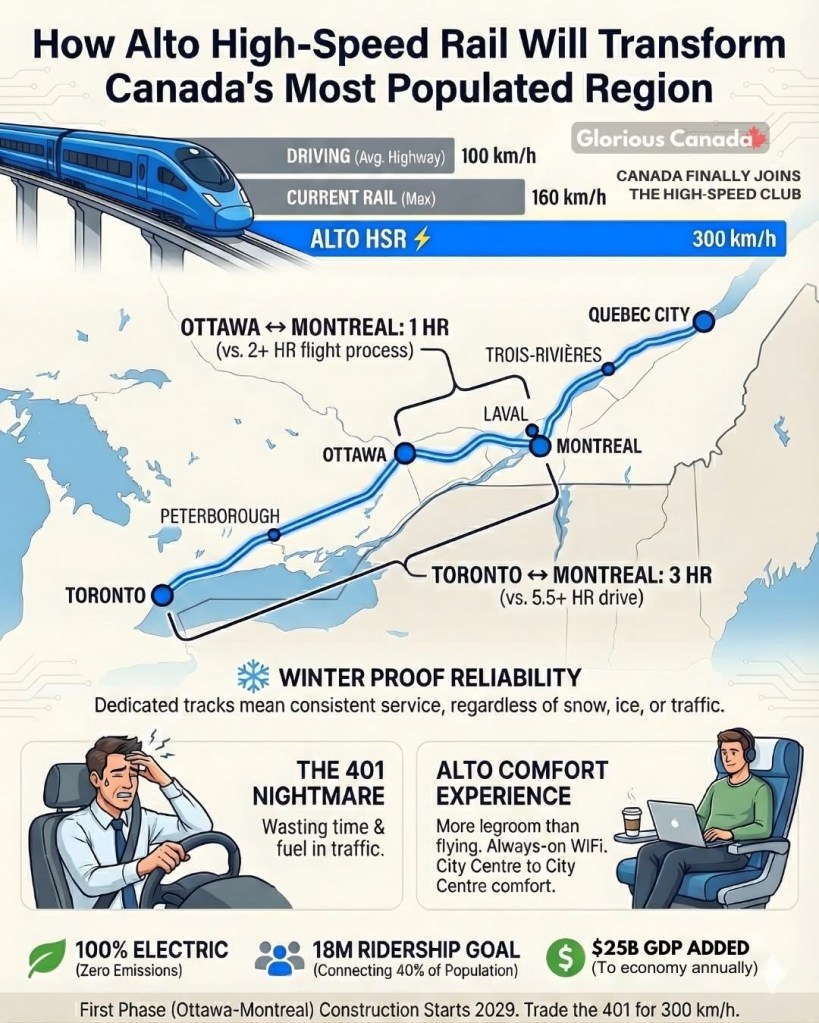
At its core, Alto is a transformative infrastructure vision: a 1,000-kilometre electrified passenger rail network connecting Toronto to Québec City with trains capable of 300 km/h speeds, slicing travel times compared to what today’s intercity rail offers and binding half the nation’s population into a single, rapid mobility corridor. The design phase, backed by a multi-billion-dollar co-development agreement with the Cadence consortium, is well underway, and the federal government has signaled its intent to see this project delivered as one of the largest infrastructure investments in decades.  

The most noteworthy milestone in recent weeks has been a strategic decision about where Alto will begin to take physical shape. On December 12, officials announced that the Ottawa–Montreal segment – roughly 200 km – will be the first portion of the network to advance toward construction, with work slated to begin in 2029. This choice reflects a practical staging strategy: by starting with a shorter, clearly defined corridor that spans two provinces, engineering and construction teams can mobilize simultaneously in Ontario and Québec and begin delivering economic and skills-development benefits sooner rather than later.  

This announcement isn’t just about geography; it marks a shift in Alto’s progression from broad planning to community-level engagement. Beginning in January 2026, Alto will launch a comprehensive three-month consultation process that includes open houses, virtual sessions, and online feedback opportunities for Canadians along the corridor. These sessions will inform critical decisions about alignment, station locations, and mitigation of environmental and community impacts. Indigenous communities, municipalities, and public institutions will be active participants in these discussions as part of Alto’s ongoing commitment to consultation and reconciliation, a recognition that this project’s success hinges not only on engineering prowess, but on thoughtful, inclusive planning.  

Beyond route planning, Alto and Cadence are also turning to Canada’s industrial capacity, particularly the steel sector, to gauge the domestic supply chain’s readiness for what will undeniably be a massive procurement exercise. With thousands of kilometres of rail and related infrastructure components needed, early outreach to the steel industry is intended not just to assess production capacity, but to maximize Canadian content and economic benefit from the outset.  

Yet not every question has a definitive answer. Strategic discussions continue over the optimal location for Alto’s eventual Toronto station, with the CEO publicly acknowledging that a direct connection to Union Station may not be guaranteed; a decision that could shape ridership patterns and integration with existing transit networks across the Greater Toronto Area.  

As the calendar turns toward 2026, the Alto project sits at an inflection point: one foot firmly planted in detailed design and consultation, the other inching closer to the realm of shovels and steel rails. Political support appears robust, and fiscal planning, including major project acceleration initiatives and supportive legislation, has built momentum. Yet, as any transportation planner will tell you, the distance between planning and construction is long, often winding, and frequently subject to political, economic, and community pressures.

Still, for advocates and observers alike, the significance of the latest developments cannot be overstated. Alto has graduated from “what if?” to “when and how,” and that alone marks a major step forward in Canada’s transportation evolution.
Five Things We Learned This Week

Week of December 6–12, 2025

Each week, we take a step back from the noise and look at five developments from around the world that stood out — across science, culture, sport, politics, and the natural world.

🌠 1. Geminid Meteor Shower Peaks with One of the Best Displays in Years

The annual Geminid meteor shower peaked this week, delivering bright, frequent meteors across much of the globe. Astronomers noted especially favorable viewing conditions, with the shower producing vivid fireballs caused by debris from asteroid 3200 Phaethon.

Why it matters: In a world often dominated by bad news, predictable and awe-inspiring celestial events remind us that some rhythms remain constant — and shared by everyone under the same sky.

🎮 2. The 2025 Streamer Awards Highlight the Scale of Live-Streaming Culture

Held on December 6, the 2025 Streamer Awards drew massive global audiences and celebrated creators shaping the modern entertainment landscape. Livestreaming continues to redefine celebrity, media economics, and community building — particularly among younger audiences.

Why it matters: What began as a niche subculture is now a dominant media force, influencing advertising, politics, and how people connect across borders.

🏆 3. Women’s World Floorball Championships Begin in the Czech Republic

The 15th Women’s World Floorball Championships kicked off this week, bringing together 16 national teams. The tournament highlights the rapid global growth of the sport and increasing investment in women’s international competition.

Why it matters: Expanding visibility for women’s sports strengthens international athletic ecosystems and reflects broader cultural shifts toward equity and representation.

🌍 4. Powerful Earthquake Strikes Northeastern Japan

A magnitude-7.6 earthquake struck off Japan’s Aomori coast on December 8, injuring dozens and prompting tsunami advisories and evacuations. Emergency services responded quickly, and authorities warned of ongoing aftershocks.

Why it matters: Japan’s preparedness limited loss of life, underscoring the importance of long-term investment in disaster readiness as seismic and climate risks persist worldwide.

🛂 5. Mediterranean Migration Continues as Boats Reach Malta

Dozens of migrants were brought ashore in Malta this week after dangerous crossings from North Africa. The arrivals highlight the ongoing humanitarian and political pressures shaping migration policy across the Mediterranean.

Why it matters: Migration remains one of the defining global challenges of our time, intersecting with climate change, conflict, and economic inequality.


Closing thoughts:
This week’s stories span wonder and warning — from meteor-lit skies to seismic shocks, cultural change, and enduring humanitarian challenges. Together, they remind us that the world is vast, interconnected, and constantly in motion.

Five Things is a weekly Rowanwood Chronicles feature, tracking global developments from Saturday to Friday.

Empowering Homeowners for a Resilient, Clean Energy Future

As climate change accelerates, extreme weather events are no longer a distant threat, they are a pressing reality affecting our homes, our communities, and our energy systems. Power outages during heat waves, ice storms, or high winds are becoming more frequent and severe. In response, it is time for local government to actively encourage homeowners and cottage owners to take control of their energy future by installing solar panels, small wind turbines, and battery storage.

Distributed generation, the ability for households to produce and store their own electricity, is not just an environmental choice. It is a resilience strategy. When power lines fail during storms, homes with solar panels and batteries can maintain critical functions and even contribute power back to the grid. This reduces stress on centralized utilities and helps keep neighborhoods safe and functional during emergencies. Communities that embrace decentralized energy are less vulnerable and more self-sufficient.

Critics often argue that increasing local generation threatens the revenue of traditional utility companies. While it is true that utilities rely on steady consumption to fund infrastructure, this concern overlooks an opportunity: utilities can evolve by integrating distributed energy into their business models. Programs that pay homeowners for excess energy exported to the grid, time-of-use pricing, and community battery projects all allow utilities to remain profitable while supporting a more resilient and cleaner energy system. Resistance rooted in short-term financial interests should not stand in the way of long-term public benefit.

Encouraging household renewable energy is also an economic investment in our communities. Solar panel and small wind turbine installations create local jobs in manufacturing, installation, and maintenance. Money saved on electricity bills stays in the local economy, supporting small businesses and families. Municipal incentives, such as property tax credits, grants, or low-interest loans, can lower the initial cost barrier, making clean energy accessible to more residents. Over time, these measures pay for themselves in reduced infrastructure strain and a healthier, more sustainable environment.

Practical policy steps can make this vision a reality. Local governments can streamline permitting processes for solar and wind installations, adopt bylaws that encourage battery storage, and explore bulk purchase programs to reduce costs. Public education campaigns can inform residents about how to safely integrate renewable technologies into their homes. Together, these measures signal that the municipality is committed to both climate action and community resilience.

The transition to clean, distributed energy is not optional; it is necessary. By supporting homeowners and cottage owners in adopting solar, small wind, and battery storage, local governments can protect communities, strengthen the economy, and reduce greenhouse gas emissions. The tools are available, the climate urgency is clear, and the time to act is now. Empowering residents to generate and store their own electricity is one of the most effective steps a municipality can take toward a safer, cleaner, and more resilient future.

Quebec’s Agrifood Strategy: A National Lesson in Food Security

Quebec has quietly become a national leader in agrifood planning and food security. At a time when global food systems are increasingly fragile, the province offers a clear and pragmatic model for how public policy, local investment, and social equity can combine to build a more resilient, sustainable food system. The rest of Canada would do well to take note.

Central to Quebec’s approach is its comprehensive provincial framework, Politique bioalimentaire 2018–2025: Alimenter notre monde. This policy articulates a long-term vision for food sovereignty and ecological stewardship. It promotes value-added processing, regional production, and stronger local supply chains. What sets Quebec apart is not simply the breadth of the strategy, but the coordination behind it. Provincial and federal funds are deployed in tandem, targeting greenhouse expansion, food transformation infrastructure, agri-environmental practices, and innovation. In 2023, Quebec committed $175 million toward increasing regional food self-sufficiency, a move that signaled a shift away from dependence on volatile global supply chains.

This funding strategy has been reinforced by the Canada–Quebec Sustainable Canadian Agricultural Partnership agreement, which committed $955 million over five years to support producers across the province. The agreement includes enhanced compensation under AgriStability, infrastructure renewal programs, and expanded support for environmental and climate-smart practices. With a 25 percent increase over the previous five-year framework, this is one of the most ambitious agrifood investments in the country.

Quebec’s focus on food processing has also paid dividends. In Saguenay–Lac-Saint-Jean, for example, Céréales Normandin received over $3.5 million in combined provincial and federal support to expand its grain-processing capacity. By transforming local cereals into flour, semolina, and plant-based protein concentrates, the facility strengthens Quebec’s ability to retain value within the province. It also reduces dependency on long-haul transportation and foreign inputs. This kind of investment represents a structural shift toward field-to-fork sovereignty.

But production and processing are only part of the story. Quebec integrates food security into its broader public health and education agenda. The province supports farm-to-school programs that connect children directly with local farms, using classroom engagement and institutional procurement to build food literacy and sustainable eating habits. Programs like AgrÉcoles and Farm to School Québec are designed not as symbolic gestures, but as long-term educational investments. They are complemented by robust health policy measures, including proposed front-of-package nutrition labels and consideration of a sugary drinks tax. While other provinces rely on voluntary industry commitments, Quebec has shown a willingness to legislate for public health.

Climate adaptation is another defining element. Quebec has made significant advances in controlled-environment agriculture, particularly hydro-powered greenhouses. These facilities now supply roughly half of the province’s fruits and vegetables year-round. This model aligns well with Quebec’s decarbonization goals and offers a buffer against supply chain disruptions caused by weather, wildfires, or border issues. The greenhouse sector also creates jobs in rural regions, adding social and economic depth to what might otherwise be seen as technical infrastructure.

Quebec’s broader social policy reinforces its food security efforts. The province maintains Canada’s most generous child benefits and has indexed income supports to inflation, resulting in lower levels of food insecurity compared to most other provinces. By recognizing that hunger is not just a supply issue but a matter of income and social policy, Quebec links its agrifood system to social resilience. This integrated approach provides not only food, but dignity and stability.

Cultural identity plays a role as well. Quebec has long embraced supply management in sectors like dairy and maple syrup, not as a form of protectionism, but as a tool for supporting regional producers and maintaining quality standards. This model may not translate directly across all of Canada, but it offers a reminder that local economies thrive when policy reflects place-based values.

Perhaps the most compelling lesson from Quebec is its refusal to silo food policy. Instead, it has created a system where agriculture, health, education, environment, and social equity intersect. The result is not just a stronger food system, but a stronger society. In an era of climate disruption, geopolitical instability, and growing inequality, Quebec is showing how to build something that is local, resilient, and future-ready.

Canada as a whole will face increasing pressure in the years ahead to secure its food systems. If policy-makers are serious about ensuring affordability, sustainability, and sovereignty, they would be wise to study what Quebec has already built.

Sources
• Government of Canada. “Canada and Quebec sign a new $955 million agreement over five years to support Quebec’s agricultural sector.” March 2023. https://www.canada.ca/en/agriculture-agri-food/news/2023/03/canada-and-quebec-sign-a-new-955-million-agreement-over-5-years-to-support-quebecs-agricultural-sector.html
• Government of Canada. “Over $3.5 million for Céréales Normandin to expand its product range.” March 2024. https://www.canada.ca/en/economic-development-quebec-regions/news/2024/03/increasing-quebecs-food-selfsufficiency-over-35m-for-cereales-normandin-to-expand-its-product-range.html
• Equiterre. “Farm to School Québec.” https://www.equiterre.org/en/articles/project-local-food-procurement-farm-to-school-quebec
• The 14. “Reinforcing policies to improve Quebec’s food supply.” https://the-14.com/reinforcing-policies-to-improve-quebecs-food-supply
• West Quebec Post. “Quebec to invest $175 million over five years to increase food self-sufficiency.” https://www.westquebecpost.com/quebec-to-invest-175-million-over-five-years-to-increase-food-self-sufficiency

The Fragile Independence of NGOs: Funding, Mission, and the Cost of Survival

After more than 25 years advising organizations across sectors, I’ve come to appreciate the vital role NGOs play in filling the gaps governments can’t, or won’t, address. From frontline social services to environmental stewardship to global health and education, their work is often visionary, community-led, and deeply human. But I’ve also seen behind the curtain. And one uncomfortable truth emerges time and again: far too many NGOs are built on a financial foundation so narrow that one funding shift, often from a single government department, can bring the entire structure down.

This doesn’t mean these organizations lack heart or competence. Quite the opposite, but when 60 to 80 percent of their time and energy is spent chasing the next tranche of funding just to pay rent or keep skeleton staff employed, something is clearly out of balance. I’ve worked with executive directors who are more skilled in crafting grant proposals than in delivering the programs they were trained to lead. I’ve seen staff burn out, not from the intensity of service delivery, but from the treadmill of fundraising cycles that reward persistence over purpose.

The tension is most pronounced when a single government agency becomes the main or only funder. In those cases, the NGO may retain its legal independence, but it quickly becomes functionally dependent, unable to challenge policy, adapt freely, or pivot when the community’s needs shift. I’ve often told boards in strategic planning sessions: “If your NGO would cease to exist tomorrow without that one government grant, then you don’t have a sustainable organization, you have an outsourced program.”

This is not a call for cynicism. It’s a call for structural realism. NGOs need funding. Governments have a legitimate role in supporting social initiatives. But the risk lies in overconcentration. With no diversified base of support, whether from individual donors, private philanthropy, earned income, or even modest membership models, NGOs are vulnerable not only to budget cuts, but to shifts in political ideology. A change in government should not spell the end of essential community services. And yet, it too often does.

What’s the solution? It starts with transparency and strategy. Boards must get serious about income diversity, even if that means reimagining their business model. Funders, including governments, should fund core operations, not just shiny new projects, and do so on multi-year terms to allow for proper planning. And NGO leaders need to communicate their value clearly, not just to funders, but to the communities they serve and the public at large. You can’t build resilience without buy-in.

Supporting NGOs doesn’t mean ignoring their structural weaknesses. In fact, the best way to support them is to help them confront those weaknesses head-on. Mission matters. But so does the means of sustaining it. And in today’s volatile funding landscape, the most mission-driven thing an NGO can do might just be to get smart about its money.

A Year in the Wilds of The Rowanwood Chronicles

A reflective essay by the fellow who somehow decided that blogging about politics, climate, gender, and quantum mechanics was a relaxing hobby

I did not set out to become a blogger. No one does. Blogging is something that happens to you when you’ve said “someone should really write about this” one too many times and then realize the someone is you. That was my first year of The Rowanwood Chronicles. A steady accumulation of small irritations, large curiosities, and the occasional planetary existential dread finally pressuring me into a keyboard.

Over the past twelve months I have written about food systems, seismic faults, mononormativity, AI governance, and the demise of centralized social media platforms. This is, I admit, not a tidy list. Most writers pick a lane. I picked several highways, a few dirt roads, and one unmarked trail that led straight into a thicket of gender theory. Some readers have thanked me. Others have quietly backed away like I had started talking about cryptocurrency at a family barbecue. Fair enough.

The funny thing about running a blog with the byline “Conversations That Might Just Matter” is that you end up feeling mildly responsible for the state of the world. Somewhere in the back of my mind I became convinced that if I took one week off, climate policy would collapse, privacy laws would be gutted by corporate lawyers, and Canada would discover a massive geological fault running directly under my house. It is exhausting being the only person preventing civilization from tipping off its axis, but I have bravely carried on.

Along the way, I learned a few things.

First, people really do want long-form writing. They want context. They want to know why their health system is groaning like a Victorian heroine on a staircase. They want someone to explain decentralized social media without sounding like a blockchain evangelist who drinks only powdered mushroom tea. They want nuance rendered in plain language. I can do that. Sometimes even coherently.

Second, writing about politics is like trying to pet a squirrel. You can do it, but you have to keep your hands calm, your movements measured, and be prepared for the possibility that something small and unpredictable will bite you. Every time I published a political piece, I felt like I was tiptoeing across a frozen lake holding a hot cup of tea. Most of the time it held. Some days it cracked.

Third, the world is endlessly, maddeningly fascinating. One moment I was researching drought-related crop instability in the Global South. The next, I was reading government reports about flood plain management. Then I found myself knee-deep in a rabbit hole about the Tintina Fault, which sits there in the Yukon like an unbothered geological time bomb politely waiting its turn. Writing the blog became my excuse to satisfy every curiosity I have ever had. It turns out I have many.

What surprised me most was what readers responded to. Not the posts where I worked terribly hard to sound authoritative. Not the deeply researched pieces where I combed through reports like a librarian possessed. No. What people loved most were the pieces where I sounded like myself. Slightly bemused. Occasionally outraged. Often caffeinated. Always trying to understand the world without pretending to have mastered it.

That was the gift of the year. The realization that a blog does not need to be grand to be meaningful. It simply needs to be honest. Steady. And maybe a little mischievous.

I will admit that I sometimes wondered whether writing about governance, equity, and science from my small corner of Canada made any difference at all. But each time someone wrote to say a post clarified something for them, or started a discussion in their household, or helped them feel less alone in their confusion about the world, I remembered why I started.

I began The Rowanwood Chronicles because I wanted to understand things. I kept writing because I realized other people wanted to understand them too.

So here I am, a year older, slightly better informed, and armed with a list of future topics that spans everything from biodiversity corridors to the psychology of certainty. The world is complicated. My curiosity is incurable. And The Rowanwood Chronicles is still the place where I try to make sense of it all.

If nothing else, this year taught me that even in a noisy world full of predictions and outrage, there is room for thoughtful conversation. There is room for humour. There is room for stubborn optimism. And there is definitely room for one more cup of tea before I press publish.

Five Things We Learned This Week

Five Things: November 22 to 28

Here are five global developments worth noting this week, drawn from a wide range of international reporting and not confined to any single news outlet.

1. 🌋 Iceland’s Grindavík Volcano Stabilizes After New Fissure Activity

Geologists in Iceland reported that seismic activity near Grindavík slowed after a brief eruption scare earlier in the week. Though magma movement remains active underground, emergency crews have stabilized the zone and residents are cautiously optimistic about returning home.

Sources: Icelandic Met Office, RÚV, BBC World

2. 🛰️ Japan’s SLIM Lander Powered Back On

Japan surprised the global space community by successfully re-establishing partial communications with the SLIM lunar lander, which had been offline due to power and temperature constraints. Engineers are assessing what new data can be captured before the next lunar night.

Sources: JAXA Briefing, NHK, SpaceNews

3. 📚 Argentina Announces Major National Library Restoration Effort

Argentina’s Ministry of Culture launched a significant restoration program for the National Library in Buenos Aires, including digitization of rare archives and structural modernization. The project is expected to take three years and employ over two hundred specialists.

Sources: Página/12, El País, Associated Press

4. 🛢️ North Sea Energy Transition Project Moves Ahead

The United Kingdom and Norway signed a new cooperative agreement expanding their joint North Sea energy transition corridor. The plan accelerates development of subsea cables, carbon capture networks, and offshore wind linkages expected to reduce regional emissions through 2035.

Sources: The Guardian, NRK, Financial Times

5. 🐘 Kenya Reports Significant Decline in Elephant Poaching

Conservation agencies in Kenya announced that elephant poaching has reached its lowest level in over two decades, crediting increased ranger patrols, community-based wildlife programs, and newly deployed drone surveillance.

Sources: Kenya Wildlife Service, Al-Jazeera, Africanews


Five Things is a weekly Rowanwood Chronicles feature tracking global developments from Saturday to Friday.

Britain’s Return to Europe: A Vision Rooted in Purpose, Not Nostalgia

Across the United Kingdom, a quiet reckoning is underway. Eight years after the Brexit referendum, the promise of a bold new chapter outside the European Union lies in tatters. Instead of renewed sovereignty and global resurgence, the country finds itself diminished: economically weaker, diplomatically isolated, and socially fragmented. For many, it is no longer a question of whether we should rejoin the EU, but how, and when.

Yet to speak of rejoining is to confront difficult truths. The journey back will not be quick. It will demand political leadership, public engagement, and diplomatic humility. But for a nation with Britain’s history, talents, and spirit, the path, though long, is both viable and vital. What lies at the end of that path is not simply a restoration of past privileges, but a reclaiming of our rightful place among Europe’s community of nations.

The first step must be political courage. While public opinion is shifting, particularly among younger generations and those long unconvinced by the false dawn of Brexit, the political establishment remains hesitant. The shadow of the 2016 referendum still looms large. Yet true leadership does not bow to ghosts; it charts a course forward. A future government must be willing to speak frankly to the British people: about the costs of Brexit, about the realities of international cooperation, and about the immense benefits of restoring our partnership with Europe.

Equally crucial is the task of restoring trust, both at home and abroad. The manner in which the UK left the EU, marked by bluster and broken commitments, left scars in Brussels and beyond. If Britain is to re-enter the fold, it must do so not as a reluctant exception-seeker, but as a committed and respectful partner. There can be no return to the days of opt-outs and special deals. We must approach accession not with entitlement, but with earnest intent, ready to meet the responsibilities of membership and contribute fully to the shared European project.

Legally and procedurally, rejoining would require a formal application under Article 49 of the Treaty on European Union. This would involve, in principle, a willingness to engage with all facets of membership, including the euro and Schengen, even if transitional arrangements are negotiated. There can be no illusions of a “lite” version of membership. The EU today is not the same bloc we left, it is more integrated, more self-assured. Britain must return on terms of mutual respect, not exception.

But if the process is demanding, the rewards are profound. Economically, the toll of Brexit is undeniable. The Office for Budget Responsibility estimates a 4% permanent reduction in GDP, an astonishing figure that translates into stagnating wages, struggling businesses, and faltering public services. Rejoining the Single Market would ease the friction that now stifles trade; full membership would restore investor confidence, supply chain resilience, and long-term economic momentum.

The argument is not merely about pounds and pence. On the world stage, Britain has not become more powerful post-Brexit, it has become peripheral. While we remain a respected military ally through NATO, our absence from the EU’s decision-making tables has cost us influence on climate policy, digital regulation, and global standards. In an era defined by democratic backsliding and geopolitical rivalry, our values: openness, rule of law, multilateralism, are best defended as part of a European alliance, not apart from it.

There is also a human dimension to this story, one often lost in policy debates. Brexit severed the everyday connections that bound us to our neighbours: the right to study in Paris, to work in Berlin, to fall in love in Lisbon without visas or barriers. Young Britons have had opportunities stripped from them. Scientists and artists find collaboration curtailed. Rejoining is not just an economic necessity, it is a moral obligation to restore the freedoms our citizens once took for granted.

And we cannot overlook the unity of the United Kingdom itself. Brexit has aggravated constitutional fault lines. Scotland and Northern Ireland voted to remain. The subsequent fallout, particularly around the Northern Ireland Protocol, has exposed the fragility of our Union. A return to the EU would not solve every issue, but it would provide a stable framework in which our nations might rediscover common cause, rather than drift further apart.

This journey will take time. It may begin with small, confident steps: rejoining Erasmus, aligning regulatory frameworks, re-entering common programmes. But these must be steps along a clearly signposted road, not gestures to nowhere. The destination, full EU membership, must be embraced not as a retreat to the past, but as a leap toward the future.

Britain belongs in Europe. Not just because of shared geography, but because of shared values: democracy, dignity, justice, and peace. We left on the back of a broken promise. We can return with purpose. And when we do, it will not be as the Britain that left, but as a Britain renewed, ready to lead once more, not from the sidelines, but from the heart of Europe.

Five Things We Learned This Week

Week of November 15–21, 2025

⚖️ 1. EU Moves to Limit Big Tech Power

European regulators proposed sweeping rules on Nov 18 to curb dominant tech companies, including stricter data-sharing requirements and restrictions on self-preferencing.

Why it matters: This could reshape how major platforms operate across Europe and force Big Tech to open up more, potentially leveling the playing field for smaller competitors.

🌍 2. COP30 Leaders Agree on New Climate Finance Pledge

On Nov 19, world leaders at COP30 committed to a $150 billion fund over the next five years aimed at helping vulnerable developing nations adapt to climate change.

Why it matters: This may mark a turning point for climate justice by providing crucial resources for countries facing rising seas, extreme weather, and food insecurity.

🔬 3. University Scientists Create Recyclable Batteries with 90% Efficiency

A European research team announced on Nov 20 the development of a new battery design that is both high-efficiency (approximately 90 percent) and made from fully recyclable materials.

Why it matters: If scalable, this could dramatically cut the environmental impact of batteries for electric vehicles and energy storage.

🧠 4. Breakthrough in Early Alzheimer’s Detection

On Nov 21, a biotech company revealed a blood test that can predict early Alzheimer’s disease with over 85 percent accuracy, even before symptoms appear.

Why it matters: Early detection enables earlier interventions, potentially slowing disease progression and improving long-term outcomes.

🛢️ 5. Iran and Saudi Arabia Sign Oil-Export Infrastructure Deal

On Nov 17, Iran and Saudi Arabia signed a historic agreement to jointly develop pipeline and export infrastructure after years of strained relations.

Why it matters: The deal could reshape energy dynamics in the region, ease geopolitical tensions, and potentially affect global oil prices.

This week delivered a rare mix of scientific breakthroughs, political shifts, and geopolitical surprises. Each event hints at broader changes taking shape across the world. As always, the Rowanwood Chronicles will keep watching how these threads unfold in the weeks ahead.

Reshaping Watershed Governance: Evaluating Ontario’s Plan to Merge Conservation Authorities

Background updated to reflect the government announcement of October 31, 2025.

🔎 Background

On October 31, 2025 the Ministry of the Environment, Conservation and Parks announced its intention to introduce legislation to create a new Ontario Provincial Conservation Agency to provide province-wide leadership and oversight of conservation authorities. At the same time the government released a public consultation proposing to consolidate Ontario’s 36 conservation authorities into seven regional, watershed-based authorities.

The stated aims are reducing fragmentation, improving consistency in permitting and services, freeing up resources for front-line conservation work and aligning watershed management with provincial priorities in housing, infrastructure, economic growth and climate resilience.

Note — The proposal retains watershed-based boundaries and envisions seven regional conservation authorities aligned with major watershed systems. Implementation would follow further legislation, regulation and a formal transition period.

✅ Advantages (Pros)

⚖️Consistency and Standardization

  • The current 36-authority system shows significant variation in policies, fees, processes and technical capacity. Consolidation seeks to standardize permitting and reduce duplication.
  • A more consistent system may speed approvals, improve service delivery and align permitting with broader provincial housing and infrastructure goals.

🛠️Scale and Capacity Building

  • Larger regional authorities can pool technical specialists in hydrology, ecology, GIS, modelling and flood forecasting.
  • A single digital permitting platform, improved data management and updated floodplain mapping could strengthen operational efficiency.

🧭Watershed-Scale Management

  • Environmental issues such as flood risk and source protection cross municipal boundaries; watershed-level jurisdictions better reflect ecological realities.
  • Regional governance may improve coordination between upstream and downstream communities and enable restoration at appropriate scales.

📈Uplift in Minimum Service Standards

  • Province-wide minimum standards could reduce disparities between well-resourced and under-resourced conservation authorities.
  • Improved mapping, monitoring and data systems may enhance hazard warnings and risk reduction for communities.

⚠️ Disadvantages (Cons)

🌾Loss of Local Knowledge and Relationships

  • Local conservation authorities often maintain deep, place-based knowledge and long-standing relationships with municipalities, landowners, volunteers and Indigenous communities.
  • Centralization may weaken local responsiveness and reduce the fine-grained understanding needed for small watershed issues.

👥Governance and Accountability Dilution

  • Shifting authority to regional boards or a provincial agency risks reducing municipal voice and local accountability.
  • Changes to levy systems, board appointments or decision-making structures could alter how closely governance reflects community priorities.

🔄Transition Risk, Disruption and Cost

  • Merging organizations requires complicated alignment of IT systems, budgets, staffing, policies and permitting processes.
  • Short-term disruption, backlog growth or staff uncertainty may affect performance even if long-term efficiencies are possible.

🏞️Threat to Locally-Tailored Programs

  • Education programs, stewardship initiatives, volunteer groups and recreation programming may be deprioritized in a larger regional authority.
  • Locally raised funds may be redistributed toward broader regional priorities, limiting community-specific flexibility.

🪶Indigenous Consultation and Place-Based Considerations

  • The restructuring spans multiple Indigenous territories; a one-size-fits-all model risks overlooking local priorities and cultural site protection.
  • Strong Indigenous partnerships are increasingly recognized as essential to watershed management and must be protected during transition.

❓ Key Uncertainties and Implementation Risks

  • How governance structures will be designed, including board composition and municipal representation.
  • How locally-generated funding will be treated and whether it will remain local during and after transition.
  • How IT migration, mapping, staffing and permitting backlogs will be managed to maintain service continuity.
  • How performance standards will be enforced and how regional authorities will be monitored.
  • How Indigenous and local stakeholder engagement will be maintained throughout the transition process.

🛡️ Recommendations and Mitigation Measures

  • Maintain local field offices, technical staff and advisory committees to preserve place-specific knowledge.
  • Ensure meaningful municipal representation on regional boards, including mechanisms for smaller communities’ voices.
  • Protect locally-generated revenues for an initial transition period to safeguard community programs.
  • Publish a transition plan with clear timelines, role protections and service-level guarantees.
  • Establish Indigenous participation protocols and co-governance options where desired.
  • Create province-wide standards with room for regional adaptation based on watershed differences.

🧾 Conclusion

The proposed consolidation provides opportunities to modernize Ontario’s conservation authority system, build technical capacity, improve consistency and align watershed management with provincial priorities. At the same time, the risks are substantial: loss of local stewardship, weakened accountability, transitional disruption and potential erosion of long-standing municipal and Indigenous partnerships.

The outcome will depend on governance design, funding arrangements, transition planning and the strength of public and Indigenous engagement. With appropriate safeguards, the reforms could enhance watershed resilience and public service; without them, consolidation could undermine decades of community-led conservation work and trust.

References

  1. “Proposed boundaries for the regional consolidation of Ontario’s conservation authorities” (ERO 025-1257), Environmental Registry of Ontario.
  2. Ontario Government announcement on conservation authority restructuring, October 31, 2025.
  3. McMillan LLP analysis of proposed consolidation.
  4. Dentons LLP overview of amalgamation and the creation of the Ontario Provincial Conservation Agency.
  5. Reporting and analysis from conservation organizations and independent media regarding risks to local stewardship and watershed management.