Five Things We Learned This Week

Week of August 16–22, 2025

Every week the world offers lessons, surprises, and turning points that reshape how we see science, politics, climate, sport, and society. From discoveries at the edge of our solar system to debates in global trade, here are five things that stood out this past week.

🪐 Science – Webb spotted a new moon of Uranus.

Astronomers using the James Webb Space Telescope identified S/2025 U1, a previously unknown moon orbiting Uranus. The object, just a few kilometers across, was detected with Webb’s NIRCam instrument. ESA released the images on August 19, marking the first Uranian moon discovery in more than two decades.

🔥 Climate – Wildfire smoke blanketed Iberia.

Southern Europe’s summer turned grim as a new round of wildfires in Portugal and northwest Spain sent thick plumes of smoke across the region. A Copernicus Sentinel-3 pass on August 17 captured the scale of the blazes, and ESA published the analysis on August 20, warning of worsening fire conditions linked to heatwaves and drought.

💱 Economy – New Zealand cut rates.

The Reserve Bank of New Zealand lowered its Official Cash Rate to 3.0% on August 20, citing subdued domestic activity and a steady decline in inflation. The move positions New Zealand as one of the first advanced economies to begin a rate-cut cycle in 2025, with global markets watching closely.

🌐 Trade – Planned US–India talks were called off.

Diplomatic calendars shifted this week when scheduled trade negotiations between the US and India were abruptly canceled on August 16. The talks were expected to tackle tariff relief and market access, but both sides agreed to delay in light of “scheduling conflicts” – a move analysts say underscores ongoing frictions.

⚽ Sports – Arsenal nicked Old Trafford.

The Premier League opened with drama as Arsenal edged Manchester United 1–0 on August 17. Riccardo Calafiori’s first-half header silenced Old Trafford and gave Arsenal an early statement win in the title race. The match was hailed as a tactical masterclass and set the tone for an intense season ahead.

From the outer reaches of Uranus’ orbit to the heat-scorched forests of Iberia, from economic shifts in the Pacific to football roars in Manchester, the week reminded us how interconnected, and unpredictable, our world remains.

We’ll be back next Saturday with another round of lessons, insights, and surprises. Until then, may your week be full of curiosity and connection.

Five Things We Learned This Week

Here’s the latest edition of “Five Things We Learned This Week” for Aug 9–15, 2025, showcasing five entirely new global developments—each occurring in the past seven days:

A whirlwind of weather, science, space – and a fresh kickoff in football. Here are five globally-relevant moments from the past seven days.

1. 🏛️ No Ukraine peace deal at the Alaska summit

U.S. President Donald Trump and Russia’s Vladimir Putin met in Anchorage on Aug 15. After nearly three hours, both sides left without a ceasefire agreement, though Trump called it “very productive.” Why it matters: It was the highest-level direct talk since the war’s escalation, and the lack of a deal keeps pressure on Europe and NATO to sustain support for Kyiv. Source:Reuters video report (published Aug 16, covering the Aug 15 meeting).  

2. 🌪️ Erin became 2025’s first Atlantic hurricane – and quickly strengthened

By late Aug 15, Erin intensified from a tropical storm to a hurricane over the central Atlantic, with forecasters warning of further strengthening over warm waters. Why it matters: It ends an unusually quiet start to the Atlantic season and reinforces how hot oceans can turbo-charge storms even far from land. Sources: National Hurricane Center advisories on Aug 15; overview reporting.    

3. 🧠 A brain implant restored near-conversational speech after paralysis

Scientists reported a wireless brain–computer interface that let a person with paralysis produce natural-sounding speech at everyday speeds, with substantial accuracy, in trials published Aug 14–15Why it matters: It’s a major step toward practical communication for people who can’t speak, showing rapid gains in speed and intelligibility. Sources: Nature news explainer (Aug 14) and Stanford Medicine release (Aug 15).   

4. 🛰️ Europe launched MetOp-SG-A1 on Ariane 6 to supercharge weather & air-quality data

An Ariane 6 rocket lifted off from Kourou at 21:37 local time on Aug 12 (00:37 UTC Aug 13), placing MetOp-SG-A1 into orbit. The satellite carries Copernicus Sentinel-5 instruments to monitor pollutants and ozone daily. Why it matters: Better global forecasting and climate chemistry tracking are coming from Europe’s new polar-orbiting workhorse. Sources: Arianespace press release; Airbus press note.   

5. ⚽ The Premier League kicked off – with Liverpool’s late surge

The 2025–26 Premier League season opened Aug 15, and Liverpool pulled a dramatic 4–2 win over Bournemouth at Anfield after a second-half swing. Why it matters: Beyond the points, the opener set the tone for a tightly-bunched title race predicted across England’s top flight. Sources:ESPN match report; The Guardian coverage.  

AlphaEarth Foundations as a Strategic Asset in Global Geospatial Intelligence

Over the course of my career in geomatics, I’ve watched technology push our field forward in leaps – from hand‑drawn topographic overlays to satellite constellations capable of imaging every corner of the globe daily. Now we stand at the edge of another shift. Google DeepMind’s AlphaEarth Foundations promises a new way to handle the scale and complexity of Earth observation, not by giving us another stack of imagery, but by distilling it into something faster, leaner, and more accessible. For those of us who have spent decades wrangling raw pixels into usable insight, this is a development worth pausing to consider.

This year’s release of AlphaEarth Foundations marks a major milestone in global-scale geospatial analytics. Developed by Google DeepMind, the model combines multi-source Earth observation data into a 64‑dimensional embedding for every 10 m × 10 m square of the planet’s land surface. It integrates optical and radar imagery, digital elevation models, canopy height, climate reanalyses, gravity data, and even textual metadata into a single, analysis‑ready dataset covering 2017–2024. The result is a tool that allows researchers and decision‑makers to map, classify, and detect change at continental and global scales without building heavy, bespoke image‑processing pipelines.

The strategic value proposition of AlphaEarth rests on three pillars: speed, accuracy, and accessibility. Benchmarking against comparable embedding models shows about a 23–24% boost in classification accuracy. This comes alongside a claimed 16× improvement in processing efficiency – meaning tasks that once consumed days of compute can now be completed in hours. And because the dataset is hosted directly in Google Earth Engine, it inherits an established ecosystem of workflows, tutorials, and a user community that already spans NGOs, research institutions, and government agencies worldwide.

From a geomatics strategy perspective, this efficiency translates directly into reach. Environmental monitoring agencies can scan entire nations for deforestation or urban growth without spending weeks on cloud masking, seasonal compositing, and spectral index calculation. Humanitarian organizations can identify potential disaster‑impact areas without maintaining their own raw‑imagery archives. Climate researchers can explore multi‑year trends in vegetation cover, wetland extent, or snowpack with minimal setup time. It is a classic case of lowering the entry barrier for high‑quality spatial analysis.

But the real strategic leverage comes from integration into broader workflows. AlphaEarth is not a replacement for fine‑resolution imagery, nor is it meant to be. It is a mid‑tier, broad‑area situational awareness layer. At the bottom of the stack, Sentinel‑2, Landsat, and radar missions continue to provide open, raw data for those who need pixel‑level spectral control. At the top, commercial sub‑meter satellites and airborne surveys still dominate tactical decision‑making where object‑level identification matters. AlphaEarth occupies the middle: fast enough to be deployed often, accurate enough for policy‑relevant mapping, and broad enough to be applied globally.

This middle layer is critical in national‑scale and thematic mapping. It enables ministries to maintain current, consistent land‑cover datasets without the complexity of traditional workflows. For large conservation projects, it provides a harmonized baseline for ecosystem classification, habitat connectivity modelling, and impact assessment. In climate‑change adaptation planning, AlphaEarth offers the temporal depth to see where change is accelerating and where interventions are most urgent.

The public release is also a democratizing force. By making the embeddings openly available in Earth Engine, Google has effectively provided a shared global resource that is as accessible to a planner in Nairobi as to a GIS analyst in Ottawa. In principle, this levels the playing field between well‑funded national programs and under‑resourced local agencies. The caveat is that this accessibility depends entirely on Google’s continued support for the dataset. In mission‑critical domains, no analyst will rely solely on a corporate‑hosted service; independent capability remains essential.

Strategically, AlphaEarth’s strength is in guidance and prioritization. In intelligence contexts, it is the layer that tells you where to look harder — not the layer that gives you the final answer. In resource management, it tells you where land‑cover change is accelerating, not exactly what is happening on the ground. This distinction matters. For decision‑makers, AlphaEarth can dramatically shorten the cycle between question and insight. For field teams, it can focus scarce collection assets where they will have the greatest impact.

It also has an important capacity‑building role. By exposing more users to embedding‑based analysis in a familiar platform, it will accelerate the adoption of machine‑learning approaches in geospatial work. Analysts who start with AlphaEarth will be better prepared to work with other learned representations, multimodal fusion models, and even custom‑trained embeddings tailored to specific regions or domains.

The limitations – 10 m spatial resolution, annual temporal resolution, and opaque high‑dimensional features – are real, but they are also predictable. Any experienced geomatics professional will know where the model’s utility ends and when to switch to finer‑resolution or more temporally agile sources. In practice, the constraints make AlphaEarth a poor choice for parcel‑level cadastral mapping, tactical ISR targeting, or rapid disaster damage assessment. But they do not diminish its value in continental‑scale environmental intelligence, thematic mapping, or strategic planning.

In short, AlphaEarth Foundations fills a previously awkward space in the geospatial data hierarchy. It’s broad, fast, accurate, and globally consistent, but not fine enough for micro‑scale decisions. Its strategic role is as an accelerator: turning complex, multi‑source data into actionable regional or national insights with minimal effort. For national mapping agencies, conservation groups, humanitarian planners, and climate analysts, it represents a genuine step change in how quickly and broadly we can see the world.

Five Things We Learned This Week

Here’s your brand‑new edition of “Five Things We Learned This Week” for July 26 – August 1, 2025 – each highlight is entirely fresh and occurred within the past seven days:

1. Kamchatka Megaquake and Volcanic Eruptions Shake the Pacific

• On July 30, a massive 8.8 magnitude megathrust earthquakestruck off Russia’s Kamchatka Peninsula – one of the strongest ever recorded – triggering global tsunami alerts; fortunately, the eventual tsunami impact was limited.

• Multiple volcanoes erupted in response, including Krasheninnikov (for the first time in centuries) and others like Klyuchevskaya and Shiveluch – fueling a volcanic spike across the region.

2. USGS Issues Aftershock Forecast Following the Megaquake

• The USGS released a detailed aftershock forecast following the Kamchatka quake, projecting:

• a 2% chance of an additional magnitude-8 quake,

24% chance of a magnitude 7 or higher,

• and over 99% chance of further magnitude 4+ aftershocks in the coming week. 

3. A Tragic Campground Accident in Canada

• On July 31, at Cumberland Lake Park Campground in British Columbia, a falling tree tragically killed a 26-year-old mother and her 5-month-old baby; authorities confirmed the tree was decayed, with no foul play suspected. A memorial is planned for August 10.

4. Markets Brace for Trump’s Broad Tariffs

• On August 1, global markets reacted strongly after steep U.S. tariffs were imposed on key trading partners like Canada, Brazil, India, and Taiwan, triggering concerns over trade tensions and inflation; notably, Amazon’s shares fell 7% following underwhelming earnings, while pharma stocks fell after Trump demanded drug price cuts.

5. Britain’s Eurosceptic Move: State of Palestine Recognition

• On July 30Canada announced recognition of the State of Palestine, becoming one of the few Western countries to do so and signaling a geopolitical shift in global alignments.

These five items span global shifts in geology, safety, markets, diplomacy, and hard-to-forget human stories – all contained within July 26 to August 1, 2025 and entirely new to this series.

A Virtual Satellite for the World: Understanding the Promise and Limits of AlphaEarth

Geomatics, as my regular readers know, is a field in which I have worked for over four decades, spanning the intelligence community, Silicon Valley technology firms, and the geomatics private sector here in Ottawa. I’ve seen our discipline evolve from analog mapping and painstaking photogrammetry to real‑time satellite constellations and AI‑driven spatial analytics. This post marks the first in a new series exploring AI and geospatial data modeling, and I thought it fitting to begin with AlphaEarth Foundations – Google DeepMind’s ambitious “virtual satellite” model that promises to reshape how we approach broad‑area mapping and analysis.

Last week, Google DeepMind publicly launched AlphaEarth Foundations, its new geospatial AI model positioned as a “virtual satellite” capable of mapping the planet in unprecedented analytical form. Built on a fusion of multi-source satellite imagery, radar, elevation models, climate reanalyses, canopy height data, gravity data, and even textual metadata, AlphaEarth condenses all of this into a 64‑dimensional embedding for every 10 m × 10 m square on Earth’s land surface. The initial public dataset spans 2017 to 2024, hosted in Google Earth Engine and ready for direct analysis. In one stroke, DeepMind has lowered the barrier for environmental and land‑cover analytics at continental to global scales.

The value proposition is as much about efficiency as it is about accuracy. Google claims AlphaEarth delivers mapping results roughly 16 times fasterthan conventional remote sensing pipelines while cutting compute and storage requirements. It’s also about accuracy: in benchmark comparisons, AlphaEarth shows about 23–24% improvement over comparable global embedding models. In a field where percent‑level gains are celebrated, such a margin is significant. This efficiency comes partly from doing away with some of the pre‑processing rituals that have been standard for years. Cloud masking, seasonal compositing, and spectral index calculation are baked implicitly into the learned embeddings. Analysts can skip the pixel‑level hygiene and get straight to thematic mapping, change detection, or clustering.

That acceleration is welcome in both research and operational contexts. Environmental monitoring agencies can move faster from data ingestion to insight. NGOs can classify cropland or detect urban expansion without building a bespoke Landsat or Sentinel‑2 pipeline. Even large corporate GIS teams will find they can prototype analyses in days instead of weeks. The model’s tight integration with Google Earth Engine also means it sits within an established analytical environment, where a community of developers and analysts already shares code, workflows, and thematic layers.

Yet, as with any sensor or model, AlphaEarth must be understood for what it is, and what it is not. At 10 m ground sample distance, the model resolves features at the meso‑scale. It will confidently map an agricultural field, a city block, a wide river channel, or a forest stand. But it will not resolve a single vehicle in a parking lot, a shipping container, a rooftop solar array, or an artisanal mining pit. In urban contexts, narrow alleys vanish, backyard pools disappear, and dense informal settlements blur into homogeneous “built‑up” pixels. For tactical intelligence, precision agriculture at the plant or row scale, cadastral mapping, or detailed disaster damage assessment, sub‑meter resolution from airborne or commercial VHR satellites remains indispensable.

There’s also the mixed‑pixel problem. Each embedding represents an averaged, high‑dimensional signature for that 100 m² cell. In heterogeneous landscapes, say, the interface between urban and vegetation, one dominant surface type tends to mask the rest. High‑entropy pixels in peri‑urban mosaics, riparian corridors, or fragmented habitats can yield inconsistent classification results. In intelligence work, that kind of ambiguity means you cannot use AlphaEarth as a primary targeting layer; it’s more of an AOI narrowing tool, guiding where to point higher‑resolution sensors.

Another operational constraint is temporal granularity. The public dataset is annual, not near‑real‑time. That makes it superb for long‑term trend analysis: mapping multi‑year deforestation, tracking city expansion, monitoring wetland loss, but unsuitable for detecting short‑lived events. Military deployments, rapid artisanal mine expansion, seasonal flooding, or ephemeral construction activity will often be smoothed out of the annual composite. In agricultural monitoring, intra‑annual phenology, crucial for crop condition assessment, will not be visible here.

Despite these constraints, the model has clear sweet spots. At a national scale, AlphaEarth can deliver consistent, high‑accuracy land‑cover maps far faster than existing workflows. For environmental intelligence, it excels in identifying broad‑area change “hotspots,” which can then be queued for targeted VHR or drone collection. In humanitarian response, it can help quickly establish a baseline understanding of affected regions – even if building‑by‑building damage assessment must be done with finer resolution imagery. For climate science, conservation planning, basin‑scale hydrology, and strategic environmental monitoring, AlphaEarth is an accelerant.

In practice, this positions AlphaEarth as a mid‑tier analytical layer in the geospatial stack. Below it, raw optical and radar imagery from Sentinel‑2, Landsat, and others still provide the source pixels for specialists who need spectral and temporal precision. Above it, VHR commercial imagery and airborne data capture the sub‑meter world for operational and tactical decisions. AlphaEarth sits in the middle, offering the efficiency and generality of a learned representation without the cost or data‑management burden of raw imagery analysis.

One of the less‑discussed but important aspects of AlphaEarth is its accessibility. By releasing the embeddings publicly in Earth Engine, Google has created a shared global layer that can be tapped by anyone with an account: from a conservation biologist in the Amazon to a municipal planner in East Africa. The question is how long that access will persist. Google has a mixed track record in maintaining long‑term public datasets and tools, and while Earth Engine has shown staying power, analysts in mission‑critical sectors will want to maintain independent capabilities.

For the geomatics professional, AlphaEarth represents both a new capability and a familiar trade‑off. It accelerates the broad‑area, medium‑resolution part of the workflow and lowers the barrier to global‑scale thematic mapping. But it is no substitute for finer‑resolution sensors when the mission demands target‑scale discrimination or rapid revisit. As a strategic mapping tool, it has immediate value. As a tactical intelligence asset, its role is more about guidance than decision authority. In the right slot in the geospatial toolkit, however, AlphaEarth can shift timelines, expand analytical reach, and make broad‑area monitoring more accessible than ever before.

The Promise of Sand Batteries: A New Frontier in Thermal Energy Storage

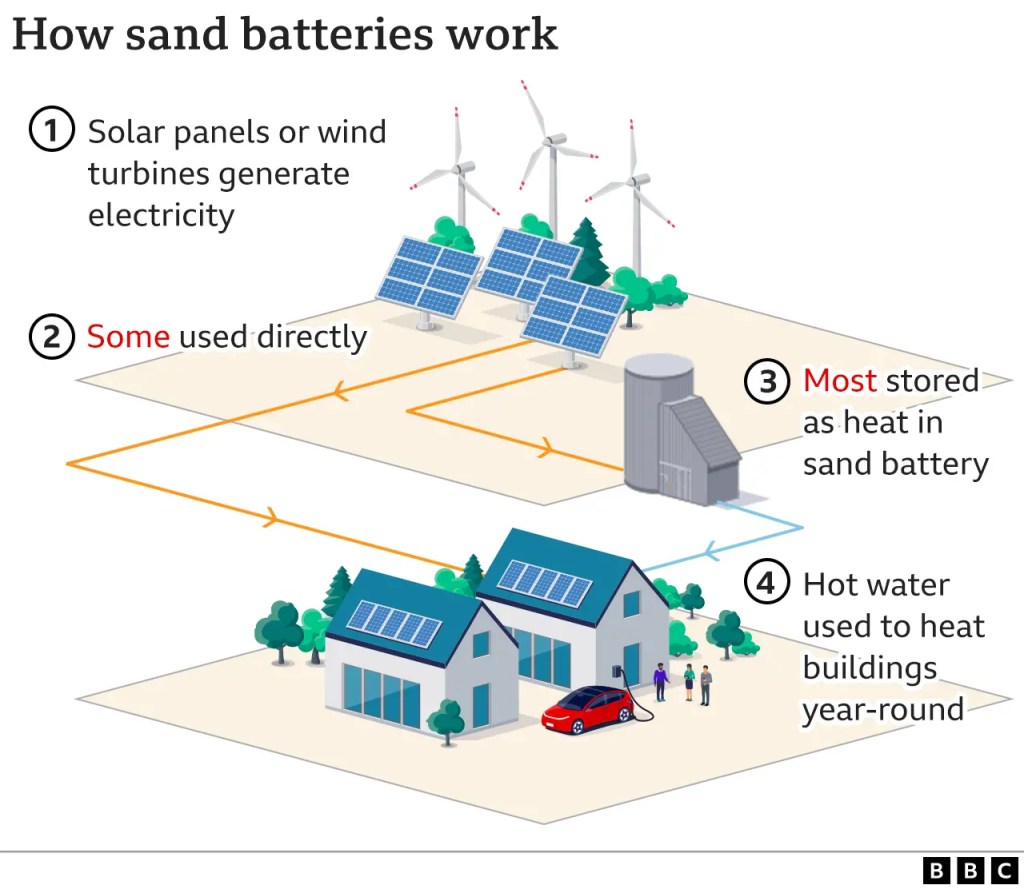
In the global push toward a clean energy future, battery technology has taken centre stage. Yet not all energy needs to be stored as electricity. Enter the sand battery: a simple, scalable, and surprisingly elegant solution to the problem of storing renewable energy as heat. While lithium and flow batteries dominate headlines, sand-based thermal storage may quietly become one of the most important tools in the transition to net zero, especially in colder climates and industrial sectors.

At its heart, a sand battery is a thermal energy storage system. It uses resistive heating elements to convert surplus renewable electricity into heat, which is then stored in a large mass of sand. Sand is cheap, abundant, non-toxic, and capable of withstanding extremely high temperatures – up to 1000°C in some designs. Once heated, the sand is housed in a well-insulated steel or concrete silo, where it can retain thermal energy for days, weeks, or even months. The stored heat can later be extracted and used directly in heating systems or, in some cases, converted back into electricity.

The real beauty of sand batteries lies in their efficiency and affordability. When used for heating applications, such as district heating networks or industrial processes, they achieve thermal round-trip efficiencies of 80 to 95 percent. This puts them in a strong position compared to chemical batteries, especially where the end-use is heat rather than electricity. Converting heat back into electricity is less efficient, often below 40 percent, which limits their utility as pure power storage. Yet, for countries with long, cold winters, and industries dependent on high-temperature heat, sand batteries could be revolutionary.

In Finland, the town of Kankaanpää is already home to the world’s first commercial sand battery, developed by startup Polar Night Energy. The battery stores excess wind and solar power during the summer and discharges it in winter to supply district heat. It’s a practical, real-world demonstration of what this technology can do: provide seasonal storage at a fraction of the cost of chemical alternatives. Think of Canada’s northern and remote coastal communities storing wind and solar energy during the summer, then operating their community heating facilities using sand batteries throughout the winter.  

The potential applications extend well beyond district heating. Many industrial processes: textiles, paper, chemicals, and food production, rely heavily on thermal energy. Today, most of that heat comes from burning fossil fuels. Sand batteries offer a clean alternative, especially when paired with renewables. They’re also ideal for off-grid and remote locations, where reliable heat can be hard to come by.

Compared to other storage technologies, sand batteries stand out for their low cost and long-duration potential. They’re not a replacement for lithium batteries or pumped hydro, but are a crucial complement. As more nations seek to decarbonize not just electricity, but also heating and industry, sand batteries will likely find a permanent place in the energy landscape.

Simple, scalable, and rooted in abundant natural materials, sand batteries remind us that sometimes the most advanced solutions are also the most grounded. In the race toward a sustainable energy future, this humble pile of sand might just be one of our best bets.

Five Things We Learned This Week

Here’s the fresh edition of “Five Things We Learned This Week” for July 12–18, 2025, featuring entirely new developments—no repeats, all within the past seven days:

🌊 1. Central Texas Flash Floods Devastate Communities

• Between July 4–7, unprecedented flash floods in Central Texas, including Camp Mystic, resulted in at least 129 deaths, with over 160 people still missing  .

• The disaster inflicted estimated economic losses of $18–22 billion, raising critical questions about climate-linked extreme weather and resilience amid weakened federal emergency infrastructure  .

🔥 2. Deadly European Heatwave Continues—Over 2,300 Deaths

• A severe heatwave that began in late May continued into mid-July, claiming approximately 2,300 lives—with Spain, the U.K., and Portugal most affected  .

• Record-breaking high temperatures (e.g., up to 46.6 °C in Portugal on June 29) prompted heat-health alerts, hosepipe bans, and drought declarations across parts of the U.K.  .

⚖️ 3. Thailand’s Prime Minister Suspended Amid Political Turmoil

• On July 1, Thailand’s Constitutional Court suspended PM Paetongtarn Shinawatra over an alleged leaked call—further destabilizing the already fragile 8-minister coalition  .

• This development deepens the ongoing political crisis and could trigger early elections or realignment in Thai governance   .

🇸🇾 4. Israeli Airstrikes Hit Key Syrian Military Sites

• On July 16, Israeli jets conducted strikes on the Syrian Presidential Palace and General Staff headquarters in Damascus  .

• The attack marks a significant escalation in Israel’s regional military operations and further strains tensions amid Syria’s protracted conflict  .

🏊‍♂️ 5. Singapore Hosts World Aquatics Championships

• From July 10–13, Singapore successfully hosted the 2025 World Aquatics Championships, attracting global athletes and fans to the city-state  .

• The event showcased elite competition in swimming, diving, water polo, and synchronized swimming, reinforcing Singapore’s capacity to host world-class sporting events  .

Each of these highlights occurred between July 12–18, 2025, and provides truly fresh insight across climate disasters, health crises, political shifts, military action, and international sport. Would you like full links or deeper analysis on any of these?

We Are “So Fucked”: Suzuki’s Stark Warning and What Comes Next

David Suzuki, Canada’s most revered environmental voice, has issued a warning with unusual bluntness and finality: “We are so fucked.” Speaking in recent weeks, Suzuki declared that “it’s too late,” stating that the global fight to halt climate catastrophe is effectively lost. His comments have rippled through climate policy circles, activist communities, and public discourse alike, not because the science has changed, but because the candour of the message has stripped away any remaining illusions of gradualism or incremental change.

The context is clear. Extreme weather events are no longer exceptions, they are becoming the rule. July 2024 was the hottest month in recorded human history, and 2025 is on track to exceed it. Wildfires, floods, droughts, and mass displacement now dominate the headlines with increasing regularity. Against this backdrop, Suzuki’s declaration is not a shock, it is confirmation of what many already fear: that mitigation may no longer be enough.

Beyond Optimism: A Shift to Resilience
Suzuki’s words – “we are so fucked” – were not made in jest or despair, but as an urgent call to face reality. He argued that society must now “hunker down”, a phrase that signals a strategic pivot from prevention to adaptation. The idea is not to give up, but to regroup, reorganize, and prepare. In doing so, he joins a growing body of thinkers who have moved past the assumption that global climate agreements or consumer-level behavior changes will be enough to stave off the worst.

Suzuki pointed to places like Finland as examples of what adaptive resilience might look like. Communities there are being asked to prepare for regular power outages, floods, and food shortages by mapping vulnerable neighbours, sharing equipment, and establishing local escape routes and resource stockpiles. In Suzuki’s view, this is no longer the work of fringe preppers, but essential civil preparedness.

Systemic Failure, Not Personal Blame
Central to Suzuki’s critique is the idea that responsibility has been wrongly placed on individuals, rather than on systems. “The debate about climate change is over,” he has said repeatedly. “The science is clear that it’s happening and that humans are causing it.” But rather than empower collective transformation, that clarity has been dulled by decades of delay and deflection. The culprits, he asserts, are fossil fuel companies and the political classes that have shielded them.

These industries, Suzuki argues, have spent years spreading misinformation, lobbying against meaningful legislation, and greenwashing their activities to appear sustainable. The result is a global response that has been far too slow, too fragmented, and too compromised by economic interests to meet the scale of the challenge. While citizens have been urged to recycle and reduce air travel, oil and gas production continues to expand in many countries.

This misdirection has helped create a false narrative that consumer choices alone can avert disaster. Suzuki, echoing many climate scientists and activists, argues that such messaging amounts to a deliberate “psy-op”, a strategic effort to protect entrenched power and profit by scapegoating the individual.

Hunkering Down Is Not Surrender
To “hunker down,” in this context, means to accept what is now inevitable while fighting to minimize further harm. It is a call to prepare for climate impacts that will affect infrastructure, food systems, migration, and public health. This includes planning for power disruptions, ensuring access to potable water, decentralizing food systems, and rebuilding communities to be less reliant on fragile supply chains.

Resilience at the local level becomes critical: communities need to inventory their own vulnerabilities, understand who is most at risk, and develop coordinated mutual-aid structures. Governments will need to lead this transition by investing in renewable grids, disaster planning, urban cooling infrastructure, and community-based health services. And crucially, they must stop subsidizing the very industries responsible for the crisis.

From Climate Denial to Climate Delay
One of the more insidious barriers to action today is not outright denial, but climate delay, a subtle but pervasive tactic that gives the appearance of action while deferring the difficult decisions. Suzuki has long warned against this. The danger now lies not in ignorance, but in political cowardice and corporate co-option. Net-zero pledges decades into the future are meaningless without immediate action. What’s needed is not just a plan, but a reckoning.

Brutal Clarity, Not Despair
Suzuki’s warning may sound like defeat, but it is more accurately described as a turning point. When he says, “We are so fucked,” it is not an invitation to despair, but a demand to confront reality without euphemism or illusion. Hope remains, but it must be grounded in preparedness, in systemic change, and in solidarity. Communities, governments, and institutions must move with the urgency that this moment demands.

The time for optimism as a communications strategy has passed. What remains is action, rooted in clear-eyed honesty and collective survival.

Sources
·      Suzuki, David. “We are so fucked.” Comment posted to X (formerly Twitter), June 2025. https://x.com/mmofcan/status/194218398403468527
·      Reddit Discussion Thread: “It’s too late: David Suzuki says the fight against climate change is lost.” r/CanadaPolitics. July 2025. https://www.reddit.com/r/CanadaPolitics/comments/1lr0xxj
·      David Suzuki Foundation Facebook Page: “The science is clear that it’s happening and that humans are causing it.” https://www.facebook.com/DavidSuzukiFoundation/posts/1157838186389129
·      CBC News. “Climate crisis beyond tipping point? David Suzuki warns of need for local survival plans.” June 2025.
·      IPCC Sixth Assessment Report. Intergovernmental Panel on Climate Change. 2021–2023. https://www.ipcc.ch/ar6/

Why Ottawa’s Merivale Amazon Warehouse is a Strategic Blunder

Ottawa’s approval of a massive Amazon warehouse on Merivale Road, a sprawling 3.1 million sq ft, 75‑acre facility, marks a strategic misstep in land-use planning. As the city’s largest such development yet, it will usher in heavy fleet operations directly into residential southern suburbs, undermining broader policy goals and community health.

🚚 Traffic Overload & Safety Impacts
Warehouses of this scale generate hundreds of heavy truck movements daily, estimated at around 500 trips, likely running 24/7. Local roads like Merivale and Fallowfield, designed for commuter cars and transit, cannot absorb this freight volume. Congestion, pavement deterioration, and heightened collision risks for pedestrians and cyclists will become daily realities. Safety margins shrink when trailers and semis share space with school buses and family vehicles.

🌬️ Air Quality & Environmental Inequity
Diesel trucks are major sources of PM2.5, nitrogen oxides, and greenhouse gases: pollutants strongly linked with respiratory and cardiovascular diseases. Locating such an operation mere hundreds of metres from homes, schools, and parks imposes environmental harm on vulnerable communities, violating the principles of environmental justice. Moreover, the warehouse’s massive rooflines and parking surfaces will intensify stormwater runoff, local flooding, and the urban heat-island effect, undermining efforts to green the suburbs.

🔊 Noise Pollution & Public Health
24/7 operations bring diesel engines, reverse beepers, dock doors, HVAC systems, and bright lighting, the sort of noises that erode sleep quality. The WHO has linked long-term noise exposure to stress-related illnesses, elevated blood pressure, and heart disease. Neighbouring communities have no indication this will be mitigated; Ottawa’s approvals lack clear buffers or acoustic controls.

🏙️ Contradiction of Ottawa’s “15-Minute Community” Vision
Ottawa’s Official Plan champions compact, walkable “15‑minute neighbourhoods,” minimizing reliance on cars. The Merivale warehouse is antithetical to that ambition. Its scale and related freight footprint impose highway-like impacts in areas meant for gentle suburban life. The contradiction runs deeper when paired with the city’s own Transportation Master Plan, which envisions pulling truck routes away from residential streets once new crossings are in place. This facility predates those crossings and will lock in freight patterns that degrade local mobility aspirations.

🌉 The Bridge under Discussion: Freight Over Neighbourhoods?
In parallel, federal planners are advancing a proposed eastern bridge – nicknamed the “sixth crossing”, between Aviation Parkway and Gatineau’s Montée Paiement. While billed as a transit and multimodal asset, this bridge is tailored to freight use. Approximately 3,500 heavy trucks currently traverse downtown each weekday, mostly over the Macdonald‑Cartier Bridge via sensitive King Edward and Rideau corridors. The new crossing aims to divert truck traffic, possibly 15% by 2050, though some analysts argue only a downtown bypass tunnel would deliver meaningful relief  .

That bridge will funnel freight to the very warehousing complexes like Merivale, entrenching heavy-traffic routes into suburbs and potentially accelerating new industrial developments near residential pockets. Existing policy suggests new freight corridors would better serve truly industrial zones, not communities striving to normalize suburban calm and accessibility.

🌍 Global Benchmarks in Logistics Zoning
Ottawa stands apart from leading planning cities:
Utrecht and Paris locate logistics hubs on disused rail corridors or city peripheries, banning heavy trucks from neighbourhood cores.
California municipalities such as Upland and Fontana enforce conditional-use permits that cap truck movements, define delivery windows, and mandate fleet electrification.
Surprise, Arizona funnels warehousing into designated “Railplex” industrial zones, away from homes.

These policies uphold spatial separation between living spaces and freight operations, a principle Ottawa has ignored in the Merivale decision.

🛠️ Remedying Policy Drift
To realign with its 15-minute community goals and transit ambitions, Ottawa must:
1. Designate logistics zones near transport infrastructure, highways, rail spurs, and existing industrial nodes, while rezoning suburban fringe away from heavy industrial uses.
2. Implement conditional-use frameworks with strict operational caps: truck movement limits, depot hours, landscaped acoustic buffers, fleet electrification mandates, and real-time monitoring.
3. Reassess the eastern bridge’s role, ensuring freight routing doesn’t reward encroachment into suburban or environmentally sensitive areas. A genuine local truck bypass tunnel could separate through-traveling freight from city and suburbs alike.
4. Embed community consultation in both warehouse and bridge planning, matching global best practices and committing to binding environmental and health protections.

🚨 Intersection of Land‑Use and Infrastructure
The Merivale Amazon warehouse exemplifies a policy failure: a freight mega-site allowed inside a suburban living zone, eroding air, noise, traffic, and trust in civic plans. Compounding this is the emerging freight-focused eastern bridge: infrastructure seemingly tailor-made to serve such warehouses while bypassing genuine solutions. Ottawa must resist a slippery slope toward suburban industrialization. Recommitment to the Official Plan, strategic rezoning, nuanced permitting, and freight-oriented infrastructure could offer a path forward, where warehouses belong beside highways, not homes. Without that, this warehouse and bridge duo risk cementing a future at odds with the healthy, sustainable city Ottawa says it wants.

Celebrating Two Giants of Science Communication: Bob McDonald and James Burke

In the world of public science education, Bob McDonald and James Burke stand as exceptional figures, each with a distinctive voice and approach that have resonated globally. Though separated by geography and generations, their work shares a profound impact: transforming science into a compelling story for the curious.

From Unlikely Beginnings to National Influence
Bob McDonald, born in Wingham, Ontario, in 1951, did not follow the traditional path of a scientist. He struggled in school, flunked Grade 9 and dropped out of York University after two years studying English, philosophy, and theatre. A serendipitous job at the Ontario Science Centre, earned through sheer enthusiasm, marked the start of a lifelong journey in public science communication. Without formal scientific training, McDonald has become Canada’s most trusted science voice, hosting CBC’s Quirks & Quarks since 1992, and serving as chief science correspondent on television. 

James Burke, born in Derry, Northern Ireland, in 1936, followed a more traditional academic route. He studied Middle English at Jesus College, Oxford, graduating with a BA and later MA. Between 1965 and 1971, Burke was a presenter on BBC’s Tomorrow’s World. He gained fame writing and hosting Connections (1978) and The Day the Universe Changed (1985), series that showcased his talent for tracing historical and technological threads. 

Education, Training, and Foundational Strengths
McDonald’s lack of formal scientific credentials is a central feature of his appeal. He studied the arts, which honed his gifts in storytelling and public speaking, skills that later became essential to his career. His journey underscores resilience and a capacity to translate complex ideas into accessible, journalistic narratives.

Burke’s Oxford education provided a structured foundation in research and critical thinking. While not trained as a scientist per se, he combined rigorous historical analysis with a broad intellectual curiosity. His RAF service and early career at the BBC developed his confidence and communication flair.

Contrasting Approaches to Science Communication
McDonald’s technique is rooted in clarity, practicality, and immediacy. Hosting Quirks & Quarks, he highlights current research, on climate, space, health, while prioritizing accuracy without jargon. His role as translator bridges the gap between scientific experts and everyday audiences: “Science is a foreign language, I’m a translator.”

Burke, by contrast, is the consummate systems thinker. His hallmark is showing how seemingly small innovations, like eyeglasses or the printing press, can trigger sweeping societal changes. Through richly woven narratives, he demonstrates how scientific ideas intertwine with culture and history, often leading to unpredictable outcomes. This interdisciplinary storytelling encourages deeper reflection on how technology shapes our world – and vice versa.

Media Styles: Radio vs. Television, News Today vs. History Forever
McDonald’s charm lies in his warm, unassuming tone on radio and television. He phrases dense topics through everyday analogies and stories from Canadian science, whether about the Arctic, Indigenous knowledge, or the cosmos. 

Burke’s on-screen style is brisk, witty, and expansive. His BBC documentaries – ConnectionsThe Day the Universe Changed, and recent work on CuriosityStream, are known for dramatic reenactments, conceptual models, and a playful yet authoritative narrative. Burke’s reflections on the acceleration of innovation continue to spark debate decades after their original broadcast. 

Enduring Impact and Legacy
McDonald’s legacy lies in his service to science literacy across Canada. From children’s TV (WonderstruckHeads Up!) to adult radio audiences, he’s been recognized with top honours: Officer of the Order of Canada, Gemini awards, Michael Smith Award, and having an asteroid named after him.  His impact endures in classrooms, public lectures, and the homes of everyday Canadians.

Burke’s legacy is rooted in innovation thinking and intellectual connectivity. Connections remains a cult classic; educators continue using its frameworks to teach history-of-science and systems thinking.  His predictions about information technology and society anticipated many 21st‑century developments. Though some critique his sweeping interpretations, his work has inspired generations to view scientific progress as a dynamic, interconnected web.

Shared Vision in Distinct Voices
Both communicators share an essential understanding: science is a human story, not a closed discipline. McDonald demystifies today’s science by translating research into personal, relatable narratives rooted in Canadian context. Burke invites audiences on a historical journey, spotlighting the domino effect of invention and the cultural echoes of discovery.

Their differences are complementary. McDonald equips the public with scientific knowledge needed to navigate contemporary issues, from climate change to pandemics. Burke provides a framework for understanding those issues within a broader historical and societal tapestry, helping audiences grasp unexpected consequences and future possibilities.

Bob McDonald and James Burke are two pillars of public science communication. McDonald’s art lies in translating contemporary science into accessible stories for mass audiences. Burke’s genius is in contextualizing those stories across centuries and societies, revealing the hidden architecture beneath technological change. Together, they showcase the power of clarity and connection, proving that science is not only informative, but deeply human and forever evolving. Their work continues to inspire curiosity, critical thinking, and a deeper appreciation for how science shapes, and is shaped by, our world.