A Strategic and Moral Reckoning: The UK-Mauritius Agreement on the Chagos Islands

In a rare moment of geopolitical clarity and moral courage, the United Kingdom has agreed to transfer sovereignty of the Chagos Islands to Mauritius while securing a 99-year lease on Diego Garcia, the region’s pivotal military base. The agreement, unveiled by Prime Minister Keir Starmer’s government, is both a forward-looking strategic arrangement and a long-overdue act of historical redress.

At the heart of the deal is a pragmatic security arrangement: the UK will retain uninterrupted access to Diego Garcia, which hosts vital joint operations with the United States. In return, it will pay £101 million annually to Mauritius. This ensures that Britain continues to anchor its defence capabilities in the Indo-Pacific; a region where rival powers like China, Russia, and Iran are rapidly expanding their influence.

From a fiscal standpoint, the agreement is well within reason. Defence Secretary John Healey rightly pointed out that the annual lease cost is comparable to operating a single aircraft carrier. In fact, the payment constitutes just 0.15% of the UK’s £67.7 billion annual defence budget—a fraction of the cost for maintaining global readiness and a meaningful presence in one of the world’s most strategically significant regions. For a modest financial outlay, the UK preserves its operational edge, cements a critical alliance with the US, and reinforces its relevance in global affairs.
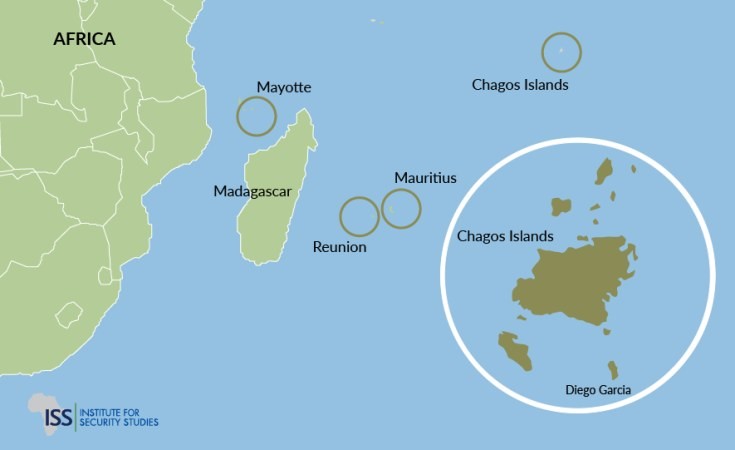
Yet the agreement is more than a security calculation. It also addresses one of Britain’s most painful colonial legacies. In 1965, the UK controversially separated the Chagos Archipelago from Mauritius, evicted the native Chagossians, and facilitated the construction of the Diego Garcia military base. These actions, condemned by the International Court of Justice and the UN General Assembly, have weighed heavily on the UK’s international standing.

The return of sovereignty to Mauritius is therefore a landmark act of accountability. It signals that Britain is willing to engage honestly with its imperial past, even when doing so involves diplomatic and political complexity. This is a step not just toward reconciliation with Mauritius, but also toward reasserting the UK’s commitment to international law and human rights.

Still, the success of this agreement must be judged not only by its geopolitical merit, but also by how it serves the people most affected: the Chagossians. The agreement allows Mauritius to implement a resettlement plan across the archipelago, excluding Diego Garcia. While this represents progress, it does not fully resolve the aspirations of Chagossians who long to return to their ancestral home.

As Bernadette Dugasse, a displaced Chagossian, movingly put it: “I don’t belong in the UK, I don’t belong in Mauritius, I don’t belong in the Seychelles. I belong in Diego Garcia.” These voices must not be sidelined. It is imperative that the UK and Mauritius ensure that Chagossians are not only consulted but empowered in shaping the future of the islands.

This deal is a model of how a former colonial power can act responsibly in today’s world, by marrying strategic foresight with moral responsibility. Britain has taken a step forward, not just in securing its defence, but in doing justice. Now, it must ensure that the Chagossian people are treated with the dignity they have long been denied.

Five Things We Learned This Week

Here is the latest edition of “Five Things We Learned This Week” for May 17–23, 2025, highlighting significant global developments across various sectors.

🛑 1. UN Warns of Escalating Humanitarian Crisis in Gaza

UN Secretary-General António Guterres described the current stage of the Gaza conflict as possibly its “cruellest phase,” with Palestinians facing immense suffering amid escalating Israeli military operations. He warned that the entire population is at risk of famine and criticized the limited humanitarian aid reaching Gaza, citing that only a fraction of permitted aid trucks have reached those in need due to insecurity. In the past 24 hours, at least 60 people were killed, including strikes on Khan Younis, Deir al-Balah, and Jabaliya, with over 50 people still buried under rubble. UN agencies and aid groups have raised alarms about inadequate food and medical supplies, with over 9,000 children treated for malnutrition and the healthcare system near collapse—94% of hospitals are damaged or destroyed. Israeli airstrikes have also targeted hospitals, further straining emergency services. Despite easing an 11-week blockade, aid remains minimal, far below pre-war levels. International criticism of Israel’s military actions continues, with leaders calling for a ceasefire and increased humanitarian access. Meanwhile, discussions are underway among Western nations about formally recognizing the state of Palestine, adding a new diplomatic dimension to the ongoing crisis. 

💉 2. NHS England Launches World’s First Gonorrhoea Vaccine

On May 21, NHS England introduced the world’s first gonorrhoea vaccine, demonstrating an efficacy of 30–40%. This development aims to combat the rising rates of gonorrhoea infections and represents a significant advancement in public health efforts to control sexually transmitted infections. 

📉 3. Trump’s New Tariff Threats Shake Global Markets

President Donald Trump’s evolving trade policies continue to send shockwaves through global markets. After a brief period of de-escalation in the U.S.-China trade war, markets were rattled on May 23, 2025, when Trump threatened to impose a 25% tariff on Apple iPhones not manufactured in the U.S. and a 50% tariff on EU goods starting June 1. These moves undermined recent optimism following tariff reductions between the U.S. and China, which had reignited S&P 500 gains and stabilized investor sentiment. However, concerns about tariffs resurfaced alongside rising inflation, tepid economic growth, and persistent federal debt nearing 100% of GDP. Despite some temporary relief—such as tariff pauses and incentives for auto and tech firms—Trump’s unpredictable trade tactics, especially his criticism of Apple’s offshore manufacturing and pressure on trading partners like the UK and India, have reintroduced uncertainty. Furthermore, even with promising AI infrastructure investments from the Middle East, the U.S.-China relationship is strained by export restrictions and sanctions tied to Huawei’s semiconductor use. Economists warn these erratic policies could spur stagflation and erode S&P 500 earnings growth, highlighting the risks of Trump’s tariff-heavy strategy amid widening fiscal deficits and global trade tensions. 

🧬 4. Discovery of New Dwarf Planet Candidate in Outer Solar System

Astronomers have reported the discovery of 2017 OF201, a new dwarf planet candidate located in the outer reaches of the Solar System. This celestial body adds to our understanding of the Solar System’s composition and the diversity of objects within it. 

🎭 5. Hay Festival of Literature and Arts Commences in Wales

The Hay Festival of Literature and Arts began on May 22 in Hay-on-Wye, United Kingdom. This annual event is one of the largest literary festivals globally, attracting authors, thinkers, and readers to celebrate literature, arts, and ideas through various talks, readings, and performances. 

Stay tuned for next week’s edition as we continue to explore pivotal global developments.

A Strategic Reset: Is the UK’s 12-Year Deal with the EU a Trial Run for Rejoining?

In a move that may mark the beginning of a new chapter, or even a slow reversal, in post-Brexit Britain, Prime Minister Keir Starmer’s government has signed a sweeping 12-year deal with the European Union. Spanning trade, fisheries, defense, energy, and youth mobility, the agreement is being sold as a pragmatic step toward economic stability. Yet, for keen observers of European geopolitics and domestic UK policy, this isn’t just about cutting red tape or smoothing customs formalities. It’s about direction, intent, and trajectory; a trajectory, some might argue subtly, but surely points back toward Brussels.

Let’s be clear – this is not rejoining the EU. The UK retains its formal sovereignty, its independent trade policy, and its seat at the World Trade Organization. Yet, in practical terms, this agreement represents a partial realignment with the European regulatory and political sphere. It’s a détente, but one that many suspect could serve as a trial run for re-entry.

Trade and Regulatory Alignment: Quiet Integration
The most immediate impacts will be felt in trade. The deal includes a new sanitary and phytosanitary (SPS) agreement that significantly eases checks on animal and plant products, long a point of friction for exporters. British sausages and cheeses can once again cross the Channel with ease, and exporters have been granted breathing room after years of customs chaos.

The price? The UK will align dynamically with EU food safety rules and standards. Not only that, but the European Court of Justice (ECJ) will have an oversight role in this domain. It’s a politically delicate concession that the previous Conservative government would have balked at, but it is one that Starmer is positioning as an economic necessity rather than a political capitulation.

This kind of soft alignment, regulatory cooperation without full membership, mirrors the arrangements held by countries like Norway and Switzerland. The UK isn’t there yet, but it’s moving in that direction, and the economic benefits are likely to reinforce the case.

Fisheries: Symbolism and Compromise
Few sectors embody the emotion of Brexit like fisheries. The 2016 Leave campaign made maritime sovereignty a powerful symbol of national self-determination. Now, the UK has agreed to extend EU access to its waters for another 12 years, hardly the full “taking back control” once promised.

However, the government insists that the deal does not grant additional quotas to EU vessels, and preserves the right to annual negotiations. To offset the political fallout, £360 million is being invested into modernizing the UK fishing industry, a sweetener aimed at skeptical coastal communities.

Yet symbolism matters. This agreement effectively freezes the reassertion of full UK control over its fisheries until 2038. That’s long enough for an entire generation of voters to become accustomed to a cooperative status quo.

Energy, Climate, and Economic Integration
Perhaps the most telling element of the deal is its ambition in energy and carbon market integration. The UK and EU will link their Emissions Trading Systems (ETS), smoothing the path for cross-border carbon credit trading, and exempting British companies from the EU’s incoming Carbon Border Adjustment Mechanism (CBAM). This could save UK firms an estimated £800 million annually.

In strategic terms, it brings the UK closer to the EU’s climate governance framework, and represents a quiet, but firm repudiation of the “Global Britain” fantasy that post-Brexit Britain could thrive on deregulated free-market exceptionalism.

Security and Mobility: A Return to Practical Cooperation
Defense is also back on the table. The UK will participate in the EU’s PESCO initiative for military mobility, signifying renewed cooperation on troop and equipment movements. Intelligence sharing and sanctions alignment are also included, moves that suggest an increasingly coordinated foreign policy framework, even outside EU structures.

Meanwhile, UK travelers will soon regain access to EU e-gates, reducing airport queues, and negotiations are underway for a youth mobility scheme. The return to the Erasmus+ student exchange programme, in particular, is a major symbolic step, reconnecting young Britons with continental Europe in a way that had been severed post-2020.

A Trial Run for Rejoining?
Viewed in isolation, each element of the deal appears pragmatic and limited. Viewed together, however, they amount to a re-entangling of the UK within EU institutions and standards. The length of the deal, 12 years, is conspicuous. It places a review just past the midpoint of what could be two Labour governments, opening a window in the 2030s for a possible reapplication for membership.

Critics argue that Starmer is “Brexit in name only,” effectively undoing much of the substance of the 2016 vote. Proponents counter that he is offering economic stability, and international credibility without rekindling the divisive debate of formal re-entry, but no one should be under any illusions: this is a serious recalibration. For a generation of younger voters who never supported Brexit, it might just feel like the first step toward righting a historic wrong.

In this light, the 12-year deal may be best understood as a proving ground. It allows both the UK and the EU to rebuild trust, test cooperation mechanisms, and create the legal and political scaffolding that could one day support full re-accession. Starmer may deny it, and Brussels may downplay it, but history has a way of turning such “interim measures” into new norms.

For now, the UK is not rejoining the EU, but the doors, long thought closed, are no longer locked. And the steps taken in this agreement may well be remembered as the start of the long walk back in.

Sources
• BBC News: https://www.bbc.com/news/articles/czdy3r6q9mgo
• Sky News: https://news.sky.com/story/uk-eu-trade-deal-what-is-in-the-brexit-reset-agreement-13370912
• Al Jazeera: https://www.aljazeera.com/news/2025/5/21/will-eu-deal-make-food-cheaper-add-12bn-to-the-uk-economy
• Financial Times: https://www.ft.com/content/66763def-d141-465d-ba96-31399071bf3b
• The Times: https://www.thetimes.co.uk/article/starmers-done-no-better-with-the-eu-than-may-8l37jm2sf

The Essequibo Equation: Venezuela’s Bid, Guyana’s Boom

The morning sun hangs low over the Atlantic, glinting off the towers rising in Georgetown, Guyana’s modest, but fast-transforming capital. A decade ago, few would have imagined this small South American nation, wedged between Brazil, Venezuela, and Suriname, would be at the center of a geopolitical and environmental drama with global stakes. Guyana is flush with oil – Black Gold. The kind that redraws maps, tilts economies, and ignites old rivalries. For Venezuela, long mired in economic freefall and domestic strife, it is an irresistible provocation.

Let’s be clear, what’s happening in Guyana is one of the most remarkable economic stories in the Western Hemisphere. Since ExxonMobil discovered vast offshore reserves in 2015, production has accelerated with almost reckless speed. By next year, output is projected to hit 900,000 barrels a day, and it could top 1.3 million before the end of the decade. For a country of under 800,000 people, that is transformative wealth, and unlike its oil-rich neighbours, some of whom squandered such windfalls, Guyana is making a bold promise; to become a net-zero emitter of greenhouse gases by 2050, even as it becomes a fossil fuel giant.

On the surface, this seems contradictory. How can you drill for oil while committing to climate leadership? Guyana’s government argues that its forest cover, nearly 85% of the national territory, is a massive carbon sink. It also claims that the revenues from oil will fund sustainable development, clean energy projects, and climate resilience. Whether this can be done without falling into the corruption, debt, and inequality traps that have cursed so many petro-states remains to be seen. So far, international financial institutions are cautiously optimistic. The government is under intense scrutiny, and the pressure to deliver transparency and social equity is mounting.

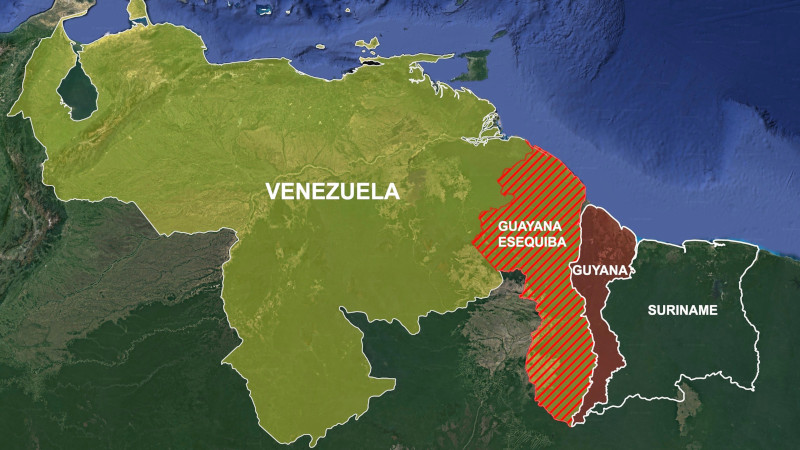
Guyana’s newfound wealth has stirred a long-simmering conflict with its neighbor to the west – Venezuela. The heart of the matter is the Essequibo region, a vast, resource-rich area that makes up nearly two-thirds of Guyana’s landmass. Venezuela has claimed it ever since the 1899 arbitration award, backed by the United States and Britain, granted the territory to what was then British Guiana. For over a century, the dispute remained largely symbolic, flaring up occasionally, but never seriously threatening borders.

Now, the stakes are very real. In 2023, Venezuela’s President Nicolás Maduro ramped up the rhetoric, holding a referendum in which voters overwhelmingly backed a proposal to annex Essequibo. Caracas argues that the arbitration was flawed and that the entire region was unlawfully taken. The timing, of course, is not coincidental. As Guyana’s oil fields, many lying off the Essequibo coastline, begin to pump billions into government coffers, Venezuela sees an opportunity to redirect domestic attention from its own failures, and tap into a nationalist cause with broad appeal.

Guyana, for its part, has responded not with sabre-rattling, but with legal precision. It brought the case before the International Court of Justice, which ruled in 2023 that it had jurisdiction. Earlier this year, in May 2025, the ICJ went further, ordering Venezuela to halt its plans to conduct elections in the disputed territory, a direct rebuke to Maduro’s annexation agenda. Venezuela has ignored the court, as it has ignored much of international law in recent years, and tensions are rising on the ground.

This is no longer a war of words. Just this month, Guyanese soldiers patrolling the border were attacked multiple times in under 24 hours. These were not large-scale military incursions, but they are warnings, probing gestures, testing the resolve of a much smaller neighbor. Guyana has responded by strengthening its military posture and drawing closer to its Western allies, including the United States and Brazil. The regional implications are grave: any escalation could destabilize the northern tier of South America, drag in other powers, and endanger vital shipping routes and energy flows.

As someone who has watched the ebb and flow of South American politics for decades, I see in this moment both peril and possibility. Guyana stands on a razor’s edge: it could become a model of how a small nation leverages its natural wealth responsibly, or it could descend into conflict, corruption, and dependence. Venezuela’s claim is, in essence a gamble, hoping that the world is too distracted to enforce international norms, and that might still makes right. Yet Guyana is not alone, and the legal, diplomatic, and moral momentum is on its side.

Whether that will be enough is another question entirely. Oil has always been more than a commodity in this region of the world. It is a force that reshapes nations and, sometimes, breaks them. For Guyana, the challenge now is not only to survive Venezuela’s ambitions, but to thrive in spite of them, and perhaps, just perhaps, to chart a new course for oil-rich states in the 21st century.

Five Things We Learned This Week

Here is the latest edition of “Five Things We Learned This Week” for May 10–16, 2025, spotlighting significant global developments across various sectors.

🧬 1. CERN’s ALICE Experiment Transmutes Lead into Gold

In a groundbreaking achievement, CERN’s ALICE experiment successfully converted lead into gold. This scientific milestone demonstrates the potential of particle physics to manipulate atomic structures, echoing the age-old alchemical quest with modern technology.  

🧠 2. Genetic Links to Obsessive–Compulsive Disorder Identified

A comprehensive study involving over 2 million participants has identified 250 genes associated with obsessive–compulsive disorder (OCD). This discovery offers new insights into the genetic underpinnings of OCD, paving the way for targeted therapies and improved understanding of the condition.  

💰 3. Reserve Bank of India Plans Record Payout to Government

The Reserve Bank of India (RBI) is expected to transfer a record surplus of up to ₹3 lakh crore to the government for the financial year 2024–25. This anticipated payout, nearly 50% higher than the previous year’s, will provide a significant fiscal boost to the government, aiding in budgetary commitments and economic initiatives.  

 4. U.S. Clean Energy Tax Incentives Face Potential Rollback

A Republican-led initiative in the U.S. House of Representatives aims to significantly cut tax credits for clean energy established under the Inflation Reduction Act. The proposed rollback could hinder progress toward reducing carbon emissions and halt the recent surge in clean energy investments, potentially impacting the U.S.’s position in the global clean tech market.   

✈️ 5. Australian Transport Workers Union Threatens Major Industrial Action

The Transport Workers Union (TWU) in Australia has announced plans for a significant industrial campaign that could disrupt the nation’s transport sector, including airline operations. The union aims to coordinate the expiry of over 200 enterprise agreements in 2026 to maximize workers’ bargaining power, targeting major companies such as Qantas, Aldi, Amazon, and Virgin Australia.  

Stay tuned for next week’s edition as we continue to explore pivotal global developments.

AUKUS: Australia’s Submarine Mirage and the Real Estate Windfall for the US and UK

This is the third in a series of posts discussing U.S. military strategic overreach. 

By any sober assessment, the AUKUS agreement is fast revealing itself not as a bold leap forward for Australian sovereignty or security, but rather as a strategic sleight of hand that gifts the United States and United Kingdom a plum prize: a deep-water Pacific base on a silver platter, without any credible assurance that Australia will ever take possession of a single operational nuclear-powered submarine.

At the heart of the matter is the glaring asymmetry in commitments. Australia is shoveling billions of taxpayer dollars, $4.6 billion and counting, into American shipyards and infrastructure while simultaneously preparing HMAS Stirling to host a rotating force of U.S. and British attack submarines as early as 2027. This “Submarine Rotational Force West” isn’t a sovereign fleet, it’s a permanent allied presence on Australian soil, marketed as “partnership,” but shaped overwhelmingly to suit U.S. Pacific ambitions.

Meanwhile, the so-called promise that Australia will receive at least three Virginia-class submarines from the United States remains riddled with legal escape hatches. Congressional legislation passed in 2023 mandates that the U.S. President must provide certification, a full nine months in advance of any transfer, that the move won’t compromise American naval readiness or foreign policy interests. Let’s be clear: this is not a contractual obligation; it’s a political permission slip, one that can be revoked, postponed, or buried under the weight of domestic American priorities at any time. With the U.S. submarine industrial base already overstretched and multiple U.S. senators flagging their concern that sending boats to Australia would weaken the American fleet, the odds are increasingly stacked against Canberra ever seeing these vessels.

Even former Australian Prime Minister Malcolm Turnbull has voiced sharp criticism of the deal, warning that it hands over operational control and strategic autonomy without receiving tangible capability in return. He’s right. As it stands, Australia’s “fleet of the future” is a geopolitical ghost, plausible on paper, dependent on Washington’s whim, and potentially decades away from delivery, if ever.

What Australia is getting, whether it asked for it or not, is an expanding foreign military footprint. The infrastructure being developed in Western Australia will support not Australian submarines, but American and British ones. It’s a curious form of defense procurement when the hardware arrives with foreign flags, foreign crews, and foreign command structures.

And let’s not forget the strategic optics: the U.S. has long wanted a more secure western Pacific presence, particularly as tensions with China escalate. With AUKUS, Washington gets a fortified naval hub in the Indian Ocean gateway without needing to build one from scratch or navigate the domestic pushback that would come with establishing such a base on U.S. territory.

In effect, Australia is underwriting the expansion of U.S. power projection in the Indo-Pacific while receiving, in return, little more than a handshake and a set of talking points about “interoperability” and “shared values.” This is not sovereign defense policy, it’s strategic dependency by design.

Until firm, non-revocable delivery timelines and control guarantees are put in place, AUKUS remains a masterclass in one-sided alliance politics. And unless Canberra wakes up to the hard truths of this arrangement, we may look back on this as the moment Australia paid handsomely to give away a base and got nothing but promises in return.

Sources
• ABC News Australia. “AUKUS legislation passes US Congress.” https://www.abc.net.au/news/2023-12-15/aukus-legislation-passes-us-congress-house-senate/103232048
• PS News. “US Congress approves AUKUS submarine technology transfer.” https://psnews.com.au/us-congress-approves-transfer-of-aukus-submarine-technology-to-australia/124954
• Sky News. “US Senators warn AUKUS deal is zero-sum game for US Navy.” https://www.skynews.com.au/world-news/us-senators-warn-joe-biden-that-submarine-aukus-deal-is-zerosum-game-for-us-navy/news-story/d74767e519b13602bc35d5a0717f2704
• Reuters. “US starts to build submarine presence on strategic Australian coast.” https://www.reuters.com/business/aerospace-defense/us-starts-build-submarine-presence-strategic-australian-coast-under-aukus-2025-03-16/
• News.com.au. “Malcolm Turnbull’s savage AUKUS takedown.” https://www.news.com.au/national/politics/former-prime-minister-malcolm-turnbull-says-aukus-deal-unfair-to-australia/news-story/6c3dcce602bb751fece0f8e4ef856054

The Hidden Cost of the F-35: Sovereignty on a Leash

This is the second in a series of posts discussing U.S. military strategic overreach. 

By any reasonable metric, the F-35 fighter is an impressive piece of military engineering. It boasts stealth capabilities, sensor fusion, and interoperable systems that promise to keep Canada in the front ranks of allied air power. Yet, beneath the glossy marketing and Lockheed Martin hype lies a truth so quietly alarming that it should give every Canadian policymaker pause: Canada does not fully control its own F-35s, not even the spare parts sitting on its own soil.

A recent Ottawa Citizen article revealed a startling fact: all spare parts for Canada’s F-35 fleet remain the legal property of the United States government until they are installed into an aircraft. Even parts that Canada has paid for, warehoused, and stored at Canadian bases are subject to U.S. control. The implications for sovereignty are both profound and disturbing.

This is not a bug in the system, it is a feature. The F-35 program operates under a U.S.-controlled global logistics system, originally known as ALIS (Autonomic Logistics Information System) and now being transitioned to ODIN (Operational Data Integrated Network). This system governs not only parts distribution, but also mission data, performance diagnostics, and maintenance schedules. In short, Canada cannot operate or maintain its F-35s without ongoing U.S. authorization.

What does this mean in practice? It means that in any scenario, be it a geopolitical crisis, a domestic emergency, or even a diplomatic spat, Canada’s operational readiness is beholden to U.S. goodwill. If Ottawa wanted to deploy its F-35s in a mission that Washington disapproved of, access to critical spare parts could be curtailed or denied. Even worse, Canada wouldn’t have a legal leg to stand on. That’s not interoperability, that’s dependency.

The Trudeau government, and now the Department of National Defence under Minister Bill Blair, has justified the F-35 purchase on the grounds of performance and alliance coherence, but this latest revelation should force a hard rethink. The fighter itself may fly, but Canadian sovereignty is grounded every time we accept conditions that limit our own use of military equipment.

This is not just a theoretical concern. Recent U.S. behaviour, whether through protectionist trade moves, political instability, or withholding of military assistance to allies, underscores the risk of over-reliance on a single partner, even one as historically close as the United States.

To be clear, this is not an anti-American stance. Cooperation with the U.S. remains vital to Canada’s defense posture. But there is a stark difference between cooperation and concession of control. The F-35 deal, as it stands, crosses that line.

Ottawa should demand contractual clarity and sovereign guarantees, including ownership and full control of spare parts. If that’s not possible within the F-35 framework, then we must have the courage to explore alternatives, however inconvenient or politically difficult they may be.

Because no matter how advanced the aircraft, a fighter jet that can’t be flown without permission isn’t a tool of national defence, it’s a symbol of diminished independence.

Sources
Ottawa Citizen F-35 fighter jet spare parts remain U.S. property until installed in Canadian aircraft https://ottawacitizen.com/public-service/defence-watch/f-35-fighter-jet-spare-parts-u-s-canada

Five Things We Learned This Week

Here is the latest edition of “Five Things We Learned This Week” for May 3–9, 2025, highlighting significant global developments across various sectors.

🌋 1. Volcanic Eruption in Iceland Disrupts Tourism

The Sundhnúkur volcanic system in Iceland erupted this week, leading to increased seismic activity near Grindavík. The Icelandic Meteorological Office reported the eruption and registered accompanying earthquakes. As a precaution, popular tourist destinations like the Blue Lagoon were evacuated, impacting the country’s tourism sector.  

💰 2. India’s Forex Reserves Decline After Eight Weeks of Gains

India’s foreign exchange reserves fell by $2.07 billion to $686.06 billion as of May 2, 2025, ending an eight-week streak of gains. The decline was primarily due to a decrease in gold reserves, which dropped from $84.37 billion to $81.82 billion. During the same week, the Indian rupee experienced volatility, appreciating by about 1% due to increased foreign inflows and optimism surrounding a potential U.S.-India trade agreement, but later depreciated by 0.9% amid geopolitical tensions between India and Pakistan.  

🧪 3. Scientists Develop Method to Generate Electricity from Rainwater

Researchers have reported a new method of generating electricity from falling rainwater using plug flow in vertical tubes. This technique converts over 10% of the water’s energy into electricity, producing enough power to light 12 LEDs. The innovation holds promise for sustainable energy solutions, especially in regions with high rainfall.  

📉 4. Consumer Goods Prices Expected to Rise Amid Tariff Pressures

Following President Trump’s introduction of steep tariffs on imports, notably a 145% tariff on Chinese goods, major consumer goods companies like Procter & Gamble, Nestlé, and Unilever anticipate raising prices. These increases add to consumer strain after three years of inflation and declining confidence, especially in the U.S., where shoppers face job uncertainty and potential recession. While some companies are attempting to pass costs to consumers, retailers and supermarkets are pushing back, warning that consumers are reaching their financial limits.  

⚔️ 5. Escalation in South China Sea Territorial Disputes

China has seized the disputed Sandy Cay Reef in the Spratly Islands of the South China Sea, intensifying territorial disputes in the region. The move has raised concerns among neighboring countries and the international community about escalating tensions and the potential for conflict in the strategically important area.  

Stay tuned for next week’s edition as we continue to explore pivotal global developments.

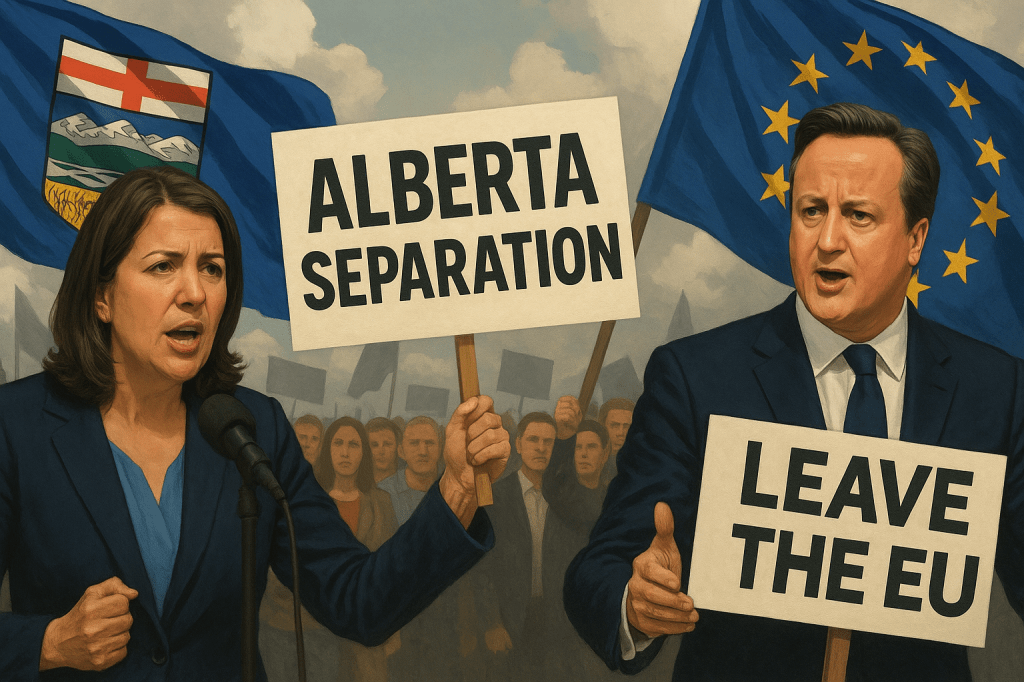
The Cameron Comparison: Will Danielle Smith Trigger Her Own Political Exit?

Danielle Smith’s political gambit with Alberta sovereignty bears an uncanny resemblance to David Cameron’s fateful decision to call a referendum on the United Kingdom’s membership in the European Union. Both leaders, faced with mounting internal pressures and populist insurgencies, sought to contain nationalist sentiment by giving it a structured outlet. In so doing, each gambled with the stability of their broader political project. Cameron, convinced that a plebiscite would put the Brexit question to bed and silence his party’s right-wing flank, ended up catalyzing the very crisis he had hoped to avoid, leading to his own political demise. Smith may be following the same treacherous path.

At the heart of both movements is the seductive notion of “taking back control”, from Brussels in the case of Brexit, and from Ottawa in Smith’s Alberta. The appeal is emotional and immediate: a narrative of betrayal by distant elites, a promise of restored autonomy, and the fantasy of economic self-sufficiency. Cameron allowed that narrative to play out on a national stage, legitimizing it with a referendum. Smith is doing something similar through legislation and rhetoric, invoking Alberta’s right to ignore or nullify federal laws under the guise of defending provincial jurisdiction.

Yet here lies the danger. Like Cameron, Smith has chosen to weaponize the language of sovereignty without a clear or viable endpoint. Her Alberta Sovereignty Within a United Canada Act is not a roadmap to secession, but it flirts with the logic of separation. The very act of mobilizing this discourse strengthens the hand of more radical forces in the province; those who see confederation not as a partnership, but as a prison. If Smith cannot deliver meaningful change within the framework of the Canadian constitution, and she likely cannot, she risks being outflanked by the separatists she once sought to co-opt. Just as UKIP’s rise drove Cameron’s decisions, the Maverick Party and other Alberta-first voices are shaping Smith’s hand, perhaps more than she realizes.

Politically, the parallels are striking and cautionary. Cameron misread the electorate and overestimated his ability to control the narrative. He expected the rational case for Remain to win out but failed to grasp the emotional and symbolic power of “Leave.” When the vote went against him, he resigned, leaving his party and country in turmoil. Smith may also be underestimating the Pandora’s box she is prying open. If public expectations are raised for a decisive break with Ottawa, one that cannot be delivered through mere provincial legislation, she may find herself either forced to escalate into unconstitutional territory or retreat in humiliation.

Moreover, Smith’s strategy could fracture the broader conservative coalition in Alberta. Urban moderates and business conservatives, critical to her electoral base, may grow weary of perpetual constitutional conflict, especially if it begins to affect investment, interprovincial relations, or federal funding. Meanwhile, the more extreme nationalist voices she has tried to placate will grow disillusioned if her sovereignty agenda produces no tangible results. Like Cameron, Smith is dancing between factions with incompatible goals, and she may end up satisfying none.

The tragedy of Cameron’s Brexit lies not just in the decision itself, but in the hubris that preceded it; the belief that one could flirt with nationalist fire and not get burned. Smith now faces a similar moment. In reaching for short-term political gain through an aggressive assertion of provincial autonomy, she may be sacrificing long-term credibility and coherence. The lesson from Brexit is not just about consequences, it’s about the limits of strategic populism. Smith, like Cameron, could soon discover that once sovereignty becomes the language of politics, it is no longer possible to control who speaks it, or how far they want to go.

From Reformist to Foot Soldier: The Political Evolution of Marco Rubio

For a time, Marco Rubio seemed to embody the hope that the Republican Party might modernize without losing its ideological spine. Young, charismatic, and the son of Cuban immigrants, he was hailed in the early 2010s as a conservative who could articulate traditional Republican values in a way that spoke to a broader, more diverse America. When he launched his presidential campaign in 2015, he positioned himself as a candidate of the future, one who could move past the culture wars and appeal to younger voters. To many in the media and even among some Democrats, Rubio seemed reasonable, serious, and, crucially, not dangerous.

This perception was always something of a projection. While Rubio carried himself with more polish and optimism than the emerging populist wing of the party, his actual positions were firmly in line with movement conservatism: staunchly anti-abortion, fiscally hawkish, anti-union, and reflexively interventionist on foreign policy.  Yet, because he wasn’t loud or cruel about it, and because he occasionally flirted with bipartisan gestures, most notably as a member of the 2013 “Gang of Eight” that attempted to pass comprehensive immigration reform, he was miscast as a moderate. The immigration effort was perhaps the high-water mark of his reputation as a bridge-builder, but the vicious backlash from conservative media and grassroots activists forced him into retreat. Rubio didn’t defend the bill; he distanced himself from it. This was an early sign of a pattern that would define his political choices; say the right thing when it’s safe, but retreat when it’s not.

Rubio’s realignment became undeniable with the rise of Donald Trump. In 2016, he famously called Trump a “con artist,” mocking his hands and personal behavior in an unusually caustic exchange; but after dropping out of the presidential race, he quickly endorsed Trump and began the long process of political adaptation. By the time Trump had cemented his control over the GOP, Rubio had made his peace with the new order. He supported Trump through both impeachment trials, echoed his talking points about “election irregularities” in 2020 without directly endorsing false claims, and has steadily absorbed the rhetoric and priorities of the MAGA movement, particularly on issues like “wokeism,” China, and the weaponization of federal institutions.

What surprises many observers now is not so much Rubio’s positions, many of which he has held, if more quietly, for years, but how fully he has embraced the tone and sensibility of the MAGA worldview. The man once billed as a “next-generation Republican” has become another foot soldier in the party’s turn toward grievance politics, culture war maximalism, and a brand of authoritarian-adjacent populism that defines today’s GOP. His evolution is not unique. It mirrors that of a party whose internal incentives now reward loyalty to Trump and punishment for dissent. Rubio is not leading that transformation; he’s adapting to it, and perhaps surviving because of it.

In truth, the notion that Rubio was ever a centrist or a true reformer was a comforting myth told by centrists and pundits who longed for a less chaotic Republican Party, but Rubio was never that man. He was always a disciplined conservative with big ambitions, more fluent in elite political language than many of his peers, but no less ideologically committed. The real shift, then, is not in Rubio’s principles, but in the conditions under which he operates. The surprise people express today is less about his transformation, and more about our own willingness to believe he was something else.