Between Sovereignty and Survival: Britain’s Nuclear Reality

The keel-laying of HMS Dreadnought in March 2025 marked a milestone in Britain’s strategic deterrent program and the future of its nuclear-powered ballistic missile submarine (SSBN) fleet. As the first of four vessels in the new Dreadnought-class, this submarine embodies both an engineering triumph and a signal of sustained commitment to the UK’s Continuous At-Sea Deterrent (CASD), which has remained unbroken since 1969. At 153.6 meters and 17,200 tonnes, the Dreadnought will be the largest submarine ever operated by the Royal Navy: a floating cathedral of stealth, survivability, and silent lethality.

The new class is expected to replace the aging Vanguard-class submarines by the early 2030s and will be in service well into the 2070s. Powered by the Rolls-Royce PWR3 nuclear reactor, a substantial evolution from the PWR2 used in the Vanguards, the Dreadnoughts promise longer life, reduced maintenance, and quieter operation, essential for a vessel designed to avoid detection at all costs. Innovations in stealth include a reshaped hull form, advanced sound-dampening technologies, and X-shaped stern rudders for more agile maneuvering in deep water. The integration of BAE Systems’ Active Vehicle Control Management (AVCM) fly-by-wire system and Thales’ Sonar 2076 gives the submarine cutting-edge sensory and navigation capabilities.

Comfort and crew sustainability have not been overlooked. Designed to accommodate 130 personnel, the submarine includes improved living quarters, separate facilities for female sailors, a small gym, and an artificial lighting system to simulate day and night cycles, no small consideration for the psychological health of crews spending months submerged in strategic silence. Operationally, the class will carry 12 missile tubes using the Common Missile Compartment (CMC), co-developed with the United States. These tubes will launch the Trident II D5 ballistic missile, a weapon system that is central to the debate over British nuclear sovereignty.

For all its sovereign trappings, the UK’s nuclear deterrent is not entirely domestically independent. The Dreadnought-class, like its predecessor, remains intimately tied to US strategic infrastructure, a reality that undermines, in the view of some, the claim of an “independent” deterrent. The Trident II D5 missiles aboard Dreadnought are not built in Britain, but rather drawn from a shared pool maintained by the US Navy at Kings Bay, Georgia. These missiles are periodically rotated, serviced, and upgraded in the United States. The UK owns no domestic facility for full-cycle missile maintenance, which introduces a logistical and, some would argue, strategic dependency.

Even the warheads, while built and maintained at the Atomic Weapons Establishment in Aldermaston, are widely understood to be based on the American W76 design. British scientists have not tested a warhead since 1991, relying instead on simulation and US data. Further, the PWR3 reactor at the heart of the Dreadnought-class, although built by Rolls-Royce, is significantly influenced by the US Navy’s S9G reactor used in its Virginia-class attack submarines. This level of integration, from missile tubes to propulsion, reflects decades of close US-UK military cooperation, formalized in arrangements like the 1958 Mutual Defence Agreement.

Supporters of the Dreadnought program argue that such collaboration is not a weakness but a pragmatic alliance. By sharing R&D burdens and pooling procurement, the UK can field a credible nuclear deterrent without spending the tens of billions required for full-spectrum independence. Operational command and control of the submarines, including launch authority, remains fully in British hands, with final decision-making retained by the Prime Minister. Indeed, the “letters of last resort” carried on each submarine are uniquely British in character: a final instruction from one head of government to another in the event of national annihilation.

Yet critics maintain that the veneer of sovereignty cannot obscure the fact that a central pillar of British defence policy is structurally dependent on American goodwill, technology, and supply chains. In any future divergence of interests between London and Washington, or under a more isolationist US administration, the UK’s deterrent capability could be compromised, not technically, perhaps, but in terms of assuredness and resilience.

The Dreadnought-class represents both continuity and compromise. It is a technical marvel and a credible means of sustaining Britain’s strategic nuclear posture; but it is also a reminder that sovereignty in the nuclear age is often a layered illusion, one maintained not through autarky, but through alliance, collaboration, and trust in the enduring strength of an Anglo-American strategic partnership that remains, for now, as silent and watchful as the vessels patrolling the deep.

Germany’s Classification of AfD as ‘Extremist’: A Modern Reckoning with a Troubled Past

On May 2, 2025, Germany’s Federal Office for the Protection of the Constitution (BfV) declared the far-right Alternative for Germany (AfD) party a “proven right-wing extremist organization.” This unprecedented designation of a party with seats in both the national and European parliaments is rooted in deep constitutional concern: the BfV’s 1,100-page report outlined how AfD promotes an ethnically defined notion of the German people, dehumanizes migrants, and undermines the dignity of minorities. For Germany, a country still haunted by its 20th-century descent into fascism, the move reflects a renewed commitment to uphold democratic values through preventive vigilance.

Germany’s decision does not exist in a vacuum. Post-war German identity has been shaped by an explicit and institutionalized rejection of Nazism and all forms of authoritarian extremism. The Basic Law—the German constitution—was crafted in response to the collapse of the Weimar Republic and the rise of Hitler’s regime, placing safeguards against the resurgence of anti-democratic ideologies. Within that framework, the BfV is mandated to monitor organizations and parties that threaten the constitutional order. That the AfD, founded in 2013 as a eurosceptic party, has evolved into a vessel for radical nationalism and xenophobia is not a matter Germany can take lightly. With rising electoral support, especially in the former East, AfD has shifted its discourse toward ethnic nativism and authoritarian populism, echoing tropes historically used to dismantle democratic norms.

Internationally, the decision drew immediate and sharp criticism from the United States. Secretary of State Marco Rubio called it “tyranny in disguise,” suggesting that classifying and surveilling a legitimate opposition party undermines democratic pluralism. Vice President JD Vance went further, framing the move as a betrayal of East German voters and likening it to a bureaucratic reconstruction of the Berlin Wall. These comments align with a broader shift in U.S. conservative circles, where cultural affinity with nationalist parties in Europe, including AfD, has grown. Yet, Germany’s Foreign Ministry stood firm, underscoring the independence of its investigative bodies and asserting that the classification was about constitutional defence, not political suppression.

Interestingly, while American officials decried the move, European far-right parties offered a different reaction. France’s National Rally and Italy’s League, both members of the Identity and Democracy (ID) group in the European Parliament, expelled the AfD from their ranks after controversial statements from an AfD leader about the Nazi SS. Marine Le Pen declared it was time to make a “clean break” with the party, suggesting that even among populist allies, AfD’s rhetoric had become too extreme.

The designation is not simply a domestic decision, it is a declaration of principle. Germany is choosing constitutional integrity over political expediency, informed by the weight of its history. In doing so, it opens a conversation about the boundaries of democratic tolerance: how far can free speech and party politics go before they endanger the very freedoms that sustain them?

Crown and Country: King Charles’s Visit Tests Canada’s Unity

King Charles III is scheduled to open Canada’s Parliament on May 27, 2025, an event of considerable constitutional and political significance. It will be the first time a reigning monarch has performed this ceremonial role since Queen Elizabeth II in October 1977, during her Silver Jubilee tour. The announcement, made jointly with Prime Minister Mark Carney, carries symbolic weight and calculated political intent. As Canada contends with renewed provocations from U.S. President Donald Trump, including veiled economic threats and rhetoric that edges toward neo-imperial posturing, the Carney government appears to be leveraging the royal visit as a demonstration of constitutional resilience and international dignity. The moment is carefully staged to evoke continuity, stability, and institutional maturity in a time of cross-border unpredictability.

Yet there is a deeper strategic layer to this decision. Donald Trump has, in recent months, made no secret of his admiration for the British monarchy. He has praised royal decorum as a model of “true leadership” and even quipped during a campaign rally in Ohio that the United States “might do better in the Commonwealth.” While intended as theatre, the remark underscores Trump’s peculiar reverence for monarchical symbolism, a reverence that contrasts sharply with his often dismissive tone toward democratic norms. By welcoming King Charles into such a central role in Canadian political life, Carney may be sending a coded diplomatic signal to Washington: Canada, unlike its southern neighbour, is grounded in institutions that project both dignity and endurance. If Trump is moved by monarchy, then Carney is speaking a language he understands.

Domestically, however, the political optics are more complicated. While the Crown remains Canada’s formal head of state, public sentiment toward the monarchy is lukewarm at best. Recent polling suggests that 67 percent of Canadians were indifferent to Charles’s accession, and more than 80 percent described themselves as personally disconnected from the institution. For many, the monarchy feels like a vestige of another era, more relevant to history books than to modern governance. Carney’s gamble, then, is that the ceremonial gravitas of a royal visit will outweigh the public’s prevailing sense of apathy or irrelevance.

That apathy becomes pronounced opposition in Quebec, where nationalist sentiment remains particularly resistant to symbols of British authority. Quebec’s sovereigntist movements have long framed the Crown as emblematic of colonialism and cultural erasure. During King Charles’s coronation, the Société Saint-Jean-Baptiste de Montréal sent a telegram to Buckingham Palace declaring him “not welcome” in the province. The message was more than rhetorical: it echoed a deep-rooted political ethos that has challenged Canada’s constitutional architecture since the Quiet Revolution. In 2022, Premier François Legault’s government moved to eliminate the requirement that members of the National Assembly swear allegiance to the monarch, a pointed gesture of institutional defiance. For Quebec nationalists, the King’s presence in Ottawa may not symbolize unity, but rather federal tone-deafness.

Yet even as the visit stirs unease in some quarters, it presents a lesser-discussed opportunity: to reimagine the role of the Crown in Canada’s ongoing reconciliation with Indigenous peoples. The monarchy is, historically and legally, a signatory to many of the foundational treaties that continue to define the relationship between Indigenous nations and the Canadian state. For many Indigenous leaders, the Crown is not merely a colonial artifact, but also a legal partner whose standing can be invoked to press for the recognition of rights, lands, and sovereignty. If handled with humility and commitment, the King’s visit could serve as the opening of a new chapter, one in which the Crown renews its role not through symbolic visits alone, but through meaningful engagement with treaty obligations. Such a move would not erase historical wrongs, but it could elevate the discourse from ceremonial niceties to active responsibility and mutual respect.

In this light, the King’s appearance is more than a formal gesture. It is a high-stakes exercise in multi-layered symbolism, directed outward to a volatile American neighbour, inward to a fragmented federation, and downward through the strata of Canada’s colonial legacy. Carney is clearly betting that monarchy, however ambivalently received, can still serve as a unifying force if cast with the right mixture of diplomacy, gravity, and forward-looking intent. The risk is that in attempting to speak to all Canadians, the gesture may resonate with too few people. On the other hand, if successful, it could lay the foundation for a reimagined relationship between Canada and its institutions, one that asserts sovereignty, invites reconciliation, and strategically reclaims tradition in a turbulent geopolitical moment.

The New Silk Spine: How the INSTC Is Redrawing Global Trade Maps

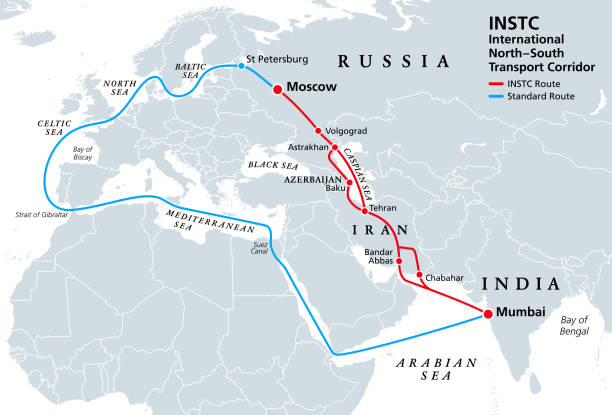
A quiet revolution in global logistics is underway, and it’s not coming from Beijing or Washington. It’s emerging from the heart of Eurasia, led by a consortium of countries who have historically occupied the margins of global trade narratives. The International North-South Transport Corridor (INSTC), a sprawling multimodal freight route linking India to Northwest Europe via Iran, Azerbaijan, and Russia, is reshaping both the geography and politics of trade.

The INSTC is more than just a 7,200-kilometre link between Mumbai and St. Petersburg. It’s a strategic recalibration, a corridor of asphalt, rails, and sea routes that bypasses the traditional maritime choke points like the Suez Canaland offers a faster, cheaper, and more resilient alternative. Cargo that once took 40 days to traverse via Suez may now move in under 25 days, with costs slashed by up to 40%. For countries like India, long constrained by maritime dependency and geopolitical roadblocks like Pakistan, the INSTC represents autonomy, reach, and leverage. By anchoring investments in Iran’s Chabahar Port and pushing road and rail links through the Caucasus into Russia, India is not just moving goods, it’s asserting presence.

Russia, reeling from Western sanctions, views the corridor as a vital artery to keep its economy tethered to global markets. With access to Europe constrained and pipelines of trade to Asia opening up, Moscow is embracing the INSTC as part of a broader pivot eastward. Iran, too, has seized its role as a key junction with zeal, positioning its territory as the bridge between warm water ports and the heart of Eurasia. Though battered by sanctions, Tehran is pushing infrastructure upgrades with a clear eye toward regional transit supremacy.

Europe is beginning to take notice. Countries like Germany and Finland are assessing the corridor’s potential to stabilize and diversify their supply chains, especially as global shipping lanes grow riskier and more expensive. Yet as enthusiasm grows in Eurasia, apprehension is mounting in the United States. The INSTC threatens U.S. strategic control over global commerce by undermining the relevance of the Panama and Suez canals, long cornerstones of American naval and economic dominance. It also boosts BRICS, a grouping increasingly seen as a challenger to the Western-led order.

Washington’s response has been twofold: diplomatic containment and competitive investment. The India-Middle East-Europe Corridor (IMEC), announced as part of the G7’s Build Back Better World initiative, is in part a direct counterweight to the INSTC. At the same time, U.S. policymakers are pressuring allies to tread carefully around Iran and Russia’s involvement, while watching closely how India—a key U.S. partner—manages its balancing act between the West and BRICS.

What is unfolding is not just a redrawing of trade routes, but a redrawing of power. The INSTC may not have the headline flash of China’s Belt and Road Initiative, but it is modular, strategic, and increasingly influential. It marks the emergence of a new Eurasian logic, one that connects the Indian Ocean to Northern Europe, not through blue-water naval lanes, but across land and short-sea corridors, driven by the very nations that were once bypassed. If the remaining gaps in infrastructure and policy can be bridged, this corridor will be more than a route, it will be a lasting statement.

Preferential Revolt: How Australia’s Voting System Is Breaking the Mould

As Australia prepares for the 2025 federal election on May 3, the national mood carries a distinctly restive undercurrent. While the major parties, the governing Labor Party under Anthony Albanese and the Liberal-National Coalition led by Peter Dutton, continue to dominate the headlines and stage debates, there is an unmistakable stir among the electorate. It’s not just about who will win, but about how Australians want to be represented in the years ahead. And this year, more than any in recent memory, the answer may lie in a growing movement determined to disrupt the traditional two-party stranglehold on power.

This discontent didn’t arise overnight. Over the past two decades, the combined vote share for Labor and the Coalition has gradually eroded. In the 2022 election, only 15 of the 150 seats in the House of Representatives were won on first preferences, down significantly from 46 in 2019. This decline in first-choice support reflects a broadening desire for alternatives, and the cracks in the old foundations have only widened since then. Australians are increasingly looking beyond the major parties to a field of independents and minor parties who promise to speak to the concerns long ignored: climate change, political integrity, housing, Indigenous rights, and gender equity among them.

At the forefront of this insurgency are the so-called “teal” independents, many of whom are professional women with strong credentials, campaigning for climate action and a more accountable, less adversarial form of politics. In 2022, they claimed several safe Liberal seats in wealthy urban electorates, sending a clear signal that voters were no longer content with business as usual. Now, in 2025, these candidates and their supporters are back, energized and better organized, facing off not only against the majors, but also against newly formed, sometimes opaque groups like “Repeal the Teal” and “Better Australia.” These groups claim neutrality, but have drawn scrutiny for shadowy funding, and messaging strategies that mirror traditional conservative talking points.

What makes this electoral fluidity possible is Australia’s unique and, in some ways, underappreciated voting system. In the House of Representatives, voters use preferential voting, where they rank candidates in order of preference rather than picking just one. If no candidate achieves a majority in the first count, the one with the fewest votes is eliminated and their ballots redistributed based on second choices, and so on, until someone crosses the 50 percent threshold. This system rewards candidates who may not be first on everyone’s list but are broadly acceptable to most voters, an ideal scenario for strong independents or minor party contenders.

The Senate, meanwhile, uses proportional representation via the single transferable vote. Voters can either rank individual candidates or select a party group, and the allocation of seats is determined by how many votes each candidate or party garners relative to a calculated quota. This system allows smaller parties, be they progressive Greens, libertarian groups, or issue-focused movements, to punch above their weight. It’s why the Senate has consistently been more diverse and less dominated by the major parties, and it’s increasingly becoming a model for what many Australians would like the lower house to reflect as well.

The major parties are far from blind to these shifts. Both Labor and the Coalition are attempting to reframe themselves in ways that respond to this moment of political flux, but their efforts are often read as reactive rather than visionary. Labor has enjoyed diplomatic and trade wins in its relationship with China, but is grappling with domestic fatigue around housing and healthcare. The Coalition, for its part, has doubled down on culture war rhetoric, and economic orthodoxy, hoping to rally its base. In taking this approach, it risks looking out of touch with a population more worried about rising rents than ideological crusades.

Nowhere is this tension more visible than in Australia’s growing Chinese-Australian communities, whose votes may swing marginal electorates. Both major parties are courting this demographic carefully. The ALP points to its restored ties with Beijing as a diplomatic success; the Coalition pushes national security fears. Yet neither approach may be enough to capture the full complexity of voter identity and aspiration in a country as diverse, and as impatient for change, as modern Australia.

A hung parliament is not only possible; many analysts consider it likely. If that happens, power will shift dramatically toward the crossbench: the independents and minor parties who are no longer content to be “preferences”, but now aspire to real leverage. For some, this signals instability. For others, it is a long-overdue correction, a rebalancing of a political system that has for too long treated voter discontent as an aberration instead of a force.

In the end, the 2025 election will be more than just a contest of parties. It will be a referendum on a political system straining under the weight of modern expectations. Voters are not just deciding who governs, they’re redefining howAustralia should be governed. If the results reflect the momentum of the past three years, then the two-party system may not collapse overnight, but it will be forced to make room for a future that looks far more plural, more negotiated, and perhaps, finally, more representative.

Five Things We Learned This Week for April 12 – 18th, 2025

Here’s the inaugural edition of my new weekly segment, “Five Things We Learned This Week,” highlighting significant global events and discoveries from April 12–18, 2025.

🌍 1. Travel Disruptions Across Europe

Travelers in Europe faced significant disruptions due to widespread strikes. In France, the Sud Rail union initiated strikes affecting SNCF train controllers, with potential weekend service interruptions extending through June 2. In the UK, over 100 ground handling staff at Gatwick Airport began a strike on April 18, impacting airlines like Norwegian and Delta. Additionally, approximately 80,000 hospitality workers in Spain’s Canary Islands staged a two-day strike over pay disputes, affecting popular tourist destinations.  

🧬 2. Potential Signs of Life on Exoplanet K2-18b

Astronomers detected large quantities of dimethyl sulfide and dimethyl disulfide in the atmosphere of K2-18b, a planet located 124 light-years away. On Earth, these compounds are typically produced by biological processes, making this the strongest evidence to date suggesting potential life beyond our solar system.  

📉 3. Global Economic Concerns Amid Tariff Tensions

The International Monetary Fund (IMF) and the European Central Bank (ECB) warned of a slowdown in global economic growth due to escalating trade tensions, particularly from recent U.S. tariffs. The ECB responded by reducing its main interest rate for the seventh time this year, citing “exceptional uncertainty.” U.S. markets remain volatile, with the S&P 500 down 14% from February highs.   

🌱 4. Earth Day 2025: “Our Power, Our Planet”

Earth Day on April 22 will spotlight the theme “Our Power, Our Planet,” emphasizing the push for renewable energy to triple clean electricity by 2030. Events worldwide aim to educate and mobilize communities toward sustainable practices and climate action.  

🐺 5. Genetic Revival of Dire Wolf Traits

Colossal Biosciences announced the birth of genetically modified grey wolves named Romulus, Remus, and Khaleesi. These wolves exhibit characteristics of the extinct dire wolf, marking a significant step in de-extinction science and raising discussions about the ethical implications of such genetic endeavors.  

Stay tuned for next week’s edition as we continue to explore pivotal global developments. Question – Should I include a link to some source material with each item or is the summary what you are looking for? 

The Dragon at the Gate: China’s Quiet Reversal of the Peking Accord

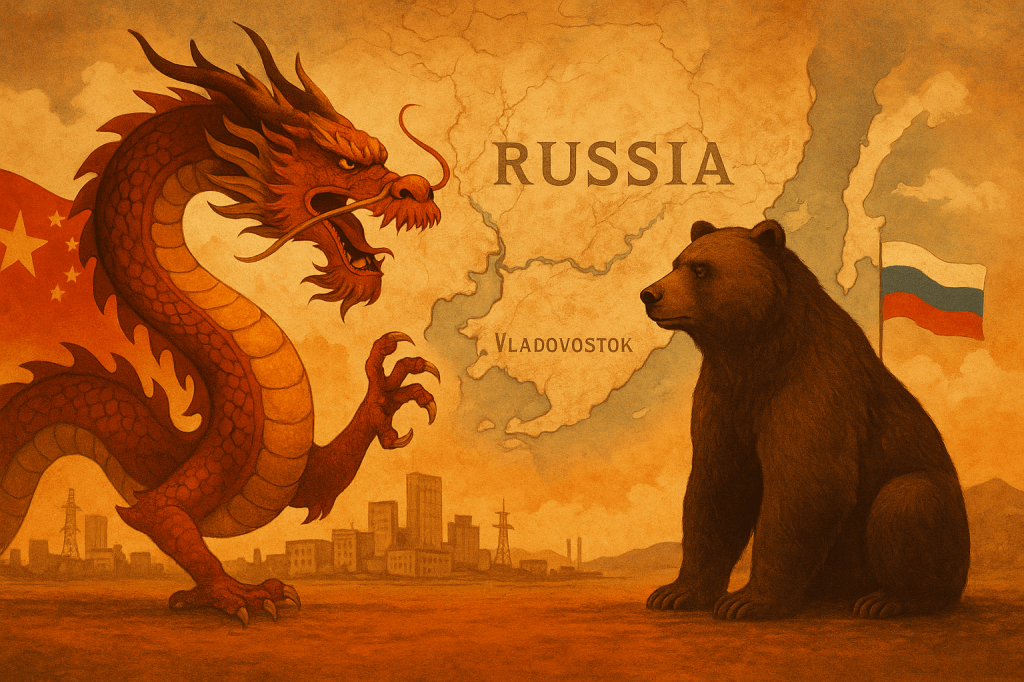
It’s a strange sight to behold – the old bear, once feared across continents, now leaning heavily on the dragon, who circles with a slow, calculating grace. Russia, once the hammer of the East, has been brought to heel by a grinding war in Ukraine, and while the West cuts ties and imposes sanctions, China, with the patience of a millennia-old civilization, sees opportunity, not just to profit, but perhaps to reshape history.

There’s a sense of irony that hangs over this moment. In 1860, the Qing dynasty signed the Peking Accord under duress, ceding vast swathes of land to the Russian Empire. That territory, now known as the Russian Far East, includes strategic regions like Vladivostok and the Amur Basin, lands that had once been part of China’s imperial periphery. The Chinese state, pragmatic in diplomacy, but deeply historical in self-conception, has never fully forgotten these losses. While official maps no longer lay claim to those regions, nationalist narratives in China occasionally whisper about redrawing what was once erased.

Fast forward to today, and the tables have turned. The war in Ukraine has battered Russia’s economy, and severed its connections to Europe. In desperation, Moscow has tilted eastward, selling gas, oil, and influence to Beijing at discount prices. This is not a partnership of equals. Russia needs Chinese markets, Chinese currency, and Chinese technology. China, meanwhile, gains leverage with every shipment of discounted crude, and every signed memorandum that ties the Russian economy tighter to the yuan. Where once they competed in Central Asia and the Arctic, now Russia finds itself the junior partner in a relationship it once dominated.

But China’s strategy isn’t conquest, it’s saturation. In the underpopulated stretches of Siberia and the Russian Far East, Chinese traders, laborers, and companies are embedding themselves quietly, but firmly. Towns along the border increasingly do their business in yuan, and many look more to Harbin or Heihe, cities in China’s Heilongjiang Province, than to Moscow. Infrastructure projects, often funded with Chinese capital, and executed by Chinese firms, are weaving a new economic fabric, one that binds these regions more to Beijing than to the Kremlin.

This isn’t a territorial war. China doesn’t need tanks to reverse the Peking Accord. It just needs time, capital, and a weakened Russia with few other friends. What we may be witnessing is not the formal return of lost lands, but something more subtle and enduring; a slow-motion annexation by way of economy, trade, and cultural seepage. A kind of imperial inversion, done not with gunboats, but with invoices and supply chains.

In geopolitics, history never dies, it just waits for the moment when the balance tilts. With every sanctioned ruble, and every Chinese-funded deal, the echoes of the 19th century grow louder. Russia may not yet realize it, but the dragon is already at the gates. Not to conquer, but to reclaim, softly, surely, and without ever having to fire a shot.

A Tale of Two Nations: Why Canada Celebrates Differences While America Seeks Sameness

For over a century, the United States has proudly embraced the metaphor of the “melting pot,” a vision in which immigrants from all over the world come together to form a singular American identity. This idea suggests that while people may arrive with distinct languages, customs, and traditions, they are expected to assimilate into a common culture; one that prioritizes English, democratic values, and a shared national ethos. The melting pot is often framed as a symbol of unity, a place where differences dissolve in the service of a greater whole. However, this model has its critics, who argue that it pressures immigrants to abandon their unique cultural heritage in order to conform.

The roots of the melting pot concept can be traced back to Israel Zangwill, a British playwright whose 1908 play The Melting Pot romanticized America as a land where old ethnic divisions would fade away, forging a new, united people. While Zangwill gave the concept its famous name, the push for assimilation had been shaping U.S. policy and attitudes long before. Theodore Roosevelt, the 26th president, was one of its most vocal proponents, arguing that immigrants must fully adopt American customs, language, and values to be considered truly American. The early 20th century saw the rise of the Americanization movement, which reinforced these ideas through public education, labor policies, and civic initiatives. By mid-century, the expectation of cultural conformity had become deeply embedded in American identity, influencing everything from language policies to popular media portrayals of immigrant life.

Canada, on the other hand, has cultivated a different metaphor, that of a “cultural mosaic.” Rather than seeking to merge all cultures into one, Canada actively encourages its people to maintain and celebrate their distinct identities. This approach is not just a social philosophy, but an official policy, first enshrined in 1971 with the introduction of the Multiculturalism Policy by Prime Minister Pierre Elliott Trudeau. Unlike the American melting pot, which emphasizes assimilation, Trudeau’s vision was one of inclusion without erasure. His government recognized that Canada’s growing diversity, particularly from non-European immigration, required a shift in how the country defined itself.

The passage of the Canadian Multiculturalism Act in 1988, under Prime Minister Brian Mulroney, further reinforced this philosophy by guaranteeing federal support for cultural communities, anti-discrimination measures, and the preservation of minority languages. Unlike the U.S., where English is seen as a central marker of national identity, Canada has long embraced bilingualism, officially recognizing both English and French. Additionally, Canada has extended support for Indigenous and immigrant languages in education and public services, further emphasizing its commitment to cultural pluralism.

The differences between these two models of integration are profound. In the United States, the expectation is often that newcomers will embrace “Americanness” above all else, whether that means speaking only English, adopting mainstream American customs, or minimizing their ethnic identity in public life. While the U.S. does recognize and celebrate diversity in some respects; Black History Month, Indigenous Peoples’ Day, and the popularity of international cuisines all attest to this, there remains a strong undercurrent that to be truly American, one must fit within a specific cultural framework.

Canada’s approach, by contrast, views multiculturalism as a strength rather than a challenge to national unity. Cities like Toronto, Vancouver, and Montreal are known for their ethnic neighborhoods, where different cultures not only survive, but thrive. Unlike the American approach, which often treats diversity as something to be managed or assimilated, Canada has built institutions that actively encourage it. Government funding for cultural festivals, multilingual public services, and policies that allow dual citizenship all reflect a belief that preserving one’s cultural roots does not weaken Canadian identity, but enriches it.

This difference is especially clear in the way both countries handle language. In the U.S., English is often seen as the primary marker of integration, with political debates regularly emerging over whether Spanish speakers should make greater efforts to assimilate linguistically. Canada, meanwhile, has long recognized both English and French as official languages, and has even extended support for Indigenous and immigrant languages in education and public services.

Ultimately, the American melting pot and the Canadian cultural mosaic reflect two very different visions of national identity. While the U.S. values unity through assimilation, Canada finds strength in diversity itself. Neither model is without its challenges, but the contrast between them speaks to fundamental differences in how these two North American nations define what it means to belong.

Beyond Free Market Myths: Why Canada Needs the EU’s Stability

Mark Carney’s approach, alongside the broader European Union model, represents a forward-thinking vision that prioritizes long-term economic stability, environmental responsibility, and social equity; values that are increasingly crucial in a world facing climate change, global financial shifts, and geopolitical instability. Contrary to the claim, that these policies have led to economic and social decline, the EU has consistently ranked among the world’s largest and most stable economic blocs, demonstrating resilience in the face of global crises. Canada, by aligning with the EU’s principles, positions itself for a more sustainable and equitable future rather than shackling itself to the short-term volatility of unregulated free-market capitalism.

Economic Resilience Over Deregulated Instability
The argument against Carney relies on a false dichotomy; that Canada must choose between European-style economic management and a purely free-market U.S.-oriented model. However, the 2008 financial crisis demonstrated the perils of unchecked capitalism, particularly in the U.S., where financial deregulation led to one of the worst economic collapses in history. In contrast, Carney’s leadership at the Bank of Canada helped the country navigate that crisis more effectively than most, avoiding the catastrophic failures seen elsewhere. Similarly, his tenure at the Bank of England reinforced the importance of prudent regulatory oversight.

The EU, despite criticism, remains a powerhouse. It is the world’s third-largest economy, behind only the U.S. and China, and has consistently maintained a high standard of living, strong labor protections, and a more balanced wealth distribution than laissez-faire models allow. Canada benefits from closer ties with such an entity, particularly as economic nationalism rises in the U.S., where protectionist trade policies under both Democratic and Republican administrations have shown a clear shift away from open-market ideals.

Climate Leadership as an Economic Advantage
Critics of Carney’s climate policies fail to acknowledge that global markets are increasingly rewarding sustainable investments. Major institutional investors, including BlackRock and major European banks, are shifting towards green finance, recognizing that the transition away from fossil fuels is not just an environmental imperative, but a financial necessity. Canada’s economy, still heavily reliant on resource extraction, must evolve rather than double down on outdated industries.

The EU’s leadership in climate policy is not an economic burden; it is an opportunity. The European Green Deal has set the standard for sustainable economic transformation, spurring innovation in renewables, clean technology, and advanced manufacturing. Canada, with its vast natural resources and technological expertise, is well-positioned to benefit from this shift rather than clinging to an increasingly obsolete model of oil dependency.

A Stronger Canada Through Strategic Alliances
The portrayal of the EU as an anti-democratic bureaucracy ignores the reality that it is a collection of sovereign states voluntarily participating in a shared economic and political framework. The EU has been a stabilizing force, promoting peace, economic integration, and democratic norms across the continent. Canada’s engagement with such an entity strengthens its global influence, diversifies its economic relationships, and reduces over-reliance on any single partner, such as the increasingly unpredictable U.S.

Aligning with the EU does not mean abandoning national sovereignty but rather embracing a model of cooperative governance that has proven effective in mitigating economic shocks and geopolitical tensions. Given the uncertainty surrounding U.S. policies, including isolationist tendencies and shifting trade dynamics, Canada’s strategic interest lies in expanding partnerships rather than limiting them.

Carney’s vision is not a step towards economic decline, but a necessary evolution towards a more resilient, sustainable, and balanced economy. The argument for unregulated capitalism ignores the lessons of past crises, dismisses the realities of climate-driven economic transformation, and underestimates the benefits of diversified global partnerships. Rather than resisting European-style policies, Canada should embrace them as part of a modern, forward-looking strategy that ensures long-term prosperity, environmental sustainability, and social stability.

Forget the Third Term—Trump’s True Threat to Democracy Is Happening Now

Donald Trump’s recent statements about serving a third term should not be taken at face value. Instead, they are likely a deliberate red herring, designed to dominate the news cycle and distract the public from the real threats to democracy that his administration and allies are pursuing. This is a classic Trump strategy; make an outrageous claim, provoke an intense reaction, and while everyone is busy debunking it, work quietly in the background to consolidate power.

The reality is that a third term is constitutionally impossible without an amendment, which would require overwhelming congressional and state-level support; something Trump does not have. So why bring it up? Because it forces Democrats, legal scholars, and the media to focus on an imaginary crisis rather than the real one. While everyone is busy arguing about whether he “means it” or if there’s a legal loophole he could exploit, the actual threats to democracy, attacks on voting rights, the erosion of institutional checks and balances, and the installation of loyalists in key positions, go largely unchecked.

We’ve seen this playbook before. Throughout his first presidency, Trump used inflammatory rhetoric to create chaos and dominate media coverage, distracting from the structural changes his administration was making behind the scenes. His lies about a “stolen election” consumed public discourse, but the real story was the groundwork being laid for legal challenges, voter suppression laws, and, ultimately, the violent January 6th insurrection. His latest comments about a third term could serve a similar function, keeping his base engaged and enraged while drawing attention away from his administration’s more immediate moves.

The most dangerous aspect of this tactic is that it works. Every time Trump makes an outrageous claim, it forces his opponents to play defense, scrambling to explain why his idea is unconstitutional or unworkable. Meanwhile, his supporters rally around him, buying into the narrative that he is the only one who can “save” the country. This shift in focus allows him to continue his real mission; undermining democratic institutions to ensure his grip on power extends far beyond 2029, even if he never officially serves a third term.

Democrats and the media must recognize this strategy for what it is. Instead of getting caught up in the spectacle, they must stay laser-focused on what Trump is actually doing. The real story isn’t whether he can serve a third term, it’s how he is working right now to weaken democracy so that he won’t have to leave power in the first place.