The Lost Diversity of Humanity 

Roughly one hundred thousand years ago, the world was home to a remarkable diversity of human species. Modern humans were only beginning their first tentative steps beyond Africa, but they were not alone. Several other lineages thrived, each adapted to its own landscapes, climates, and ways of life. These were not different “races” of a single species but distinct human branches, separated by hundreds of thousands of years of evolution, yet sometimes still close enough to interbreed.

Neanderthals were the best known of these relatives. They occupied Europe and western Asia, building tools, hunting in coordinated groups, and surviving in some of the harshest Ice Age environments. To the east, Denisovans spread widely across Asia. Although only a handful of their bones and teeth have been recovered, genetic studies show that Denisovans were a major lineage, leaving traces of their DNA in modern populations from Tibet to Oceania. On the island of Java, the last populations of Homo erectus endured. This species had been extraordinarily successful, spreading out of Africa nearly two million years earlier, and fossils suggest they survived until at least 117,000 years ago.
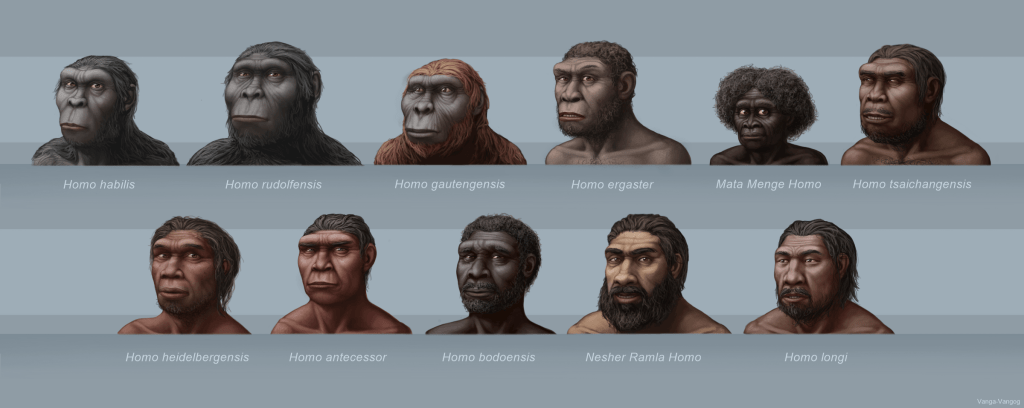
Other species thrived in more isolated environments. On the island of Flores in Indonesia lived Homo floresiensis, often nicknamed the “hobbit” because of its small stature. Despite its diminutive size, this species produced stone tools and likely controlled fire, persisting until around 60,000 years ago. In the Philippines, another small-bodied species, Homo luzonensis, has been identified from remains dating between 67,000 and 50,000 years ago. These island species highlight how isolation could produce unique evolutionary experiments within the genus Homo.

In Africa, earlier lineages had already left their mark. Homo naledi, known from the Rising Star cave system in South Africa, lived between 335,000 and 236,000 years ago. Their remains show an unusual mix of primitive and modern features, alongside evidence suggesting deliberate placement of bodies in cave chambers. Although not contemporaneous with Neanderthals or Denisovans, Homo naledi demonstrates that the human family tree was even more diverse than the late-surviving species of the Pleistocene.

These populations were not fully isolated from one another. Modern genetic evidence shows that Neanderthals and Denisovans interbred with Homo sapiens, and a few individuals even carry ancestry from both. Today, people of non-African descent typically have about 1–2 percent Neanderthal DNA, while some Oceanian groups carry up to 4–6 percent Denisovan DNA. Our genomes are a living archive of those encounters.

Why so many human lineages disappeared remains an open question. Climate fluctuations would have stressed small, scattered populations. Competition for resources may have sharpened between overlapping groups. New pathogens could have devastated communities without immunity. In some cases, Homo sapiens likely held advantages in technology, social organization, or long-distance networks of exchange. But randomness also played a role: survival at evolutionary bottlenecks is often as much about chance as about superiority.

By about 32,000 years ago, only one human species remained – Homo sapiens. Neanderthals had vanished from their European strongholds, Denisovans disappeared from the high plateaus of Asia, and the island species had long gone extinct. What survives of this lost diversity are fragments of bone, stone tools, and strands of DNA that remind us of a time when humanity was not a single lineage but a family of experiments in survival.

Far from a story of inevitable triumph, the rise of Homo sapiens is a reminder of how precarious our own existence once was. The fact that we endure may owe less to strength or intelligence than to timing, adaptability, and the accidents of evolutionary history.

Sources
• Dirks, P. H. G. M., et al. “The age of Homo naledi and associated sediments in the Rising Star Cave, South Africa.” eLife, 2017.
• Smithsonian National Museum of Natural History. “Homo naledi.” Updated January 3, 2024.
• Détroit, F., et al. “A new species of Homo from the Late Pleistocene of the Philippines.” Nature, 2019.
• Brumm, A., et al. “Age and context of Homo floresiensis remains from Liang Bua, Flores.” Nature, 2016.
• Antón, S. C., et al. “Redating Homo erectus at Ngandong, Java, Indonesia.” Nature, 2019.
• Higham, T., et al. “The timing and spatiotemporal patterning of Neanderthal disappearance.” Nature, 2014.
• Chen, F., et al. “A late Middle Pleistocene Denisovan mandible from the Tibetan Plateau.” Nature, 2019.
• Huerta-Sánchez, E., et al. “Altitude adaptation in Tibetans caused by introgression of Denisovan-like DNA.” Nature, 2014.
• Green, R. E., et al. “A draft sequence of the Neandertal genome.” Science, 2010.
• Reich, D., et al. “Denisova admixture and the first modern human dispersals into Southeast Asia and Oceania.” American Journal of Human Genetics, 2011.
• Slon, V., et al. “The genome of the offspring of a Neanderthal mother and a Denisovan father.” Nature, 2018.

Cascadia Rising: Ecology, Identity, Politics

I began this article over a year ago, and at the time my biggest challenge was finding its focus. I wasn’t sure what the central thread should be, so I followed the flow of ideas and shaped it into a summary of recent activities and announcements. In many ways, it became a placeholder; something to capture the moment and hold space until I had the chance to return and explore the subject in greater depth.

1. Bioregional Roots & Indigenous Foundations
The idea of Cascadia springs from the interconnected ecosystems spanning the Cascade Range; anchored by rivers like the Fraser, Columbia, and Snake, a landscape long inhabited by diverse Indigenous nations: Chinook, Haida, Nootka, Tlingit, and dozens more, whose vibrant cultures predate colonial borders by millennia.   

In Indigenous understanding, stewardship over land and salmon-rich waters isn’t just practical; it’s spiritual. Their societies are woven into place, honoring ecosystems as kin. This pre-colonial history sets a vital foundation for any modern Cascadia vision.

Today, Cascadian movements forefront Indigenous sovereignty and truth and reconciliation, advocating for dialogue-led, consensus-based confederation models where First Nations guide governance and cultural revitalization, like restoring Chinuk Wawa as a regional lingua franca.  

2. Bioregionalism & Mapping as Decolonizing Tools
Bioregionalism – which Cascadia champions, breaks from traditional politics, centering its framework on natural boundaries and ecological integrity. Indigenous mapping traditions inform this, such as bioregional atlases by Tsilhqotʼin, Nisga’a, Tsleil-Waututh, and others that helped affirm territorial claims in court.  

Through community-driven cartography, highlighting traditional ecosystems, language, stories; bioregional maps act as instruments of empowerment, healing, and planning rooted in place-based knowledge.  

3. Elizabeth May’s Provocative Invitation & BC’s Identity
In January 2025, Green Party of Canada leader Elizabeth May reignited Cascadian conversation with a striking, partly rhetorical offer: that California, Oregon, and Washington might consider joining Canada; with BC naturally included in the idea, based on shared values like universal healthcare, reproductive rights, and climate justice.  

Her gesture wasn’t an actual policy, but served as an emblematic spark, fueling grassroots discussions across the region; especially in BC, where many already feel culturally closer to the U.S. West Coast than to central Canada. This made the concept of transnational Cascadia feel suddenly plausible.  

4. Governor Newsom & West Coast Climate Leadership
Cascadia’s vision isn’t purely conceptual, it’s grounded in concrete policy collaboration:
• In May 2025Governor Gavin Newsom was appointed co-chair of the U.S. Climate Alliance, joining a bipartisan coalition of 24 governors spearheading high-impact, state-driven climate action, encompassing nearly 60% of the U.S. economy and 55% of its population.
Newsom also announced a major cap-and-invest (formerly cap-and-trade) budget proposal, extending California’s program through 2045 and earmarking billions toward firefighting, high-speed rail, and climate adaptation projects.   
• The three regional partners – California, Québec, and Washington, have also agreed to explore linkage of their carbon markets, signaling potential for a broader, cross-border climate economy.  
• Simultaneously, West Coast governors (Newsom, Oregon’s Tina Kotek, and Washington’s Bob Ferguson) signed a joint statement promising to defend their states’ climate policies against federal rollback, demonstrating regional resolve and cohesion.  

5. Indigenous and Climate Confluence in Cascadia’s Future
Modern Cascadia stands at the intersection of Indigenous resurgence and regional policymaking. Here’s how they converge:
Indigenous frameworks act as ethical and governance cornerstones; urging truth, place-based authority, and cultural restoration, especially in BC where colonial histories persist.
Bioregionalism and community mapping form tools for inclusion and urban planning that honor traditional ecological knowledge.
Cross-border cooperation on climate, via co-carbon markets and alliances, offers practical scaffolding for aligning policy with ecological realities.
Political solidarity, as seen in Newsom’s climate leadership and the West Coast climate defense, underscores Cascadia’s capacity as a functional mega-region, not merely a cultural idea.

Cascadia Reimagined: A Vision of Inclusive, Place-Based Governance
Cascadia today is evolving, not as a secessionist movement, but as an integrated regional model that:
• Places Indigenous sovereignty and ecological connection at its core.
• Encourages cross-jurisdictional collaboration on climate, economy, and culture.
• Utilizes bioregional mapping as a decolonizing and planning tool.
• Builds grassroots resonance through symbols, discourse, and identity.
• Innovates policy frameworks connecting shared values, particularly across BC and U.S. West Coast states.

Elizabeth May’s invitation, Governor Newsom’s climate strategy, and Indigenous leadership together signal a Cascadia imbued with governance relevance, moral thickness, and aspirational scope.

Sources
• Cascadia Bioregional Movement. Indigenous Sovereignties. Cascadia Bioregion. https://cascadiabioregion.org/indigenous-sovereignties
• Cascadia Bioregion. The Cascadia Movementhttps://cascadiabioregion.org/the-cascadia-movement
• Cascadia Bioregion. Independence and Public Opinionhttps://cascadiabioregion.org/independence-2
• CascadiaNow! Building a Resilient Cascadiahttps://www.cascadianow.org
• Brandon Letsinger. It’s Time for a Cascadia Political Movementhttps://brandonletsinger.com/political-movement/its-time-for-a-cascadia-political-movement
• KIRO 7 News. Canadian Lawmaker Offers to Take Washington, Oregon, California as New Provinces. January 10, 2025. https://www.kiro7.com/news/local/canadian-lawmaker-offers-take-washington-oregon-california-new-provinces/LPFT7I4AYBGCLHBKVOB2TIFQOQ
• Cascadia Daily News. Washington Joining Canada? Don’t Bet Your Timbits. January 10, 2025. https://www.cascadiadaily.com/2025/jan/10/washington-joining-canada-dont-bet-your-timbits
• OPB (Oregon Public Broadcasting). West Coast Governors Say They Will Defend Their Climate Policies Against Trump Attack. April 10, 2025. https://www.opb.org/article/2025/04/10/west-coast-governors-we-will-defend-our-climate-policies-against-trump-attack
• Office of Governor Gavin Newsom. Governor Newsom Appointed Co-Chair of U.S. Climate Alliance. May 9, 2025. https://www.gov.ca.gov/2025/05/09/governor-newsom-appointed-co-chair-of-u-s-climate-alliance
• U.S. Climate Alliance. News & Eventshttps://usclimatealliance.org/news-events
• CalMatters. Newsom’s Budget Leans on Cap-and-Invest to Fund High-Speed Rail and Firefighting. May 2025. https://calmatters.org/environment/climate-change/2025/05/california-governor-climate-budget-cap-trade-high-speed-rail
• ClearBlue Markets. California Cap-and-Invest Program: Extension Proposed in California Budget. 2025. https://www.clearbluemarkets.com/knowledge-base/california-cap-and-invest-program-program-extension-proposed-in-california-budget
• Washington Department of Ecology. Shared Carbon Market Agreement between California, Québec, and Washington. March 20, 2024. https://ecology.wa.gov/about-us/who-we-are/news/2024/mar-20-shared-carbon-market

Correcting the Map: Africa and the Push for Equal Earth

As regular readers know, I often write about geomatics, its services, and products. While I tend to be a purist when it comes to map projections, favouring the Cahill-Keyes and AuthaGraph projections, I can understand why the Equal Earth projection might be more popular, as it still looks familiar enough to resemble a traditional map.

The Equal Earth map projection is gaining prominence as a tool for reshaping global perceptions of geography, particularly in the context of Africa’s representation. Endorsed by the African Union and advocacy groups like Africa No Filter and Speak Up Africa, the “Correct The Map” campaign seeks to replace the traditional Mercator projection with the Equal Earth projection to more accurately depict Africa’s true size and significance. 

Origins and Design of the Equal Earth Projection
Introduced in 2018 by cartographers Bojan Šavrič, Bernhard Jenny, and Tom Patterson, the Equal Earth projection is an equal-area pseudocylindrical map designed to address the distortions inherent in the Mercator projection. While the Mercator projection is useful for navigation, it significantly enlarges regions near the poles and shrinks equatorial regions, leading to a misrepresentation of landmass sizes. In contrast, the Equal Earth projection maintains the relative sizes of areas, offering a more accurate visual representation of continents.  

Africa’s Distorted Representation in Traditional Maps
The Mercator projection, created in 1569, has been widely used for centuries. However, it distorts the size of continents, particularly those near the equator. Africa, for instance, appears smaller than it actually is, which can perpetuate stereotypes and misconceptions about the continent. This distortion has implications for global perceptions and can influence educational materials, media portrayals, and policy decisions.    

The “Correct The Map” Campaign
The “Correct The Map” campaign aims to challenge these historical inaccuracies by promoting the adoption of the Equal Earth projection. The African Union has actively supported this initiative, emphasizing the importance of accurate geographical representations in reclaiming Africa’s rightful place on the global stage. By advocating for the use of the Equal Earth projection in schools, media, and international organizations, the campaign seeks to foster a more equitable understanding of Africa’s size and significance.   

Broader Implications and Global Support
The push for the Equal Earth projection is part of a broader movement to decolonize cartography and challenge Eurocentric perspectives. By adopting map projections that accurately reflect the true size of continents, especially Africa, the global community can promote a more balanced and inclusive worldview. Institutions like NASA and the World Bank have already begun to recognize the value of the Equal Earth projection, and its adoption is expected to grow in the coming years. 

The Equal Earth map projection represents more than just a technical advancement in cartography; it symbolizes a shift towards greater equity and accuracy in how the world is represented. By supporting initiatives like the “Correct The Map” campaign, individuals and organizations can contribute to a more just and accurate portrayal of Africa and other regions, fostering a global environment where all continents are recognized for their true size and importance.

The United States: Rogue Superpower in a World of Rules

Among the ironies of our time, few are more stark than the United States’ position as the architect of the postwar international order, yet increasingly its most consistent violator. While Washington projects itself as the defender of liberty and law, its behavior on the global stage reveals a pattern of exceptionalism that borders on outright rogue conduct. Through its rejection of international legal institutions, selective engagement with treaties, and deliberate undermining of multilateral frameworks, the U.S. has placed itself outside the moral and legal structures it once championed. It is not a rogue state in the traditional sense of irrational belligerence, but a rogue superpower: one that acts with impunity, claims special exemption from global norms, and expects deference without accountability.

Nowhere is this more visible than in the United States’ relationship with the two primary institutions of international justice – the International Criminal Court (ICC) and the International Court of Justice (ICJ). The ICC, established in 2002 to prosecute individuals for genocide, crimes against humanity, and war crimes, was initially shaped with U.S. involvement. Yet when it became clear that the Court could assert jurisdiction over American officials and soldiers, Washington turned hostile. Under the George W. Bush administration, the U.S. “unsigned” the Rome Statute. Two decades later, the Trump administration went so far as to impose sanctions on ICC officials investigating alleged U.S. war crimes in Afghanistan, a breathtaking rejection of international accountability.

The ICJ, which adjudicates disputes between states, has faced similar rebuke. In 1986, after the Court found the U.S. guilty of unlawful use of force in its covert war against Nicaragua, the Reagan administration withdrew from the ICJ’s compulsory jurisdiction altogether. This pattern of participation-when-convenient and withdrawal-when-challenged defines American behavior toward supranational courts. While the U.S. demands accountability from adversaries, condemning Russia’s invasion of Ukraine or China’s abuses in Xinjiang, it immunizes itself from any comparable scrutiny. This is not justice. It is legal imperialism.

This attitude extends well beyond the courts. The U.S. has refused to join, or has actively sabotaged, numerous treaties and international organizations when their mandates threaten to constrain American power. It never ratified the United Nations Convention on the Law of the Sea (UNCLOS), despite abiding by its provisions in practice, because the treaty might impede U.S. naval dominance and deep-sea exploitation rights. It signed but never ratified the Kyoto Protocol, then withdrew from the Paris Agreement under Trump—undermining global climate efforts at a critical juncture. It refused to ratify the Arms Trade Treaty, unsigned the ICC, and withdrew from UNESCO and the UN Human Rights Council under various pretexts, only to rejoin later with little reflection. This stop-start diplomacy, driven by domestic politics rather than principled internationalism, has eroded trust in the United States as a stable global partner.

Nowhere has this erosion been more visible than during the COVID-19 pandemic. In 2020, at the height of a global health emergency, the Trump administration withdrew from the World Health Organization (WHO), accusing it of pro-China bias. The move was as symbolic as it was destructive, signaling to the world that the United States would rather abandon multilateral coordination than tolerate criticism or compromise. Though President Biden reversed that decision, the damage to global confidence in American leadership was profound.

What makes all this especially corrosive is that the United States does not retreat from these institutions out of isolationism or irrelevance, but from an inflated sense of exceptionalism. The underlying logic, whether expressed by a Republican or Democratic administration, is that the U.S. is a unique force for good and must therefore not be bound by the same rules as others. This belief animates laws like the American Service-Members’ Protection Act, which authorizes military force to free any American detained by the ICC. It is the rationale behind the rejection of nuclear disarmament treaties like the Treaty on the Prohibition of Nuclear Weapons. It fuels the refusal to ratify core labor rights conventions under the International Labour Organization. This is not principled leadership. It is institutionalized impunity.

The consequences of this behavior ripple outward. When the world’s most powerful democracy refuses legal oversight, it licenses others, Russia, China, Israel, even allies like Saudi Arabia, to do the same. It weakens the authority of the very institutions designed to prevent war, protect civilians, and resolve disputes peacefully. It turns what should be universal norms into optional guidelines for the weak, and ignites a global cynicism toward international law as a whole.

America’s rogue status is not merely a theoretical concern for academics or human rights lawyers. It is a real and present danger to global order. The United States wields extraordinary influence over international finance, trade, and military alliances. When it breaks the rules, it doesn’t just bend them, it reshapes the entire system. The result is a world where power substitutes for principle, and might defines right.

If the United States wishes to restore its global standing, not as a bully, but as a builder, it must recommit to the legal frameworks it once helped design. That means rejoining and respecting the jurisdiction of the ICC and the ICJ. It means honoring treaties even when inconvenient. It means ending the era of selective multilateralism and embracing the responsibilities that come with its global reach.

Until that shift occurs, the United States will remain a paradox in the international system: the indispensable nation behaving, more often than not, like a rogue one.

Sources:
• ICC Rome Statute: https://www.icc-cpi.int/resource-library/documents/rome-statute-of-the-international-criminal-court
• ICJ Nicaragua v. United States (1986): https://www.icj-cij.org/en/case/70
• UN Treaty Collection: https://treaties.un.org
• Human Rights Watch: https://www.hrw.org
• Arms Control Association: https://www.armscontrol.org
• United Nations Framework Convention on Climate Change (UNFCCC): https://unfccc.int
• Congressional Research Service: https://crsreports.congress.gov

Being the Shadow Behind the Throne

I’ve always found that real power lies not in wearing the crown, but in deciding who gets to wear it. Being the one who shapes events from behind the scenes, influencing the course of history without ever taking the throne myself, that’s where the real art of leadership exists. Kings may rule, but kingmakers decide who rules, and if you understand that distinction, you understand how the world truly works.

Fictional Merlin is the classic example. He never sat on a throne, never commanded armies in his own name, but without him, there would be no King Arthur. He orchestrated Uther Pendragon’s deception to conceive Arthur, mentored the boy in secret, and, when the time was right, revealed him to the world. Merlin shaped a kingdom without ever ruling it, and yet when Arthur finally stood on his own, Merlin’s influence faded. That’s the risk of the role, you create power, but you don’t always get to keep it.

Real world history is full of figures like him. Cardinal Richelieu, for example, controlled France with an iron grip, despite serving under King Louis XIII. His policies, his political maneuvers, his relentless drive to centralize power under the monarchy, all of it laid the foundation for France’s future, yet Richelieu himself was not king. He didn’t need to be. He knew that power is best wielded by those who don’t have to endure the weight of the crown.

Even Machiavelli, in The Prince, seemed to understand this dynamic. The king is the one in the spotlight, the one who takes the fall when things go wrong. The kingmaker, on the other hand, operates from a safer distance. If a ruler fails, the kingmaker can simply step back, find another candidate, and start again. That’s the beauty of working in the background, longevity, adaptability, and an ability to control without being controlled.

Modern storytelling has embraced this figure, and perhaps no one embodies it better than Tywin Lannister in Game of Thrones. Tywin never sat the Iron Throne, but he ensured that his family remained in power. He was the architect, the strategist, the one who held the true reins of authority while others played at being rulers. And yet, like so many kingmakers, his mistake was in believing he was untouchable. His own underestimation of those closest to him led to his downfall.

I know this world. I’ve played my part in choosing leaders, shaping narratives, and building influence without ever stepping directly into the spotlight. The best part of being a kingmaker is that your influence can outlast rulers themselves, but the danger is always there, push too far, control too tightly, and eventually, those you’ve lifted up will turn on you. The trick is knowing when to let go, when to fade into the background, and when to start building the next king before the old one realizes he was never really in charge to begin with. So, who are today’s kingmakers? And should we be doing more to bring them into the light in these days of threats to our democracy?

From Shearer’s Graft to Owen’s Fannyin’ — Isak’s Lost the Plot! 

By Big Mac, the OAP Blogger from Byker

Whey aye, what’s this pure pish wi’ Isak then? I’m tellin’ ye, it’s a bleedin’ disgrace! This lad could’ve been a Shearer, graftin’ away, proper Toon number 9! Man, no messing about. But noo? Nah, he’s lookin’ more like an Owen, all flash, no heart, and ready to scarper the minute he don’t get his own way. Absolute belta for takin’ the piss, if ye ask me.

Alan Shearer, now he was the real deal. A Geordie through and through, who gave every sodden drop of sweat for the Toon. None of this faffin’ about or sulkin’ when the wind changed. And then there’s Owen, a decent player maybe, but no loyalty, just a selfish git who legged it when the going got tough. Isak’s startin’ to show his true colours, and it’s nae pretty.

And it’s no just Isak who struggles wi’ loyalty and grit when movin’ on. Look at Andy Carroll, his move tae Liverpool was meant tae be a big thing, record fee and all that faff. But what happened? The poor lad ended up a right shower. Injuries kept him off the pitch, and when he did play, it was like he’d lost his feet. Never looked comfortable, like he was playin’ someone else’s game. After a while, he was shuttled off on loan and eventually sold, leavin’ Toon fans scratchin’ their heads and wonderin’ why we bothered. That’s the trouble wi’ takin’ a chance on big money moves, sometimes it just turns into a right mess.

And José Enrique? Another one who looked like he might boss it, but ended up just battlin’ injuries and poor form. When he did get on the pitch, he was all over the shop, no consistency, no confidence, just a shadow o’ the player we knew at the Toon. Fans hoped he’d sort the left-back spot, but instead he faded away and was eventually released like dead weight. Another lad who couldn’t hack it when the pressure was on, if ye ask me.

I’m well up to me neck wi’ these money-grabbing, ego-crazed wankers thinkin’ Newcastle’s just a stepping stone for their little careers. This club’s got soul, man. It’s about pride, passion, and honour. If ye can’t hack that, if ye’re too daft or too selfish to get that, then do us all a favour, jog on back to wherever ye came from.

Isak’s actin’ like a sulky bairn, whinin’ and moanin’ because things ain’t goin’ his way. Well, that’s pure shite and we won’t stand for it. We want players who’ll fight tooth and nail for every ball, who respect the badge like it’s their own family. The fans won’t tolerate no flash git more interested in his own arse than the team.

The Toon’s on the rise, new money, new dreams, but it means now more than ever we need men with balls who know what this club means. If Isak’s too thick or too soft to understand, the door’s wide open. We deserve better, and by gad, we’ll get it.

Canada Post’s Red Flag Fumble: Why “Clarifications” Can Backfire

Canada Post has a knack for finding itself in the headlines for all the wrong reasons. This week’s rural delivery flap (pun intended) has all the makings of another avoidable PR bruise. The issue? Mail carriers in rural areas have been told not to raise the red flag on mailboxes to signal incoming mail. According to Canada Post, the flag’s intended use has always been one-way: customers put it up to show there’s outgoing mail for pickup. The new instruction, they insist, is simply a “clarification” of longstanding policy, not a change in service.

For many rural residents, especially those with long driveways or mobility challenges, that little red flag has been a simple, effective communication tool for decades. It’s the rural equivalent of the notification icon on your phone – no need to trek through the snow or heat just to find an empty mailbox. Taking that away may align with corporate guidelines, but it’s a practical step backward in terms of customer experience.

Canada Post’s position is that the flag’s misuse by some carriers created inconsistency across the country. Some postal workers raised the flag for incoming mail, others didn’t, and now they’re enforcing a uniform standard. That sounds fine in a policy manual, but in real life, it translates into removing a service habit people value, without offering a replacement. And while this might be a small operational tweak from their perspective, it has outsized symbolic weight in the communities it affects.

The reaction has been swift and pointed. Rural customers, already feeling underserved compared to their urban counterparts, see this as yet another example of Ottawa making decisions without understanding life outside the city. The Canadian Union of Postal Workers says it wasn’t even consulted before the clarification went out. That’s not just a failure of courtesy; it’s a failure of internal communication that risks alienating frontline staff, the very people who are the public face of Canada Post.

For a federal agency that has spent years trying to modernize its image and service model, this is a curious hill to die on. Public trust in Canada Post has already been dented by service delays, price hikes, and reduced delivery frequency in some areas. Now, they’ve added a decision that feels to many, like a needless reduction in convenience. The optics are terrible: instead of talking about new rural service improvements, the conversation is about a flag on a box.

Good public relations isn’t just about press releases and branding campaigns. It’s about anticipating how policy changes, even small ones, will land with the people you serve. A true customer-first approach would have looked for alternatives: maybe a text notification service for rural deliveries, or an opt-in program where carriers could continue flag use. Instead, Canada Post has doubled down on the technical definition of a mailbox flag, while ignoring the human element of how that signal has been woven into daily routines.

The irony is that the red flag rule may be correct in theory, but in practice, it’s a perfect example of winning the policy argument while losing the public. For rural Canadians, this feels like one more example of an institution not listening. And for Canada Post, it’s another case of stepping on their own toes – this time, with both boots planted firmly in the gravel of a country driveway.

Sources: CP24Halifax CityNewsCJDC TV

Professor Michele Dougherty: Breaking a 350‑Year Barrier in British Astronomy

When King Charles II created the post of Astronomer Royal in 1675, alongside the founding of the Royal Observatory at Greenwich, it was more than just a courtly appointment. The role was charged with solving one of the most pressing scientific problems of the age: finding longitude at sea. Over the centuries, its holders have included some of the most brilliant minds in science. John Flamsteed, the first Astronomer Royal, painstakingly mapped the stars to guide navigation. Edmond Halley predicted the return of his famous comet. Nevil Maskelyne brought precision to seafaring with The Nautical Almanac. Sir George Biddell Airy fixed Greenwich as the Prime Meridian. In the 20th century, Sir Frank Watson Dyson’s solar eclipse observations confirmed Einstein’s General Relativity, and Martin Rees became one of the world’s most eloquent science communicators.

For 350 years, however, the title, one of the most prestigious in British science, was held only by men. That changed on 30 July 2025, when His Majesty King Charles III appointed Professor Michele Dougherty as the 16th Astronomer Royal, making her the first woman ever to hold the office.

Dougherty’s appointment was no token gesture. Born in South Africa and now Professor of Space Physics at Imperial College London, she has built an extraordinary scientific career. She led the magnetometer team on NASA’s Cassini–Huygens mission, which revealed towering plumes of water erupting from Saturn’s icy moon Enceladus; findings that ignited the search for life beyond Earth. Today, she leads the magnetometer investigation for ESA’s JUICE mission to Jupiter’s moons, launched in 2023, and bound for Ganymede to probe its suspected subsurface ocean.

Her leadership extends well beyond planetary science. Dougherty is Executive Chair of the UK’s Science and Technology Facilities Council, overseeing major research infrastructure and funding. She is also the President‑elect of the Institute of Physics. In each of these roles, she has championed ambitious science, argued for investment in research, and worked to make science accessible to the public.

Asked about her appointment, Dougherty expressed both surprise and pride. She acknowledged the symbolic significance of being the first woman in a position historically reserved for men, while insisting her selection was based on the strength of her record, not her gender. Still, she hopes her visibility in such a revered role will inspire girls and young women to pursue careers in STEM.

The Astronomer Royal no longer runs an observatory; the role is now honorary, a recognition of exceptional achievement and a platform for public engagement. Holders advise the monarch on astronomical matters and serve as ambassadors for British science. It is a role steeped in history and weighted with symbolic gravitas.

In that context, Dougherty’s appointment is more than a personal accolade. It signals the enduring relevance of astronomy in the 21st century and Britain’s commitment to scientific leadership. She inherits a legacy stretching from the age of sail to the age of space exploration. As she takes up the mantle, she has said her mission is clear: to enthuse the public about the wonders of the universe and to show how space science enriches life here on Earth.

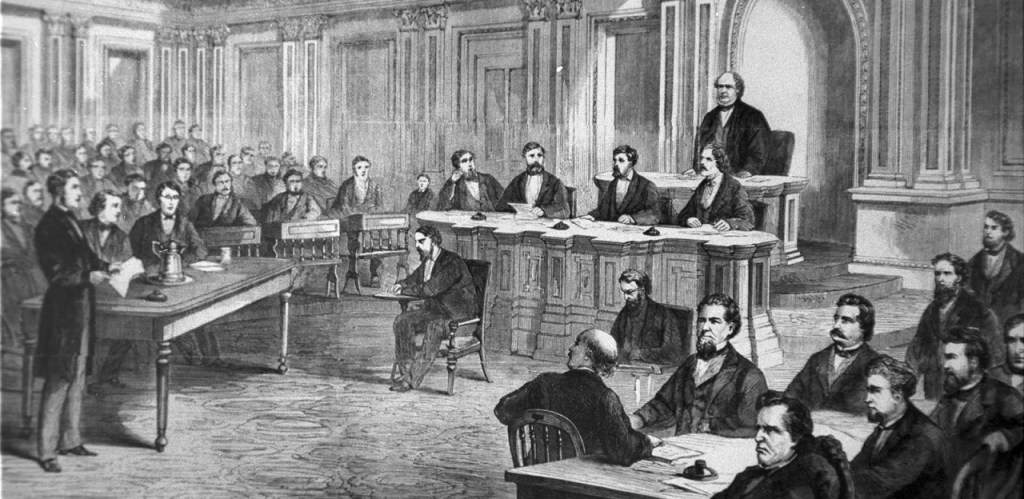
The Lost Republic: How America Abandoned Reconstruction and Built the Wrong Nation

The United States stands today on the foundation of an unfinished revolution. The Civil War, often portrayed as the crucible in which the nation was made whole, was followed by a period of unparalleled opportunity to remake the republic. That window, known as Reconstruction, saw the brief emergence of a multiracial democracy in the former Confederate states, shepherded by the Radical Republicans in Congress. These were men who believed, fiercely and with moral clarity, that the war’s outcome demanded nothing less than the complete transformation of Southern society and the full inclusion of formerly enslaved people as citizens, voters, and landowners. What followed instead was a quiet, but definitive betrayal: a failure to complete the project of Reconstruction that left the white supremacist order largely intact, and gave rise to what some, including political commentator Allison Wiltz, now refer to as the “Second Republic.”

The Radical Republicans imagined a different America, one that would break the planter class’s hold over Southern life and reconstruct the country on the basis of racial equality and federal protection of civil rights. Their vision included land redistribution, the use of military force to protect Black communities, and the permanent disenfranchisement of Confederate leaders. The legal architecture was established: the 13th, 14th, and 15th Amendments promised freedom, citizenship, and suffrage. For a moment, this new republic seemed within reach. Black men voted and held office; schools and mutual aid societies flourished; and a vibrant, if fragile, political culture began to take root in the South.

Yet the resistance to this vision was swift and violent. Former Confederates, resentful and unrepentant, regrouped under new banners. Paramilitary groups like the Ku Klux Klan emerged to intimidate Black voters and assassinate Black officeholders. Northern commitment to the cause of Reconstruction waned in the face of political fatigue, economic anxiety, and racist sentiment. The Compromise of 1877, which ended federal military occupation of the South, is widely recognized as the final nail in the coffin of Reconstruction. In exchange for a peaceful transfer of power in a contested presidential election, federal troops were withdrawn, effectively abandoning Black Southerners to white rule once again.

What emerged from this retreat was not the restoration of the antebellum order, but its mutation into something more insidious. The Southern elite reasserted dominance not through slavery, but through systems of racial control that would become known as Jim Crow. Sharecropping, vagrancy laws, and racial terror filled the vacuum left by federal inaction. In the North, corporate capitalism surged forward, aided by a Supreme Court increasingly hostile to civil rights and sympathetic to business interests. The new republic, this Second Republic, was forged not in the idealism of the Radical Republicans, but in the compromise between Northern capital and Southern white supremacy.

This betrayal continues to shape the American republic. The legacy of that failed Reconstruction is visible in the persistent racial wealth gap, in mass incarceration, and in the legal structures that continue to insulate white political power from meaningful multiracial challenge. It is felt in the enduring distortions of the Senate and Electoral College, institutions that grant disproportionate influence to states that once formed the Confederacy. It is also enshrined in the judicial philosophy that privileges state power over federal guarantees of equality, a doctrine born in the retreat from Reconstruction, and still central to American constitutional life.

What if the Radical Republicans had succeeded? That question, once the domain of counterfactual speculation, is now a central concern of a new generation of historians and public thinkers. They argue that the United States would have become a different nation entirely, one in which racial justice was not a belated corrective, but a foundational principle. A country in which democracy was not constrained by white fear and property rights, but energized by the full participation of all its citizens. In short, they argue that the real opportunity to found a just republic came not in 1776, but in the 1860s, and that the country blinked.

In this light, America’s long twentieth century: the civil rights movement, the New Deal, the struggle for voting rights, can be seen not as inevitable progress but as a series of rear-guard actions trying to recover ground lost in the 1870s. Each new wave of reform has faced the same obstacles that defeated Reconstruction: the intransigence of entrenched interests, the ambivalence of white moderates, and the enduring capacity of American institutions to absorb and deflect demands for justice. The Second Republic, born of compromise and fear, remains with us still.

To understand the full dimensions of America’s present crises, from voter suppression to white nationalist resurgence, requires reckoning with the moment the nation chose reconciliation over transformation. Reconstruction was not a tragic failure of policy; it was an abandoned revolution, and until that original promise is fulfilled, the United States remains a republic only partially realized, haunted by the ghosts of the one it refused to become.

Sources:
• Foner, Eric. Reconstruction: America’s Unfinished Revolution, 1863–1877.Harper & Row, 1988.
• Blackmon, Douglas A. Slavery by Another Name. Anchor Books, 2008.
• Wiltz, Allison. “How the United States Became a Second Republic.” Medium, 2022.
• Du Bois, W.E.B. Black Reconstruction in America, 1860–1880. Free Press, 1998 (original 1935).

Volunteerism in Canada: A Changing Landscape Across Time and Geography

Volunteerism has long been woven into the fabric of Canadian society. From informal acts of neighbourly support to highly structured programs run through non-profits and public institutions, the practice of giving time and effort without monetary reward has played a vital role in community building, social cohesion, and service delivery. Yet, as Canada changes, demographically, economically, and technologically, so too does the nature of volunteering. In particular, the contrast between rural and urban participation in volunteerism highlights both opportunity and strain within the sector.

A Historical Perspective: State Support and Civic Energy
Canada’s federal government has historically recognized the value of volunteerism and made substantial efforts to coordinate and support the sector. The most significant of these efforts came in the early 2000s with the Voluntary Sector Initiative (VSI), a groundbreaking partnership between the federal government and the voluntary sector. It aimed to improve relations, support innovation, and enhance governance in the non-profit field. Within it, the Canada Volunteerism Initiative (CVI) funded research, capacity-building, and public engagement campaigns. Although the VSI ended in 2005, it laid important groundwork by formalizing the relationship between civil society organizations and the federal state.

Departments such as Human Resources Development Canada (HRDC), later restructured into Employment and Social Development Canada (ESDC), have overseen volunteer policy and programming. Recent federal initiatives, like the Canada Service Corps (launched in 2018), focus on youth engagement in service projects and offer microgrants to promote local volunteering. The New Horizons for Seniors Program also supports older Canadians’ participation in community volunteerism. While there is no standalone federal department solely dedicated to volunteerism, it remains embedded within broader social development frameworks.

Recent Trends: Decline and Resilience
Data from the late 2010s and early 2020s reveal both strengths and stresses within the Canadian volunteer ecosystem. As of 2018, over 13 million Canadians, 41% of the population, were engaged in formal volunteerism, contributing a staggering 1.7 billion hours annually. Yet post-pandemic surveys show troubling signs: 55% to 65% of charities report difficulty recruiting and retaining volunteers, with many forced to cut programs due to shortages.

Notably, volunteer patterns are shifting. Traditional, long-term roles are declining in favour of more episodic or informal volunteering, especially among youth. Factors such as time constraints, economic insecurity, digital preferences, and burnout have reshaped how Canadians approach community service. While organizations like Volunteer Canada continue to offer leadership, training, and research, there is growing urgency to adapt volunteer roles to new realities; flexible schedules, virtual engagement, and better inclusion of marginalized groups.

The Rural – Urban Divide: Participation and Capacity
Perhaps the most persistent, and revealing, dimension of volunteerism in Canada is the divide between rural and urban communities. Historically, rural Canadians have had higher participation rates in formal volunteering. Data from the late 1990s and early 2000s show that 37% of rural residentsvolunteered, compared with 29% in urban centres. Among those with post-secondary education, rural volunteers also outpaced urban peers: 63% of rural university grads volunteered versus 42% in urban areas. Similarly, 67% of college-educated rural residents participated in community groups, compared to 55% in cities.

This elevated participation reflects the central role that volunteering plays in small towns and rural communities, where fewer formal services exist, and much of the civic infrastructure, libraries, community centres, fire services, food banks, is volunteer-run. Yet this strength is also a vulnerability. In recent years, many rural communities have reported a sharp decline in volunteer numbers. A 2025 report from rural Alberta described the “plummeting” of local volunteers, warning that essential community functions were under threat.

The rural sector also faces structural challenges. Of Canada’s ~136,000 non-profit organizations in 2022, only 21.3% were located in rural or small-town settings, compared to 78.7% in urban areas. This limits both the reach and coordination capacity of the rural volunteer system, even as demand for services grows. Moreover, rural organizations often lack the staff or infrastructure to recruit and manage volunteers effectively. Data from Volunteer Toronto’s 2025 report confirms that non-profits with dedicated volunteer managers are 16 times more successful in engaging people, resources many rural groups simply don’t have.

The Broader Role of Volunteerism: Health, Identity, and Belonging
Beyond economics and logistics, volunteerism holds deeper meaning in Canadian life. Research has long shown strong links between volunteering and well-being. Volunteers report lower stress levelsbetter mental health, and a greater sense of purpose. For newcomers, volunteering offers social integration. For youth, it builds skills and confidence. For seniors, it combats isolation.

Moreover, volunteering shapes Canadian identity. The nation’s reputation for kindness and civic responsibility is deeply connected to the widespread assumption that people help each other, often through organized groups. Volunteerism is one of the few activities that bridges socio-economic, linguistic, and cultural divides.

A Call for Renewal
Volunteerism in Canada is both a legacy and a living system. While the numbers remain impressive, the sector is showing signs of strain, especially in rural areas and among long-time service organizations. A national renewal is underway: a National Volunteer Action Strategy is being developed with support from the federal government, aiming to modernize the sector and reverse declining trends.

As Canada continues to evolve, so too must its approach to volunteerism. This means investing in recruitment, training, and support, especially where capacity is low. It means listening to the needs of volunteers themselves and creating flexible, inclusive ways to contribute. Most of all, it means recognizing volunteerism not just as charity or goodwill, but as vital infrastructure in the Canadian democratic and social landscape.

Sources
• Volunteer Canada (2023–2024 reports): https://volunteer.ca
• Statistics Canada: General Social Survey and 2018 formal volunteering stats
• Canada Service Corps and ESDC evaluation documents (2023–2024)
• Volunteer Toronto Snapshot (2025): https://www.volunteertoronto.ca
• Senate report “Catalyst for Change” (2023)
• Rural Alberta volunteer crisis coverage: https://rdnewsnow.com