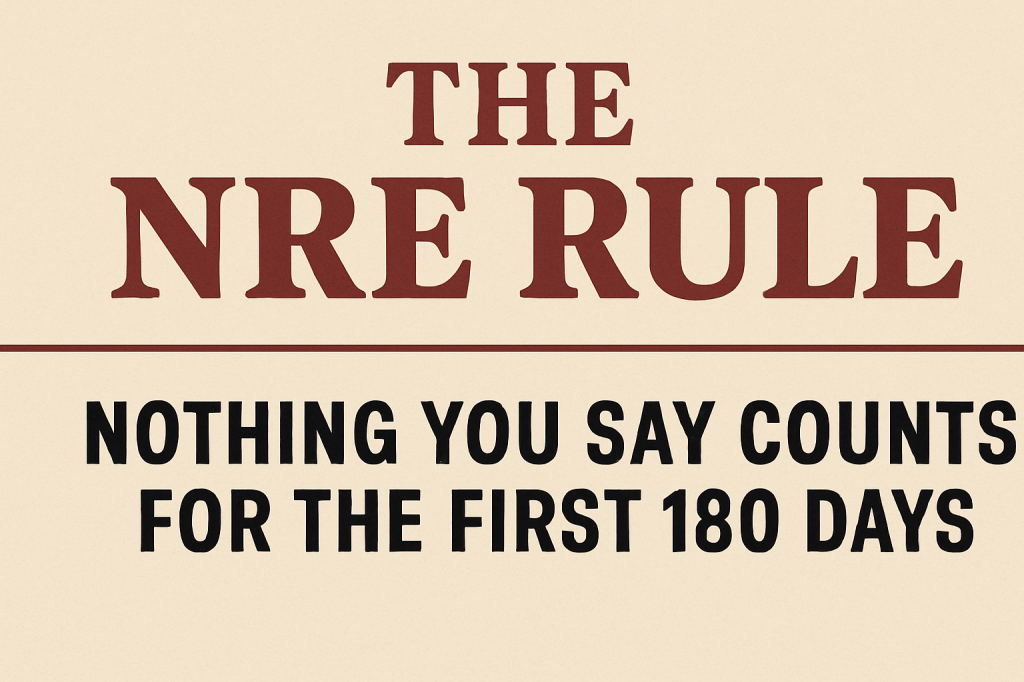
The NRE Rule: Why Nothing You Say Should Count within the First 180 Days

I first shared a version of this article on Fetlife, where it sparked some discussion. My aim here is to focus on the experience of being in the NRE zone, rather than on the potential fallout that can sometimes occur around it. That said, I do include a few considerations you might find worth reflecting on. Enjoy!

Polyamory veterans know a universal truth: New Relationship Energy (NRE) makes people completely, gloriously bonkers. And not in a “quirky fun” way – in a “you just cancelled dinner with your long‑term partner because your new crush sent you a TikTok of a honey badger” kind of way.

For the uninitiated, NRE is that fizzy cocktail of dopamine, oxytocin, and serotonin your brain starts shaking up the moment you meet someone new who lights up your nervous system. Think champagne meets espresso meets a sugar rush. You’re drunk on possibility, jittery with lust, and convinced you’ve found The One (or The One Plus the Others You Already Love).

Your friends nod knowingly while making silent bets on how long before you resurface. Your partners smile politely while you quietly move your toothbrush back to your bathroom. And you? You’re busy imagining joint vacations, co‑buying an air fryer, and wondering whether it’s “too soon” to introduce them to your entire extended family. (Spoiler: yes, it is.)

The NRE Rule

My personal safeguard – forged in the fires of experience – is what I call The NRE Rule:

For the first 180 days, whatever you say to each other is lovely – even magical – but it doesn’t count for shit.
Come day 181, you’d better know what you’re saying and committing to… or else.

Why 180 days? Because science says that’s about how long it takes for the champagne bubbles of NRE to start going flat. The hormonal flood subsides, reality wanders back in wearing sweatpants, and suddenly you’re seeing this person in normal lighting – not just by candlelight or after three Negronis.

Neuroscience tells us that in those first months, your brain is actively conspiring to make you overlook flaws. Evolution likes this trick – it’s great for mating – but terrible for deciding who you should let rearrange your furniture.

Why It Works

The NRE Rule is not about being cynical. It’s about enjoying the high without buying real estate while you’re still tipsy. It:

  • Protects your long‑term loves from your NRE‑drunk time‑management disasters.
  • Keeps your new connection fun without attaching premature permanence.
  • Gives relationships breathing space to prove they work in ordinary, boring, real‑life conditions.

So by all means, whisper “forever” under the covers, build blanket forts, and make each other playlists. Just don’t sign a mortgage, merge your Netflix accounts, or promise to raise alpacas together until you’ve passed the 180‑day checkpoint.

Because here’s the thing: Day 181 is when the fun talk turns into real talk. That’s when “I’ll always be there for you” starts meaning right now, in this actual moment, with all our messy schedules and emotional baggage. It’s when the NRE sparkle gives way to the glow of real compatibility — or the thud of “oh… so that’s who you are.”

Until then? Enjoy the sugar rush. Just remember: before 180 days, you’re spending Monopoly money. After that? The bank account opens for real.

And I don’t care how cute they are – no one gets the air fryer until they’ve made it to Day 181.

The Jade Tree and Carl Jung’s Synchronicity

I hadn’t thought about her in over a year. No particular reason. No emotional weight behind it. She just drifted across my mind, calmly, clearly, and I noted it, then moved on.

Half an hour later, my phone buzzed. A message from her. No small talk, no explanation. Just a photo of a jade tree I’d given her a while back. It looked healthy. Thriving, actually. She thought I’d like to see how well it was doing.

I thanked her for the photo, wished her well, and left it at that. I didn’t feel any great pull to re-engage, but the moment stayed with me, not because of her, but because of the timing. The randomness. The feeling that something just lined up.

Carl Jung had a name for this kind of thing: synchronicity. He defined it as a “meaningful coincidence”. Two or more events connected not by cause and effect, but by meaning. They happen together, seemingly by chance, but resonate with something deeper. He saw it as a sign that there’s more to reality than we can see or measure. That sometimes, our inner world and the outer world speak to each other. Quietly. Precisely.

I’m not someone who needs to romanticize everything. People reach out. Thoughts come and go. But there was something clean about this particular moment; no buildup, no emotional noise. Just the sense of a thread that hadn’t fully frayed. A small echo between two people, delivered through a jade tree and a phone screen.

There’s no need to dig into it more than that. I wasn’t longing for her. I wasn’t unresolved, but when synchronicity shows up like this, I pay attention. Not because I think it means something I need to act on, but because it reminds me I’m connected to more than just what’s in front of me.

Jung believed these moments reflected the presence of a collective unconscious, a shared field of symbolic meaning, memory, and emotion. A psychic network we’re all tuned into, whether we realize it or not. Maybe that’s true. Maybe it’s simpler than that. Maybe we just carry people with us in subtle ways, and now and then, something stirs.

What I know is this: there was no reason for her to reach out when she did. And no reason for me to be thinking of her right before. But she did. And I was. And I’m glad I noticed.

The jade tree is still growing. That’s enough.

Polyamory: The Questions That Never Go Away

The other day, I found myself having a familiar conversation with a friend, the kind I’ve had countless times with people curious about my relationship orientation and wondering if it might be a fit for them. It struck me that I’ve been here before, walking through the same starting points, answering the same questions. So I decided to put my thoughts into a reference piece. That way, when the topic comes up again, we can skip the “Polyamory 101” stage and dive straight into the richer, deeper conversations that matter most. With that all said, here’s how I think about the moral, ethical, and societal questions people often ask me about polyamory.

I’ve been openly polyamorous for decades now. Long enough to have seen the word move from whispered corners of niche communities into mainstream conversations, long enough to have been called both a dangerous libertine and a brave pioneer. And no matter how many workshops, blog posts, and late-night kitchen-table talks we have, the same core questions always seem to come back: Is this right? Is this fair? And what does it mean for the world we live in?

These are the moral, ethical, and societal questions about polyamory. I’ve lived with them, wrestled with them, and come to see them not as irritants, but as invitations to think more deeply about love, freedom, and responsibility.

The Moral Questions: Is It Right?
The first challenge people throw at polyamory is moral. We’ve been raised in a culture that equates “true love” with exclusive love. From fairy tales to wedding vows, monogamy is painted as the gold standard of moral romance. So when I say I love more than one person, and mean it, some people hear betrayal or moral failure.

But morality isn’t just about what’s familiar. It’s about how we treat people. I’ve always believed that love is not a finite resource; my love for one person doesn’t diminish my love for another any more than loving one child means I love the others less. In my experience, the moral litmus test for polyamory isn’t “one or many”, it’s whether everyone involved is respected, valued, and cared for.

Jealousy often gets cast as a moral signpost too. In monogamous thinking, if you’re jealous, it must mean something wrong is happening, or that love is being stolen away. In poly life, jealousy is a signal, not a verdict. It asks: What do I need? What am I afraid of? Can we talk about this? It’s uncomfortable work, but it’s moral work, the kind that builds rather than breaks trust.

The Ethical Questions: Is It Fair?
Even when people accept that polyamory can be moral, they ask about ethics, the fairness and integrity of the thing. And here, I’ll be the first to admit: it’s easy to get this wrong.

Polyamory rests on the foundation of informed consent. That’s not just a buzzword. It means that every partner knows the full truth of the relationship structure and has genuinely chosen it without manipulation or coercion. If someone’s “agreeing” because they fear losing their partner, that’s not consent, that’s survival.

It also means telling the truth even when it’s messy. Ethical polyamory is radical honesty in action: “Yes, I have feelings for someone else.” “Yes, I’m sleeping with them.” “Yes, I want to go deeper with them.” That kind of disclosure can sting, but it’s the only way this works without slipping into betrayal.

Then there’s the question of power. In polyamory, mismatched emotional maturity, financial independence, or social status can easily tilt the playing field. I’ve seen relationships where one partner held the “permission card”, and the other lived in quiet resentment. I’ve also seen polycules where new partners were treated like secondary accessories rather than full human beings. Ethical polyamory demands constant checking of those dynamics, because it’s all too easy for someone to feel trapped in what was meant to be a consensual, liberating arrangement.

The Societal Questions: What Does It Mean for the World?
Even if you sort out the personal morality and the interpersonal ethics, polyamory still sparks societal questions. Should we, as a culture, recognise polyamorous families in law? What would that mean for marriage, for inheritance, for child custody? These aren’t abstract questions when you’re raising kids with multiple committed partners, or when a hospital only recognises one “next of kin.”

There’s also the matter of public perception. Polyamory still carries stigma, enough that people can lose jobs, face custody challenges, or be ostracised from their communities if they’re open about it. That stigma bleeds into how we’re portrayed in media: either as exotic free-love rebels or as moral cautionary tales. Rarely as ordinary, loving, responsible adults living in families that just happen to be larger than average.

Public health debates make an appearance here too. Some assume that more partners mean more risk, full stop. The truth is more nuanced. In my experience, poly people, because we have to talk about sexual health with multiple partners, are often more rigorous about testing, safer sex practices, and ongoing health conversations than many monogamous folks.

And then there’s the question of the next generation. What does it mean for kids to grow up in polyamorous households? I can only speak from my own circle, but the kids I’ve seen raised in poly families tend to understand diversity in relationships from a young age. They learn that love can take many forms, that honesty matters, and that family is defined by care and commitment rather than a strict headcount.

Living the Questions
I don’t pretend polyamory is for everyone. It’s not morally superior to monogamy; it’s simply another valid form of relationship, one that requires its own skills, boundaries, and resilience. But I’ve learned that these moral, ethical, and societal questions are not hurdles to clear once and forget. They’re a constant part of the landscape.

Every time I commit to someone new, I’m asking myself: Is this right? Is this fair? What will this mean for the web of relationships I’m part of? Those questions don’t weaken my relationships, they strengthen them. They keep me honest. They keep me accountable.

Polyamory, at its best, isn’t just about loving more than one person. It’s about loving with more integrity, more awareness, and more intention. And in that sense, the questions aren’t a problem to solve. They’re the very thing that keeps the love alive.

On the Illusion of Self-Discovery 

In an age where “finding yourself” has become a lifestyle brand, it’s hard not to notice, gently, how strange it all is.

You see it everywhere: bright, hopeful faces on “healing journeys,” framed against sunsets in Bali; corporate executives burning out in glass towers only to reappear months later as “authentic living” coaches after a $12,000 retreat in the Andes. Suburban families decluttering their closets in search of inner peace, as if enlightenment might be hidden somewhere between last season’s jackets and the yoga mats.

Modern self-discovery, especially among the comfortable and educated classes, has become an elaborate ritual. The tools vary: yoga teacher trainings, digital detox camps, van life road trips, artisanal workshops on gratitude, but the impulse remains deeply human: the yearning to feel whole, to understand oneself beyond the blur of obligations.

And yet, with a kind of quiet sadness, you realize that much of this restless effort misses the heart of what older wisdom traditions have long tried to say: that the self you are chasing cannot be caught like a butterfly. The ego, the needy, striving “I”, is not a puzzle to be solved or a prize to be won. It is an illusion to be gently seen through, a dream to wake up from.

In this softer light, it’s clear that modern self-discovery often becomes a new form of grasping. A gentler grasping, perhaps, dressed in mindfulness retreats and ayahuasca ceremonies, but grasping nonetheless. Transformation is packaged, marketed, and sold, with self-actualization offered for a price. It’s not that these experiences are without value; many carry glimpses of beauty and honesty, but when the pursuit becomes a new identity, a new project of consumption, it quietly reinforces the very suffering people hope to leave behind.

Meanwhile, the genuine work, the real, hard, simple work, remains overlooked. It doesn’t glitter. It looks like sweeping a floor without resentment, holding silence without needing to fill it, sitting with discomfort without demanding it change. It looks like living, fully and without drama, in the plainness of an unremarkable day.

Ancient teachings, whether whispered under the Bodhi tree, scribbled in the margins of Stoic letters, or passed hand-to-hand among Sufi poets, point always to the same difficult kindness: You do not find yourself by changing scenery. You find yourself by changing how you see.

And sometimes, by realizing, with a soft sigh, not a harsh judgment, that there was no fixed, shining “self” to find after all.

This truth is not meant to mock anyone’s search. It is not meant to diminish the sincere longing behind every yoga mat, every travel blog, every self-help journal. Longing is sacred. The path is sacred. It is only that the destination, in the end, may be smaller and quieter than expected, not a place to arrive at, but a way of being already waiting inside the life you have.

And that, perhaps, is enough.

The “True Love Will Change Him” Myth

One of the most persistent cultural myths about relationships is the idea that “true love” can fundamentally change someone’s nature. It appears in countless stories: the roguish bachelor who becomes the devoted husband, the restless wanderer who finally settles down, the free spirit tamed by the right partner. In the context of polyamory, this myth often takes a specific form: the belief that a happily polyamorous person will eventually abandon multiple loves when they meet the “right one.”

For many polyamorous people, this is a familiar experience. We disclose our relationship orientation clearly and early, often as one of the very first things we share. And yet, it is not uncommon to encounter potential partners who hear “I am polyamorous” not as a statement of identity or practice, but as a challenge to be overcome. The assumption lingers that love, if deep enough, will lead to conversion.

This assumption reveals more about the cultural scripts we inherit than about the people involved. Generations of romantic storytelling have reinforced the notion that the highest form of intimacy is exclusive, permanent monogamy. When polyamorous individuals do not conform to this arc, partners may experience confusion, disappointment, or even a sense of betrayal, as though a promised transformation has failed to occur.

The problem runs deeper than mismatched expectations. At first glance, polyamory appears to be a liberating and beautiful idea. Who would not want more love, more intimacy, more sources of support and joy? Yet when lived in practice, polyamory frequently exposes unresolved vulnerabilities. The experience of sharing a partner can provoke profound feelings of abandonment, inadequacy, or betrayal. For many, it becomes the first time they must directly confront the reality of their attachment style and emotional insecurities.

This is one reason polyamory is often misunderstood. It is not simply “more love,” nor is it an easy alternative to monogamy. It is a demanding practice that requires rigorous self-examination, radical honesty, and a capacity for discomfort. Jealousy, fear, and insecurity do not disappear in polyamory; they are amplified. To remain in the dynamic requires bravery, and a willingness to name and work through these challenges.

It also requires discipline. Not only sexual discipline, though that is critical, given the need for careful vetting and consideration of potential partners, but emotional discipline. Communication skills become the backbone of any polyamorous structure. And here, one of the most sobering truths emerges. 

“The quality of a polycule is directly proportional to the communication skills of its least emotionally secure member; or, if you prefer something gentler, less absolute, more accepting – a polycule’s health depends less on its most skilled communicator, than on how well its least secure member feels heard.”

If even one person in the network is unable to express needs, set boundaries, or listen without defensiveness, the strain reverberates outward. This is why intentional partner choice matters. Attraction and chemistry may open the door, but sustainability depends on emotional maturity and the capacity for dialogue. Without these, polyamory can quickly collapse into chaos and harm, easily mistaken for selfishness or exploitation disguised as “freedom.”

The myth of “true love will change him” bypasses this complexity. It reassures us that we will not need to face our own insecurities, because eventually the polyamorous partner will conform to a monogamous ideal, but this reassurance is hollow. The harder truth is that no amount of affection can erase a person’s fundamental orientation toward relationships. Attempting to do so often results not in intimacy, but in resentment and disillusionment.

A more grounded vision of love recognizes people as they are, rather than as we wish them to be. True love, in this light, is not about rewriting someone’s story, but about choosing to join it. It requires clarity, communication, and the courage to engage with the difficult emotions that inevitably arise. Polyamory, when practiced with integrity, is not a rejection of love’s depth, but an expansion of its possibilities, provided those involved are willing to meet the demands it places upon them.

Ultimately, the challenge of polyamory is also its gift. It forces participants to confront their own fears, to sharpen their honesty, and to expand their capacity for empathy. It strips away the comforting illusion that love can be a simple cure-all. In doing so, it offers a different, and perhaps more radical, lesson: that love is not about changing another person, but about embracing them fully, while also accepting the work required to embrace oneself.

An idea that’s been waiting since 2019 is finally ready to come into the light. PolyConnections will be a shared space for stories and reflections from across the polyamorous community: a place to write, to connect, and to listen. It’s been a long time coming, but the conversation is about to begin.

My Favorite Films Part I: Music, Story, and Cinematic Art

For me, a film is never just a story on a screen. I experience it as a convergence of senses and artistry: the framing of a shot, the cadence of dialogue, the nuance of performance, the sweep of production design – but always, equally, the music. A soundtrack can transform a scene, turning ordinary emotion into something transcendent, guiding my heart as much as the narrative guides my mind. This first part of my favorite films highlights those that move me through story, music, and cinematic craftsmanship, forming an immersive experience I return to again and again.

1. The Lord of the Rings (Extended Editions)
2001–2003 | Director: Peter Jackson | Writers: Fran Walsh, Philippa Boyens, Peter Jackson, Stephen Sinclair

A sweeping fantasy epic where hobbits, warriors, and kings unite to destroy the One Ring, resisting corruption and forging unlikely bonds amid war.

Why I like it: I’m captivated by the depth of the world and the moral stakes of loyalty, courage, and chosen family. Howard Shore’s score is integral, a musical backbone that elevates battle, sorrow, and triumph alike. The extended editions let me linger on every character nuance, visual detail, and the orchestral music that carries the emotional weight, making the story as immersive for the heart as it is for the eyes.

2. Blade Runner (Final Cut)
2007 (original 1982) | Director: Ridley Scott | Writers: Hampton Fancher, David Peoples

In a rain-soaked, neon Los Angeles, a weary detective hunts rogue replicants, blurring the line between human and artificial life.

Why I like it: I’m drawn to its meditation on identity and mortality, a story that lingers in the mind long after the credits. Vangelis’s haunting synthesizer score defines the atmosphere, turning every raindrop and neon reflection into a sonic experience. The music, cinematography, and acting fuse seamlessly, making me feel the melancholy, tension, and beauty of a world that’s both alien and intimately human.

3. Monsoon Wedding
2001 | Director: Mira Nair | Writer: Sabrina Dhawan

A chaotic Delhi wedding gathers extended family, exposing secrets, desires, and generational tensions while celebrating resilience and love.

Why I like it: The interwoven stories of love, family, and tradition resonate deeply with my own life. The music – Bollywood, classical, and folk – animates the chaos, making every dance, argument, and revelation pulse with rhythm and emotion. I return to this film for its warmth, humor, and humanity, and the soundtrack ensures I’m dancing emotionally as well as mentally, caught up in the joy and mess of life.

4. Lawrence of Arabia
1962 | Director: David Lean | Writers: Robert Bolt, Michael Wilson

A sweeping desert epic tracing T. E. Lawrence’s transformation from eccentric officer to legendary leader of the Arab Revolt.

Why I like it: The grandeur of the deserts and Lawrence’s moral complexity enthrall me. Maurice Jarre’s score turns the desert into a character, giving voice to both isolation and transcendence. I admire the cinematic sweep, the subtlety of performance, and the orchestral music that amplifies every moment of tension, courage, and reflection. The film reminds me of the vastness of human experience, both visually and musically.

5. The Martian
2015 | Director: Ridley Scott | Writer: Drew Goddard (novel by Andy Weir)

Stranded on Mars, astronaut Mark Watney survives through ingenuity, humor, and science until Earth can bring him home.

Why I like it: I love the optimism, wit, and relentless problem-solving. The use of 70s pop songs adds humor and heart, making the isolation bearable and delightfully human. Music becomes part of survival, and every track resonates with hope, playfulness, and ingenuity. The combination of scientific ingenuity, visual storytelling, and musical choices perfectly balances intellect, emotion, and entertainment for me.

Final Thoughts
These five films exemplify how music and narrative can intertwine to create something larger than the sum of their parts. From sweeping epics to intimate tales, each one offers a fully immersive experience, engaging my imagination, my emotions, and my ear for melody and harmony. They remind me that cinema is a multidimensional art, where sight, sound, and story can linger in memory long after the screen goes dark.

Her Power, My Rules: When a Submissive is a Real Alpha

She commands a room with a glance. Corporate meetings, brand deals, photo shoots, livestreams watched by thousands, she owns them all. My girl is a powerhouse in every sense. She’s in her 30s, brilliant, ferociously independent, raising kids and rising in an industry where power is often performative, and women are taught to either outdo men or obey them.

She does neither. She submits – to me.

I’m her older Daddy Dom. Retired. Steady. Quiet. A man who no longer needs to impress anyone, and in our private world, behind the soft chime of a voice note or the sharp tone of a command, she kneels. Not because she’s weak, because she chooses to lay down her power at my feet.

That’s not a contradiction. That’s the truth of submission most people can’t grasp: real power doesn’t vanish under discipline – it expands.

I Don’t Dom Her Potential – I Hold It
She didn’t come to me for control. She already controls everything. What she needed was containment. Someone who could see the whole of her and not be intimidated. Someone who would honor the woman, the brand, the mother, the CEO, and still grab her by the throat when the time was right.

My rules aren’t petty. They’re structural. She checks in before meetings, sends me her weekly intentions, wears specific underthings I’ve chosen for her to major events. I don’t micromanage her brand, I support the woman behind it. I help her carve out rituals that let her breathe.

And when she forgets herself, or needs to be brought back down from the ledge of performance and pressure? I correct her. Not cruelly. Not theatrically. Just enough to remind her that she doesn’t have to do it all alone.

She Makes Money. I Make Meaning.
There’s something that happens when an ambitious woman comes home to a Dominant who doesn’t need anything from her. I don’t want her money. I don’t curate her followers. I care that she ate today. That she’s sleeping enough. That she remembers who she is when the cameras are off.

She once said to me, “I’ve never had a man ask for less from me, and yet get more.”

She’s right. I don’t push her to produce. I make space for her to rest. And in that space, her submission blooms like something sacred.

Because here’s the truth: it takes a patient, considerate man to hold a woman like her. She is the Alpha Wolf in the public square, yet in my presence, she is a girl again. Not smaller, just softer. More fluid. More honest.

And I protect that space like it’s sacred.

Submission Is a Rebellion, Too
When we first began, she worried what people might think. “You’re older. You’re retired. You’re not in the scene like I am,” she said.

“You don’t need another performer,” I told her. “You need someone who sees past your act.”

She laughed. That was the moment we both knew.

She’s used to being the one people orbit, but in our dynamic, she surrenders. Not as a loss, but as a conscious, defiant act of rebellion against the world that insists she always be on.

When she kneels, she’s not giving up status. She’s reclaiming her soul.

We Negotiate With Truth, Not Fantasy
Our D/s doesn’t run on clichés. There are no 24/7 protocols that disregard her children’s needs. There are no humiliating tasks that undermine her role in the industry. Our play is intense, yes, but always integrated.

Sometimes she wears my collar under a power suit. Sometimes she sends a voice memo in the car before a pitch meeting “Daddy, I’m scared. Tell me I’ve got this.”

I tell her. Every time. Because my Dominance isn’t performative. It’s responsive. It adapts to her evolution without compromising its authority.

She calls it the most grown-up relationship she’s ever had.

Not Everyone Will Understand Us, and That’s Okay
Sometimes people within our inner circle ask her why a woman like her; beautiful, public, successful, would kneel to a retired, older man. They don’t understand that what we have isn’t about age or power imbalances. It’s about Resonance. Safety. Depth.

She once whispered in bed, after a scene, “I feel small and safe in your hands. Like everything I don’t show the world can just…..fall away.”

That’s the highest compliment a submissive can give, because when a woman like her chooses to submit, it’s not from need. It’s from trust.

And when a man like me receives it, it’s not from conquest. It’s from care.

There are many kinds of D/s relationships. Ours is not performative, or photogenic, or built for display. It is deeply intentional, ethically structured, and spiritually rich. She brings the storm. I hold the stillness. She is the Alpha in the world, but in my arms?

She is mine. Entirely.

The Problem with TNG Groups: Why We Can’t Afford to Ignore the Elders (Updated)

The update is because apparently I wasn’t clear enough around the distinction between BDSM play and sex, while making the case for intergenerational mentorship, without diluting the importance of age-specific spaces. 

By now, most of us active in the kink world have heard of TNG groups – short for The Next Generation. These are community spaces, usually restricted to members aged 18 to 35, designed to provide younger people with opportunities to explore BDSM among peers, free from what some see as the social and sexual pressures of older participants.

I understand the motivation. For younger people, entering a kink space for the first time can be daunting, especially when it’s populated by people who are decades older. There’s a very real concern about predatory behaviour, especially in communities where power exchange is already a central theme. Boundaries matter. And spaces where younger kinksters can build confidence, self-knowledge, and friendships without fear of being “creeped on” are valid and valuable.

Yet, somewhere along the way, the well-intentioned effort to protect and empower young people has hardened into something less healthy: exclusion. What began as a way to create peer-based support networks has too often become a wall that blocks essential mentorship, skill transmission, and historical continuity, elements that BDSM, as both a practice and a culture, can’t afford to lose.

BDSM Is Not Sex – But Sex Has Muddied the Water
We need to start by untangling a key confusion that’s quietly undermining both sides of this debate: BDSM play is not inherently sexual. The popularization of kink through mainstream media and online platforms like FetLife and Reddit has brought in a wave of newcomers, many from swinger or sex-positive backgrounds, who conflate BDSM with sex, and especially with casual sex.

To be clear, there is nothing wrong with mixing sex and kink when it’s negotiated. But BDSM is, at its core, about power exchange, control, sensation, trust, and often intense emotional experiences. For many long-time practitioners, myself included, it’s not about genitals or orgasms. It’s about precision, discipline, psychological connection, and often an aesthetic rooted in service, restraint, and deep consent.

When younger kinksters say, “We don’t want to be hit on by older members,” they are absolutely within their rights, but when that discomfort is extended to include exclusion from educational play parties, skill shares, or mentoring scenes simply because someone is over 40, we are no longer talking about safety, we’re talking about ageism. And in doing so, we risk throwing out the very scaffolding that makes BDSM sustainable.

The Value of Mentorship in BDSM
Unlike sex, which most people figure out through personal experimentation, BDSM carries real physical, psychological, and ethical risks. There are tools that can break skin, restrict breathing, or trigger trauma. There are dynamics that mimic abuse but rely on deep consent, mutual care, and communication. These things are not intuitive. They are learned.

Much of what we know today about safety, negotiation, aftercare, trauma-informed practice, and even how to structure a D/s relationship, was developed by earlier generations of kinksters who often learned the hard way. There is a lineage of knowledge that deserves to be passed down, not cut off.

I’ve seen firsthand what happens when younger players are left to figure things out on their own. I’ve watched scenes falter because no one recognized emotional drop. I’ve seen harm escalate because boundaries were not clearly discussed. I’ve witnessed newer Dominants imitate porn-inspired dynamics with no understanding of service, responsibility, or care. And I’ve seen submissives pushed beyond their limits by equally inexperienced peers, not out of cruelty, but out of ignorance.

This is not a matter of policing young people. It’s a call to enrich their experience with the depth of collective wisdom that already exists.

Let TNG Stay Social – But Open the Gates for Skill-Building
To be clear, I’m not against TNG spaces. The desire to socialize with peers is entirely valid. Younger folks deserve spaces where they can be themselves, flirt freely, and build community without feeling objectified by older members, but BDSM play spaces and skill-sharing events are not the same thing as social mixers. When TNG policies extend to the full exclusion of older, experienced practitioners from education-focused events, we lose the very thing that makes kink community valuable.

The solution isn’t to abandon age-based spaces, it’s to differentiate between social comfort and educational necessity. TNG groups can and should host age-restricted munches, parties, and discussion groups, but when it comes to workshops, play parties focused on learning, mentorship programs, and community leadership, older kinksters still have a vital role to play.

That role isn’t about control or dominance over the group. It’s about availability, humility, and stewardship. The job of an elder isn’t to run the show, but to help others run their own shows safely and meaningfully.

Safer Communities Require Bridges, Not Walls
We don’t build safer communities by locking people out. We build them by teaching people how to assess risk, how to spot manipulation, how to say no and how to hear no. These are not age-bound skills, they are community-bound ones, and community can’t thrive without cross-generational dialogue.

We also need to reject the simplistic framing that younger equals safe and older equals predatory. Harmful behaviour exists across all ages, genders, and orientations. What matters is ethics, accountability, and communication, not the date on someone’s birth certificate.

Toward a New Kind of TNG – One Rooted in Collaboration
Imagine a model where TNG groups maintain social autonomy, but invite older members to run skill-based workshops, offer scene coaching, or mentor newer Dominants and submissives. Where events have posted boundaries, vetting, and safety teams, but also include intergenerational wisdom. Where “creepy” behaviour is called out and dealt with directly, not just filtered out through blanket age bans. Where learning is prioritized, not sanitized.

TNG spaces could become crucibles for a new kind of kink culture, one that’s trauma-informed, neurodivergence-aware, inclusive, and intersectional, but only if they also embrace the old lessons that still matter. We don’t need elders to dominate the room, but we do need them to be in the room.

Don’t Lose the Map
No one climbs a mountain without a guide. And no one should be expected to navigate the emotional, psychological, and physical terrain of BDSM without access to experienced support. If you’re 22 and just stepping into kink, you deserve better than a social group with no elders, and a YouTube playlist. You deserve mentorship, safety, and tradition alongside your peer group.

At the time of writing, my regular BDSM play partners range in age from their early 30s to mid 60s, and I’m currently mentoring a newcomer to the community in her early 40s. Because we’ve taken the time to communicate clearly, set expectations, and build trust, age fades into the background. What truly matters are knowledge, skill, and lived experience.

It’s time we stopped treating age as the enemy and started treating community as the goal. Let the TNG groups flourish, but let the wisdom flow.

Sources
• Barker, M., & Langdridge, D. (2010). Understanding Non-Monogamies. Routledge.
• Newmahr, S. (2011). Playing on the Edge: Sadomasochism, Risk, and Intimacy. Indiana University Press.
• Easton, D., & Hardy, J. W. (2017). The Ethical Slut (3rd ed.). Ten Speed Press.
• Rubel, D. J. (2014). “Kink and the Problem of Nonsexual Intimacy.” Journal of Positive Sexuality, 1(1), 16–19.
• Martinez, T. (2022). “The Rise and Limits of TNG Spaces in the Kink Community.” Leatherati Archive.

No Seed, All Sizzle: My Secret Weapon in Modern Dating

I’ve learned there are a few phrases in a man’s conversational toolkit that can stop time, reset the vibe, and spark a flash of unexpected interest. “I cook a tasty risotto” is decent. “I volunteer at the local animal shelter” gets a respectful nod. Yet nothing, and I mean nothing, hits quite like “I’ve had a vasectomy.”

Boom. Eyes widen. Shoulders relax. Somewhere in the distance, you can almost hear a jazz saxophone kick in. Suddenly, I’m no longer just another charming guy with good shoes and half-decent banter – I’m the unicorn of casual dating. The Responsible One. The Guy Who Took the Hit So Nobody Else Has To.

Make no mistake, this is not about pity. I don’t limp into rooms or tell tragic tales of what was bravely left behind in a clinic that smelled faintly of antiseptic and regret. Quite the opposite. I say it with a wink and a little smile, because I know exactly what it means to them. No babies. No pills. No oopsies.

In that moment, it’s as if the entire weight of reproductive labour, historically dropped squarely on women’s shoulders, suddenly lifts. No tracking cycles. No last-minute pharmacy dashes. No quiet dread over a missed period, and a malfunctioning condom. I’m walking, talking sexual freedom, with a surgical receipt.

Now, not every woman reacts the same way. Some go wide-eyed and whisper “thank you” like I’ve just rescued a puppy from a burning building. Others get curious, like I’ve admitted I can tie knots with my tongue or moonlight as a tantra instructor. Either way, it’s a green light wrapped in satin and signed “with gratitude.”

The snip, you see, is the ultimate adult move. It doesn’t just say I’m not planning on having more (or any) kids. It says I’ve thought about consequences. I’ve taken action. I’ve made a permanent decision not to play Russian roulette with someone else’s uterus. That’s hot.

Sex becomes lighter. Freer. No post-coital math, no awkward “you on the pill?” conversations, no side-eye toward the bedside drawer and its expired latex. Just grown-up fun, with a safety net sewn in by a professional.

And let’s not ignore the sheer boldness of it. There’s something undeniably sexy about a man who says, “Yeah, I let someone down there with a scalpel, and I did it for the team.” That’s confidence. That’s swagger. That’s a whole new level of big dick energy (ironic, considering the location of the procedure).

So, yes, when I mention I’ve had a vasectomy, women’s eyes light up. Not just because of what it says about the plumbing, but because of what it says about the person attached to it. Consider it a plot twist, a punchline, and a promise: no surprises, just pleasure.

I may have had the tubes tied, but trust me, the vibes? Completely unleashed.

When Stillness Meets Flow

When the masculine rests in awareness, and the feminine moves in devotion – the universe finds its perfect geometry”

This quote by Kaivalyapadama is a poetic distillation of ancient tantric and yogic philosophy, weaving together the metaphysical, psychological, and relational dimensions of existence.

Archetypal Masculine and Feminine Energies

This isn’t about gender, but about principles found in all beings and in all systems:

  • The Masculine symbolizes stillness, presence, consciousness, structure, and witnessing. It is the container.
  • The Feminine symbolizes movement, feeling, intuition, energy, creation, and love. It is the flow within the container.

In tantric traditions (Shiva-Shakti, for example), Shiva (masculine) is pure consciousness — unmoving, eternal — while Shakti (feminine) is the energy that dances creation into being. Without awareness, devotion flails. Without devotion, awareness stagnates.

“Rests in Awareness” – The Role of the Masculine

To rest in awareness is not to dominate, judge, or fix — but to simply be. It is radical presence. In individuals, this is the quiet, centered part of the self that holds space for chaos, change, and emotion without becoming reactive.

In relationships, the masculine partner who embodies awareness becomes a sanctuary — their stillness creates trust, safety, and depth. In society, a culture rooted in awareness promotes wisdom over reaction, and long-term vision over short-term gain.

“Moves in Devotion” – The Role of the Feminine

To move in devotion is to surrender into flow with love, beauty, and purpose. The feminine principle here is not passive, but deeply powerful — dancing, birthing, transforming. Devotion doesn’t mean subservience, but alignment: the feminine energy knows that movement without love becomes frenzy, while love without movement becomes longing.

In a person, when your emotions, desires, and creative forces move from a place of devotion — to truth, to a cause, to spirit — they become transformational rather than chaotic.

“The Universe Finds Its Perfect Geometry”

Geometry, especially in spiritual traditions, signifies order, balance, symmetry, and harmony. Sacred geometry underpins everything from atomic structure to the golden ratio in sunflowers to cathedral design.

So when these energies align:

  • Awareness holds space,
  • Devotion flows through it,
  • The resulting dance is not random, but exquisitely structured — a mandala of being.

This is not just esoteric metaphor: many relational therapists, somatic practitioners, and spiritual teachers use this lens. It’s evident in sexual polarity dynamics, in leadership and support systems, in artistic creation, even in neural science where calm awareness (prefrontal cortex) holds space for emotional movement (limbic system).

Application and Practice

This quote calls us toward balance:

  • In ourselves: Can I cultivate still presence and loving movement?
  • In our relationships: Do we create dynamics where one can witness, and the other can offer energy?
  • In society: Are we building systems that balance structure with flow, logic with empathy, clarity with creativity?

Meditation (awareness) and prayer (devotion) are often seen as two wings of the same bird. Stillness invites movement; movement is anchored by stillness.

Conclusion

This quote is less a prescription than a profound invitation — to align the inner masculine and feminine, to dance with our own nature, and to trust that when these polarities are rightly placed, life doesn’t just function — it harmonizes. Geometry isn’t merely about lines and angles; it’s about relationships — and when awareness and devotion relate well, the pattern they create is nothing less than sacred.