The Church of the Polyamorous Christ

If only this were real!

The Church of the Polyamorous Christ is a spiritual movement that reimagines Christian teachings to fully embrace and affirm polyamorous relationships. At the heart of its manifesto is a simple, profound belief: that the love exemplified by Christ is limitless, far too vast to be contained by monogamy alone. This theology holds that Christ’s message of compassion, acceptance, and radical love applies to all forms of consensual, ethical relationships, including those that involve multiple partners and the full spectrum of LGBTQIA2S+ identities.

A central tenet of the church is the idea that traditional Christian doctrines around marriage and sexuality often fall short of expressing the depth and breadth of Christ’s love. Instead, the church calls for a faith rooted in mutual respect, honesty, and open-hearted communication. It also seeks to dismantle the social and religious stigmas that continue to weigh down non-monogamous relationships, seeing those barriers as obstacles to living out a more inclusive and authentic Christian love.

The Church of the Polyamorous Christ invites its followers to grow spiritually by embracing the beauty and diversity of human connection. It challenges the notion that monogamy is the only valid or moral path, and instead celebrates a theology where diverse expressions of love are understood as sacred reflections of the divine.

And to be clear, this isn’t polygamy in terms of one man with many wives. This is polyamory: a celebration of all genders, all sexualities, and all loving combinations built on trust and consent.

Sounds kind of incredible, doesn’t it?

Now, if only I weren’t a Secular Spiritualist…

The Family Tradition of Rhubarb and Ginger Jam

I first published a version of this post back in June 2011. Sadly, Grandpa is no longer with us, but we are still making this delicious condiment, while the rhubarb patch continues to give generously. 

As a Brit, I’ll admit my palate is rather different from that of many North American friends and family; think Marmite, fish and chips, black pudding, and Indian cuisine, to name a few essential food groups. Over time, some of these traditional flavours have been happily adopted by my Canadian household. The clearest example? A proper roast beef dinner with Yorkshire pudding.

But this time of year brings a particular delight for many Brits: rhubarb season.

It’s the first week of June, and we’re already onto our second, or is it third? rhubarb crumble of the year. The twenty or so crowns in our perennial vegetable and fruit garden just keep on giving. So, as tradition dictates, it’s time to make rhubarb and ginger jam.

Ever since moving into my first flat (that’s “apartment” for my North American readers), I’ve been making preserves of one sort or another. Given my love of Indian food, pickles and chutneys have always topped the list, but when fruit is abundant: strawberries, blackcurrants, rhubarb, out comes the jamming pan.

Yes, I do freeze plenty for later, but there’s something deeply satisfying about having your morning toast slathered in jam you made with your own hands. That simple pleasure, paired with a cup of coffee, is hard to beat.

My all-time favourite preserve book remains The Penguin Book of Jams, Pickles & Chutneys by David and Rose Mabey, first published in 1976. I’ve acquired many others over the years, but this was my first – and I return to it again and again.

One notable difference between UK and North American cookbooks is the way ingredients are measured. North American books use volume – cups, tablespoons, etc., while British texts rely on weight. When I first moved to California, this forced me to buy a set of measuring cups and introduced all sorts of anxiety about measuring chunky foods like beans or cut rhubarb by volume. I’ve since adapted, but my kitchen scales remain front and centre. I still find myself drifting back to the traditional recipes of my twenties.

The Mabeys’ rhubarb and ginger jam recipe is simple and elegant: just rhubarb, sugar, lemon juice, and a muslin bag of bruised root ginger. Over the years, though, my love of that spicy root has led me to make some adjustments. I now chop the fresh ginger directly into the jam and toss in a generous handful of crystallized ginger as well.

The process is straightforward. I layer the rhubarb and sugar in a large ceramic bowl, that once belonged to my grandmother, pour over the lemon juice, and let the mixture sit overnight. The next day, I transfer the resultant syrupy and fruit into my preserving pan, add the fresh and crystallized ginger, and bring it all to a rolling boil. The setting point usually arrives quickly, and the result is twelve 250 ml jars of thick, tart, spicy jam with a texture and flavour unlike anything else.

This family tradition of making and devouring rhubarb and ginger jam may only go back thirty-odd years, but it now spans three generations. Each spring, someone inevitably exclaims, “We have to keep a jar or two back for Grandpa’s visit!” as the breakfast jars begin to empty.

Looks like it’s time to plan a second batch.

I learned over the years to fill a number of 125 ml jars for guests as gifting 250 ml of this delicious manna from the heavens is just too generous, even for visiting family. I was also lucky enough to acquire a hardback copy of the Mabey book a few years ago, and it’s never far from my side.

Shared Spaces, Different Rules: When BDSM, Swinging, and Polyamory Collide

This has been an ongoing topic of conversation among a number of my friends and community members over the last year. While this post is not the definitive answer, I hope it helps continue the discussion.

Merged doesn’t have to mean blurred

More and more, those of us in the BDSM, polyamory, and swinger communities are finding ourselves in overlapping spaces: at events, online, and even in our relationships. What used to be distinct subcultures with their own values and norms is starting to feel like one big, blended scene.

For some, this is energizing. For others, it’s disorienting.

The truth is, we don’t all approach relationships, power, or sex the same way. And while there’s room for overlap, there’s also the risk of misunderstanding, boundary friction, or even cultural erasure if we don’t approach this merger with care.

So let’s talk about what we’re gaining, and what we could lose, when our communities start to share the same space.

Why the Overlap is Happening

The convergence of these communities isn’t random. We all operate outside traditional relationship structures and sexual expectations. We value consent, self-determination, and authenticity.

And let’s be honest; finding safe, welcoming spaces can be hard. It makes sense that events and groups are becoming more collaborative and open to cross-community participation.

Many people don’t want to pick just one label. A polyamorous submissive might enjoy occasional swinger parties. A Dominant may explore romantic non-monogamy. Shared spaces let people experiment and connect without feeling boxed in.

On a practical level, venue access, costs, and organizers’ energy also drive collaboration, yet collaboration only works when we recognize how different our needs and expectations can be.

What We Gain by Coming Together

💬 Bigger, Stronger Communities
Merging creates larger, more resilient networks. Whether we’re sharing resources, building friendships, or pushing for social recognition, we’re stronger together.

📚 Learning Across Lifestyles
Each community has something to teach. BDSM offers detailed consent frameworks and boundary-setting. Polyamory brings emotional literacy and communication models. Swingers know how to host low-pressure sexual spaces. Shared wisdom benefits us all.

🎉 More Inclusive Events
Workshops, discussion nights, and play parties with room for cross-community participation give people a chance to explore without committing to a label.

📢 Amplified Visibility
Speaking together helps shift the narrative about non-normative relationships and sexualities. We challenge stereotypes more effectively when our voices are united.

But There Are Real Risks, Too

⚠️ Different Cultures, Different Norms
Each community operates on its own foundation:

  • BDSM: Structured power dynamics, not necessarily tied to sex or romance.
  • Swinging: Primarily recreational sex, often in couple-based social networks.
  • Polyamory: Emotional intimacy, often with long-term relational goals.

These are more than an orientation or styles, they’re cultural languages. Colliding without translation causes friction.

🚧 Consent and Boundary Confusion
In BDSM, consent is explicit and often negotiated in advance. In swinger circles, casual physicality may be expected. Poly meetups might center on emotional connection, not touch. If expectations aren’t clear, people get hurt, even unintentionally.

🏠 Loss of Dedicated Spaces
Some BDSM dungeons now carry sexual expectations introduced through swinger norms. For those who use BDSM as a non-sexual, power-centered expression, that shift can feel deeply alienating.

🧩 Risk of Exclusion
When merged spaces cater mostly to those who fit all three categories, others get pushed to the edge. An asexual Dominant, or a solo polyamorous person uninterested in parties, may not find what they need in these new environments.

🤷‍♂️ Public Misunderstanding
Outsiders already conflate BDSM, polyamory, and swinging. Merged visibility can increase confusion: polyamory gets reduced to casual sex, BDSM gets sexualized, swinging gets dismissed. Nuance is lost.

So How Do We Do It Right?

Clarity Above All
Be transparent. Is this a BDSM workshop with room for poly topics? A swinger party with structured scenes? People need to know what they’re walking into.

Consent Is More Than a Buzzword
It’s not just about sex or play – it’s about everything. Don’t assume touch, energy, or conversation is welcome without agreement.

Shared Events, Distinct Zones
Merged doesn’t have to mean blurred. Offer spaces within events that honor BDSM protocol, support poly dialogue, or provide swinger-friendly play. Let people choose their comfort zones.

Center Marginalized Voices
Make space for the folks who get overlooked – queer, trans, neurodivergent, BIPOC, disabled, and asexual folks deserve to feel included in merged scenes, too.

Final Thoughts

The blending of BDSM, swinging, and polyamory is happening, whether we plan for it or not. The question is: will we do it with care?

We don’t need to erase our boundaries to share space. We just need to see each other clearly, communicate well, and build with intention.

If we do that, we create a community that’s not only broader; but deeper, richer, and more resilient than any of us could build alone.


Suggested Tags

#BDSM #Polyamory #Swingers #Community #ConsentCulture #NonMonogamy #EthicalNonMonogamy #PowerExchange #RelationshipAnarchy #RespectTheDifferences #MergedSpaces #AltSexualities #NavigatingBoundaries #FetLifeVoices

A Polyamory Field Guide for Confused Monogamists

Because love is wild, weird, and occasionally involves group calendars.

Welcome, curious traveler. If you’ve stumbled upon this guide, it likely means someone you know: your co-worker, yoga teacher, ex, cousin, or that barista with the undercut and a quiet glow, has outed themselves as polyamorous. And you? You’re confused, intrigued, possibly mildly panicked. Never fear! This field guide will gently walk you through the exotic, misunderstood, and thoroughly lovable creature that is the polyamorous human – so, let’s begin.

🧭 Species Overview: What Even Is a Polyamorous Person?
Scientific name
Homo relatus plurimus
Common name
: “Poly person,” “Polycule member,” “My girlfriend’s girlfriend’s boyfriend”

These marvelous mammals form consensual, often complex, romantic or emotional bonds with more than one partner at a time, and they do it on purpose. This is not cheating, drama, or a mid-life crisis wrapped in a dreamcatcher. This is a relationship orientation, NOT a lifestyle, based on honesty, consent, and surprisingly detailed calendar invites.

🔍 Identification Tips: How to Spot a Polyamorous Person
Poly people often blend in with the general population, but subtle signs include:
• An uncanny fluency in emotional vocabulary (“We’re having a boundaries conversation later tonight!”).
• Casual references to more than one romantic partner without a trace of scandal.
• Slightly glazed eyes when explaining relationship structures to their monogamous friends.
• A tote bag with a slogan like “Love is not a limited resource,” or “Jealousy is a feeling, not a crime scene.”

🛠️ Care and Handling: Interacting With a Polyamorous Person
 DO:
• Ask questions respectfully if you’re curious.
• Understand that their love life isn’t about you.
• Remember that polyamory is about choices, not deficiencies.
• Recognize that it’s not “open season” on their relationship.

 DO NOT:
• Say, “I could never do that” as if it’s a moral high ground.
• Ask, “Which one is your real partner?”
• Suggest therapy unless they’ve asked you for referrals.
• Assume they’re hitting on you. Seriously. They’re busy.

📅 Mating Rituals and Social Habits
Polyam folks engage in a variety of rituals, including:
Metamour brunches (bonding with their partner’s partner over pancakes and mutual respect).
Group text diplomacy, where emotional logistics rival that of small governments.
Cuddle piles – think platonic affection meets adult slumber party.
Relationship check-ins that sound like performance reviews, but with more hand-holding.

They are generally very adept at managing emotional needs, being transparent, and decolonizing their expectations of romance. Wild, I know.

🧠 Cognitive Traits: What’s Going On in Their Big Open Minds? 
Common traits include:
• A belief in abundance over scarcity.
• A deep commitment to radical honesty.
• Advanced communication skills developed through trial, error, and books with titles like The Ethical Slut, polysecure, and More Than Two (we don’t talk about the drama around that one).
• Often hold the revolutionary idea that different people meet different emotional needs, and that’s… fine?

🦺 Safety Precautions
Approaching a polyamorous person does not put you at risk of:
• Losing your spouse (unless you’re already halfway there).
• Being dragged into a cult (unless it’s the cult of clear communication).
• Having to talk about your feelings (okay, maybe a little).

🗣️ Frequently Asked Questions (FAQ)
Q: So do you all just sleep together?

A: Sometimes! But also sometimes we just eat noodles and talk about boundary renegotiation. It’s not a porno, Karen.

Q: What if you fall in love with someone else?
A: That’s kind of the idea. Love isn’t subtraction – it’s multiplication.

Q: Isn’t it just a phase?
A: So is high school. Doesn’t mean it wasn’t real.

Q: Can I be poly too?
A: Of course! If you’re willing to unpack your social conditioning, communicate honestly, and manage three anniversaries, a birthday, and a shared Google Doc titled “Feelings.”

🎉 Conclusion: Love Is Weird. That’s the Point.
At the end of the day, polyamory isn’t about being cooler, smarter, or more emotionally evolved than anyone else. It’s just one way, among many, to approach human connection. So if you meet a polyamorous person, don’t panic. Don’t assume. Just listen. They’re not here to convert you. They’re just living a life that works for them.

And in the grand safari of love, that’s something to admire, even if you prefer your own cozy monogamous tent. Now if you’ll excuse us, we’ve got a potluck at 7pm, and a relationship summit at 9pm.

A Gentleman’s Guide to Fostering Love

At this point in my life, I’ve figured out who I am, and what I bring to the table. I’m not here for grand romantic illusions, nor am I fumbling through awkward first dates trying to impress anyone. No, what I do is far more refined – I teach, I mentor, I foster.

I provide a comfortable, well-appointed sanctuary for remarkable women in their 30s and 40s who are figuring out their next steps. They come into my life, full of ambition, wit, and occasionally a deep frustration with men who still haven’t mastered basic emotional intelligence. They stay for a while, we share some incredible experiences, and eventually, they find their forever home; sometimes with another partner, sometimes in a new adventure, and sometimes still with me, just in a different way.

Now, before you assume I’m some kind of wandering sage, let me be clear; I’m not a lonely old monk dispensing wisdom and jazz records. I’ve got a full, dynamic love life of my own. My partner in her 60s keeps me on my toes, challenging me in ways only someone who’s been around long enough to take no nonsense can. She’s my equal, my match, and my co-conspirator in navigating a life filled with love, humor, and a shared appreciation for craft ale, especially stouts. And then there are my younger partners, fiercely independent, brilliantly talented, and unwilling to settle for anything less than what they deserve.

I’m not collecting people; I’m building connections. And fostering isn’t about temporary fixes or waiting for someone to move on. It’s about appreciating the time we have together, without needing to force it into a predefined shape. Some partners stay in my orbit for years, others drift in and out, and it all works because honesty, respect, and a shared love of good conversation make everything smoother.

People often assume polyamory is chaotic, but that’s only if you’re doing it wrong. For me, it’s about balance. It’s about offering and receiving care without ownership. It’s about knowing that love isn’t a finite resource, and that just because someone moves on to another stage of their life doesn’t mean what we had wasn’t real.

And while I’ve fostered many wonderful women through various chapters of their journeys, let’s not forget, I’m a bit of a rescue myself. My partners challenge me, push me to grow, and occasionally force me to retire my outdated pop culture references. They bring new energy, new perspectives, and new reasons to keep up with life’s ever-changing rhythms.

So no, I don’t date in the traditional sense. I create space for extraordinary women to thrive, sometimes with me, sometimes elsewhere. And if that means I get to spend my years surrounded by sharp minds, quick wit, and an ever-expanding appreciation for different ways of loving? Well, I’d say that’s a pretty great forever home of my own.

How a 15-Acre Hobby Farm Near Ottawa Is Helping To Save the World

Tucked into the gently rolling landscape near Ottawa, where Canadian Hardiness Zone 5 cradles forests through cold winters and warm, green summers, a 15-acre hobby farm hums with quiet purpose. At first glance, it seems like a peaceful retreat, 11 acres of mixed forest, 4 acres of open land, but beneath the stillness lies a powerful, invisible engine of climate action.

This isn’t just a hobby farm. It’s a carbon sink, a micro-forest sanctuary, and a quietly defiant response to the global climate crisis.

The land is a mosaic of native species, maple, black cherry, beech, oak, and poplar stand shoulder to shoulder with pine, fir, and spruce. Half the forest is allowed to run wild, a dense tangle of trees and undergrowth where time and nature make their own rules. The other half is gently managed with selective thinning and nurturing to promote health and resilience. Together, they form a thriving biome that plays a vital role in absorbing and storing carbon dioxide from the atmosphere.

In a world scrambling to limit greenhouse gas emissions, this modest forest is making a real difference.

Tree Math: Carbon Accounting for a Better Future
According to forest carbon research by Natural Resources Canada and other experts, mixed temperate forests like this one can sequester between 2.5 and 6.0 tonnes of CO₂ per acre per year, depending on age, species, and management.

Here, the forest has been evaluated more precisely:
• The 5.5 acres of managed forest, with its encouraged regrowth and carefully tended canopy, sequesters an estimated 5.5 tonnes of CO₂ per acre per year.
• The 5.5 acres of wild, dense forest, with its thick stands of aging trees and self-regulating ecosystems, sequesters a more modest, but still powerful 3.5 tonnes of CO₂ per acre.

Together, that means this forest is pulling approximately 49.5 tonnes of CO₂ out of the atmosphere every year. That’s not just a number – it’s a force.

It’s the equivalent of:
• Offsetting the annual carbon emissions of 10 passenger vehicles
• Neutralizing the electricity use of about 7 Canadian homes
• Canceling out the emissions of nearly 250 propane BBQ tanks or over 110,000 smartphone charges

Each year, the trees breathe in carbon, storing it in wood, roots, and soil. They do this without fanfare. They don’t ask for credit, but they are doing the slow, essential work of saving the planet – tree by tree.

Rooted in Regeneration: Permaculture and Agroforestry
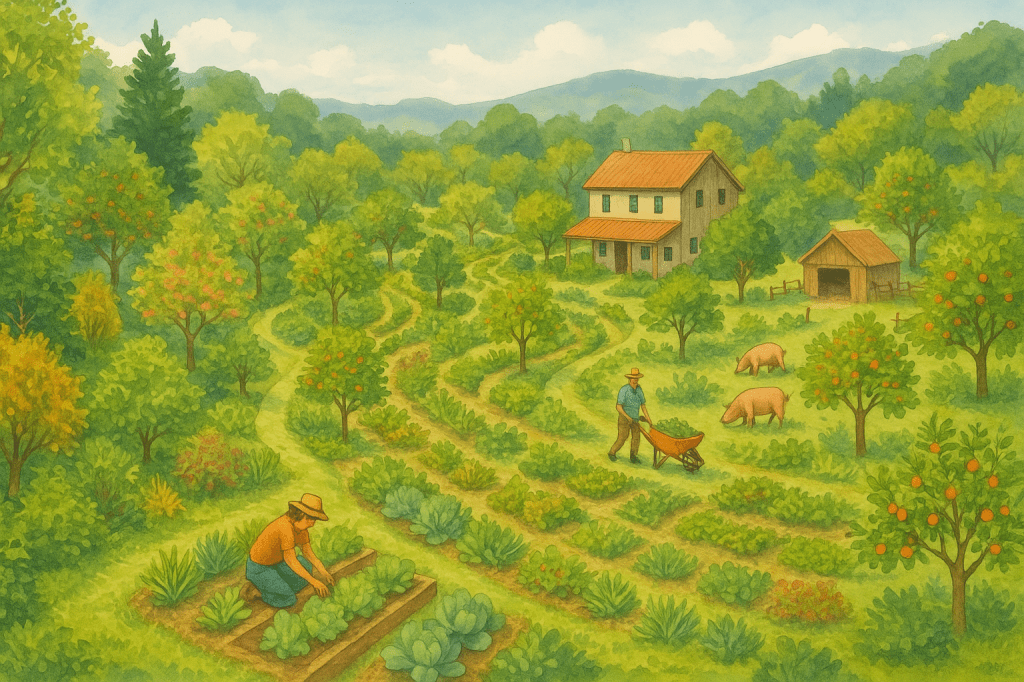
Beyond the forest, the remaining four acres of the property form a living laboratory for regenerative land use, guided by the principles of permacultureand agroforestry.

Here, perennial fruit and vegetable beds are woven through flowering hedgerows and small windbreaks of nut and berry trees. Apple, plum, and pear trees grow beside hardy perennial crops like rhubarb, asparagus, and sun chokes. Herbs spiral outward in patterns that mimic natural ecosystems, encouraging pollinators and providing continuous yield with minimal intervention.

This is no ordinary garden, it’s a climate-positive food forest in the making. Carefully designed guilds of plants mimic the structure of natural woodland ecologies. Deep-rooted plants draw nutrients from the subsoil. Groundcovers protect against erosion. Legumes fix nitrogen. Every element supports another. Even fallen branches and leaf mulch are repurposed into hugelkultur mounds, which retain water and build soil carbon over time.

Together, the forest and farm create a system that captures carbon, regenerates soil, and produces food, not in spite of nature, but in deep collaboration with it.

A Local Action With Global Implications
Climate action often feels like something that happens elsewhere, in government chambers, UN conferences, or corporate boardrooms. But on this hobby farm, the frontlines are right here, in bark and branches, under loamy soil and perennial cover. While politicians debate net-zero goals and global emissions caps, these 15 acres are already doing their part.

And the story doesn’t end with sequestration. The whole property becomes a model, not of scale, but of intentionality. It proves that one person, on one piece of land, can be part of the solution.

A Blueprint for the Future
If every small landowner in Ontario set aside just part of their land for forest preservation, regenerative farming, or agroecological food production, the collective carbon sink would grow exponentially. The 49.5 tonnes of CO₂ absorbed here could be multiplied by thousands of similar efforts. This hobby farm is not just saving the world, it’s showing others how to do it too.

So next time someone says the climate crisis is too big for individuals to affect, point them to this patch of trees and garden beds outside Ottawa. Tell them about the forest that quietly pulls nearly 50 tonnes of CO₂ from the sky every year. Tell them about the permaculture orchard that feeds people and soil alike. Tell them about the hobby farm that’s making a difference.

Because real change doesn’t always look like a protest march or a giant wind turbine. Sometimes, it looks like a sapling taking root in Zone 5, and being given the time and space to grow.

Sowing Wild: Embracing Chaos Gardening in a Canadian Raised Bed

This spring, I’m trying something new, or perhaps, it’s something very old. I’m giving two of my 3’ x 8’ raised beds over to chaos. Not to neglect, but to intelligent disorder, a conscious step away from the regimented rows and into the wild wisdom of nature.

I’ve spent years designing gardens around principles of companion planting, guilds, crop rotation, and soil stewardship. These tools work, no doubt, but nature doesn’t plant in rows. She scatters. She layers. She invites diversity, and lets the strongest, most adaptive life flourish. And so, inspired by that, I’m preparing a chaos garden.

Here’s the plan: I’ve gathered a mixed jar of seed: vegetables, herbs, flowers, and a few rogue wild edibles that I’ve saved or collected over the years. Into it go radish, arugula, calendula, dill, kale, turnip, nasturtium, peas, and fennel. Some mustard for early leaves, some poppy for beauty, some chard for colour. Even a few tomato and squash seeds, just to see who wins the race.

I’ll loosen the soil, adding compost and manure, broadcast the mix by hand, rake it in gently, and water deeply. No rows. No labels. Just biodiversity in motion.

This kind of growing goes by many names: scatter plantingchaos gardening, even seed bombing when done guerrilla-style, but under the surface, it shares DNA with deeper systems thinking. It’s a living expression of polyculture, multiple species growing together in dynamic balance. It echoes permaculture’s ethic of cooperation with natural systems, and it sets the stage for self-seeding gardens, where plants aren’t just harvested, they’re invited to return.

Why do this?

First, because diversity builds resilience. Different plants fill different niches. Deep roots break soil; shallow roots hold moisture. Nitrogen fixers support leafy greens. Leafy greens shade the soil. Flowering herbs call in predators that keep pests in check.

Second, because it discourages monoculture pests and weeds. If you can’t find a pattern, neither can the cabbage moth.

Third, because it invites observation. I don’t know what will thrive, but I know I’ll learn something from what does.

And finally, because it’s joyful. There’s a delight in surprise, in watching an ecosystem unfold in real time, unbound by our expectations.

I won’t intervene much. I’ll harvest what’s ready, let the rest go to seed, and see what returns next year. My role is less conductor, more steward. Less controller, more curious partner.

I still have my perennial fruit and vegetables scattered across the hobby farm using permaculture layers, so I won’t be going hungry if the chaos fails to produce. 

In a world obsessed with order and output, these little beds will be a place of play, experimentation, and ecological trust. A microcosm of what happens when we let go, just a bit, and let the land speak back.

If you’re curious about trying this yourself, start small. Choose a bed or even a large container. Use what you have, and most of all, resist the urge to overthink it. Nature knows what to do.

This is the season I choose to sow chaos. I suspect it will be the most ordered thing I grow.

Here’s a curated list of vegetable, herb, and edible flower seeds well-suited for chaos planting in Canadian Hardiness Zone 5. These plants are generally fast-growing, cold-tolerant, or self-seeding—and they don’t mind a little competition.

Leafy Greens (Cut-and-Come-Again, Fast Growers)
These thrive in early spring/fall and often reseed:
Arugula – spicy, fast to mature, great for pollinators when it flowers
Lettuce (mixed looseleaf varieties) – tolerates partial shade, quick to sprout
Mustard Greens – bold flavor, early spring/fall performer
Tatsoi – cold-hardy Asian green, forms a rosette
Mizuna – feathery leaves, handles crowding well
Spinach – plant early; loves cool weather

Root Crops
These do surprisingly well when thinned during harvest:
Radish – very fast, natural “row marker” and soil loosener
Carrots – mix different colours/sizes for variety
Turnip – dual-purpose (roots + greens)
Beets – harvest baby greens or mature roots
Rutabaga – slower to mature, tolerates cooler temps

Legumes (Nitrogen Fixers)
Support other plants and create vertical interest:
Peas (sugar snap or shelling) – sow early, great for trellises or natural climbing
Fava Beans – cold-tolerant and nitrogen-rich
Bush Beans – not too tall, easy to scatter

Cabbage Family (Brassicas)
Pest-prone in rows, but thrive in mixed beds:
Kale – resilient, frost-tolerant, often overwinters or self-seeds
Pak Choi – fast-maturing and shade-tolerant
Broccoli Raab – leafy with small florets, matures quickly
Mustard – doubles as a trap crop for flea beetles

Herbs (Pollinator Magnets & Companion Plants)
They support insect diversity and natural pest control:
Dill – attracts ladybugs and beneficial wasps
Cilantro – bolts quickly, great for early pollinators
Parsley – slower growing, useful kitchen herb
Chervil – good for shade and cool conditions

Edible Flowers (Beauty + Function)
These help deter pests and support pollinators:
Calendula – self-seeds easily, blooms early and long
Nasturtiums – edible leaves and flowers, acts as aphid trap crop
Borage – self-seeds readily, attracts bees
Violas – small, edible blooms for salads

Others for Experimentation
A few crops that might surprise you:
Swiss Chard – colourful, resilient, good for succession
Zucchini or Pattypan Squash – use only a few seeds; they get large
Cherry Tomatoes – some may thrive if your season is long enough
Onions (green onions from seed) – slow, but good in dense plantings

Tips for Success in Zone 5 Chaos Planting
Sow early in spring (as soon as the soil is workable)
• Choose cold-hardy or short-season varieties (mature in 50–70 days)
Water evenly after sowing, then mulch lightly to retain moisture
• Harvest regularly and thin as needed, using what’s edible

The Library in My Mind: How I Built a Memory Palace

Back in the late ‘80s, while waiting for my security clearance, the UK government put me through a variety of training courses – everything from project management and information technology to people skills. One of the more intriguing courses focused on building a library-style memory palace, a way to organize and recall information by mentally structuring it like a library. The idea of turning my mind into a well-ordered archive fascinated me – each piece of knowledge neatly stored and easily retrievable.

This technique has deep historical roots. It’s often traced back to Simonides of Ceos, a Greek poet from the 5th century BCE. According to legend, Simonides was called outside during a banquet, and while he was away, the building collapsed, killing everyone inside. The bodies were unrecognizable, but he realized he could recall exactly where each guest had been seated. This discovery led to the idea that spatial memory could be used as a structured recall system. The method was later refined by Roman orators like Cicero, who mentally placed key points of their speeches within familiar spaces and retrieved them by “walking” through those locations in their minds. Monks and scholars in the Middle Ages adapted the technique for memorizing religious texts and legal codes, and today, it’s still widely used – by memory champions, actors, lawyers, and even fictional detectives like Sherlock Holmes.

Inspired by this, I built my own mental library. I imagined a grand study—towering bookshelves, stained-glass windows, and a long oak table at the center. To stay organized, I divided it into sections: science, history, philosophy, personal experiences, and creative ideas. Each book represented a concept, placed where I could easily “find” it when needed.

At first, it felt awkward, like navigating an unfamiliar house. To train myself, I spent a few minutes each day mentally walking through the space, reinforcing connections. I used vivid imagery – a glowing tome for quantum physics, a worn parchment for ancient history. Storytelling also helped. I imagined Einstein seated in the physics section, Shakespeare near literature, and a wise, hooded monk in philosophy. When I struggled to recall something, I’d “ask” them, making the process more interactive.

Before long, the system became second nature. When writing, I could mentally browse my research shelves without flipping through endless notes. Before discussions, I’d “walk” through key sections to refresh my memory. Even decision-making improved – I’d place pros and cons in different areas and “see” them from multiple perspectives before making a choice.

The best part? My library keeps evolving. I add new shelves, reorganize sections, and revise old knowledge as I learn. It’s a living system, shaping the way I think and process information.

This isn’t a technique reserved for scholars or memory champions. Anyone can build a mental library, whether for learning, storytelling, or just keeping thoughts in order. With a little practice, it becomes second nature – a space you can visit anytime, where knowledge is always at your fingertips.

The Often Hidden, and Misunderstood Dominant/submissive Dynamic in Human Relationships

At the core of every human interaction lies a subtle dance of power and vulnerability – a dynamic of dominance and submission. This concept, while often misunderstood or dismissed, is deeply embedded in the way we connect with one another, influencing everything from romantic relationships to professional interactions and even friendships. It’s not always about control or acquiescence in the traditional sense, but about the ebb and flow of influence, support, and leadership.

The Universal Nature of Power Dynamics
Power dynamics exist on a spectrum, manifesting in ways both explicit and implicit. In romantic partnerships, for instance, one partner might naturally take the lead in decision-making or planning, while the other might shine in nurturing emotional intimacy. Neither role is inherently superior – both are essential to a healthy balance. This interplay isn’t about domination in a harsh sense; it’s about trust. Submission, in this context, is a choice to yield or follow, often driven by respect for the other’s strengths.

Even in friendships, these dynamics are present. Think about your closest friends: Is there someone who often initiates plans or provides guidance when you’re struggling? Conversely, is there someone who seeks comfort or advice from you? These roles might shift over time or depend on the situation, but the dynamic persists.

Why Dominance and Submission Are Not Always About Control
Dominance often carries a negative connotation, evoking images of manipulation or authoritarian behavior. But in healthy dynamics, dominance is less about control and more about leadership, confidence, or decisiveness. Similarly, submission isn’t about weakness—it’s about trust, vulnerability, and the willingness to let someone else take the reins when appropriate.

Consider a workplace setting. A manager might take on the dominant role by providing direction, while employees adopt a submissive role by following that direction to achieve shared goals. However, a good manager also knows when to step back and listen, showing that dominance and submission are situational and reciprocal.

The Fluidity of These Roles
The most successful relationships – romantic, platonic, or professional – are those where dominance and submission flow naturally and aren’t rigidly fixed. A romantic partner who typically leads financially might lean on their counterpart for emotional stability. A friend who usually gives advice might need a shoulder to cry on. Recognizing this fluidity allows for deeper, more authentic connections because each person feels valued for their unique contributions.

The Pitfalls of Imbalance
Problems arise when one person perpetually dominates or perpetually submits, leaving no room for reciprocity. An overly dominant person may come across as controlling or dismissive, while an overly submissive person may lose their sense of self or feel unfulfilled. Healthy dynamics require mutual respect, clear communication, and a willingness to adapt to each other’s needs.

Embracing the Dynamic
Recognizing the Dominance/submission dynamic in your relationships doesn’t mean you need to label or overanalyze every interaction. Instead, it’s an opportunity to better understand yourself and the people around you. Who tends to take charge, and in what situations? When do you feel most comfortable leading, and when do you find strength in stepping back?

Ultimately, this dynamic is not about power for its own sake – it’s about balance. Every human connection thrives on give-and-take, on moments of leadership and surrender. Embracing this truth can help you build deeper, more meaningful relationships grounded in trust, respect, and mutual support.

In what areas of your life do you see this dynamic at play?

He Said, She Said: The Perks of Dating Across Generations

He Says: Dating an independent younger mother is like finding a partner with superhero qualities. She’s resilient, focused, and masterful at managing her time; better than most CEOs. She doesn’t need rescuing; she’s already fought her battles and won. What she values is a partner who brings wisdom, stability, and a calm presence in her whirlwind of responsibilities. For an older guy like me, it’s refreshing. There’s no pretense, no unnecessary drama, just an authentic, meaningful connection, built on mutual respect.

And let’s talk about her energy! It’s magnetic, a constant reminder that life is vibrant and full of possibilities. She keeps me engaged, challenges me to stay present, and proves that growing older doesn’t mean slowing down. More than that, she’s aligned with my thinking about the beauty of balance; how to be both independent and deeply connected.

She Says: Dating an older gentleman is like stepping into an oasis of calm after the daily chaos of parenting. He’s emotionally grounded, self-assured, and, best of all, done with playing games. My time is my most valuable asset, and I need someone who respects my schedule, understands my priorities, and supports me without trying to control or fix things. Older men get that.

What I love about him is his ability to listen, his steady presence. I’ve spent so much time managing crises and doing everything myself that it’s a relief to be with someone who can just be there without adding pressure. He doesn’t expect perfection, he values honesty and effort, and there’s something deeply reassuring about being with someone who knows who they are, what they want, and how to be a real partner.

He Says: Stability? Sure, but let’s talk about the fact that I’m learning just as much from her. Her independence is inspiring, it pushes me to be more adaptable, more open to change. And that vitality? It’s contagious. I may have a few gray hairs, but that doesn’t mean I’m set in my ways. If anything, her passion and determination remind me that life is about movement, growth, and embracing new experiences.

What makes this work is that we’re not trying to force anything. We don’t have to be everything to each other, but we show up when it counts. When life throws us curveballs, we face them together; no drama, no games. It’s a partnership built on respect, not expectations.

She Says: And let’s not forget patience. Older men have a way of slowing things down in the best possible way. In a world that’s constantly demanding more, that kind of presence is priceless. I used to worry about how a relationship might affect my kids, but with him, it’s just… easy. He’s patient with them, but he also knows when to step back and give me space to handle things. He respects the boundaries I’ve set as a parent, but he’s always there when I need him.

And the way he makes time for me, just us, no distractions, reminds me of how important it is to nurture the connection we’ve built. There’s an ease to being with him that I didn’t know I was looking for, and now that I’ve found it, I can’t imagine going back to anything less.

He Says: And that’s what makes it work, isn’t it? We’re not playing by anyone else’s rules. We’re just two people figuring it out together, supporting each other, growing together, and sharing a real connection. Her kids, her responsibilities, they’re part of the package, but they’re never a barrier. I’m not here to replace anyone or change anything; I’m here to be part of her life, to add something positive. And honestly, it’s one of the most rewarding things I’ve ever done.