Posts exploring astronomy, climate technology, AI, and the frontiers of knowledge. These reflections mix scientific wonder with practical foresight, keeping one eye on the stars and the other on how innovation can shape our daily lives.
Historic trilateral negotiations involving Ukraine, Russia, and the United States opened in Abu Dhabi, marking the first such talks since the 2022 full-scale invasion. Discussions focused on humanitarian access, territorial questions, and confidence-building measures amid continued fighting.
2️⃣ 🔬 Fusion Energy Edges Closer to Reality
Scientists reported major advances in fusion research, with tokamak projects such as ITER, EAST, and KSTAR achieving improved plasma stability and sustained reaction times. The progress has renewed optimism around fusion as a future source of clean, abundant energy.
3️⃣ 💼 Davos Signals: AI and Economic Resilience
At the World Economic Forum in Davos, IMF and ECB leaders emphasized the resilience of the global economy while warning that artificial intelligence could dramatically reshape labor markets. Calls focused on reskilling, regulation, and renewed multilateral cooperation.
4️⃣ 📡 Space & Science Momentum
NASA advanced preparations for the Artemis II crewed lunar flyby mission, while astronomers reported new findings on interstellar chemistry and planetary formation. Together, these developments highlight accelerating momentum in space science and exploration.
5️⃣ 📚 Innovation & Higher Education Shifts
Canada’s AI ecosystem saw a significant boost as research institute Mila partnered with Inovia Capital to launch a $100 million Venture Scientist Fund, aimed at bridging academic research and startup development. Universities also expanded sustainability and climate research hubs.
📌 Notable Context From the Week
🌍 Nordic countries increased diplomatic and security coordination around Greenland amid rising geopolitical tensions.
🧪 Scientists reported breakthroughs in quantum materials, solar physics, and potential habitability indicators on Europa.
🌦️ Severe weather and infrastructure challenges continued to affect regions of South Asia and North America.
This is the 500th post on Rowanwood Chronicles, and I want to pause for a moment rather than rush past the number.
Five hundred posts means months of thinking in public. It means essays written early in the morning with coffee going cold, notes drafted in train stations and kitchens, arguments refined and re-refined, and ideas that only became clear because I was willing to write them out imperfectly first. It means following threads of geopolitics, technology, culture, relationships, power, science fiction, and lived experience wherever they led, even when they led somewhere uncomfortable or unfashionable.
This blog was never intended to be a brand or a platform. It has always been a workshop. A place to test ideas, to connect dots, to push back against lazy thinking, and to explore what it means to live ethically and deliberately in a complicated world. Some posts have aged well. Others mark exactly where my thinking was at the time, and I am content to leave them there as signposts rather than monuments.
What has surprised me most over these five hundred posts is not how much I have written, but how much I have learned from the responses, private messages, disagreements, and quiet readers who later surfaced to say, “That piece helped me name something.” Writing in public creates a strange kind of community, one built less on agreement than on shared curiosity.
To those who have been reading since the early days, thank you for staying. To those who arrived last week, welcome. To those who argue with me in good faith, you have sharpened my thinking more than you know. And to those who read quietly without ever commenting, you are still part of this.
I have no intention of slowing down. There are still too many systems to interrogate, futures to imagine, and human stories worth telling. Five hundred posts in, Rowanwood Chronicles remains what it has always been: a place to think carefully, write honestly, and refuse simple answers.
The first full week of 2026 made it clear that the world did not ease into the new year quietly. From geopolitics and protest movements to shared moments of wonder in the night sky, this past week offered reminders of how quickly events continue to unfold across multiple fronts.
🇻🇪✈️ The United States Captured Venezuela’s President in a Shock Operation
On January 3, U.S. military forces carried out a rapid operation in Venezuela that resulted in the capture of President Nicolás Maduro and his wife. Reports indicate they were transported to the United States to face longstanding charges, immediately triggering international legal and diplomatic debate.
Why it matters: This unprecedented move fundamentally alters regional geopolitics and raises serious questions about sovereignty, international law, and escalation in the Western Hemisphere.
📣✊ Iran Cut Internet Access as Protests Expanded Nationwide
By January 9, Iranian authorities had imposed widespread internet restrictions as protests against economic conditions and political repression spread across multiple cities. The shutdowns accompanied an intensified security response.
Why it matters: Internet blackouts remain a defining tool of modern authoritarian control, highlighting the growing tension between digital connectivity, civil resistance, and state power.
🌕🔭 A Brilliant Wolf Supermoon Lit Up Early January Skies
On the nights of January 3 and 4, skywatchers around the world were treated to a striking Wolf Supermoon, appearing larger and brighter due to its close proximity to Earth.
Why it matters: Shared celestial events offer rare moments of collective experience, reminding us that some rhythms still transcend borders, politics, and conflict.
🎯🏆 Luke Littler Retained His World Darts Championship Title
The 2026 PDC World Darts Championship concluded on January 3, with Luke Littler successfully defending his title in a dramatic final that drew significant global viewership.
Why it matters: The growing popularity of international niche sports reflects shifting entertainment landscapes and the rise of new global sporting figures.
🕊️🌍 The United Nations Advanced Quiet Peacebuilding Efforts
Throughout the week of January 3 to 9, the UN Department of Political and Peacebuilding Affairs reported continued diplomatic engagements focused on de-escalation and dialogue in regions including the Middle East and Yemen.
Why it matters: While rarely headline-grabbing, sustained diplomacy remains essential to preventing conflict escalation and creating space for long-term stability.
Closing thoughts: This week’s five stories remind us that history does not pause for calendars. Power shifts, public resistance, human achievement, and cosmic wonder all unfolded simultaneously, shaping the opening chapter of 2026 in ways both dramatic and subtle.
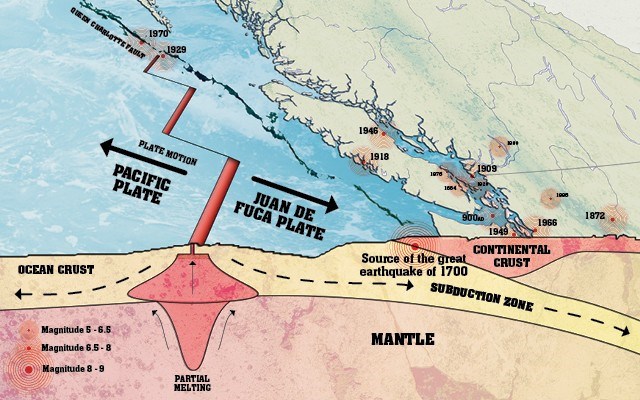
On Canada’s west coast, the phrase “the Big One” has drifted too easily into metaphor. It is used casually, invoked vaguely, and then set aside as a distant abstraction. The most recent British Columbia Disaster and Climate Risk and Resilience Assessment strips that comfort away. What it describes is not speculative catastrophe but a rigorously modelled scenario grounded in geology, history, and infrastructure analysis. A magnitude 9.0 megathrust earthquake off Vancouver Island is not only possible; it is among the more likely high-impact earthquake scenarios facing the province.
The source of the risk is the Cascadia Subduction Zone, where the Juan de Fuca Plate is slowly, but inexorably being driven beneath the North American Plate. This is not a fault that slips frequently and harmlessly. It locks, accumulates strain over centuries, and then fails catastrophically. The last full rupture occurred in January 1700, an event reconstructed through coastal subsidence records in North America and tsunami documentation preserved in Japanese archives. Geological evidence indicates that such megathrust earthquakes recur on timescales of hundreds, not thousands, of years. In emergency management terms, this places Cascadia squarely within the planning horizon.
The provincial assessment models a magnitude 9.0 earthquake occurring offshore of Vancouver Island. The projected consequences are stark. Approximately 3,400 fatalities and more than 10,000 injuries are expected. Economic losses are estimated at 128 billion dollars, driven by the destruction of roughly 18,000 buildings and severe damage to at least 10,000 more. These figures do not rely on worst-case fantasy. They emerge from known building inventories, population distribution, soil conditions, and transportation dependencies. They reflect what happens when prolonged, intense shaking intersects with modern urban density.
Geography shapes the damage unevenly, but decisively. Vancouver Island bears the brunt, particularly along its western coastline, where proximity to the rupture zone amplifies shaking and tsunami exposure. Eastern Vancouver Island, including Victoria, remains highly vulnerable due to soil conditions and aging infrastructure. On the mainland, a narrow, but densely populated band stretching from the United States border through Metro Vancouver to the Sunshine Coast experiences significant impacts, especially in areas built on deltaic and reclaimed land. Liquefaction in these zones undermines foundations, buckles roadways, and fractures buried utilities, compounding the initial damage long after the shaking stops.
The earthquake does not arrive alone. A tsunami follows as an inseparable companion hazard. The assessment projects wave arrival on the west coast of Vancouver Island within 10 to 20 minutes, leaving little time for anything other than immediate self-evacuation. The east coast of Vancouver Island and the Lower Mainland face longer lead times, roughly 30 to 60 minutes, but also greater population exposure. In parallel, major aftershocks, widespread landslides, fires ignited by damaged gas and electrical systems, and flooding from compromised dikes and water infrastructure unfold across days and weeks.
Probability is often misunderstood in public discussion, oscillating between complacency and panic. The assessment estimates a 2 to 10 per cent chance of such an extreme event occurring within the next 30 years. That range may sound small, but emergency management does not measure risk by likelihood alone. It multiplies likelihood by consequence. A low-frequency, ultra-high-impact event demands attention precisely because recovery, once required, will dominate public policy, fiscal capacity, and social stability for decades.
Comparative modelling reinforces this conclusion. United States federal planning scenarios for Cascadia earthquakes project casualty figures in the tens of thousands when the full Pacific Northwest is considered. Insurance industry analyses warn that a major Cascadia rupture would strain or overwhelm existing insurance and reinsurance systems, prolonging recovery and shifting costs to governments and individuals. These are not contradictions of the British Columbia assessment but confirmations of its scale.
What emerges from this body of evidence is not a call for fear, but for seriousness. Preparedness for Cascadia is not primarily about individual survival kits, though those matter. It is about seismic retrofitting of critical infrastructure, realistic tsunami evacuation planning, protection of water and fuel lifelines, and governance systems capable of functioning under extreme disruption. It is also about public literacy: understanding that strong shaking may last several minutes, that evacuation must be immediate and on foot, and that official assistance will not be instantaneous.
The Big One is not an unknowable threat lurking beyond prediction. It is a known risk with defined parameters, measurable probabilities, and foreseeable consequences. The only variable that remains open is how well institutions and communities choose to prepare. History shows that Cascadia will rupture again. Policy choices made before that moment will determine whether the event becomes a national trauma measured in generations, or a severe but survivable test of resilience.
Sources: British Columbia Ministry of Emergency Management and Climate Readiness. Disaster and Climate Risk and Resilience Assessment, October 2025, Chapter 5 Earthquake Scenarios. Province of British Columbia. Yahoo News Canada. “B.C. report warns magnitude 9.0 quake could kill thousands.” 2025. Geological Survey of Canada. Earthquakes and the Cascadia Subduction Zone. Natural Resources Canada. U.S. Federal Emergency Management Agency. Cascadia Subduction Zone Earthquake and Tsunami Planning Scenarios. Wikipedia. “Cascadia Subduction Zone” and “1700 Cascadia Earthquake.”
Each week, we step back from the noise and look at five developments that actually tell us something about where the world is heading. This past week brought a mix of policy shifts, environmental tension, geopolitical maneuvering, regional sport, and a reminder that the universe is still very much larger than our daily concerns.
🇺🇸 1. U.S. launches pilot programs to cut Medicare drug costs
On December 19, the U.S. Centers for Medicare and Medicaid Services announced two new pilot programs aimed at lowering prescription drug costs for Medicare recipients. The initiatives, known as GLOBE and GUARD, will benchmark U.S. drug prices against those paid in comparable countries, with implementation planned for 2026.
Why it matters: This represents one of the most concrete efforts yet to confront runaway pharmaceutical pricing in the United States, with direct implications for millions of seniors and for how health care costs are managed in aging societies.
🌲 2. European Union delays landmark anti-deforestation law
EU member states agreed this week to delay implementation of the bloc’s anti-deforestation regulation by one year. The law targets imports linked to forest loss, including cocoa, palm oil, soy, and beef, and is intended to reduce Europe’s global deforestation footprint.
Why it matters: The delay highlights the tension between environmental ambition and economic pressure, raising concerns that climate and biodiversity commitments are still vulnerable to political hesitation.
💥 3. EU approves indefinite freeze on Russian state assets
European governments approved an indefinite extension of the freeze on Russian central bank assets held within the EU. This decision clears the way for expanded financial support to Ukraine, including the use of interest generated from frozen assets.
Why it matters: This move strengthens Ukraine’s financial position while signaling that economic sanctions against Russia are becoming more entrenched and structurally permanent.
🏆 4. Southeast Asian Games continue amid political tension
The 2025 Southeast Asian Games continued this week in Thailand, with thousands of athletes competing across dozens of events. Cambodia withdrew from the Games amid political disputes, but the competition has remained a focal point of regional sporting life.
Why it matters: Regional sports events often reveal as much about diplomacy and politics as they do about athletics, especially in parts of the world where sport plays a key role in national identity.
🪐 5. Interstellar comet makes rare close pass by Earth
Astronomers observed interstellar comet 3I/ATLAS as it made its closest approach to Earth on December 19. It is only the third confirmed interstellar object ever detected passing through our solar system.
Why it matters: Objects like 3I/ATLAS offer rare scientific opportunities to study material formed around other stars, expanding our understanding of how planetary systems evolve across the galaxy.
Closing thought: From the politics of medicine and forests to the frozen assets of war and visitors from beyond our solar system, this week reminded us that scale matters. Some decisions ripple through households, others reshape global alliances, and a few quietly remind us that we are part of something far larger than ourselves.
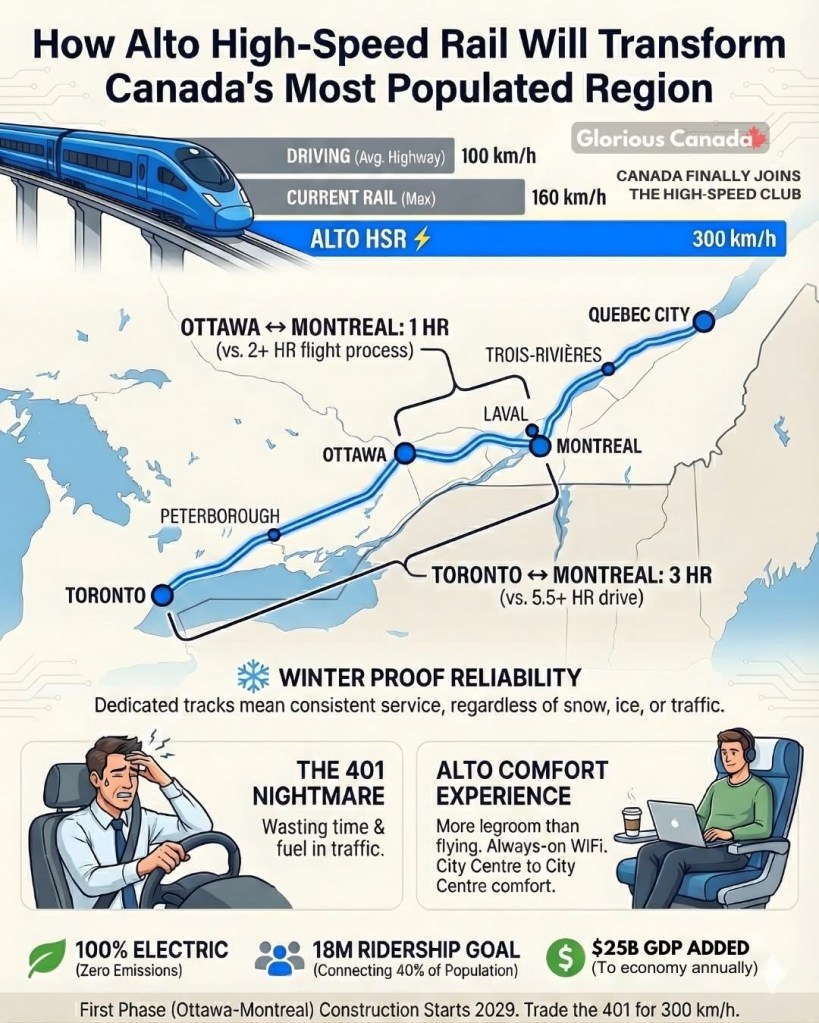
For years, Canada’s ambitious dream of linking its greatest cities with true high-speed rail has hovered in the realm of feasibility studies and future pipe dreams. Now, in the closing weeks of 2025, that dream has shifted decidedly toward reality; not because steel is yet being laid, but because the Alto high-speed rail initiative has crossed a crucial threshold from concept to concerted preparation and public engagement.
At its core, Alto is a transformative infrastructure vision: a 1,000-kilometre electrified passenger rail network connecting Toronto to Québec City with trains capable of 300 km/h speeds, slicing travel times compared to what today’s intercity rail offers and binding half the nation’s population into a single, rapid mobility corridor. The design phase, backed by a multi-billion-dollar co-development agreement with the Cadence consortium, is well underway, and the federal government has signaled its intent to see this project delivered as one of the largest infrastructure investments in decades.
The most noteworthy milestone in recent weeks has been a strategic decision about where Alto will begin to take physical shape. On December 12, officials announced that the Ottawa–Montreal segment – roughly 200 km – will be the first portion of the network to advance toward construction, with work slated to begin in 2029. This choice reflects a practical staging strategy: by starting with a shorter, clearly defined corridor that spans two provinces, engineering and construction teams can mobilize simultaneously in Ontario and Québec and begin delivering economic and skills-development benefits sooner rather than later.
This announcement isn’t just about geography; it marks a shift in Alto’s progression from broad planning to community-level engagement. Beginning in January 2026, Alto will launch a comprehensive three-month consultation process that includes open houses, virtual sessions, and online feedback opportunities for Canadians along the corridor. These sessions will inform critical decisions about alignment, station locations, and mitigation of environmental and community impacts. Indigenous communities, municipalities, and public institutions will be active participants in these discussions as part of Alto’s ongoing commitment to consultation and reconciliation, a recognition that this project’s success hinges not only on engineering prowess, but on thoughtful, inclusive planning.
Beyond route planning, Alto and Cadence are also turning to Canada’s industrial capacity, particularly the steel sector, to gauge the domestic supply chain’s readiness for what will undeniably be a massive procurement exercise. With thousands of kilometres of rail and related infrastructure components needed, early outreach to the steel industry is intended not just to assess production capacity, but to maximize Canadian content and economic benefit from the outset.
Yet not every question has a definitive answer. Strategic discussions continue over the optimal location for Alto’s eventual Toronto station, with the CEO publicly acknowledging that a direct connection to Union Station may not be guaranteed; a decision that could shape ridership patterns and integration with existing transit networks across the Greater Toronto Area.
As the calendar turns toward 2026, the Alto project sits at an inflection point: one foot firmly planted in detailed design and consultation, the other inching closer to the realm of shovels and steel rails. Political support appears robust, and fiscal planning, including major project acceleration initiatives and supportive legislation, has built momentum. Yet, as any transportation planner will tell you, the distance between planning and construction is long, often winding, and frequently subject to political, economic, and community pressures.
Still, for advocates and observers alike, the significance of the latest developments cannot be overstated. Alto has graduated from “what if?” to “when and how,” and that alone marks a major step forward in Canada’s transportation evolution.
There is a peculiar habit in Ottawa that reveals itself most clearly in defence procurement. It is the habit of mistaking alignment for dependence, cooperation for deference, and interoperability for inevitability. The proposed Canadian Forces space command and control project, now quietly priced somewhere between two hundred and four hundred million dollars, is a textbook example. What should be a sober discussion about Canadian sovereignty in the most strategic domain of the twenty-first century has instead become another case study in how deeply the senior civilian and uniformed leadership of the Department of National Defence has been captured by American assumptions, priorities, and frameworks.
The issue is not that Canada works closely with the United States in space. That is both unavoidable and desirable. The issue is that DND increasingly appears incapable of imagining a serious military capability that does not begin with the question, “How does the U.S. do this?” rather than, “What does Canada actually need?” When briefing notes openly frame U.S. assistance as a foundational requirement rather than an optional enhancement, the problem is no longer technical. It is cultural. Strategic thinking has been outsourced long before any contract is signed.
This is institutional capture, not conspiracy. It happens when careers are built inside allied command structures, when promotion rewards smooth interoperability rather than independent judgment, and when senior civilians absorb the same assumptions as the generals they are meant to challenge. Over time, the centre of gravity shifts. Canadian officers and officials begin to see American systems as the default, American timelines as the clock, and American doctrine as neutral truth rather than national preference. At that point, sovereignty is not surrendered dramatically. It simply fades into the background.
The space project exposes this drift with unusual clarity. Space command and control is not a niche capability. It sits at the intersection of intelligence, surveillance, targeting, Arctic defence, and escalation control. A system that cannot function independently in a crisis, even for a limited period, is not a sovereign capability. It is a terminal plugged into someone else’s infrastructure. Yet DND’s language suggests comfort with exactly that outcome, as though Canada’s role is to be a well-behaved node in an American-led network rather than a state with its own strategic thresholds and political constraints.
This is where the Carney government must act decisively, and quickly. Defence reform cannot be limited to budgets and white papers. The problem is not primarily money. It is leadership. Both the senior civilian ranks and the uniformed command structure at DND require a reset in incentives, expectations, and worldview. Canada needs defence leaders who are capable of working with the United States without being intellectually subordinate to it, who understand that alliance management is not the same thing as strategic abdication.
Strategic changes at the top of DND are therefore not punitive. They are corrective. The Carney government should be looking for leaders with demonstrated experience outside permanent U.S. frameworks, leaders who have worked in multilateral, civilian-led, or genuinely independent contexts. It should be asking hard questions about how often Canadian alternatives are even presented internally before U.S. options are adopted by default. And it should be willing to rotate out senior figures who have become too comfortable treating American preferences as Canadian interests.
None of this requires anti-Americanism. It requires maturity. The United States will continue to pursue its own interests in space, just as Canada must pursue ours. True allies respect that distinction. What they do not respect, and should not be encouraged to expect, is quiet compliance dressed up as partnership.
Space is not just another procurement file. If Canada cannot think clearly about sovereignty there, it will not think clearly about it anywhere. The danger is not that Canada will anger Washington. The danger is that Canada will stop mattering to itself. That is a failure no ally can fix for us, and no amount of interoperability will excuse.
Each week, we take a step back from the noise and look at five developments from around the world that stood out — across science, culture, sport, politics, and the natural world.
🌠 1. Geminid Meteor Shower Peaks with One of the Best Displays in Years
The annual Geminid meteor shower peaked this week, delivering bright, frequent meteors across much of the globe. Astronomers noted especially favorable viewing conditions, with the shower producing vivid fireballs caused by debris from asteroid 3200 Phaethon.
Why it matters: In a world often dominated by bad news, predictable and awe-inspiring celestial events remind us that some rhythms remain constant — and shared by everyone under the same sky.
🎮 2. The 2025 Streamer Awards Highlight the Scale of Live-Streaming Culture
Held on December 6, the 2025 Streamer Awards drew massive global audiences and celebrated creators shaping the modern entertainment landscape. Livestreaming continues to redefine celebrity, media economics, and community building — particularly among younger audiences.
Why it matters: What began as a niche subculture is now a dominant media force, influencing advertising, politics, and how people connect across borders.
🏆 3. Women’s World Floorball Championships Begin in the Czech Republic
The 15th Women’s World Floorball Championships kicked off this week, bringing together 16 national teams. The tournament highlights the rapid global growth of the sport and increasing investment in women’s international competition.
Why it matters: Expanding visibility for women’s sports strengthens international athletic ecosystems and reflects broader cultural shifts toward equity and representation.
🌍 4. Powerful Earthquake Strikes Northeastern Japan
A magnitude-7.6 earthquake struck off Japan’s Aomori coast on December 8, injuring dozens and prompting tsunami advisories and evacuations. Emergency services responded quickly, and authorities warned of ongoing aftershocks.
Why it matters: Japan’s preparedness limited loss of life, underscoring the importance of long-term investment in disaster readiness as seismic and climate risks persist worldwide.
🛂 5. Mediterranean Migration Continues as Boats Reach Malta
Dozens of migrants were brought ashore in Malta this week after dangerous crossings from North Africa. The arrivals highlight the ongoing humanitarian and political pressures shaping migration policy across the Mediterranean.
Why it matters: Migration remains one of the defining global challenges of our time, intersecting with climate change, conflict, and economic inequality.
Closing thoughts: This week’s stories span wonder and warning — from meteor-lit skies to seismic shocks, cultural change, and enduring humanitarian challenges. Together, they remind us that the world is vast, interconnected, and constantly in motion.
Five Things is a weekly Rowanwood Chronicles feature, tracking global developments from Saturday to Friday.
For years the commercial launch landscape has been dominated by a handful of highly visible spaceports in the United States, Europe, and increasingly East Asia. Yet in the background, Oman has been assembling something unusual: a purpose-built, strategically positioned gateway for small- and medium-lift access to orbit. The Etlaq Spaceport, located on Oman’s Al Wusta coast, represents a calculated national investment in the emerging multipolar space economy. Far from being a showpiece, Etlaq is designed as a workhorse facility for rapid, repeatable commercial launch operations in a region previously absent from the global map of operational spaceports.
Etlaq’s development traces back to Oman’s broader attempt to diversify its science and technology sectors. The country recognised early that the Middle East had both the geography and the climate to host a modern launch complex: plentiful open coastline, low population density in potential downrange zones, and political stability that makes long-term planning feasible. The resulting site incorporates modular pads, integrated payload processing halls, and clean transport corridors between facilities to simplify vehicle flow. Unlike older spaceports retrofitted over decades, Etlaq was engineered from its inception around commercial cadence expectations. Operators can move a vehicle through processing, integration, and fueling with minimal pad occupancy time, aligning the port with the market’s shift toward higher launch frequencies.
A major strategic turning point came with the introduction of Oman’s October 2025 regulatory framework, CAD5-01, which modernised licensing, insurance, and environmental requirements for launch providers. While the update appeared technical to the public, it was transformative behind the scenes. CAD5-01 offers a predictable, internationally aligned pathway for operators to certify their missions, mirroring best practices from the United States and Europe while preserving Oman’s flexibility to respond rapidly to commercial timelines. This regulatory clarity is exactly what new space companies look for when selecting a launch site. Combined with Etlaq’s equatorial advantage, CAD5-01 signaled that Oman intends to compete seriously for global launch contracts, not merely serve regional demand.
Etlaq’s ambitions are further reinforced by Oman’s participation in the Global Spaceport Alliance. The Alliance has become the connective tissue of the commercial launch industry, ensuring that spaceports around the world share interoperable standards, safety philosophies, and operational frameworks. For a facility as young as Etlaq, this membership is more than symbolic. It links Oman into a network of regulators, insurers, launch operators, and policy specialists who collectively define the expectations of 21st-century spaceport operations. The effect is twofold: Etlaq gains credibility with international clients and accelerates its own organisational maturity by aligning with procedures used at more established ports. Rather than growing in isolation, it develops in dialogue with the global industry.
What distinguishes Etlaq, however, is not only its integration but its strategic forward posture. As the global launch market becomes increasingly congested, companies are searching for sites that offer reliability, proximity to equatorial orbits, and streamlined regulatory cycles. Oman’s location provides relatively clear trajectories for low-inclination missions while avoiding many of the flight-path restrictions faced by older spaceports. This matters for an industry where minor delays cascade into major scheduling and insurance consequences. Etlaq’s designers have built the facility with the expectation of rapidly expanding demand, planning for additional pads, dedicated line-of-sight telemetry corridors, and expanded infrastructure to support higher-frequency operations.
Taken together, Etlaq is positioning itself as a pragmatic, globally integrated commercial launch node. It benefits from modern regulatory architecture, membership in a coordinating international alliance, and a geographic setting that offers advantages too often overlooked in the Middle East. Oman is not attempting to dominate the launch sector but to host a dependable, commercially attractive platform for the next generation of small-satellite missions, Earth-observation constellations, and responsive launch services.
In an era where the world needs more launch capacity, not less, Etlaq stands out as a quietly strategic entrant. It is the kind of spaceport built not for headlines but for sustained operational relevance, and that may prove more valuable in the long run.
A reflective essay by the fellow who somehow decided that blogging about politics, climate, gender, and quantum mechanics was a relaxing hobby
I did not set out to become a blogger. No one does. Blogging is something that happens to you when you’ve said “someone should really write about this” one too many times and then realize the someone is you. That was my first year of The Rowanwood Chronicles. A steady accumulation of small irritations, large curiosities, and the occasional planetary existential dread finally pressuring me into a keyboard.
Over the past twelve months I have written about food systems, seismic faults, mononormativity, AI governance, and the demise of centralized social media platforms. This is, I admit, not a tidy list. Most writers pick a lane. I picked several highways, a few dirt roads, and one unmarked trail that led straight into a thicket of gender theory. Some readers have thanked me. Others have quietly backed away like I had started talking about cryptocurrency at a family barbecue. Fair enough.
The funny thing about running a blog with the byline “Conversations That Might Just Matter” is that you end up feeling mildly responsible for the state of the world. Somewhere in the back of my mind I became convinced that if I took one week off, climate policy would collapse, privacy laws would be gutted by corporate lawyers, and Canada would discover a massive geological fault running directly under my house. It is exhausting being the only person preventing civilization from tipping off its axis, but I have bravely carried on.
Along the way, I learned a few things.
First, people really do want long-form writing. They want context. They want to know why their health system is groaning like a Victorian heroine on a staircase. They want someone to explain decentralized social media without sounding like a blockchain evangelist who drinks only powdered mushroom tea. They want nuance rendered in plain language. I can do that. Sometimes even coherently.
Second, writing about politics is like trying to pet a squirrel. You can do it, but you have to keep your hands calm, your movements measured, and be prepared for the possibility that something small and unpredictable will bite you. Every time I published a political piece, I felt like I was tiptoeing across a frozen lake holding a hot cup of tea. Most of the time it held. Some days it cracked.
Third, the world is endlessly, maddeningly fascinating. One moment I was researching drought-related crop instability in the Global South. The next, I was reading government reports about flood plain management. Then I found myself knee-deep in a rabbit hole about the Tintina Fault, which sits there in the Yukon like an unbothered geological time bomb politely waiting its turn. Writing the blog became my excuse to satisfy every curiosity I have ever had. It turns out I have many.
What surprised me most was what readers responded to. Not the posts where I worked terribly hard to sound authoritative. Not the deeply researched pieces where I combed through reports like a librarian possessed. No. What people loved most were the pieces where I sounded like myself. Slightly bemused. Occasionally outraged. Often caffeinated. Always trying to understand the world without pretending to have mastered it.
That was the gift of the year. The realization that a blog does not need to be grand to be meaningful. It simply needs to be honest. Steady. And maybe a little mischievous.
I will admit that I sometimes wondered whether writing about governance, equity, and science from my small corner of Canada made any difference at all. But each time someone wrote to say a post clarified something for them, or started a discussion in their household, or helped them feel less alone in their confusion about the world, I remembered why I started.
I began The Rowanwood Chronicles because I wanted to understand things. I kept writing because I realized other people wanted to understand them too.
So here I am, a year older, slightly better informed, and armed with a list of future topics that spans everything from biodiversity corridors to the psychology of certainty. The world is complicated. My curiosity is incurable. And The Rowanwood Chronicles is still the place where I try to make sense of it all.
If nothing else, this year taught me that even in a noisy world full of predictions and outrage, there is room for thoughtful conversation. There is room for humour. There is room for stubborn optimism. And there is definitely room for one more cup of tea before I press publish.





 The Rowanwood Chronicles