Posts exploring astronomy, climate technology, AI, and the frontiers of knowledge. These reflections mix scientific wonder with practical foresight, keeping one eye on the stars and the other on how innovation can shape our daily lives.
The feedback I have been getting is that readers have been enjoying my serialised essays exploring subject matter to greater depth. This series of posts is for my friends on both sides of the Atlantic who love to debate this topic, often over European old growth wine and Alberta beef steaks.
Living in North America since the early 1990s as a European, I’m constantly struck by the quirks, surprises, and sometimes baffling differences between the continents. Over the next few weeks, I’ll explore ten key contrasts: spanning work, cities, food, and politics, and share what these differences mean in everyday life.
The Ten Differences
1. Social Safety Nets
In Europe, healthcare, pensions, and social support are expected parts of life. In North America, it’s more “your responsibility,” with benefits often tied to your job. It’s a mindset shift—comfort versus risk, security versus self-reliance, and it shapes so much of daily life.
2. Urban Planning and Transport
European cities invite walking, biking, and public transit. North American life often demands a car for everything. That difference affects how people socialize, shop, and spend their days. Suddenly, running errands isn’t quick, it’s a logistical decision.
3. Work-Life Balance
Europeans enjoy generous vacations and shorter workweeks. North Americans often work longer hours with less guaranteed downtime. Life here can feel like a constant race, while in Europe, there’s a stronger sense of living, not just working.
4. Cultural Formality and Etiquette
Europeans prize subtlety, traditions, and social cues. North Americans are casual, direct, and friendly—but sometimes painfully blunt. Adjusting between the two takes awareness: what feels warm here might feel sloppy there, and what feels polite there can seem distant here.
5. Business Practices
European companies lean toward consensus, careful planning, and stability. North American firms move fast, take risks, and chase growth. The difference shows up in meetings, negotiations, and career paths; you quickly learn when to push and when to wait.
6. Education Systems
Europe often offers low-cost or free higher education and emphasizes broad learning. North America favors expensive, specialized programs. The gap affects opportunities, student debt, and the way people approach learning for life versus learning for a career.
7. Food Culture
In Europe, meals are rituals – slow, social, and seasonal. Here, convenience and speed often rule, and portions are huge. That doesn’t just shape diets; it changes how people connect over meals and how they experience daily life.
8. Political Culture
European politics embrace multiple parties, coalitions, and compromise. North America leans on two parties and polarized debates. This difference affects trust, civic engagement, and how people view the government’s role in society.
9. History and Architecture
Europeans live among centuries of history in their streets, buildings, and laws. North America feels newer, faster, and more forward-looking. The environment subtly teaches what matters: continuity versus reinvention, roots versus growth.
10. Attitudes Toward Environment
Europe integrates sustainability into daily life: cycling, recycling, and urban planning. North American approaches vary, often prioritizing convenience or growth over ecology. Cultural attitudes toward responsibility shape everything from transportation to policy priorities.
These ten contrasts are just a glimpse of life across the Atlantic. In the weeks ahead, I’ll dive deeper into each, sharing stories, observations, and reflections. The goal isn’t just comparison, it’s understanding how culture shapes choices, habits, and even identity. Stay tuned for the journey.
In 1958, Aldous Huxley wrote a slender, but haunting volume titled Brave New World Revisited. It was his attempt to warn a generation already entranced by television, advertising, and early consumer culture that his 1932 dystopia was no longer fiction, it was unfolding in real time. Huxley believed that the most stable form of tyranny was not one enforced by fear, as in Orwell’s 1984, but one maintained through comfort, pleasure, and distraction. “A really efficient totalitarian state,” he wrote, “would be one in which the all-powerful executive…..control a population of slaves who do not have to be coerced, because they love their servitude.”
Huxley’s argument was not about overt repression, but about the subtle engineering of consent. He foresaw a world where governments and corporations would learn to shape desire, manage attention, and condition emotion. The key insight was that control could come wrapped in entertainment, convenience, and abundance. Power would no longer need to break the will, it could simply dissolve it in pleasure.
The Psychology of Voluntary Servitude In Brave New World, the population is pacified by a combination of chemical pleasure, social conditioning, and endless amusement. Citizens are encouraged to consume, to stay busy, and to avoid reflection. The drug soma provides instant calm without consequence, while a system of engineered leisure: sport, sex, and spectacle keeps everyone compliant. Critical thought, solitude, and emotion are pathologized as “unnatural.”
In Revisited, Huxley warned that real-world versions of this society were forming through media and marketing. He recognized that advertising, propaganda, and consumer psychology had evolved into powerful instruments of social control. “The dictators of the future,” he wrote, “will find that education can be made to serve their purposes as efficiently as the rack or the stake.” What mattered was not to crush rebellion, but to prevent it from occurring by saturating people with triviality and comfort.
The result is a society of voluntary servitude, one in which citizens do not rebel because they do not wish to. They are too busy, too entertained, and too distracted to notice the shrinking space for independent thought.
From Propaganda to Persuasion Huxley’s vision differed sharply from George Orwell’s. In 1984, the state controls through surveillance, fear, and censorship. In Huxley’s future, control is exercised through persuasion, pleasure, and distraction. Orwell feared that truth would be suppressed; Huxley feared it would be drowned in a sea of irrelevance. As Neil Postman put it in Amusing Ourselves to Death (1985), “Orwell feared those who would ban books. Huxley feared there would be no reason to ban a book, for there would be no one who wanted to read one.”
Modern societies have largely taken the Huxleyan path. The average person today is targeted by thousands of marketing messages per day, each designed to exploit cognitive bias and emotional need. Social media platforms fine-tune content to maximize engagement, rewarding outrage and impulse while eroding patience and depth. What Huxley described as a “soma” of distraction now takes the form of algorithmic pleasure loops and infinite scrolls.
This system is not maintained by coercion, but by the careful management of dopamine. We become self-regulating consumers in a vast behavioral economy, our desires shaped and sold back to us in a continuous cycle.
The Pharmacological and the Psychological Huxley was also among the first to link chemical and psychological control. He predicted a “pharmacological revolution” that would make it possible to manage populations by adjusting mood and consciousness. He imagined a world where people might voluntarily medicate themselves into compliance, not because they were forced to, but because unhappiness or agitation had become socially unacceptable.
That world, too, has arrived. The global market for antidepressants, stimulants, and mood stabilizers exceeds $20 billion annually. These drugs do genuine good for many, but Huxley’s insight lies in the broader social psychology: a culture that prizes smooth functioning over introspection and equates emotional equilibrium with virtue. The line between healing and conditioning becomes blurred when the goal is to produce efficient, compliant, and content individuals.
Meanwhile, the tools of mass persuasion have become vastly more sophisticated than even Huxley imagined. Neuromarketing, data mining, and psychographic profiling allow advertisers and political campaigns to target individuals with surgical precision. The 2016 Cambridge Analytica scandal revealed just how easily personal data could be weaponized to shape belief and behavior while preserving the illusion of free choice.
The Politics of Distraction What results is not classic authoritarianism but something more insidious: a managed democracy in which citizens remain formally free but existentially disengaged. Political discourse becomes entertainment, outrage becomes currency, and serious issues are reframed as spectacles. The goal is not to convince the public of a falsehood but to overwhelm them with contradictions until truth itself seems unknowable.
The philosopher Byung-Chul Han calls this the “achievement society,” where individuals exploit themselves under the illusion of freedom. Huxley anticipated this, writing that “liberty can be lost not only through active suppression but through passive conditioning.” The citizen who is perpetually entertained, stimulated, and comforted is not likely to notice that his choices have narrowed.
Resisting the Comforting Cage Huxley’s warning was not anti-technology but anti-passivity. He believed that freedom could survive only if individuals cultivated awareness, attention, and critical thought. In Revisited, he proposed that education must teach the art of thinking clearly and resisting manipulation: “Freedom is not something that can be imposed; it is a state of consciousness.”
In an age where every click and scroll is monetized, the act of paying sustained attention may be the most radical form of resistance. To read deeply, to reflect, to seek solitude, these are not mere habits but acts of self-preservation in a culture that thrives on distraction.
Huxley’s world was one where people loved their servitude because it was pleasurable. Ours is one where servitude feels like connection: constant, frictionless, and comforting. Yet the essence of his message remains the same: the most effective form of control is the one we mistake for freedom.
Sources: • Aldous Huxley, Brave New World (1932) • Aldous Huxley, Brave New World Revisited (1958) • Neil Postman, Amusing Ourselves to Death (1985) • Shoshana Zuboff, The Age of Surveillance Capitalism (2019) • Byung-Chul Han, The Burnout Society (2015) • Christopher Lasch, The Culture of Narcissism (1979)
Another week where science, markets and policy nudged the world in small and big ways. Below are five date-checked items from September 29 → October 5, 2025, each drawn from primary reporting and checked for event dates.
🔭 Webb hints at an atmosphere on TRAPPIST-1e
On Oct 1, 2025 teams working with James Webb Telescope data reported spectral hints consistent with an atmosphere around the rocky exoplanet TRAPPIST-1e. The results are preliminary and require follow-up spectroscopy, but they raise the possibility that this nearby world could retain gases relevant to habitability. Why it matters: Detecting an atmosphere on a nearby rocky planet would be a major step toward assessing exoplanet habitability and prioritizing future observations.
🛰️ Webb detects moon-forming chemistry around CT Cha b
Between Sept 29 – Oct 4, 2025, NASA and STScI highlighted Webb spectroscopy showing a circumplanetary disk around the young planet CT Cha b with molecules associated with moon formation — organics and simple hydrocarbons were reported in the disk. Why it matters: Observing moon-forming chemistry beyond the Solar System gives new insight into how satellite systems assemble and how common moon formation may be.
📉 U.S. services sector stalls as new orders weaken (ISM, Oct 3)
On Oct 3, 2025 the ISM non-manufacturing index fell to the 50 breakeven level, with new orders plunging and employment in the sector remaining weak — a clear slowdown in the U.S. services economy. Why it matters: Services dominate the U.S. economy; a stall raises the odds of central-bank easing and changes the outlook for jobs and growth.
📉 Canada’s services PMI contracts further (S&P Global, Oct 3)
Also on Oct 3, 2025 S&P Global reported Canada’s services PMI at 46.3 in September — a three-month low signaling continued contraction, with declines in employment and outstanding business. Why it matters: The slide points to economic vulnerability in Canada and will factor into Bank of Canada policy deliberations.
👷 Planned hiring at its weakest in 16 years even as layoffs ease (Oct 2)
On Oct 2, 2025 reports showed U.S. planned hiring for the year fell to its lowest level in 16 years, even as announced layoffs eased in September — a sign of persistent caution among employers. Why it matters: Weak hiring intentions alongside lower layoffs indicate a cautious labour market that could keep wage and inflation pressures muted and alter growth prospects.
Closing thoughts: From possible atmospheres on nearby rocky worlds to warning lights in services sectors and hiring plans, this week mixed cosmic curiosity with economic caution. We’ll keep tracking these threads—scientific, fiscal, and social—and bring you the five things worth your attention every Saturday.
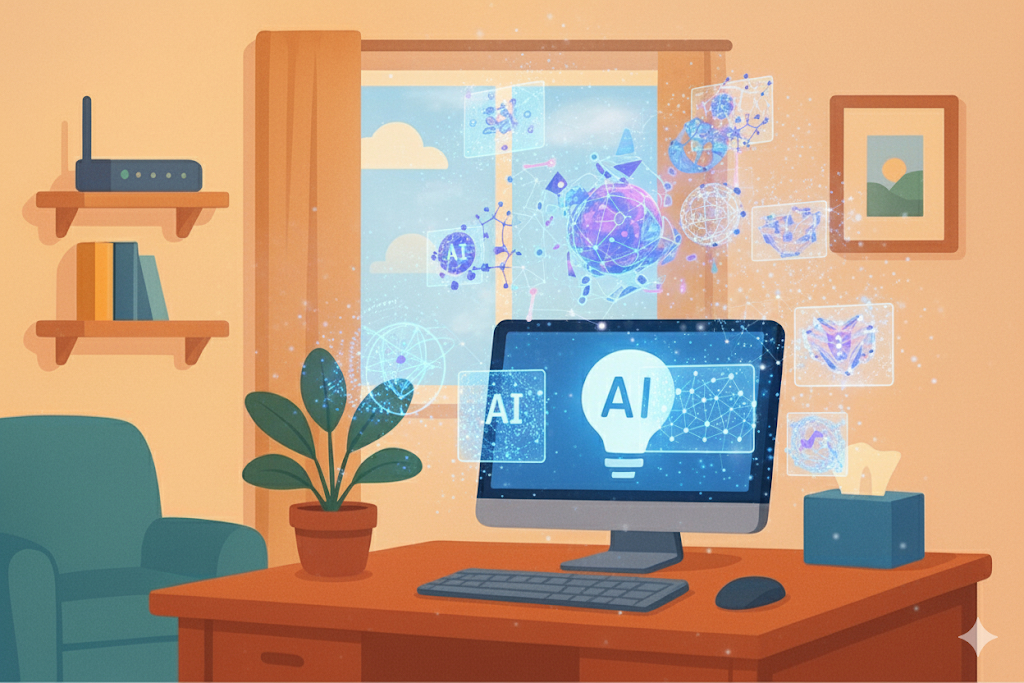
The rise of high-speed fibre internet has done more than just make Netflix faster and video calls clearer, it has opened the door for ordinary people to run powerful technologies from the comfort of their own homes. One of the most exciting of these possibilities is self-hosted artificial intelligence. While most people are used to accessing AI through big tech companies’ cloud platforms, the time has come to consider what it means to bring this capability in-house. For everyday users, the advantages come down to three things: security, personalization, and independence.
The first advantage is data security. Every time someone uses a cloud-based AI service, their words, files, or images travel across the internet to a company’s servers. That data may be stored, analyzed, or even used to improve the company’s products. For personal matters like health information, financial records, or private conversations, that can feel intrusive. Hosting an AI at home flips the equation. The data never leaves your own device, which means you, not a tech giant, are the one in control. It’s like the difference between storing your photos on your own hard drive versus uploading them to a social media site.
The second benefit is customization. The AI services offered online are built for the masses: general-purpose, standardized, and often limited in what they can do. By hosting your own AI, you can shape it around your life. A student could set it up to summarize their textbooks. A small business owner might feed it product information to answer customer questions quickly. A parent might even build a personal assistant trained on family recipes, schedules, or local activities. The point is that self-hosted AI can be tuned to match individual needs, rather than forcing everyone into a one-size-fits-all mold.
The third reason is independence. Relying on external services means depending on their availability, pricing, and rules. We’ve all experienced the frustration of an app changing overnight or a service suddenly charging for features that used to be free. A self-hosted AI is yours. It continues to run regardless of internet outages, company decisions, or international disputes. Just as personal computers gave households independence from corporate mainframes in the 1980s, self-hosted AI promises a similar shift today.
The good news is that ordinary users don’t need to be programmers or engineers to start experimenting. Open-source projects are making AI more accessible than ever. GPT4All offers a desktop app that works much like any other piece of software: you download it, run it, and interact with the AI through a simple interface. Ollama provides an easy way to install and switch between different AI models on your computer. Communities around these tools offer clear guides, friendly forums, and video tutorials that make the learning curve far less intimidating. For most people, running a basic AI system today is no harder than setting up a home printer or Wi-Fi router.
Of course, there are still limits. Running the largest and most advanced models may require high-end hardware, but for many day-to-day uses: writing, brainstorming, answering questions, or summarizing text, lighter models already perform impressively on standard laptops or desktop PCs. And just like every other piece of technology, the tools are becoming easier and more user-friendly every year. What feels like a hobbyist’s project in 2025 could be as common as antivirus software or cloud storage by 2027.
Self-hosted AI isn’t just for tech enthusiasts. Thanks to fibre internet and the growth of user-friendly tools, it is becoming a real option for everyday households. By bringing AI home, users can protect their privacy, shape the technology around their own lives, and free themselves from the whims of big tech companies. Just as personal computing once shifted power from corporations to individuals, the same shift is now within reach for artificial intelligence.
The past seven days brought wins on the pitch, hard lessons about infrastructure security, big sporting firsts and renewed climate focus. Below are five date-checked items from Saturday, September 20 to Friday, September 26, 2025, drawn from primary reporting so you can follow the facts and the context.
🏈 NFL to host regular-season games in Rio starting 2026
The NFL committed at least three regular-season games in Rio de Janeiro over a five-year span beginning in 2026, with the first expected at Maracanã Stadium. Why it matters: This is a major step in the NFL’s globalization strategy and signals serious investment in Brazil’s fan base.
🏟 Sold-out Twickenham cements the UK as a hub for women’s sport
The Women’s Rugby World Cup final at Twickenham drew more than 80,000 spectators, breaking attendance records and underlining the UK’s strength as a venue for top-tier women’s events. Why it matters: It shows that women’s sports can fill major stadiums and attract large audiences, changing the economics of media rights and sponsorship.
🖥 Cyberattack disrupts check-in systems at major European airports
A cyberattack on September 20 disrupted check-in and boarding systems at airports including Brussels, Berlin and London Heathrow, forcing manual processing and flight delays. Why it matters: The incident exposed vulnerabilities in travel infrastructure and the real costs of digital disruption in critical services.
🌍 New York prepares for a record Climate Week amid political headwinds
New York readied dozens of events, UN forums and activist actions for Climate Week starting late September, despite political tensions around environmental policy. Why it matters: Climate Week remains a key forum for mobilizing civic and corporate pressure on climate action and policy.
🚴 UCI Road World Championships held in Kigali, marking the first time in Africa
The UCI Road World Championships began on September 21 in Kigali, Rwanda, the first time the event was hosted on African soil and including new women’s U23 categories. Why it matters: Hosting the worlds in Africa reflects cycling’s geographic diversification and could accelerate development of talent and interest across the continent.
Closing thoughts: This week combined sporting milestones with urgent reminders about infrastructure resilience and the continuing centrality of climate diplomacy. Sport continues to expand its global footprint while attackers probe digital weak points and activists press for policy action. We will keep watching how these threads evolve and what they mean locally and globally.
In contemporary organizational theory, the capacity to share knowledge efficiently is increasingly recognized not merely as a good practice, but as one of the central levers of influence, innovation, and competitive advantage. Influence in the workplace is no longer determined solely by formal authority or proximity to decision-makers; it hinges instead on who opens up their ideas, disseminates outcomes, and builds collective awareness. Knowledge sharing, properly conceived, is a social process that undergirds learning, creativity, and organizational agility.
Why Sharing Still Matters Even with advances in digital collaboration tools, hybrid work environments, and more explicit knowledge management policies, many organizations continue to wrestle with information silos, “knowledge hoarding,” and weak visibility of what colleagues are doing. These behaviors impose hidden costs: duplication of work, failure to capitalize on existing insights, slow adoption of innovations, and organizational inertia.
Empirical studies confirm that when organizational climate is supportive, when centralization and formalization are lower, knowledge sharing behavior (KSB) tends to increase. For example, a recent study of IT firms in Vietnam (n = 529) found that a positive organizational climate had a direct positive effect on KSB, while high degrees of centralization and formalization decreased knowledge‐sharing intentions.
Moreover, knowledge sharing is strongly associated with improved performance outcomes. In technological companies in China, for instance, research shows that AI-augmented knowledge sharing, along with organizational learning and dynamic capabilities, positively affect job performance.
Theoretical Foundations & Diffusion of Influence A number of established frameworks help us understand both how knowledge spreads and why sharing can shift influence within organizations. • Diffusion of Innovations (Everett Rogers et al.): This theory explains how new ideas are adopted across a social system over time via innovators, early adopters, early majority etc. Key variables include communication channels, time, social systems, and the characteristics of the innovation itself. • Threshold Models & Critical Mass: Recent experiments suggest that when a certain proportion of individuals (often around 20-30%) behave in a particular way (e.g. adopting or sharing an innovation), that can tip the whole system into broader adoption. For example, one study found that social diffusion leading to change in norms becomes much more probable once a committed minority exceeds roughly 25% of the population. • Organizational Climate & Intention/Behavior Models: Behavior intentions (e.g. willingness to share) are shaped by trust, perceived support, alignment of individual and organizational values, and perceived risk/benefit. These mediate whether knowledge is actually shared or hidden.
Barriers & Enablers Understanding why people don’t share is as important as understanding why they do.
Barriers include: • Structural impediments like overly centralized decision frameworks, rigid hierarchy, heavy formalization. These reduce the avenues for informal sharing and flatten the perceived payoff for going outside established channels. • Cognitive or psychological obstacles, such as fear of criticism, loss of advantage (“knowledge as power”), lack of trust, or simply not knowing who might benefit from what one knows. • Technological and process deficiencies: poor documentation practices, weak knowledge management systems, lack of standard archiving, difficult to locate material, etc. These make sharing costly in terms of effort, risk of misunderstanding, or duplication.
Enablers include: • Cultivating a learning culture: where mistakes are not punished, where experimentation is supported, and where informal learning is valued. Studies in team climate show that the presence of an “organizational learning culture” correlates strongly with innovative work behavior. • Leadership that is supportive of sharing: transformational, inclusive leadership, openness to new ideas even when they challenge orthodoxy. Leaders who make visible their support for sharing set norms. • Recognition, incentive alignment, and reward systems that explicitly value sharing. When sharing contributes to promotions, performance evaluations, or peer recognition, people are more likely to invest effort in it.
Influence through Sharing: A Refined Model Putting this together, here is a refined model of how sharing translates into influence: 1. Visibility: Sharing makes one’s work visible across formal and informal networks. Visibility breeds recognition. 2. Peer Adoption & Critical Mass: Innovation often needs a threshold of peer adoption. Once enough people (often around 20-30%) accept or discuss an idea, it tends to propagate more broadly. Early informal sharing helps reach that threshold. 3. Legitimization & Institutionalization: When enough peers accept an idea, it begins to be noticed by formal leadership, which may then adopt it as part of official strategy or practice. What was once “radical” becomes “official.” 4. Influence & Reward: As an individual or team’s ideas get absorbed into the organizational narrative, their influence increases. They may be entrusted with leadership, provided more resources, or seen as agents of change.
Recent Considerations: Hybrid Work, Digital Tools, AI Over the past few years, changes in how and where people work, plus the integration of AI into knowledge-sharing tools, add new dimensions: • Remote and hybrid setups tend to magnify the problems of invisibility and isolation; informal corridor conversations or impromptu check-ins become less likely. Organizations must work harder to construct virtual equivalents (e.g. asynchronous documentation, digital forums, internal social networks). • AI and knowledge-management platforms can help accelerate sharing, reduce friction (e.g. discovery of existing reports, automatic tagging, summarisation), but they also risk over-trust in automation or leaving behind tacit knowledge that is hard to codify. • Given the increasing volume of information, selective sharing and curating become skills. Not every detail needs to be shared widely, but knowing what, when, and how to share is part of influence.
Implications for Practice For individuals aiming to increase their influence via sharing: • Embed documentation and archival processes into every project (e.g. phase reports, lessons learned). • Use both formal and informal channels: internal blogs or newsletters, but also coffee chats, virtual social spaces. • Be willing to experiment, share preliminary findings; feedback improves ideas and increases visibility.
For organizations: • Build a culture that rewards sharing explicitly through performance systems. • Reduce structural barriers like overly centralized control or onerous formalization. • Provide tools and training to lower the effort of sharing; make knowledge easier to find and use. • Encourage cross-team interactions, peer networks, communities of practice.
Final Word Sharing is not just a morally good or nice thing to do, it is one of the most potent forms of influence in knowledge-based work. It transforms static assets into living processes, elevates visibility, enables innovation, and shapes organization culture. As the world of work continues to evolve, those who master the art and science of sharing will increasingly become the architects of change.
References: Here are key sources that discuss the concepts above. You can draw on these for citations or further reading. 1. Xu, J., et al. (2023). A theoretical review on the role of knowledge sharing and … [PMC] 2. Peters, L.D.K., et al. (2024). “‘The more we share, the more we have’? Analyses of identification with the company positively influencing knowledge-sharing behaviour…” 3. Greenhalgh, T., et al. (2004). “Diffusion of Innovations in Service Organizations.” Milbank Quarterly – literature review on spreading and sustaining innovations. 4. Ye, M., et al. (2021). “Collective patterns of social diffusion are shaped by committed minorities …” Nature Communications 5. Bui, T. T., Nguyen, L. P., Tran, A. P., Nguyen, H. H., & Tran, T. T. (2023). “Organizational Factors and Knowledge Sharing Behavior: Mediating Model of Knowledge Sharing Intention.” 6. Abbasi, S. G., et al. (2021). “Impact of Organizational and Individual Factors on Knowledge Sharing Behavior.” 7. He, M., et al. (2024). “Sharing or Hiding? Exploring the Influence of Social … Knowledge sharing & knowledge hiding mechanisms.” 8. Sudibjo, N., et al. (2021). “The effects of knowledge sharing and person–organization fit on teachers’ innovative work …” 9. Academia preprint: Cui, J., et al. (2025). “The Explore of Knowledge Management Dynamic Capabilities, AI-Driven Knowledge Sharing, Knowledge-Based Organizational Support, and Organizational Learning on Job Performance: Evidence from Chinese Technological Companies.” 10. Koivisto, K., & Taipalus, T. (2023). “Pitfalls in Effective Knowledge Management: Insights from an International Information Technology Organization.”
When I first arrived in Silicon Valley in 1991, I did so on an H-1B visa. The program was brand new at the time, created to ensure that highly skilled professionals could move quickly into positions where American companies faced genuine gaps in expertise. My own case reflected that original vision perfectly. The U.S. firm that acquired my UK employer needed continuity and leadership in managing the transition of products and markets. I was the senior person left standing after the American parent stripped away the British management team, and my experience as product manager made me indispensable.
The process worked with remarkable speed, and the offer was more than fair. A $75,000 salary in 1991, equivalent to nearly $180,000 today, was a clear acknowledgment of the skills and responsibilities I brought with me. The system was designed to secure talent, not to undercut wages, and for me it delivered exactly what was promised: a career-defining opportunity and a way for an American company to gain the expertise it needed to thrive.
But what worked so well for me in 1991 has, over the decades, drifted far from that original intent. The H-1B program was meant to bring the best and brightest from abroad to fill roles that were difficult to source domestically. Instead, it has increasingly become a pipeline for large outsourcing firms that import entry-level workers at far lower wages than their American counterparts. Where the original standard was senior-level knowledge and proven skill, many visas now go to contractors whose roles could often be filled within the domestic labor pool.
This misuse creates what one former U.S. immigration official has called a “split personality disorder” for the program. Roughly half the visas still go to companies that genuinely need high-level specialists and can offer long-term careers, but the other half are captured by consulting firms whose business model depends on renting out lower-cost workers. That shift undermines both American workers, who see wages suppressed, and skilled foreign professionals, who are often treated as interchangeable resources rather than valued contributors.
The lottery system has further distorted the program. Once a simple way to fairly distribute a limited number of visas, it has been gamed by firms flooding the system with multiple applications. The recent drop in lottery bids, after the government cracked down on such practices, revealed just how much abuse had taken hold.
If the H-1B visa is to remain credible, it needs to return to its original purpose: rewarding specialized knowledge, proven expertise, and long-term commitment. Proposals to allocate visas based on wage levels rather than random chance would be a step in the right direction. They would align the system once again with its founding principle: bringing in the kind of high-value, hard-to-replace professionals that the U.S. economy truly needs.
My own journey in 1991 demonstrates the potential of the H-1B program when it is used as intended. It was a bridge for talent, a tool for competitiveness, and a life-changing opportunity. But unless it is reformed, the program risks being remembered not for what it enabled, but for how it was exploited.
Another week of sports shocks, economic shifts, and global moments. Below are five items that turned heads between Saturday, September 13 and Friday, September 19, 2025. Each item is date-checked and drawn from primary reporting so you can follow the facts and the context.
⚽ Canada ends New Zealand’s World Cup dominance to reach final
On September 19 Canada defeated defending champions New Zealand 34-19 in the Women’s Rugby World Cup semi final at Ashton Gate, booking a spot in the final for only the second time in the nation’s history. Why it matters: The result breaks a decade of New Zealand dominance, underlines the rise of Canada’s women’s program, and sets the stage for a historic final.
💷 UK borrowing surges and the pound weakens amid budget pressures
In mid September government borrowing rose well above forecasts, pushing August borrowing to its highest level in years. The pound weakened as markets digested the higher deficit and the risk of tougher fiscal measures. Why it matters: Higher borrowing raises questions for autumn budget planning and could force policy adjustments that affect growth and household budgets.
🧮 S&P Global updates show mixed growth with regional divergence
The September economic outlook from S&P Global revised growth up for economies such as the United States, Japan, Brazil and India while downgrading forecasts for Canada, Germany and Russia. Inflation remains uneven globally. Why it matters: The patchwork outlook changes the balance of global risks and opportunities, influencing trade, investment and policy choices.
📈 FAANG and AI stocks push markets higher as Fed cut odds rise
Tech giants and AI-related firms led gains during the week as investors continued to price a nearer Federal Reserve easing. The market rotation highlighted renewed appetite for growth names. Why it matters: Shifting expectations about monetary policy affect asset valuations, capital flows and corporate funding decisions.
🔭 Near-Earth asteroid 2025 FA22 made a safe flyby and was closely tracked
The object known as 2025 FA22, estimated between 130 and 290 meters, passed safely on September 18. Observatories used the close approach to refine orbital data and practice planetary defence procedures. Why it matters: Even large near-Earth objects can be monitored and ruled out as threats, which builds confidence in detection and response systems.
Closing thoughts: This week mixed sporting triumph and market optimism with sober economic readings and planetary vigilance. As these stories unfold they will shape policy decisions, investment priorities and public conversation. We will keep tracking developments and bringing you the five things worth your attention each week.
In an era when artificial intelligence threatens to displace traditional journalism, a glaring contradiction has emerged: news organizations that block AI crawlers from accessing their content are increasingly using AI to generate the very content they deny to AI. This move not only undermines the values of transparency and fairness, but also exposes a troubling hypocrisy in the media’s engagement with AI.
Fortifying the Gates Against AI Many established news outlets have taken concrete steps to prevent AI from accessing their content. As of early 2024, over 88 percent of top news outlets, including The New York Times, The Washington Post, and The Guardian, were blocking AI data-collection bots such as OpenAI’s GPTBot via their robots.txt files. Echoing these moves, a Reuters Institute report found that nearly 80 percent of prominent U.S. news organizations blocked OpenAI’s crawlers by the end of 2023, while roughly 36 percent blocked Google’s AI crawler.
These restrictions are not limited to voluntary technical guidelines. Cloudflare has gone further, blocking known AI crawlers by default and offering publishers a “Pay Per Crawl” model, allowing access to their content only under specific licensing terms. The intent is clear: content creators want to retain control, demand compensation, and prevent unlicensed harvesting of their journalism.
But Then They Use AI To Generate Their Own Content While these publishers fortify their content against external AI exploitation, they increasingly turn to AI internally to produce articles, summaries, and other content. This shift has real consequences: jobs are being cut and AI-generated content is being used to replace human-created journalism. • Reach plc, publisher of Mirror, Express, and others, recently announced a restructuring that places 600 jobs at risk, including 321 editorial positions, as it pivots toward AI-driven formats like video and live content. • Business Insider CEO Barbara Peng confirmed that roughly 21 percent of the staff were laid off to offset declines in search traffic, while the company shifts resources toward AI-generated features such as automated audio briefings. • CNET faced backlash after it published numerous AI-generated stories under staff bylines, some containing factual errors. The fallout led to corrections and a renewed pushback from newsroom employees.
The Hypocrisy Unfolds This dissonance, blocking AI while deploying it, lies at the heart of the hypocrisy. On one hand, publishers argue for content sovereignty: preventing AI from freely ingesting and repurposing their work. On the other hand, they quietly harness AI for their own ends, often reducing staffing under the pretense of innovation or cost-cutting.
This creates a scenario in which: AI is denied access to public content, while in-house AI is trusted with producing public-facing content. Human labor is dismissed in the name of progress, even though AI is not prevented from tapping into the cultural and journalistic capital built over years. Control and compensation arguments are asserted to keep AI out, yet the same AI is deployed strategically to reshape newsroom economics.
This approach fails to reconcile the ethical tensions it embodies. If publishers truly value journalistic integrity, transparency, and compensation, then applying those principles selectively, accepting them only when convenient, is disingenuous. The news media’s simultaneous rejection and embrace of AI reflect a transactional, rather than principled, stance.
A Path Forward – or a Mirage? Some publishers are demanding fair licensing models, seeking to monetize AI access rather than simply deny it. The emergence of frameworks like the Really Simple Licensing (RSL) standard allows websites to specify terms, such as royalties or pay-per-inference charges, in their robots.txt, aiming for a more equitable exchange between AI firms and content creators.
Still, that measured approach contrasts sharply with using AI to cut costs internally, a strategy that further alienates journalists and erodes trust in media institutions.
Integrity or Expedience? The juxtaposition of content protection and AI deployment in newsrooms lays bare a cynical calculus: AI is off-limits when others use it, but eminently acceptable when it serves internal profit goals. This selective embrace erodes the moral foundation of journalistic institutions and raises urgent questions: • Can publishers reconcile the need for revenue with the ethical imperatives of transparency and fairness? • Will the rapid rise of AI content displace more journalists than it empowers? • And ultimately, can media institutions craft coherent policies that honor both their creators and the audience’s right to trustworthy news
Perhaps there is a path toward licensing frameworks and responsible AI use that aligns with journalistic values, but as long as the will to shift blame, “not us scraping, but us firing”, persists, the hypocrisy remains undeniable.
For centuries, every major technological shift has sparked fears about the death of the crafts it intersects. The printing press didn’t eliminate scribes, it transformed them. The rise of the internet and word processors didn’t end journalism, they redefined its forms. Now, artificial intelligence fronts the same familiar conversation: is AI killing professional writing, or is it once again reshaping it?
As a business consultant, I’ve immersed myself in digital tools: from CRMs to calendars, word processors to spreadsheets, not as existential threats, but as extensions of my capabilities. AI fits into that lineage. It doesn’t render me obsolete. It offers capacity, particularly, the capacity to offload mechanical work, and reclaim time for strategic, empathic, and creative labor.
The data shows this isn’t just a sentimental interpretation. Multiple studies document significant declines in demand for freelance writing roles. A Harvard Business Review–cited study that tracked 1.4 million freelance job listings found that, post-ChatGPT, demand for “automation-prone” jobs fell by 21%, with writing roles specifically dropping 30% . Another analysis on Upwork revealed a 33% drop in writing postings between late 2022 and early 2024, while a separate study observed that, shortly after ChatGPT’s debut, freelance job hires declined by nearly 5% and monthly earnings by over 5% among writers. These numbers are real. The shift has been painful for many in the profession.
Yet the picture isn’t uniform. Other data suggests that while routine or templated writing roles are indeed shrinking, strategic and creatively nuanced writing remains vibrant. Upwork reports that roles demanding human nuance: like copywriting, ghostwriting, and marketing content have actually surged, rising by 19–24% in mid-2023. Similarly, experts note that although basic web copy and boilerplate content are susceptible to automation, high-empathy, voice-driven writing continues to thrive.
My daily experience aligns with that trend. I don’t surrender to AI. I integrate it. I rely on it to break the blank page, sketch a structure, suggest keywords, or clarify phrasing. Yet I still craft, steer, and embed meaning, because that human judgment, that voice, is irreplaceable.
Many professionals are responding similarly. A qualitative study exploring how writers engage with AI identified four adaptive strategies, from resisting to embracing AI tools, each aimed at preserving human identity, enhancing workflow, or reaffirming credibility. A 2025 survey of 301 professional writers across 25+ languages highlighted both ethical concerns, and a nuanced realignment of expectations around AI adoption.
This is not unprecedented in academia: AI is already assisting with readability, grammar, and accessibility, especially for non-native authors, but not at the expense of critical thinking or academic integrity. In fact, when carefully integrated, AI shows promise as an aid, not a replacement.
In this light, AI should not be viewed as the death of professional writing, but as a test of its boundaries: Where does machine-assisted work end and human insight begin? The profession isn’t collapsing, it’s clarifying its value. The roles that survive will not be those that can be automated, but those that can’t.
In that regard, we as writers, consultants, and professionals must decide: will we retreat into obsolescence or evolve into roles centered on empathy, strategy, and authentic voice? I choose the latter, not because it’s easier, but because it’s more necessary.
Sources • Analysis of 1.4 million freelance job listings showing a 30% decline in demand for writing positions post-ChatGPT release • Upwork data indicating a 33% decrease in writing job postings from late 2022 to early 2024 • Study of 92,547 freelance writers revealing a 5.2% drop in earnings and reduced job flow following ChatGPT’s launch ort showing growth in high-nuance writing roles (copywriting, ghostwriting, content creation) in Q3 2023 • Analysis noting decreased demand (20–50%) for basic writing and translation, while creative and high-empathy roles remain resilient • Qualitative research on writing professionals’ adaptive strategies around generative AI • Survey of professional writers on AI usage, adoption challenges, and ethical considerations • Academic studies indicating that AI tools can enhance writing mechanics and accessibility if integrated thoughtfully







 The Rowanwood Chronicles