The State of Geomatics in Paraguay

As of 2025, Paraguay’s mapping and cartography landscape is undergoing significant transformation, driven by technological advancements, collaborative initiatives, and institutional reforms. I was working in country on an agri-traceability USAID initiative, just over a decade ago, when Paraguay received funding from a development bank for a national mapping project. Problems with a clear mandate, objectives, and governance limited the outcomes of that project, and it’s good to say that huge progress has since been made.  

National and Thematic Mapping

MapBiomas Paraguay
Launched in 2023, MapBiomas Paraguay is a collaborative initiative involving Guyra Paraguay and WWF Paraguay. Utilizing Google Earth Engine, it produces annual land use and land cover (LULC) maps from 1985 to 2022 at a 30-meter resolution. These maps, encompassing ten LULC classes, are instrumental for environmental monitoring, policy-making, and land management. The platform offers open access to raster maps, transition statistics, and satellite mosaics, with updates planned annually.  

Historical Thematic Mapping
Historically, Paraguay’s thematic mapping has been limited. Notable efforts include a 1:500,000 scale resource mapping project in 1975, covering geology, soils, vegetation, and population, and a 1995 publication focusing on soil and land use in the Oriental Region. These maps were produced with support from international organizations and are based on the WGS84 datum.  

Urban and Regional Mapping

YouthMappersUNA and Atlas Urbano Py
Addressing the scarcity of up-to-date urban data, the YouthMappersUNA chapter at the National University of Asunción initiated the Atlas Urbano Py project. This project employs open-source tools like OpenStreetMap (OSM), Mapillary, and QGIS to map urban areas. Fieldwork includes 360° photomapping and drone-based orthophotography, resulting in detailed building use and height data for municipalities along Route PY02. To date, over 21,000 georeferenced images and 3,700 building polygons have been documented.   

Cadastral Mapping and Property Fabric

Servicio Nacional de Catastro (SNC)
The SNC is responsible for Paraguay’s cadastral mapping. Recognizing the need for modernization, a comprehensive reform is underway to streamline procedures, update technological infrastructure, and enhance legal certainty. A significant development is the proposed National Unified Registry (RUN), aiming to integrate the General Directorate of Public Registries, the General Directorate of National Cadaster Services, and the Department of Surveying and Geodesy. This integration seeks to reduce processing times by at least 20% and improve transparency.   

Indigenous Land Mapping

A participatory project focused on indigenous land delimitation has been conducted in six communities of the Mbya Guaraní and Yshir peoples. Covering approximately 35,828 hectares, this initiative involved geolocating traditional boundaries, documenting land invasions, and integrating data into the SNC’s digital cadaster. The project provides legal tools for communities to assert land rights and seek regularization.  

Open Geospatial Data Infrastructure

Paraguay is part of the GeoSUR initiative, a regional network promoting free access to geospatial data across Latin America and the Caribbean. GeoSUR supports the development of spatial data infrastructures (SDIs) by providing tools for data sharing, visualization, and analysis. While progress has been made, challenges remain in ensuring data interoperability, standardization, and widespread adoption of open data practices.   

Paraguay’s cartographic landscape is evolving through collaborative efforts, technological integration, and institutional reforms. National initiatives like MapBiomas Paraguay enhance environmental monitoring, while grassroots projects such as Atlas Urbano Py address urban data gaps. Reforms in cadastral systems aim to improve land administration and legal certainty. Continued investment in open data infrastructures and capacity building will be crucial for sustaining and advancing these developments.  

Five Things We Learned This Week

Week of August 30 – September 5, 2025

The last seven days served up political shocks, seismic tragedy, market drama, and a fresh burst of cosmic wonder. Here are five items worth bookmarking from around the world, each happening inside the Aug 30 – Sep 5 window.

🛡️ 1. Israel strike in Sanaa killed senior Houthi ministers

On August 30, an Israeli strike on Sanaa hit the Houthi-run government, killing the prime minister and several senior ministers according to Houthi authorities. This was the first reported strike to kill top Houthi officials, and it sharpened regional tensions at a time of already high volatility.

Why it matters: hitting senior leaders raises the risk of escalation across the Red Sea corridor and complicates humanitarian access for Yemenis already suffering a long crisis.  

🌍 2. Catastrophic earthquake in Afghanistan kills hundreds

On September 1, a powerful earthquake struck Afghanistan, flattening villages and killing hundreds with thousands injured. Rescue teams and air evacuation missions were mobilized as the international community rushed aid. The death toll and destruction made this one of the most devastating natural disasters of the year in the region.

Why it matters: the scale of destruction deepens the humanitarian emergency and highlights the urgent need for coordinated international relief and long-term rebuilding assistance.  

📈 3. U.S. jobs data showed a sharp slowdown, markets reacted

On September 5, the U.S. Labor Department released August payrolls showing far weaker job growth than expected and an unemployment rate that rose to around 4.3. Markets quickly priced stronger odds of Fed easing, and chip and AI-related stocks powered moves in major indices as investors refocused on rate cut timing.

Why it matters: softer jobs data materially increases the likelihood of Federal Reserve rate cuts this month, which would ripple through currency, bond, and equity markets worldwide.  

🌐 4. White House signs order to put lower Japanese auto tariffs into effect

On September 4–5, the White House signed an executive order implementing lower tariffs on certain Japanese auto imports, following earlier negotiations. The move is part of a broader, shifting U.S. tariff posture and comes as Washington balances trade leverage with strategic industrial partnerships.

Why it matters: the order signals selective liberalization within a larger protectionist trade environment, and it could reshape supply chains and auto industry planning for 2026 and beyond.  

🔭 5. Webb released spectacular newborn-star images that lit up science feeds

Between Sept 3 and Sept 5, NASA and news outlets published new James Webb Space Telescope images showing dense clusters of newborn stars, including extraordinary detail in the Lobster Nebula and Pismis 24 star-forming regions. The images were widely shared and discussed by astronomers for the clarity they bring to early stellar evolution.

Why it matters: the images provide data to test star formation models and keep Webb at the center of rapid advances in understanding how stars and clusters form.   

Another week, another snapshot of a world in motion. Some stories inspire hope, others demand action, but all of them remind us how interconnected our lives have become. Join us again next week as we gather the moments that matter most – the ones that shape the days ahead.

The Billion-Dollar Bonk: A Light-Hearted Look at How Much Men Spend Chasing the Booty

Let’s face it, men across the globe, are hopelessly, hilariously, and historically committed to spending absurd amounts of money trying to see, touch, or vaguely interact with sex. Whether it’s through in-person escapades, premium subscriptions to people named “CandyHearts69,” or an emotional relationship with a chatbot named “Mia the Naughty Elf,” men have collectively built a sexual spending empire that could probably fund world peace, colonize Mars, and still leave room for snacks.

Sex Work Is Work… and Business Is Booming
According to a 2023 report by Statista, the global commercial sex industry (we’re talking in-person, real-world sex work here) rakes in over $180 billion USD annually. That’s “billion” with a “B,” as in “Bonkers.” To put that in perspective, that’s more than the GDP of Hungary. That’s more than people spend on coffee. More than on Netflix. More than on avocado toast. Basically, if sex work were a country, it’d be hosting the Olympics by now.

Of that amount, it’s estimated that 90–95% of clients are male, making men the financial backbone of the world’s oldest profession. In other words, if the sex economy were a chair, men would be all four legs, the cushion, and probably the wobbly bit under the seat nobody can tighten.

Porn – The Only Subscription Men Never Cancel
Now, onto the virtual wonderland that is online porn. This is where the numbers get truly pants-down ridiculous.

According to a 2022 report from the University of Nevada, the online pornography industry brings in about $15 billion USD per year. That includes everything from subscriptions to OnlyFans, cam sites, custom videos, and, yes, that one guy still buying DVDs in 2025.

OnlyFans alone had 190 million users as of 2023 and paid out over $5 billion to creators in a single year. The majority of subscribers? You guessed it – men. The platform is less “OnlyFans” and more “OnlyDudes-Willing-To-Pay-$12.95-a-Month-To-Be-Called-Baby.”

Cam sites like Chaturbate and Stripchat bring in hundreds of millions annually, where men tip tokens for things like “wiggle,” “bounce,” “moan,” or the sacred “ask-me-about-my-feet” tier. For some reason, knowing it’s live makes it feel more “authentic,” like artisan cheese or handcrafted bread, but much sweatier.

Let’s Not Forget the Analog Guys
There’s a whole other demographic of men still spending money in more traditional ways: strip clubs, bachelor party dancers, and sketchy motel rooms with plastic plants and a mirror on the ceiling. While harder to quantify, strip clubs in the U.S. alone generate over $6 billion a year (IBISWorld, 2023). That’s just men throwing cash into the air to temporarily feel like a 2003 rap video.

Don’t get us started on massage parlors with “happy endings,” where the happiness is subjective and the endings are suspiciously pricey.

A Global Brotherhood of Bonkonomics
Let’s break it down globally, shall we?
Japan: Home of the “soapland” and cosplay cafes, Japanese men drop $24 billion USD a year on the adult entertainment industry (Deloitte Japan, 2022).
Germany: Legal sex work contributes $20 billion USD annually, making it both efficient and very, very naked.
United States: Between porn, sex work (legal and not-so-much), and clubs, American men alone contribute $35–50 billion to the sex economy.
United Kingdom: British men spend about £5 billion (≈$6.3 billion USD) annually, presumably while apologizing and calling everyone “love.”

Everywhere, men are paying for sex in some form like it’s a gym membership: full of guilt, poorly hidden, and rarely used to its full potential.

What Could That Money Buy?
So, what could men have done instead?
• Bought every citizen on Earth a decent sandwich.
• Rebuilt Notre Dame in solid gold.
• Cloned David Beckham 48,000 times.
• Paid off the student debt of every art history major in North America – twice.

But no. We have chosen nipples over Nobel Prizes. We live in a world where men will argue over who pays for dinner, then quietly drop $300 a month on a cam girl who once said “hi” with a winky face.

A Round of Applause (and Possibly Penicillin)
Let’s not judge too harshly. After all, sex, paid or not, is part of being human. Yet the sheer economic scale of men’s pursuit of orgasms is an impressive, bewildering testament to male dedication, desire, and sheer… enthusiasm. Whether through a screen or in person, whether it’s emotional support from an AI waifu or a dancer named Sapphire who knows how to make eye contact feel like a confessional, men will continue to spend.

Because in the end, some things are eternal: death, taxes, and a man handing over his credit card to see some booty.

Sources
• Statista, “Size of the global commercial sex industry,” 2023.
• University of Nevada, “Pornography Industry Report,” 2022.
• IBISWorld, “Strip Clubs in the US – Market Size 2023.”
• Deloitte Japan, “Adult Industry Revenue Report,” 2022.
• The Independent (UK), “Britons Spend £5 Billion a Year on Adult Services,” 2023.

Nation-Building by Design: The Strategic Nature of Carney’s Infrastructure Agenda

Canada is entering a new phase of nation-building, one that blends urgent economic needs with longer-term structural transformation. Under Prime Minister Mark Carney, the government has moved decisively to put infrastructure back at the centre of Canadian economic policy. The legislative and programmatic architecture that has been put in place in 2025 reveals not only a desire to build quickly, but also a strategy to re-shape the foundations of trade, energy, housing, and Arctic sovereignty. The pattern of investment and institution-building shows a layered approach: short-term relief to pressing bottlenecks, medium-term positioning of Canada as a reliable trading partner and energy supplier, and long-term steps to reinforce sovereignty, climate resilience, and competitiveness.

At the core lies the One Canadian Economy Act, passed in June 2025, which dismantles federal barriers to interprovincial trade while creating the Building Canada Act. This framework enshrines the ability to designate projects of “national interest” for streamlined approval. The intent is clear: Canada cannot afford to have critical transmission lines, export terminals, or transportation corridors stalled indefinitely in regulatory gridlock. To operationalize this authority, the government launched a Major Projects Office (MPO), with an Indigenous Advisory Council integrated into its structure. The MPO serves as a single-window permitting and financing hub, designed to shepherd nation-building projects through approvals in under two years. The short-term gain is administrative clarity and accelerated approvals; the medium-term payoff is a pipeline of projects that directly enhance trade capacity and energy reliability.

Housing has been treated with equal urgency. The creation of Build Canada Homes, announced in the May Throne Speech and detailed in August, signals a willingness to intervene directly in housing supply. Paired with CMHC’s Housing Design Catalogue, which offers standardized blueprints for gentle density from accessory units to six-plexes, the federal role is shifting from passive funding to active delivery. Short-term gains include faster project approvals and cost savings for small-scale builders. In the medium term, Build Canada Homes intends to scale modular and prefabricated construction to double housing output, stabilizing affordability while anchoring domestic supply chains in Canadian lumber and inputs. The long-term structural effect would be the normalization of higher building rates across the country, a prerequisite for sustaining workforce mobility and economic competitiveness.

Trade and corridor infrastructure forms the third pillar. The Trade Diversification Corridor Fund, budgeted at five billion dollars, is designed to expand port and rail capacity and reduce Canada’s overreliance on U.S. gateways. The High Frequency Rail (HFR) project between Toronto, Ottawa, Montreal, and Quebec City is continuing, promising transformative improvements to the most densely populated corridor. In the short run, HFR stimulates engineering and pre-construction employment. Medium-term gains will appear in reduced congestion, faster business travel, and increased regional integration. The long-term dividends include lower emissions and globally competitive connectivity between Canada’s political and financial capitals.

The expansion of the Port of Churchill in northern Manitoba illustrates how the government is aligning regional development with national strategy. With over $175 million in new federal funding, $36 million from Manitoba, and parallel commitments from Saskatchewan, Churchill is being re-equipped as a trade-enabling Arctic gateway. Recent investments in rail reliability, storage capacity for minerals, and new wharf facilities are positioning it as a potential hub for agricultural exports and critical minerals. The short-term impact is the stabilization of Hudson Bay Railway service, critical for northern communities. The medium-term benefit is expanded shipping capacity during the navigable season. The long-term prize lies in climate-extended Arctic navigation, which could turn Churchill into a permanent transatlantic container port, reshaping Canada’s role in global shipping.

Energy and clean industrial infrastructure represent another strategic frontier. Through the Canada Growth Fund (CGF), Ottawa is deploying $15 billion to de-risk large low-carbon projects, with seven billion earmarked for carbon contracts for difference. This mechanism gives investors certainty that carbon pricing will not collapse, unlocking private capital for carbon capture, hydrogen, and industrial decarbonization. Short-term benefits include early project commitments, such as waste-to-energy facilities in Alberta. Medium-term, these contracts build a domestic market for clean technologies and expand Canada’s share in global green supply chains. Long-term, CGF instruments lay the foundation for a carbon-competitive industrial economy, ensuring Canadian heavy industry remains viable under international climate rules.

The Arctic and defence agenda provides a parallel set of strategic investments. NORAD modernization, including the joint development of over-the-horizon radar with Australia, directly strengthens northern surveillance. The Canadian Patrol Submarine Project, with three bidders shortlisted, will anchor significant industrial activity in Canadian shipyards. In the short run, these procurements inject capital into defence industries. Medium-term gains include jobs, technology transfer, and new capacity in coastal infrastructure. The long-term effect is reinforcement of Arctic sovereignty and continental security at a time of intensifying geopolitical competition.

Underlying all of this is continuity through existing transfers such as the Canada Community-Building Fund, which locks in $26.7 billion for local water, transit, and road projects through 2034. These represent the essential backbone investments that ensure communities can absorb population growth and remain livable, complementing the marquee projects at the national level.

Taken together, these initiatives reveal a strategy that is both defensive and offensive. In the short term, Canadians will see more housing starts, more shovels in the ground for rail and port expansions, and more certainty for clean-tech investors. Over the medium term, the country will gain diversified trade routes, a more mobile workforce, and scaled-up housing supply that cools inflationary pressures. In the long run, the institutional innovations of 2025, the One Canadian Economy Act, the Major Projects Office, and the Canada Growth Fund, may be remembered as the architecture that enabled Canada to hold its ground as a sovereign, competitive, and sustainable economy in a fracturing world.

Reevaluating Policing Priorities: A Call for Community-Centered Approaches in Ottawa

The Ottawa Police Service (OPS) has proposed a significant budget increase, citing the need to enhance services across the city. However, evidence suggests that reallocating existing funds towards community-focused policing could be a more effective, and sustainable approach to reducing crime without additional financial burden.

Community Policing: A Proven Strategy
The OPS has implemented several community-oriented strategies that have shown promising outcomes. The Community Outreach, Response, and Engagement (CORE) Strategy, for instance, focuses on addressing the root causes of crime in specific areas such as the ByWard Market and Rideau Street. By increasing foot patrols and engaging with local stakeholders, the OPS has reported a 17.9% reduction in calls for service and a 4.62% decrease in crime across these hotspots. 

Similarly, the District Deployment Model tailors policing efforts to the unique needs of Ottawa’s diverse neighborhoods. This approach emphasizes collaboration with community partners to resolve local issues, enhancing service delivery and community trust.

Resource Reallocation: Investing in Prevention
The proposed budget increase for the OPS is substantial, potentially adding approximately $30 million to the police budget. Critics argue that these funds could be more effectively utilized by investing in community-based services that address the root causes of crime, such as poverty, mental health, and education.

Initiatives like Crime Prevention Ottawa’s “Vision Jasmine” project have demonstrated the effectiveness of community-led efforts in reducing crime. By focusing on community engagement and support, such programs have led to a significant reduction in crime rates in neighborhoods that experienced multiple homicides. 

Building Trust Through Engagement
Community policing emphasizes building trust and collaboration between police and community members. The OPS’s CORE Strategy and District Deployment Model are steps in this direction, aiming to create stronger relationships with residents and address their unique concerns. Investing in these initiatives can lead to more effective policing and a safer community overall.

While the OPS’s request for a budget increase highlights the need for enhanced services, a shift towards community-focused policing offers a more sustainable and effective solution. By reallocating existing resources to initiatives that address the underlying causes of crime and foster community trust, Ottawa can create a safer and more equitable environment for all residents.

On the Illusion of Self-Discovery 

In an age where “finding yourself” has become a lifestyle brand, it’s hard not to notice, gently, how strange it all is.

You see it everywhere: bright, hopeful faces on “healing journeys,” framed against sunsets in Bali; corporate executives burning out in glass towers only to reappear months later as “authentic living” coaches after a $12,000 retreat in the Andes. Suburban families decluttering their closets in search of inner peace, as if enlightenment might be hidden somewhere between last season’s jackets and the yoga mats.

Modern self-discovery, especially among the comfortable and educated classes, has become an elaborate ritual. The tools vary: yoga teacher trainings, digital detox camps, van life road trips, artisanal workshops on gratitude, but the impulse remains deeply human: the yearning to feel whole, to understand oneself beyond the blur of obligations.

And yet, with a kind of quiet sadness, you realize that much of this restless effort misses the heart of what older wisdom traditions have long tried to say: that the self you are chasing cannot be caught like a butterfly. The ego, the needy, striving “I”, is not a puzzle to be solved or a prize to be won. It is an illusion to be gently seen through, a dream to wake up from.

In this softer light, it’s clear that modern self-discovery often becomes a new form of grasping. A gentler grasping, perhaps, dressed in mindfulness retreats and ayahuasca ceremonies, but grasping nonetheless. Transformation is packaged, marketed, and sold, with self-actualization offered for a price. It’s not that these experiences are without value; many carry glimpses of beauty and honesty, but when the pursuit becomes a new identity, a new project of consumption, it quietly reinforces the very suffering people hope to leave behind.

Meanwhile, the genuine work, the real, hard, simple work, remains overlooked. It doesn’t glitter. It looks like sweeping a floor without resentment, holding silence without needing to fill it, sitting with discomfort without demanding it change. It looks like living, fully and without drama, in the plainness of an unremarkable day.

Ancient teachings, whether whispered under the Bodhi tree, scribbled in the margins of Stoic letters, or passed hand-to-hand among Sufi poets, point always to the same difficult kindness: You do not find yourself by changing scenery. You find yourself by changing how you see.

And sometimes, by realizing, with a soft sigh, not a harsh judgment, that there was no fixed, shining “self” to find after all.

This truth is not meant to mock anyone’s search. It is not meant to diminish the sincere longing behind every yoga mat, every travel blog, every self-help journal. Longing is sacred. The path is sacred. It is only that the destination, in the end, may be smaller and quieter than expected, not a place to arrive at, but a way of being already waiting inside the life you have.

And that, perhaps, is enough.

Blood and Creed: Vice President Vance’s Reimagining of American Citizenship

On July 5, 2025, Vice President J.D. Vance delivered a notable address at the Claremont Institute’s Statesmanship Award Dinner in San Diego. For a man in the second-highest office of the land, his treatment of American citizenship was striking, not for its novelty, but for its clear departure from foundational norms. 

From Creed to Kinship
Vance began by challenging the idea of the United States as a creedal nation, a polity bound by shared principles of the Declaration of Independence, calling it simultaneously over-inclusive (drawing in “hundreds of millions, maybe billions” who support American ideals abroad) and under-inclusive (excluding those with ancestral ties, but extremist beliefs). He presented a contrasting model of citizenship rooted in ancestry, place, and “blood-and-soil.” With sentimental reference to generations of his family buried in a Kentucky cemetery, Vance argued that belonging should be tied to living history and rootedness rather than abstract ideals. 

This represents more than rhetorical flourish. It signals a paradigm shift, from civic affiliation to ethnic membership. In Vance’s terms, ancestry becomes a qualifier; heritage becomes identity.

Critique from the Center and Beyond
Historians and public intellectuals wasted little time pushing back. Ambassador Daniel Fried offered a powerful critique in The National Interest, opposing Vance’s redefinition for its reversal of Abraham Lincoln’s post–Civil War vision. Lincoln had conceived the nation as “a new nation, conceived in liberty”, not as a bloodline-bound entity. Fried emphasized that Lincoln saw citizenship as a matter of shared principles, not ancestry, drawing on immigrants who “feel…they are part of us” through creed.

Historian and public author John Ganz described Vance’s stance as an “anti-Declaration.” He highlighted the inconsistency of invoking Revolutionary and Civil War symbols while undermining the very ideals those conflicts advanced. Ganz drew contrast with Harry Jaffa, whose defense of Lincoln affirmed that “all men are created equal” meant just that, regardless of bloodline.

Tad Stoermer’s “Heritage Citizenship”
Into this debate steps Tad Stoermer: public historian, educator, and author, who coined the term “heritage citizenship” to categorize this turn toward ancestry-based belonging. Stoermer views this not as nostalgic reflection but as active project: a “restoration” of a racially-defined First Republic rooted in whiteness. The goal, he suggests, is the rewriting of constitutional logic, to reassert lineage as citizenship’s arbiter. 

Why This Matters Today
If Vance’s vision is enacted, it would have real-world consequences:

1. Birthright Citizenship at Risk
The 14th Amendment guarantees citizenship based on birth within U.S. jurisdiction: an inclusive, principle-based foundation. Vance’s model, however, introduces a lineage test, posing a legal challenge to this constitutional baseline.

2. Political and Social Exclusion
Consider the millions of post-1965 immigrant-descended Americans: legal, patriotic, educated, yet lacking “Appalachian blood.” Their citizenship, under Vance’s rubric, becomes negotiable, diluted by ancestry.

3. Ideological Flexibility for Elites
Despite its broad implications, heritage citizenship allows selective exceptions, for political elites, spouses, or allies (e.g., Vance’s own wife, born in California to Indian immigrants), which erodes the internal consistency of the ideology. Vance can romanticize heritage, while simultaneously reserving membership for his inner circle.

Going Backwards – Constitutionally and Symbolically
This vision directly counters Lincoln’s redefinition of the Union after 1863. At Gettysburg, he consecrated the Union’s cause as “a new birth of freedom,”establishing citizenship through legal equality. Vance’s model, in contrast, retreats into pre-14th Amendment logic, where race and lineage determined belonging.

It also undermines the United States’ role on the global stage. Fried points out that the American creed, its principle-based identity, enabled it to attract “hundreds of millions, maybe billions” of adherents abroad, forming what he describes as a “positive-sum” global leadership structure  . Heritage-based identity, by contrast, is zero-sum, exclusive, and inward-looking.

A Historian’s Judgment
For any senior historian, the implications are stark:
Constitutional Regression: Voting rights and equal protection, hard-won through amendments and civil rights struggles, are put back on the chopping block.
Political Inequality: Heritage citizenship enables a bifurcated class of Americans, those with “authentic” lineage and those without.
National Myth versus National Reality: The U.S. has always been a nation of immigrants and wanderers. Vance’s speech polices belonging by ancestry, contra 250 years of integrated identity-building.

Vice President Vance’s Claremont Institute speech is not merely poetic, it is profoundly political. It stakes out heritage, soil, and blood as qualifiers of sovereignty. Critics like Fried, Ganz, and Stoermer understand this as both intellectual and legal retrenchment. The choice now faces American democracy: Will we continue as a principle-based republic, where citizenship is claimed through belief, law, and shared action? Or will we succumb to a lineage-based model that narrows the definition of who belongs?

In highlighting ancestry over creed, Vance’s model asks an inflammatory question: does American identity belong to those we include, or those we exclude? The answer, for nearly two centuries, has been creed. It must remain so.

In a nation guided by Vance-style heritage criteria, citizenship would shift from being a legal, civic covenant to a cultural inheritance. That model would disqualify immigrants, their children, Jewish Americans, those of Latino or Asian descent, even well-known political figures, unless they belong to the “right” ancestry group. Yet the model grants latitude for elite figures, a glaring hypocrisy exposing the project’s exclusionary core. It’s not just a nostalgic vision, it’s a blueprint for a tiered citizenry: real if you’re insider heritage, negotiable if not.

The Lost Diversity of Humanity 

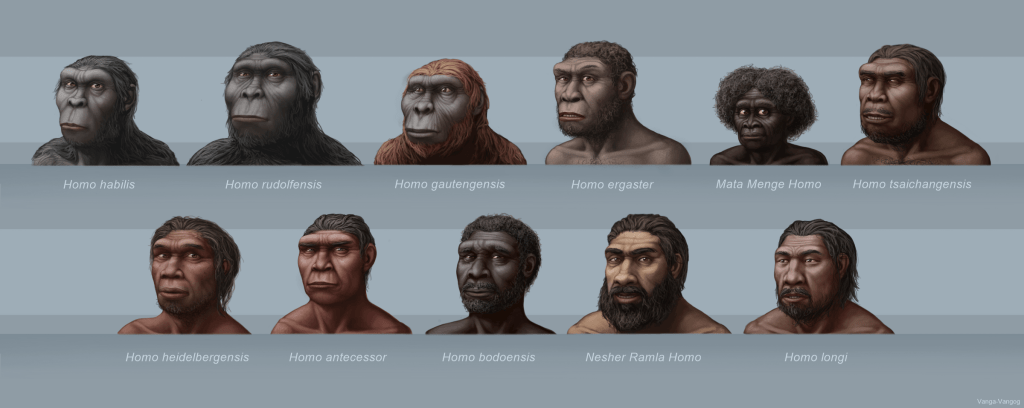
Roughly one hundred thousand years ago, the world was home to a remarkable diversity of human species. Modern humans were only beginning their first tentative steps beyond Africa, but they were not alone. Several other lineages thrived, each adapted to its own landscapes, climates, and ways of life. These were not different “races” of a single species but distinct human branches, separated by hundreds of thousands of years of evolution, yet sometimes still close enough to interbreed.

Neanderthals were the best known of these relatives. They occupied Europe and western Asia, building tools, hunting in coordinated groups, and surviving in some of the harshest Ice Age environments. To the east, Denisovans spread widely across Asia. Although only a handful of their bones and teeth have been recovered, genetic studies show that Denisovans were a major lineage, leaving traces of their DNA in modern populations from Tibet to Oceania. On the island of Java, the last populations of Homo erectus endured. This species had been extraordinarily successful, spreading out of Africa nearly two million years earlier, and fossils suggest they survived until at least 117,000 years ago.

Other species thrived in more isolated environments. On the island of Flores in Indonesia lived Homo floresiensis, often nicknamed the “hobbit” because of its small stature. Despite its diminutive size, this species produced stone tools and likely controlled fire, persisting until around 60,000 years ago. In the Philippines, another small-bodied species, Homo luzonensis, has been identified from remains dating between 67,000 and 50,000 years ago. These island species highlight how isolation could produce unique evolutionary experiments within the genus Homo.

In Africa, earlier lineages had already left their mark. Homo naledi, known from the Rising Star cave system in South Africa, lived between 335,000 and 236,000 years ago. Their remains show an unusual mix of primitive and modern features, alongside evidence suggesting deliberate placement of bodies in cave chambers. Although not contemporaneous with Neanderthals or Denisovans, Homo naledi demonstrates that the human family tree was even more diverse than the late-surviving species of the Pleistocene.

These populations were not fully isolated from one another. Modern genetic evidence shows that Neanderthals and Denisovans interbred with Homo sapiens, and a few individuals even carry ancestry from both. Today, people of non-African descent typically have about 1–2 percent Neanderthal DNA, while some Oceanian groups carry up to 4–6 percent Denisovan DNA. Our genomes are a living archive of those encounters.

Why so many human lineages disappeared remains an open question. Climate fluctuations would have stressed small, scattered populations. Competition for resources may have sharpened between overlapping groups. New pathogens could have devastated communities without immunity. In some cases, Homo sapiens likely held advantages in technology, social organization, or long-distance networks of exchange. But randomness also played a role: survival at evolutionary bottlenecks is often as much about chance as about superiority.

By about 32,000 years ago, only one human species remained – Homo sapiens. Neanderthals had vanished from their European strongholds, Denisovans disappeared from the high plateaus of Asia, and the island species had long gone extinct. What survives of this lost diversity are fragments of bone, stone tools, and strands of DNA that remind us of a time when humanity was not a single lineage but a family of experiments in survival.

Far from a story of inevitable triumph, the rise of Homo sapiens is a reminder of how precarious our own existence once was. The fact that we endure may owe less to strength or intelligence than to timing, adaptability, and the accidents of evolutionary history.

Sources
• Dirks, P. H. G. M., et al. “The age of Homo naledi and associated sediments in the Rising Star Cave, South Africa.” eLife, 2017.
• Smithsonian National Museum of Natural History. “Homo naledi.” Updated January 3, 2024.
• Détroit, F., et al. “A new species of Homo from the Late Pleistocene of the Philippines.” Nature, 2019.
• Brumm, A., et al. “Age and context of Homo floresiensis remains from Liang Bua, Flores.” Nature, 2016.
• Antón, S. C., et al. “Redating Homo erectus at Ngandong, Java, Indonesia.” Nature, 2019.
• Higham, T., et al. “The timing and spatiotemporal patterning of Neanderthal disappearance.” Nature, 2014.
• Chen, F., et al. “A late Middle Pleistocene Denisovan mandible from the Tibetan Plateau.” Nature, 2019.
• Huerta-Sánchez, E., et al. “Altitude adaptation in Tibetans caused by introgression of Denisovan-like DNA.” Nature, 2014.
• Green, R. E., et al. “A draft sequence of the Neandertal genome.” Science, 2010.
• Reich, D., et al. “Denisova admixture and the first modern human dispersals into Southeast Asia and Oceania.” American Journal of Human Genetics, 2011.
• Slon, V., et al. “The genome of the offspring of a Neanderthal mother and a Denisovan father.” Nature, 2018.

Five Things We Learned This Week

This week gave us a mix of cosmic discoveries, market drama, unsettling conflicts, and surprising science that could change how we handle pollution. Here are five fresh, date-checked stories from around the world, each one happened between Aug 23 and Aug 29, 2025.

📈 1. Markets hit records after Nvidia’s results spark an AI rally (Aug 28, 2025)

Wall Street pushed higher on Aug 28 as investors digested Nvidia’s quarterly numbers and continued AI spending, driving the S&P 500 and Dow to record closes. The rebound came despite mixed guidance and persistent trade worries, showing how AI-infrastructure demand is still reshaping markets.

Why it matters: markets are still being driven by AI investment cycles; earnings from a few big players are moving broad indices.

🔭 2. JWST finds an unusually large sample of candidate early galaxies (Aug 23–24, 2025)

Teams mining James Webb Space Telescope infrared images announced this week that dozens, and in early reports more than 300 candidate objects, appear unusually bright and may be among the universe’s earliest galaxies; follow-up spectroscopy on one candidate was reported as confirmed in the same window. These results were discussed in several science roundups published Aug 23–24.

Why it matters: JWST keeps pushing back the frontier on when and how quickly the first galaxies formed, forcing revisions to early-universe models.

🐛 3. Scientists report new plastic-eating biological pathways in waxworms (Aug 27, 2025)

On Aug 27, labs publishing in science outlets revealed mechanisms by which waxworm larvae and their gut microbes break down polyethylene, one of the most persistent plastics. The study used genomic and enzymatic analysis to identify key enzymes that accelerate polyethylene degradation under lab conditions.

Why it matters: this gives plausible biological routes for future biodegradation strategies and new directions for tackling single-use plastic waste.  

🕊️ 4. Israeli strikes hit Sanaa, Yemen (Aug 24, 2025)

Reuters photo dispatches and field reports from Aug 24 documented powerful airstrikes on Sanaa that caused extensive damage and civilian casualties. The images circulated worldwide and were part of broader coverage of escalating regional strikes and their humanitarian impact during the week.

Why it matters: visual evidence from the field sharpened international concern about civilian harm and widened diplomatic focus on de-escalation and aid access.  

🌏 5. North Korea records fastest economic growth in eight years (reported Aug 29, 2025)

On Aug 29, reporting based on South Korean central-bank estimates noted North Korea’s economy grew about 3.7% in 2024, its fastest pace in eight years, a trend analysts connected to deeper economic ties with Russia and informal trade patterns.

Why it matters: shifting economic dynamics in the region affect sanctions efficacy, humanitarian conditions, and geopolitical calculations.  

Another week, another snapshot of a world in motion. Some stories inspire hope, others demand action, but all of them remind us how interconnected our lives have become. Join us again next week as we gather the moments that matter most — the ones that shape the days ahead.

Cascadia Rising: Ecology, Identity, Politics

I began this article over a year ago, and at the time my biggest challenge was finding its focus. I wasn’t sure what the central thread should be, so I followed the flow of ideas and shaped it into a summary of recent activities and announcements. In many ways, it became a placeholder; something to capture the moment and hold space until I had the chance to return and explore the subject in greater depth.

1. Bioregional Roots & Indigenous Foundations
The idea of Cascadia springs from the interconnected ecosystems spanning the Cascade Range; anchored by rivers like the Fraser, Columbia, and Snake, a landscape long inhabited by diverse Indigenous nations: Chinook, Haida, Nootka, Tlingit, and dozens more, whose vibrant cultures predate colonial borders by millennia.   

In Indigenous understanding, stewardship over land and salmon-rich waters isn’t just practical; it’s spiritual. Their societies are woven into place, honoring ecosystems as kin. This pre-colonial history sets a vital foundation for any modern Cascadia vision.

Today, Cascadian movements forefront Indigenous sovereignty and truth and reconciliation, advocating for dialogue-led, consensus-based confederation models where First Nations guide governance and cultural revitalization, like restoring Chinuk Wawa as a regional lingua franca.  

2. Bioregionalism & Mapping as Decolonizing Tools
Bioregionalism – which Cascadia champions, breaks from traditional politics, centering its framework on natural boundaries and ecological integrity. Indigenous mapping traditions inform this, such as bioregional atlases by Tsilhqotʼin, Nisga’a, Tsleil-Waututh, and others that helped affirm territorial claims in court.  

Through community-driven cartography, highlighting traditional ecosystems, language, stories; bioregional maps act as instruments of empowerment, healing, and planning rooted in place-based knowledge.  

3. Elizabeth May’s Provocative Invitation & BC’s Identity
In January 2025, Green Party of Canada leader Elizabeth May reignited Cascadian conversation with a striking, partly rhetorical offer: that California, Oregon, and Washington might consider joining Canada; with BC naturally included in the idea, based on shared values like universal healthcare, reproductive rights, and climate justice.  

Her gesture wasn’t an actual policy, but served as an emblematic spark, fueling grassroots discussions across the region; especially in BC, where many already feel culturally closer to the U.S. West Coast than to central Canada. This made the concept of transnational Cascadia feel suddenly plausible.  

4. Governor Newsom & West Coast Climate Leadership
Cascadia’s vision isn’t purely conceptual, it’s grounded in concrete policy collaboration:
• In May 2025Governor Gavin Newsom was appointed co-chair of the U.S. Climate Alliance, joining a bipartisan coalition of 24 governors spearheading high-impact, state-driven climate action, encompassing nearly 60% of the U.S. economy and 55% of its population.
Newsom also announced a major cap-and-invest (formerly cap-and-trade) budget proposal, extending California’s program through 2045 and earmarking billions toward firefighting, high-speed rail, and climate adaptation projects.   
• The three regional partners – California, Québec, and Washington, have also agreed to explore linkage of their carbon markets, signaling potential for a broader, cross-border climate economy.  
• Simultaneously, West Coast governors (Newsom, Oregon’s Tina Kotek, and Washington’s Bob Ferguson) signed a joint statement promising to defend their states’ climate policies against federal rollback, demonstrating regional resolve and cohesion.  

5. Indigenous and Climate Confluence in Cascadia’s Future
Modern Cascadia stands at the intersection of Indigenous resurgence and regional policymaking. Here’s how they converge:
Indigenous frameworks act as ethical and governance cornerstones; urging truth, place-based authority, and cultural restoration, especially in BC where colonial histories persist.
Bioregionalism and community mapping form tools for inclusion and urban planning that honor traditional ecological knowledge.
Cross-border cooperation on climate, via co-carbon markets and alliances, offers practical scaffolding for aligning policy with ecological realities.
Political solidarity, as seen in Newsom’s climate leadership and the West Coast climate defense, underscores Cascadia’s capacity as a functional mega-region, not merely a cultural idea.

Cascadia Reimagined: A Vision of Inclusive, Place-Based Governance
Cascadia today is evolving, not as a secessionist movement, but as an integrated regional model that:
• Places Indigenous sovereignty and ecological connection at its core.
• Encourages cross-jurisdictional collaboration on climate, economy, and culture.
• Utilizes bioregional mapping as a decolonizing and planning tool.
• Builds grassroots resonance through symbols, discourse, and identity.
• Innovates policy frameworks connecting shared values, particularly across BC and U.S. West Coast states.

Elizabeth May’s invitation, Governor Newsom’s climate strategy, and Indigenous leadership together signal a Cascadia imbued with governance relevance, moral thickness, and aspirational scope.

Sources
• Cascadia Bioregional Movement. Indigenous Sovereignties. Cascadia Bioregion. https://cascadiabioregion.org/indigenous-sovereignties
• Cascadia Bioregion. The Cascadia Movementhttps://cascadiabioregion.org/the-cascadia-movement
• Cascadia Bioregion. Independence and Public Opinionhttps://cascadiabioregion.org/independence-2
• CascadiaNow! Building a Resilient Cascadiahttps://www.cascadianow.org
• Brandon Letsinger. It’s Time for a Cascadia Political Movementhttps://brandonletsinger.com/political-movement/its-time-for-a-cascadia-political-movement
• KIRO 7 News. Canadian Lawmaker Offers to Take Washington, Oregon, California as New Provinces. January 10, 2025. https://www.kiro7.com/news/local/canadian-lawmaker-offers-take-washington-oregon-california-new-provinces/LPFT7I4AYBGCLHBKVOB2TIFQOQ
• Cascadia Daily News. Washington Joining Canada? Don’t Bet Your Timbits. January 10, 2025. https://www.cascadiadaily.com/2025/jan/10/washington-joining-canada-dont-bet-your-timbits
• OPB (Oregon Public Broadcasting). West Coast Governors Say They Will Defend Their Climate Policies Against Trump Attack. April 10, 2025. https://www.opb.org/article/2025/04/10/west-coast-governors-we-will-defend-our-climate-policies-against-trump-attack
• Office of Governor Gavin Newsom. Governor Newsom Appointed Co-Chair of U.S. Climate Alliance. May 9, 2025. https://www.gov.ca.gov/2025/05/09/governor-newsom-appointed-co-chair-of-u-s-climate-alliance
• U.S. Climate Alliance. News & Eventshttps://usclimatealliance.org/news-events
• CalMatters. Newsom’s Budget Leans on Cap-and-Invest to Fund High-Speed Rail and Firefighting. May 2025. https://calmatters.org/environment/climate-change/2025/05/california-governor-climate-budget-cap-trade-high-speed-rail
• ClearBlue Markets. California Cap-and-Invest Program: Extension Proposed in California Budget. 2025. https://www.clearbluemarkets.com/knowledge-base/california-cap-and-invest-program-program-extension-proposed-in-california-budget
• Washington Department of Ecology. Shared Carbon Market Agreement between California, Québec, and Washington. March 20, 2024. https://ecology.wa.gov/about-us/who-we-are/news/2024/mar-20-shared-carbon-market