The Northlander Returns: A New Era for Rail in Northern Ontario

The vast majority of my readers know how enthusiastic I am about the continued development of public transportation capacity, and especially trains for regional services.  

After more than a decade of absence, the Ontario Northlander train is poised to make its triumphant return, and for many in Northern Ontario, it couldn’t come soon enough. This isn’t just a story about a train line being revived. It’s about equity, connectivity, environmental sustainability, and economic renewal. As someone who has spent the better part of my career analyzing and advocating for robust public transit solutions, I see the Northlander’s revival as a long-overdue correction to a critical transportation misstep.

The Ontario Northlander was first launched in 1976, operated by Ontario Northland Railway (ONR), as a passenger rail service running between Toronto and Cochrane. For decades, the train was a vital artery, an essential link between rural northern communities and the political, economic, and cultural hub of Southern Ontario. Students rode it to university. Seniors depended on it for healthcare visits in the city. Tourists boarded it in search of pristine lakes and forests. And entire communities built their sense of connection around it.

Then, in 2012, the service was cancelled. The provincial government at the time pointed to financial unsustainability and declining ridership, replacing the train with bus service. But buses, while useful, were never an adequate substitute for the comfort, reliability, and year-round stability of rail. For the people of the North, many of whom already feel excluded from Queen’s Park’s decision-making, the cancellation was a bitter pill. And so, for over a decade, the memory of the Northlander lived on not as a nostalgic curiosity, but as a symbol of something lost and needed again.

Fast-forward to 2021, when the Ontario government formally announced that it would restore Northlander rail service. The new plan is far more ambitious than a simple restart of the old route. This time, the train will run between Toronto and Timmins, with a continuation to Cochrane, and it will serve up to 16 stops along the way. North Bay, Temiskaming Shores, Kirkland Lake; these are not just waypoints, but communities that have long been underserved by modern transportation infrastructure. The revival is no half-measure. It’s a $139.5 million commitment, involving track upgrades, station refurbishments, and the acquisition of three brand-new Siemens Venture trainsets. These aren’t your grandfather’s rail cars. They’ll feature accessible washrooms, Wi-Fi, wider seating, power outlets, and onboard storage for mobility aids, meeting the full range of needs for modern travellers.

One of the most exciting aspects of the Northlander’s return is the attention being paid to operational timing and scheduling. Service is expected to begin by the end of 2026, with trains running between four and seven days per week, depending on demand and seasonal needs. The journey from Toronto to Timmins will take about 10 to 11 hours, and both daytime and overnight departures are being considered to best accommodate passengers. This scheduling approach reflects a deeper understanding of how people in the North actually travel, whether they’re making medical trips, visiting family, or commuting for work. It’s not just about frequency; it’s about relevance and reliability.

There are several layers of benefit to this project, each more meaningful than the last. First and foremost, it’s about connectivity. For too long, Northern Ontario has been left behind in the transportation conversation, despite its immense contributions to the provincial economy through mining, forestry, and tourism. Reconnecting the North to the South by train helps bridge not only physical distances but economic and cultural divides as well. Trains don’t just move people, they move opportunity.

Economically, this revival is a catalyst. Local businesses will benefit from improved mobility for both workers and customers. Tourism operators can expect a boost as more visitors opt for the scenic, stress-free route north. And for municipalities along the route, the return of passenger rail service is a magnet for investment in everything from hospitality to infrastructure. The Northlander isn’t just arriving—it’s bringing momentum with it.

There’s also a compelling environmental case. In a province increasingly focused on climate resilience, rail offers a significantly greener alternative to individual car travel and regional flights. Each trainload of passengers represents dozens of vehicles off the road, translating into measurable reductions in greenhouse gas emissions. For Ontario to meet its long-term sustainability goals, projects like the Northlander aren’t just helpful, they’re necessary.

Perhaps most importantly, though, this train is about accessibility and inclusion. Whether you’re a senior with limited mobility, a student on a tight budget, or a resident of a remote community without a driver’s license, the Northlander offers something invaluable: freedom. The freedom to travel without dependence on a car. The freedom to access services and opportunities that would otherwise be out of reach. And the freedom to feel seen and served by the systems meant to support you.

The Northlander’s return is not a silver bullet, and challenges will remain. Ridership must be cultivated through thoughtful marketing and community outreach. Service quality must be maintained. And long-term funding must remain a political priority, no matter who holds office. But none of these challenges are insurmountable. What matters most is that the train is coming back, new, improved, and loaded with promise.

For too long, the Northlander was a missing piece of the provincial puzzle. Its return is not only an act of restoration but of renewal. It affirms that every corner of this province matters, and that no community should be cut off from the future by virtue of its geography. So, all aboard. The North is on track once again.

Sources
Ontario Northland: The Northlander
Ontario Government Announcement: Passenger Rail in the North
BayToday: All Aboard for the New Era of the Northlander
Wikipedia: Ontario Northlander
Northern Policy Institute: Passenger Rail and Northern Access
Fields or Fences? The Controversy Around the Planned Prison in Kemptville, Ontario

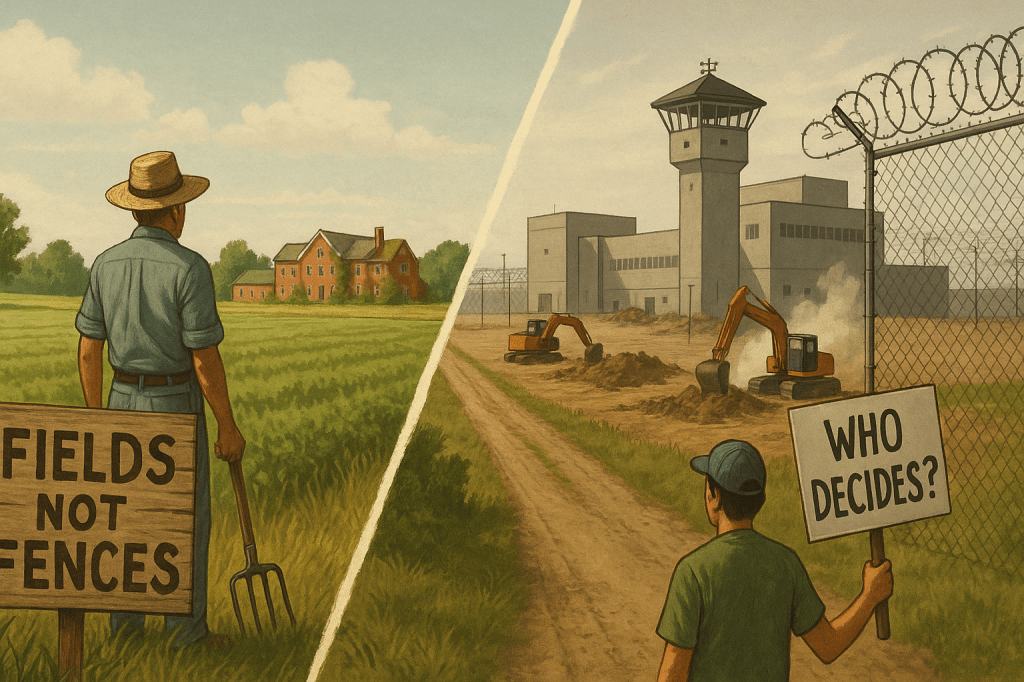
Across a quiet stretch of rural Eastern Ontario, a storm is brewing, not of thunder and rain, but of land use, justice policy, and civic trust. In the town of Kemptville, just 60 kilometers south of Ottawa, the Ontario government has proposed building the Eastern Ontario Correctional Complex (EOCC), a 235-bed provincial jail, on what was once part of the Kemptville College campus; prime agricultural land with deep community roots.

The story of this proposed prison is not only one of construction and policy, but of clashing visions for the future of Eastern Ontario. It is a story of farmland and fences, of children and correctional officers, of infrastructure gaps and political decisions. And perhaps most importantly, it is a story of a community asking why? Why here, and why now?

A Campus Reborn… and a Prison Across the Street

Following the closure of Kemptville College in 2016, the lands were acquired by the Municipality of North Grenville and repurposed into the Kemptville Campus Education and Community Centre. The site now houses educational institutions, youth programs, early learning centres, agricultural innovation hubs, and outdoor experiential learning, drawing hundreds of children and families onto the grounds daily.

Literally across the street, however, the province of Ontario plans to build a modern jail to alleviate overcrowding in Ottawa’s aged and strained Ottawa-Carleton Detention Centre. In 2020, the EOCC was announced without prior consultation with local residents or municipal authorities. Since then, Ontario’s Ministry of the Solicitor General and Infrastructure Ontario have proceeded through environmental, geotechnical, and archaeological assessments, while the procurement process to select a construction partner continues.

In preparation, the province announced a $21.8 million investment in late 2024 to expand the local wastewater treatment facility, an infrastructure boost that would support both the prison and North Grenville’s projected population growth. While this has been framed as a win for the municipality, many in the community see it as paving the way for a facility they never asked for.

Local Voices, Deep Opposition

The backlash has been loud and sustained. The Coalition Against the Proposed Prison (CAPP) has been leading opposition efforts, supported by environmental groups, farmland advocates, and concerned citizens. Their concerns are rooted in what they see as a violation of planning principles: the conversion of 182 acres of prime farmland into a high-security facility in a region ill-equipped for such a purpose.

Their slogan – Fields Not Fences – captures the sentiment. To them, the decision is symbolic of a top-down, opaque approach to governance that neglects local values and long-term sustainability. And perhaps nowhere is this more palpable than on the Kemptville Campus itself.

What About the Kids?

With daycares, high schools, after-school programs, and even an agroforestry centre on the Kemptville Campus, many parents and educators are worried. While there are no official restrictions announced for youth-focused activities, the mere proximity of a medium-security correctional facility raises real questions.

Will the presence of the EOCC, even at a distance, impact perceptions of safety for school trips, outdoor learning, and daycare enrollment? Will families hesitate to send their children to programs just meters away from a working jail? These are not hypothetical concerns, they are being asked by parents, including Mayor Nancy Peckford, whose own children attend the Campus. In public statements, she has pushed the province for assurances, including appropriate setbacks and enhanced communication with the municipality.

The Ministry has agreed to locate the facility as close to Highway 416 as possible, rather than directly beside the campus. It has also committed to design considerations to shield the facility from view, but critics argue that no amount of landscaping can change the fact that children and correctional officers may soon be sharing a road.

Why Not Ottawa?

Perhaps the most confounding part of the province’s decision is its choice to build the jail outside of Ottawa. The provincial rationale, that Eastern Ontario needs more capacity, and that the Kemptville site is government-owned and available, seems less persuasive when weighed against logistical realities. Somehow it feels as if not having to purchase land in Ottawa was the main provincial concern.

Ottawa already hosts the region’s justice infrastructure: courts, legal aid offices, probation services, and public transit. Incarcerated individuals often require court appearances, mental health supports, and visits from family or counsel. Placing a prison in a small town without intercity transit creates additional barriers and isolates the incarcerated even further. It also forces staff to commute from Ottawa, increasing carbon emissions and reducing accessibility.

From an urban planning perspective, this is the antithesis of smart growth. It moves essential services away from existing infrastructure hubs, while forcing a rural community to absorb the impacts, social, environmental, and reputational, of a decision made elsewhere.

The Bigger Picture: Justice, Land, and Power

The Kemptville prison story reveals a broader tension between provincial power and local agency. On one side, a government seeking to modernize correctional infrastructure, reduce Ottawa’s jail overcrowding, and use its own land holdings efficiently. On the other, a community that sees farmland, education, and public trust being sacrificed for a carceral future they do not endorse.

It also reveals the contradictions in Ontario’s approach to land use and justice reform. While it invests in mental health, rehabilitation, and community supports rhetorically, its actions suggest a continued reliance on incarceration, disproportionately impacting Indigenous and racialised people. And while the province claims to value sustainable development, it is choosing to pave over productive farmland at a time when food security and climate resilience are becoming increasingly urgent.

What Comes Next?

Construction of the EOCC has not yet begun. The procurement process is ongoing, and opposition efforts, including a judicial review, are still active. What happens in the next year may determine not only the future of one community, but the direction of Ontario’s justice philosophy.

Will the province revisit its decision in light of sustained resistance? Will it reconsider siting the facility closer to Ottawa, where its infrastructure already exists? Or will it press forward, betting that time and investment will outlast protest?

For now, the fields across from Kemptville Campus remain untouched, but as bulldozers wait in the wings, the people of North Grenville are asking: are we building something we need, or destroying something central to a sustainable community?

Sources

Mr. Carney, Let’s Be Bold and Smart: A Revenue-Neutral Universal Basic Income Is Within Reach

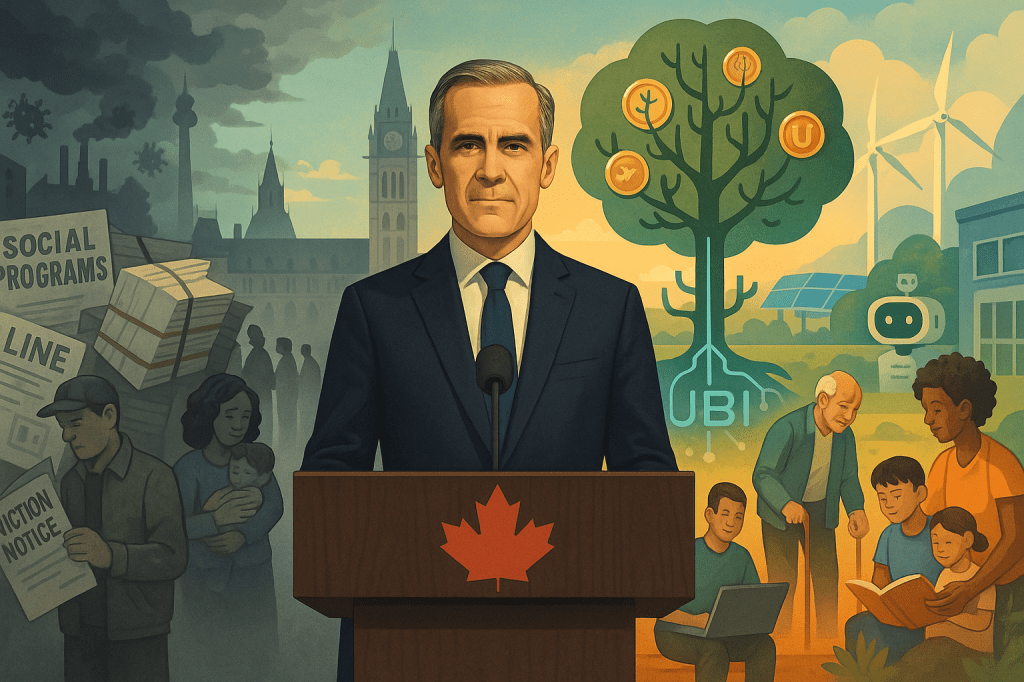
The election of Mark Carney as Canada’s new Prime Minister marks more than a changing of the guard, it signals a chance to transform how we think about economic justice, social policy, and the role of government in a post-pandemic, post-carbon, AI-disrupted world. Yet, if this new Liberal administration wants to do more than manage decline or tinker at the edges, it must champion Universal Basic Income (UBI), and it must do so within this first term.

To skeptics, the usual pushback is cost. “We can’t afford it.” But what if I told you we can, without adding a cent to the deficit?

A bold, revenue-neutral UBI is not only possible, it’s the smart, responsible, and forward-thinking choice. It would simplify our bloated patchwork of social programs, reduce inequality, and stabilize the economy, all while respecting fiscal realities. Carney, with his reputation for monetary prudence and social conscience, is uniquely positioned to make this happen.

The Case for UBI, Now More Than Ever
We live in precarious times. AI and automation are displacing jobs once thought secure. The gig economy has redefined work for an entire generation, offering flexibility but no stability. Climate change is reshaping our industries, economies, and communities. And regional inequalities, from rural depopulation to urban housing crises, are deepening social division.

UBI provides a powerful, simple solution: a no-strings-attached income that ensures every Canadian can meet their basic needs, make real choices, and live with dignity. No complex eligibility criteria. No stigma. Just a stable foundation for all.

This isn’t a call for endless spending. This is a plan for smart reinvestment, one that replaces outdated, fragmented systems with a coherent, efficient, and humane approach.

Revenue-Neutral UBI: A Practical Path
The key to political and economic viability is fiscal neutrality. Here’s how we get there:

Streamline the Social Safety Net
Our current welfare architecture is costly, overlapping, and often punitive. We propose replacing core income support programs, provincial social assistance, EI for low-wage workers, and a range of targeted income-tested tax credits, with a single, universal UBI. This simplification reduces administrative duplication and restores dignity to recipients.

Rethink OAS and GIS
These seniors’ programs already operate as a basic income for the elderly. By integrating them into a universal model, with UBI replacing these benefits for most, but supplemented by needs-based top-ups for seniors with unique medical or housing costs, we ensure fairness without duplication.

Restructure (Not Eliminate) CPP
CPP remains essential as a pension earned through contribution, but some recalibration of contribution thresholds and benefit tiers, alongside UBI, can reduce reliance on inflated public pensions to cover basic needs, while preserving the contributory principle.

Modest, Targeted Tax Reform
To close the revenue loop, introduce a small surtax (e.g., 2%) on individual incomes over $150,000, and slightly increase capital gains inclusion rates. These are not radical measures, they simply ask the wealthiest Canadians to help ensure every citizen has a secure foundation. For 95% of taxpayers, no increase would be necessary.

Numerous economic models (including work by Evelyn Forget, UBC’s Kevin Milligan, and CCPA researchers) show that a well-designed UBI can be nearly or entirely self-funding when paired with smart policy adjustments like these.

Political Opportunity and Liberal Legacy
Prime Minister Carney doesn’t need to look far for historical inspiration. Universal healthcare, bilingualism, the Charter, these were all ambitious Liberal achievements once considered politically risky and fiscally daunting, yet they reshaped Canada.

UBI can be his legacy. It would resonate across voter blocs: rural Canadians seeking stability, urban millennials burdened by debt and housing costs, women and caregivers locked out of full-time work, and gig workers with no safety net. It’s a unifying policy in a fragmented nation.

Moreover, by leading with a revenue-neutral model, Carney can neutralize opposition from deficit hawks and centrists, while winning support from social democrats, Indigenous leaders, environmentalists, and the entrepreneurial class alike.

A Step-by-Step Roadmap

  • Launch a National UBI Task Force in the first 100 days, chaired by experts in economics, social policy, and Indigenous governance.
  • Table a UBI White Paper by the end of Year 1, outlining fiscal models, legal changes, and implementation scenarios.
  • Pilot the program in a representative region (e.g., Northern Ontario, Atlantic Canada, or an urban-rural mix) with independent evaluation.
  • Introduce legislation in Year 3, with phased implementation beginning before the 2029 election.

This is not pie-in-the-sky. This is responsible governance meeting bold vision.

The Values We Must Uphold
UBI is about more than money, it’s about modernizing our social contract. It says to every Canadian: you matter. You are not a cost, a case file, or a problem to manage. You are a citizen with rights, worth, and potential.

Mr. Carney, you’ve spoken eloquently about “values-based capitalism” and “inclusive transitions.” UBI is the policy vehicle that delivers on those values. And by designing it to be fiscally neutral, you can bring the skeptics along without compromising ambition.

Now is the time to lead not just with caution, but with courage. We can afford Universal Basic Income, not in spite of economic constraints, but because of them.

Let’s stop managing poverty. Let’s start guaranteeing security. Let’s build a Canada where no one is left behind.

Shared Spaces, Different Rules: When BDSM, Swinging, and Polyamory Collide

This has been an ongoing topic of conversation among a number of my friends and community members over the last year. While this post is not the definitive answer, I hope it helps continue the discussion.

Merged doesn’t have to mean blurred

More and more, those of us in the BDSM, polyamory, and swinger communities are finding ourselves in overlapping spaces: at events, online, and even in our relationships. What used to be distinct subcultures with their own values and norms is starting to feel like one big, blended scene.

For some, this is energizing. For others, it’s disorienting.

The truth is, we don’t all approach relationships, power, or sex the same way. And while there’s room for overlap, there’s also the risk of misunderstanding, boundary friction, or even cultural erasure if we don’t approach this merger with care.

So let’s talk about what we’re gaining, and what we could lose, when our communities start to share the same space.

Why the Overlap is Happening

The convergence of these communities isn’t random. We all operate outside traditional relationship structures and sexual expectations. We value consent, self-determination, and authenticity.

And let’s be honest; finding safe, welcoming spaces can be hard. It makes sense that events and groups are becoming more collaborative and open to cross-community participation.

Many people don’t want to pick just one label. A polyamorous submissive might enjoy occasional swinger parties. A Dominant may explore romantic non-monogamy. Shared spaces let people experiment and connect without feeling boxed in.

On a practical level, venue access, costs, and organizers’ energy also drive collaboration, yet collaboration only works when we recognize how different our needs and expectations can be.

What We Gain by Coming Together

💬 Bigger, Stronger Communities
Merging creates larger, more resilient networks. Whether we’re sharing resources, building friendships, or pushing for social recognition, we’re stronger together.

📚 Learning Across Lifestyles
Each community has something to teach. BDSM offers detailed consent frameworks and boundary-setting. Polyamory brings emotional literacy and communication models. Swingers know how to host low-pressure sexual spaces. Shared wisdom benefits us all.

🎉 More Inclusive Events
Workshops, discussion nights, and play parties with room for cross-community participation give people a chance to explore without committing to a label.

📢 Amplified Visibility
Speaking together helps shift the narrative about non-normative relationships and sexualities. We challenge stereotypes more effectively when our voices are united.

But There Are Real Risks, Too

⚠️ Different Cultures, Different Norms
Each community operates on its own foundation:

  • BDSM: Structured power dynamics, not necessarily tied to sex or romance.
  • Swinging: Primarily recreational sex, often in couple-based social networks.
  • Polyamory: Emotional intimacy, often with long-term relational goals.

These are more than an orientation or styles, they’re cultural languages. Colliding without translation causes friction.

🚧 Consent and Boundary Confusion
In BDSM, consent is explicit and often negotiated in advance. In swinger circles, casual physicality may be expected. Poly meetups might center on emotional connection, not touch. If expectations aren’t clear, people get hurt, even unintentionally.

🏠 Loss of Dedicated Spaces
Some BDSM dungeons now carry sexual expectations introduced through swinger norms. For those who use BDSM as a non-sexual, power-centered expression, that shift can feel deeply alienating.

🧩 Risk of Exclusion
When merged spaces cater mostly to those who fit all three categories, others get pushed to the edge. An asexual Dominant, or a solo polyamorous person uninterested in parties, may not find what they need in these new environments.

🤷‍♂️ Public Misunderstanding
Outsiders already conflate BDSM, polyamory, and swinging. Merged visibility can increase confusion: polyamory gets reduced to casual sex, BDSM gets sexualized, swinging gets dismissed. Nuance is lost.

So How Do We Do It Right?

Clarity Above All
Be transparent. Is this a BDSM workshop with room for poly topics? A swinger party with structured scenes? People need to know what they’re walking into.

Consent Is More Than a Buzzword
It’s not just about sex or play – it’s about everything. Don’t assume touch, energy, or conversation is welcome without agreement.

Shared Events, Distinct Zones
Merged doesn’t have to mean blurred. Offer spaces within events that honor BDSM protocol, support poly dialogue, or provide swinger-friendly play. Let people choose their comfort zones.

Center Marginalized Voices
Make space for the folks who get overlooked – queer, trans, neurodivergent, BIPOC, disabled, and asexual folks deserve to feel included in merged scenes, too.

Final Thoughts

The blending of BDSM, swinging, and polyamory is happening, whether we plan for it or not. The question is: will we do it with care?

We don’t need to erase our boundaries to share space. We just need to see each other clearly, communicate well, and build with intention.

If we do that, we create a community that’s not only broader; but deeper, richer, and more resilient than any of us could build alone.


Suggested Tags

#BDSM #Polyamory #Swingers #Community #ConsentCulture #NonMonogamy #EthicalNonMonogamy #PowerExchange #RelationshipAnarchy #RespectTheDifferences #MergedSpaces #AltSexualities #NavigatingBoundaries #FetLifeVoices

🔥 Billie Piper Is (Possibly) the Doctor, and the Whoniverse Will Never Be the Same 🔥

As I wrote a month ago, I was ready to move on from this show, and then Davies throws us a huge twisted surprise in the form of Billie Piper! 

The Doctor Who fandom is on fire following the explosive twist in the Season 2 finale, The Reality War. Just when we thought we had a grasp on where Russell T Davies was taking us, Ncuti Gatwa’s Fifteenth Doctor regenerated… into Billie Piper. Yes, that Billie Piper. The Rose Tyler. The Bad Wolf. The Moment. And now, potentially, the Doctor herself.

This isn’t just a stunt, it’s a paradigm shift. Never before in the show’s 60+ year history has a former companion become the Doctor. And Piper’s return, announced with a cheeky “Introducing Billie Piper” credit, has launched Doctor Who into completely uncharted territory.

🌀 So What Could This Mean?

  • She’s the actual Sixteenth Doctor. The regeneration was legit, the torch has been passed, and Billie Piper now holds the keys to the TARDIS. Her earlier role as The Moment in The Day of the Doctor showed she can embody Time Lord gravitas with ease — now we get the full dose.
  • She’s a Doctor from an alternate universe or timeline. We’ve seen how messy reality can get when timelines converge (hello, Reality War), and this could be a brilliant multiversal twist.
  • She’s a projection, interface, or psychic echo. Could the Doctor have splintered himself across reality, creating a version that looks like his most iconic companion? The symbolism would be rich and emotionally resonant.
  • A new regeneration cycle entirely. With the lore expanding since The Timeless Child, the idea of new rules, new forms, and new faces makes Billie Piper’s presence feel like the launch of a bold new era, not just a casting surprise.

❤️ Fans Are Loving It

Across Reddit, Twitter, and fan forums, the excitement is electric. Longtime fans see this as a poetic full-circle moment: the return of one of NuWho’s founding stars, not as a memory, but as the next incarnation of the Doctor. New viewers get a twist that redefines the show’s boundaries and potential. And Billie? She’s clearly thrilled to be back, calling the role “irresistible” and promising something unlike anything we’ve seen before.

✨ Final Take

This move by Davies is genius-level showrunning: nostalgic, surprising, and bold. Billie Piper as the Doctor could mean a full season of unpredictable energy, cosmic-scale storytelling, and emotional depth, all anchored by one of Doctor Who’s most beloved performers.

The TARDIS has never felt so wide open.


📚 Sources

The Gender Revolution: Challenging Patriarchy Through Authenticity and Inclusion

At the beginning of Pride month, I thought I would write about how the gender revolution continues to challenge the patriarchy.

Transgender, non-binary, and intersex individuals are at the forefront of dismantling the patriarchy by challenging the rigid binary system of gender that has long served as a foundation for patriarchal control. Their very existence calls into question the assumption that gender is biologically fixed and limited to male and female, revealing instead that gender is a spectrum shaped by culture, society, and personal identity. By stepping outside these traditional categories, they expose the arbitrary nature of the binary and the oppressive structures that enforce it.

This disruption strikes at the heart of patriarchy, which relies on the dominance of men and the subjugation of women, while erasing those who exist outside these categories. Trans, non-binary, and intersex people decenter masculinity as the default and destabilize the hierarchy that assigns privilege based on adherence to rigid gender roles. By refusing to conform, they challenge the power structures that define worth and authority through this binary lens, opening the door to more equitable understandings of identity and power.

Their visibility also reshapes the cultural landscape, introducing new norms that value authenticity and inclusivity over conformity. The push for gender-neutral pronouns, inclusive policies, and equitable representation shifts societal expectations and disrupts patriarchal systems that thrive on control and standardization. These changes are not superficial; they represent a fundamental reimagining of how society organizes itself, centering individuality and respect over outdated binaries.

Furthermore, the activism of trans, non-binary, and intersex people often intersects with other struggles, including race, class, and disability justice. Their work highlights the interconnectedness of oppressive systems, fostering solidarity across movements and reinforcing the need for an intersectional approach to dismantling patriarchy. By challenging the binary, they do more than fight for their own liberation; they open pathways for others to envision a world free from the constraints of outdated gender norms.

In living authentically and advocating for change, trans, non-binary, and intersex individuals offer a radical critique of the status quo and a hopeful vision for the future. Their courage and resilience are reshaping how we think about gender, identity, and power, and in doing so, they are helping to dismantle one of the most deeply entrenched frameworks of oppression.

Policing the Halls: Why Officers Don’t Belong in Ontario Schools

The integration of police officers into Ontario schools, primarily through School Resource Officer (SRO) programs, has been a contentious issue for decades. Initially introduced in the early 1990s, these programs aimed to foster positive relationships between students and law enforcement, deter criminal behavior, and enhance school safety. Over time, however, concerns about their effectiveness and impact on marginalized communities have led to widespread reevaluation and, in many cases, the termination of such programs.

One of the most comprehensive evaluations of an SRO program in Ontario was conducted by Carleton University, focusing on Peel Region’s initiative. The study reported several benefits, including reduced crime and bullying, improved mental health among students, and a significant return on investment, estimating $11.13 in social and economic benefits for every dollar spent. Notably, students who had experienced bullying or violence reported feeling significantly safer after five months of the program. School staff also benefited, spending less time on disciplinary matters due to the support of SROs.  

Despite these findings, the presence of police in schools has faced mounting criticism. Critics argue that SRO programs disproportionately affect racialized and marginalized students, contributing to a school-to-prison pipeline. For instance, the Toronto District School Board (TDSB) implemented its SRO program in 2008, but terminated it in 2017 after a review revealed that some students felt intimidated by the presence of officers, particularly Black students who expressed fear related to armed officers in schools.    

Similarly, the Peel District School Board ended its SRO program in 2020, acknowledging that it had a negative impact on segments of the student population and citing concerns about systemic racism and the disproportionately punitive effects of such programming.  The Ottawa-Carleton District School Board followed suit in 2021, with trustees voting to end participation in the SRO program and issuing a formal apology for any harm experienced by students or community members.   

The Ontario Human Rights Commission (OHRC) has also weighed in, emphasizing the need to consider terminating SRO programs in light of existing research and meaningful community consultation. The OHRC highlighted that while some students may feel safer with police presence, others, particularly those from marginalized communities, may feel unsafe or targeted, which can negatively impact their educational experience.  

Given this historical context, reintroducing police into Ontario schools raises significant concerns. While studies like the one conducted in Peel Region suggest potential benefits, they often fail to adequately address the experiences of marginalized students who may feel alienated or criminalized by police presence. The risk of exacerbating systemic inequalities and undermining the educational environment for these students outweighs the purported advantages. 

Instead of reinstating SRO programs, resources should be allocated to initiatives that promote equity and inclusivity within schools. This includes investing in mental health services, hiring more guidance counselors, and implementing restorative justice practices that address behavioral issues without resorting to punitive measures. By focusing on these alternatives, Ontario can create a safer and more supportive educational environment for all students, particularly those who have historically been marginalized. 

While the intention behind placing police officers in schools may be to enhance safety and build community relations, the evidence suggests that such programs can have detrimental effects on marginalized student populations. Ontario’s educational institutions should prioritize inclusive and supportive measures that address the root causes of behavioral issues without contributing to systemic disparities.

Five Things We Learned This Week

Here is the latest edition of “Five Things We Learned This Week” for May 24–30, 2025, highlighting significant global developments across various sectors.

🧠 1. AI Threatens to Displace Half of White-Collar Jobs

Dario Amodei, CEO of AI firm Anthropic, has warned that artificial intelligence could eliminate up to 50% of entry-level white-collar jobs within the next five years. Tasks such as document summarization, report analysis, and computer coding are increasingly being performed by AI at levels comparable to a smart college student. Amodei predicts that U.S. unemployment rates could reach 20% by 2030 if proactive measures aren’t taken. He advocates for policy interventions, including taxing AI labs, to mitigate potential economic disruptions.  

🏗️ 2. Kmart Announces $500 Million Fulfillment Center in Australia

Kmart has unveiled plans to invest $500 million in constructing a new 100,000 square meter Omnichannel Fulfillment Centre at ESR’s Intermodal Precinct in Moorebank, Australia. Scheduled for completion by the end of 2027, the facility aims to modernize logistics, enhance supply chains, and support Kmart’s $20 billion revenue goal over the next decade. The project is expected to create over 1,300 jobs during its construction and operational phases.  

🇲🇳 3. Political Turmoil Escalates in Mongolia

Mid-May saw the onset of sustained protests in Ulaanbaatar, Mongolia, with demonstrators calling for the resignation of the prime minister over corruption allegations involving his family. On May 21, the ruling Mongolian People’s Party expelled the Democratic Party from the coalition government after several of its lawmakers supported the protests, effectively dissolving the coalition less than a year after its formation.  

🎶 4. Rio de Janeiro Hosts Massive Free Music Festival

The “Todo Mundo no Rio” (Everyone in Rio) music festival transformed Copacabana Beach into a massive stage, attracting over 2.1 million attendees. The event featured performances by international artists and is part of a series of annual megashows promoted by the City of Rio de Janeiro to establish May as a month of cultural celebration.  

🧬 5. Advancements in Gene Editing with CRISPR 3.0

Scientists have developed CRISPR 3.0, a new gene-editing technique that allows for highly precise DNA edits without causing unintended mutations. This advancement holds promise for curing genetic disorders and advancing personalized medicine by enabling more accurate and safer genetic modifications.  

Stay tuned for next week’s edition as we continue to explore pivotal global developments.

Canada’s Non-Timber Forest Products Industry: A Sleeping Giant in the Agrifood Sector

Back in 2010-2012, I was working with clients such as the Canadian Model Forest Network, Agriculture and Agri-Food Canada, and Natural Resources Canada to help define and develop this industry. I thought it was time to update myself on its progress.  

When Canadians think of forests, they typically picture lumber, pulp, and paper. Yet, beyond the timber trade lies an equally vital and dramatically underdeveloped resource sector: non-timber forest products (NTFPs). These include wild mushrooms, berries, medicinal herbs, tree saps, florals, and natural resins; goods that have been harvested for centuries by Indigenous peoples and rural communities, but remain economically marginal in modern Canada. As the agrifood sector seeks to diversify income sources, adapt to climate risks, and respond to consumer demand for sustainable and culturally authentic products, NTFPs represent an untapped reservoir of opportunity.

Canada, after all, is one of the most forested countries on Earth, with over 347 million hectares of forest covering approximately 38% of its landmass. Within these ecosystems is a treasure trove of bioresources, many of which are already enjoying renewed interest in global markets: from functional foods and nutraceuticals to cosmetics and natural health products. The challenge is not whether Canada has the raw materials. It is whether the country can align policy, investment, and Indigenous partnerships to turn these undervalued goods into robust regional economies.

At present, the NTFP sector is dominated by one clear leader: maple syrup. Worth over $1 billion annually, and with Quebec supplying more than 70% of the world’s maple syrup, this industry is the flagship of Canada’s non-timber forest economy. Wild blueberries, predominantly from Quebec, Nova Scotia, and New Brunswick, form another lucrative market, with production values exceeding $300 million in 2023. Yet outside of these headline commodities, the remaining NTFP sector is diffuse, localized, and largely informal. Wild mushrooms like morels, chanterelles, and lobster mushrooms are harvested across British Columbia, Ontario, and the Maritimes, often exported to European and Asian buyers, but little coordinated infrastructure exists to support consistent volumes or traceable quality. Medicinal plants such as chaga, Labrador tea, and devil’s club are well known to Indigenous communities, but underutilized in formal markets.

The potential for growth in this sector is significant. Globally, the market for natural health and functional food products is expanding rapidly. Medicinal mushrooms, in particular, are on track to reach $19 billion by 2030, according to 2024 projections by Global Market Insights. Canada’s forests host many of these species, including chaga, reishi, lion’s mane, and turkey tail, all of which are in high demand in wellness and integrative medicine circles. Similarly, birch sap, a staple in parts of Eastern Europe and Russia, is beginning to attract attention in North America as a low-sugar, antioxidant-rich beverage. There is considerable room for Canadian producers to position their NTFPs in these emerging global niches, especially if backed by origin branding, sustainability certification, and cultural narratives that resonate with eco-conscious consumers.

Despite this promise, the NTFP sector remains constrained by structural barriers. Chief among these is the fragmented and often inconsistent regulatory environment across provinces. Many NTFPs fall outside the scope of forestry tenure agreements and agricultural marketing boards, leaving harvesters in a grey zone with unclear land access rights or commercialization protocols. In some provinces, the rules for harvesting and selling wild mushrooms or herbal plants vary from one jurisdiction to another, complicating efforts to build coordinated value chains. The lack of aggregation infrastructure and cold storage capacity further limits the ability of small-scale producers to move beyond seasonal, informal markets.

Another limiting factor is the scarcity of applied research and product development capacity tailored to NTFPs. Few Canadian universities or government research agencies have dedicated programs for wild plant or fungal product development, and even fewer link with Indigenous knowledge systems in ways that are respectful, reciprocal, and rights-based. Traditional knowledge about the ecological cycles, medicinal uses, and sustainable harvest of forest plants remains vastly underrecognized in Canada’s commercial landscape. Until this knowledge is better integrated and protected through co-management and intellectual property frameworks, the sector will remain vulnerable to exploitation and underperformance.

Equity and land tenure issues must also be addressed. Indigenous communities are among the most active stewards and knowledge-holders of NTFPs, yet they often face structural barriers to entering or scaling in commercial markets. The promise of NTFPs as a tool for Indigenous economic development is well documented, but to realize that potential, governments must ensure clear access rights, provide targeted funding for Indigenous-led enterprises, and support co-governance models that reflect Indigenous sovereignty over forest resources.

Looking ahead, the Canadian NTFP sector needs a concerted strategy. This means intergovernmental coordination to harmonize regulations, investment in processing and aggregation infrastructure, and the development of national standards for quality assurance. Just as importantly, there must be a storytelling effort, one that situates NTFPs not merely as exotic forest goods, but as emblematic of Canada’s commitment to sustainable agriculture, reconciliation, and regional resilience. Products like Labrador tea, spruce tips, and wild fiddleheads should not be relegated to niche farmers’ markets; they should be among Canada’s most proudly exported biocultural goods.

If Canada is to meet its agrifood diversification and climate adaptation goals, the time has come to give non-timber forest products their due. The market is maturing, the environmental case is strong, and the social and economic benefits, particularly for Indigenous and rural communities, are substantial. We must move beyond pilot projects and showcase stands. With vision and investment, Canada’s NTFP industry could blossom from a peripheral activity into a pillar of the national agrifood economy.

Sources
• Natural Resources Canada. (2021). Non-Timber Forest Products in Canada: An Overview. https://www.nrcan.gc.ca/
• Agriculture and Agri-Food Canada. (2023). Statistical Overview of the Canadian Fruit Industry 2023. https://agriculture.canada.ca/
• Global Market Insights. (2024). Medicinal Mushroom Market Size, Share & Trends Analysis. https://www.gminsights.com/
• Indigenous Forestry Initiative. (2023). Case Studies in Indigenous-Led NTFP Enterprises. https://www.canada.ca/en/environment-climate-change/services/indigenous-forestry-initiative.html

F-35A vs Gripen E: Why Canada Needs a Mixed Air Fleet

Canada is finalizing a long-term commitment to its next-generation fighter fleet. While the Lockheed Martin F-35A Lightning II has dominated the headlines and procurement process, many analysts and defence strategists continue to argue for a more balanced approach that reflects Canada’s non-aggressive, defence-oriented military posture. Enter the JAS 39 Gripen E, Sweden’s cost-effective and resilient multirole fighter.

In this article, we compare the F-35A and Gripen E across key domains, and propose a strategic mixed-fleet solution tailored to Canada’s unique geography, alliances, and policy values.

F-35A vs Gripen E: A Comparative Analysis

FeatureF-35A Lightning IIJAS 39 Gripen E
OriginUnited StatesSweden
RoleStealth multirole strike & ISRAgile, cost-effective air defense
Stealth5th-gen stealth with internal weapons baysLow-observable 4.5-gen fighter; external weapons only
SensorsFusion: AESA radar, DAS, EOTS, HMDAESA radar, IRST, electronic warfare suite
Speed & AgilityMach 1.6, less agileMach 2.0, supercruise, high agility
Operating Cost~$35,000/hr~$8,000 – $10,000/hr
MaintenanceComplex, centralized logisticsModular, road-capable, easy maintenance
InteroperabilityDeep NATO/NORAD integrationFlexible, sovereign-capable system
Best Suited ForHigh-end coalition warfareDomestic sovereignty & intercept missions

The F-35A excels in stealth, sensor fusion, and networked warfare. It’s optimized for first-strike and multi-domain operations in complex allied theatres. The Gripen E, by contrast, is designed for national airspace protection, low-cost deployment, and high survivability through speed and agility.

For most countries, the choice between them is binary. But for Canada, a mixed fleet provides the best of both worlds.

Canada’s Defence Posture: Defence, Not Offence

Canada’s 2017 defence policy, Strong, Secure, Engaged (source), emphasizes:

  • Sovereignty protection, particularly in the Arctic
  • Fulfillment of NORAD and NATO responsibilities
  • Commitment to peacekeeping and allied security, not aggression or projection

This makes a single-type, stealth-heavy force both expensive and strategically limiting. The F-35A’s sophistication comes with high costs and logistical burdens. The Gripen’s versatility and affordability make it ideal for Canada’s domestic priorities, especially Arctic response and cost-effective patrols.

The Ideal Fleet Mix: 48 F-35A + 36 Gripen E

A proposed balanced force of 84 aircraft could look like this:

  • 48 F-35A Lightning II – Two combat squadrons for NATO/NORAD + First-strike SEAD missions
  • 36 JAS 39 Gripen E – Two intercept/sovereignty squadrons for Cold Lake & Bagotville + Pilot training

This mix satisfies Canada’s allied obligations while keeping operational costs under control and increasing resilience and redundancy.

Mission-by-Mission Alignment

Mission TypeAircraft Best Suited
NATO expeditionary combatF-35A
Arctic sovereignty patrolsGripen E
NORAD interceptsGripen E (routine), F-35A (high threat)
Peacekeeping air policingGripen E
First-strike SEAD missionsF-35A
Pilot trainingGripen E (cost-effective)

Additional Benefits of a Mixed Fleet

  • Economic efficiency: Gripen costs 3–4x less to operate, allowing more flying hours and Arctic readiness.
  • Strategic autonomy: Saab offers greater technology transfer and offset potential, unlike the F-35 program.
  • Operational resilience: Gripens can operate from rural or improvised runways in the North.
  • Supplier diversification: Reduces geopolitical and logistical risk from relying on a single supplier (U.S.).

Potential Challenges & Mitigations

ConcernMitigation
Dual logistics systemsSegmented basing and dedicated maintenance crews
InteroperabilityGripen is NATO-compatible and can integrate via standard datalinks
Training duplicationGripen used for advanced pilot training and tactical development

Final Word

A dual-fighter strategy is neither nostalgic nor redundant, it is forward-thinking. By balancing cutting-edge stealth with efficient sovereignty defence, Canada can build an air force that is:

  • Strategically aligned with its defensive posture
  • Economically sustainable over decades
  • Technologically capable of high-end conflict
  • Operationally flexible across vast geography

This isn’t just a compromise, it’s a model of how Canada can lead by example in blending technology, sovereignty, and peacekeeping into a cohesive air defence strategy.

Sources

Tags: #CanadianDefence #F35 #Gripen #NORAD #NATO #ArcticDefence #MilitaryPolicy #Peacekeeping #AirPower