Louisiana: A Tapestry of Cultures and Clashing Politics

Thinking about how the Trump administration targeted Quebec, it’s language and cultural protection laws as a trade issue, makes me wonder about other unique cultures to be found in North America, and how they must be protected and supported so that can thrive. 

Louisiana is one of the most culturally and politically diverse states in the U.S., shaped by centuries of colonization, migration, and social upheaval. Its identity is a fusion of Indigenous heritage, French and Spanish rule, African influence, and waves of immigrant communities, each leaving an indelible mark on the state’s music, food, language, and traditions. While Louisiana’s reputation often conjures images of jazz-filled streets and spicy Creole dishes, its cultural complexity goes far beyond the postcard version. The same holds true for its politics, which remain as layered and contradictory as the people who call it home.

At the heart of Louisiana’s cultural richness is its history of colonization. Long before Europeans arrived, Indigenous tribes such as the Houma, Chitimacha, and Caddo lived along the state’s bayous and forests, cultivating their own traditions that persist to this day. The arrival of French explorers in the late 17th century set the stage for Louisiana’s deep Francophone roots, later reinforced by Spanish rule and the eventual return to French governance before Napoleon sold the territory to the United States. Unlike other parts of the American South, Louisiana retained much of its European colonial heritage, from its legal system, still based on Napoleonic civil law, to the Catholicism that remains a cultural and religious cornerstone, particularly in the southern part of the state.
The distinct identities of Louisiana’s Creole and Cajun populations further enrich its cultural landscape. The term “Creole” originally referred to people of European descent born in the colony, but over time it expanded to include people of mixed French, Spanish, African, and Indigenous ancestry. Creole culture is inseparable from the rhythms of zydeco music, the spice-laden flavors of gumbo and étouffée, and the linguistic blend of French, Spanish, and West African dialects that still echo in Louisiana Creole speech. Cajuns, on the other hand, descend from Acadian exiles forced out of Canada by the British in the 18th century. They settled in the swamps and prairies of south Louisiana, where they developed a fiercely independent identity rooted in their own dialect of French, fiddle-driven music, and a cuisine that, while similar to Creole food, leans more heavily on rustic ingredients like smoked sausage and crawfish.

The African influence on Louisiana’s culture is profound. Under both French and Spanish rule, enslaved Africans were a critical part of Louisiana’s economy and society, bringing agricultural expertise and spiritual traditions that persist in the region’s religious practices, including voodoo. Unlike in much of the American South, enslaved people in Louisiana had a higher rate of manumission under Spanish rule, leading to a large and influential population of free people of color who contributed to the state’s art, music, and business world. This legacy is most famously seen in New Orleans, where jazz was born in the late 19th century, blending African rhythms, blues structures, and European brass instrumentation into what would become America’s greatest musical export.

Beyond its historic communities, Louisiana continues to be a place of immigration and cultural blending. In the aftermath of the Vietnam War, thousands of Vietnamese refugees settled along the Gulf Coast, where they became an integral part of the seafood industry and introduced new flavors and traditions to the region. Today, their influence is visible in everything from Vietnamese-Cajun crawfish boils to the bustling pho restaurants of New Orleans and Baton Rouge. Other immigrant groups, including Hondurans, Italians, and Croatians, have also left their mark, particularly in Louisiana’s fishing and food industries.

Just as Louisiana’s culture defies easy categorization, so does its politics. Historically, the state was a Democratic stronghold, shaped by its Catholic, agrarian roots, and the populist legacy of figures like Huey Long, who built his career on promises of wealth redistribution, infrastructure development, and defiance of the political elite. Long’s legacy remains deeply embedded in Louisiana’s political DNA, with many politicians still invoking his populist rhetoric even as the state has shifted toward Republican dominance.

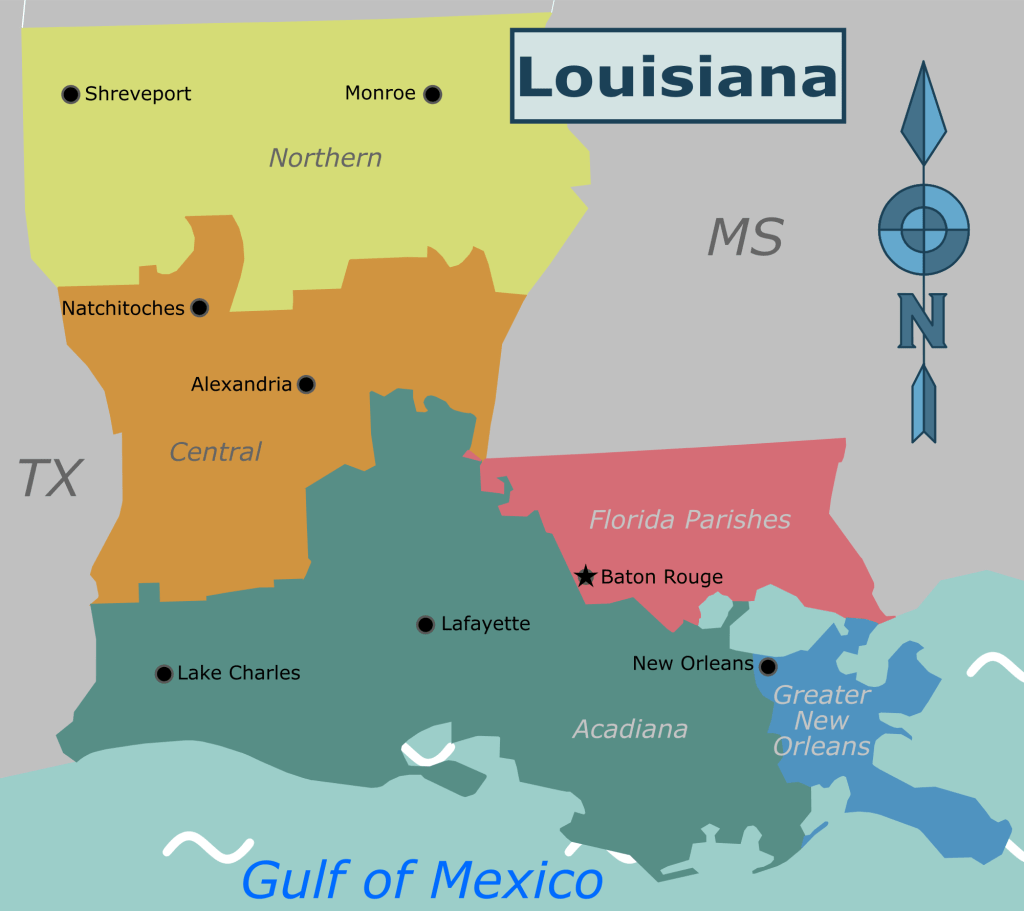
Today, Louisiana’s political landscape is sharply divided by geography and demographics. Urban centers like New Orleans and Baton Rouge lean liberal, with strong Black and progressive voting blocs advocating for criminal justice reform, environmental protections, and expanded social programs. In contrast, rural Louisiana, particularly in the north, aligns more closely with the Deep South—socially conservative, evangelical Protestant, and deeply Republican. The Acadiana region, home to the Cajun population, has long maintained a distinct political identity. While once a bastion of working-class Democratic politics, it has increasingly moved to the right, particularly on social issues, though economic populism remains a common theme in local elections.

Louisiana’s racial history continues to shape its political discourse in ways that are often contentious. The long struggle for civil rights, from the desegregation battles of the 1960s to ongoing debates over voting rights and police reform, remains a central issue. Meanwhile, the state’s economic reliance on oil, gas, and fishing means that environmental politics are often fraught, as coastal communities grapple with rising seas and frequent hurricanes while also depending on industries that contribute to these very problems.

Perhaps the most defining feature of Louisiana politics is its enduring embrace of colorful, often scandal-ridden leadership. Corruption has long been a fact of life in the state’s political world, with governors, legislators, and city officials frequently making headlines for bribery, fraud, and backroom deals. Yet, rather than diminish voter engagement, this history has fostered a kind of cynical but amused pragmatism among Louisiana’s residents. People expect their politicians to be flawed, but they also expect them to deliver; whether that means rebuilding roads, cutting through bureaucratic red tape, or simply keeping the good times rolling.

In many ways, Louisiana is a place of contradictions. It is at once fiercely traditional and wildly innovative, politically conservative yet home to some of the most progressive cultural movements in the country. It reveres its past but is constantly reshaped by new influences. This complexity is what makes Louisiana so compelling; a state where history is always present, culture is never static, and politics, for better or worse, is never boring.

Reinforcing Mononormativity at Women’s Expense

Jennyfer Jay’s writing and social media presence offer an intimate, often vulnerable look into her personal experiences navigating contemporary womanhood. Her reflections on casual dating, relationships, and emotional growth resonate with many women grappling with a world that seems increasingly disconnected and transactional. However, despite the sincerity of her storytelling, her work implicitly reinforces mononormative narratives, those that assume monogamy as the only valid or fulfilling form of romantic relationship. This framing not only limits the imagination of what relationships can look like, but paradoxically sets women up for failure in the very dynamics she critiques.

Jay’s essays frequently center on the emotional toll of casual sex and emotionally unavailable men. While these are valid themes, her framing often implies that the natural arc of a woman’s life, and healing, is toward securing emotional commitment from one man. This reinforces the mononormative ideal that stability, validation, and maturity are achieved through exclusive partnership. In her work, men who avoid commitment are treated as broken or selfish, while women who desire commitment are portrayed as evolved or emotionally ready. This binary undercuts the possibility that diverse relationship structures, such as ethical non-monogamy, relationship anarchy, or solo polyamory, might also offer meaningful paths toward emotional growth, security, and connection.

What Jay’s narratives tend to overlook is the systemic nature of the mononormative trap. By valorizing monogamous commitment as the end goal, she leaves little room for women to explore other models of love and companionship without shame. Her reflections, while emotionally resonant, often risk pathologizing women’s unhappiness as stemming from men’s refusal to play their part in the monogamous script, rather than from the script itself. In this way, Jay participates in a cultural feedback loop where women are socialized to desire a particular kind of relationship, and then blamed, or encouraged to blame men, when it fails.

This dynamic is particularly evident in her TikTok content, where Jay sometimes uses the confessional format to speak to younger women about “knowing their worth” or “not settling for less.” While empowering on the surface, the subtext implies that true worth is ultimately validated by a partner who chooses exclusivity. This undermines women who find satisfaction in non-exclusive relationships, or who define emotional success on different terms. Furthermore, it shifts the burden of relational success onto women’s ability to “choose better,” rather than questioning the limiting structures themselves.

To be clear, Jennyfer Jay’s work has value: it opens important conversations, validates emotional experiences, and challenges harmful behaviour, but it is also crucial to interrogate the assumptions it upholds. A deeper, more liberatory feminist approach would challenge the centrality of monogamy altogether, recognizing that love, commitment, and emotional fulfillment need not conform to normative ideals. Without this lens, Jay’s content risks entrenching the very narratives it seeks to critique, leaving women emotionally entangled in systems that do not serve them.

Sources:
• Jennyfer Jay on Medium: https://medium.com/@JennyferJay
• Jennyfer Jay on TikTok: https://www.tiktok.com/@jennyferjay
• Pieper, M. (2020). Mononormativity and Its Discontents. Journal of Contemporary Social Theory.
• Barker, M. (2013). Rewriting the Rules: An Integrative Guide to Love, Sex and Relationships. Routledge.

The Hidden Cost of the F-35: Sovereignty on a Leash

This is the second in a series of posts discussing U.S. military strategic overreach. 

By any reasonable metric, the F-35 fighter is an impressive piece of military engineering. It boasts stealth capabilities, sensor fusion, and interoperable systems that promise to keep Canada in the front ranks of allied air power. Yet, beneath the glossy marketing and Lockheed Martin hype lies a truth so quietly alarming that it should give every Canadian policymaker pause: Canada does not fully control its own F-35s, not even the spare parts sitting on its own soil.

A recent Ottawa Citizen article revealed a startling fact: all spare parts for Canada’s F-35 fleet remain the legal property of the United States government until they are installed into an aircraft. Even parts that Canada has paid for, warehoused, and stored at Canadian bases are subject to U.S. control. The implications for sovereignty are both profound and disturbing.

This is not a bug in the system, it is a feature. The F-35 program operates under a U.S.-controlled global logistics system, originally known as ALIS (Autonomic Logistics Information System) and now being transitioned to ODIN (Operational Data Integrated Network). This system governs not only parts distribution, but also mission data, performance diagnostics, and maintenance schedules. In short, Canada cannot operate or maintain its F-35s without ongoing U.S. authorization.

What does this mean in practice? It means that in any scenario, be it a geopolitical crisis, a domestic emergency, or even a diplomatic spat, Canada’s operational readiness is beholden to U.S. goodwill. If Ottawa wanted to deploy its F-35s in a mission that Washington disapproved of, access to critical spare parts could be curtailed or denied. Even worse, Canada wouldn’t have a legal leg to stand on. That’s not interoperability, that’s dependency.

The Trudeau government, and now the Department of National Defence under Minister Bill Blair, has justified the F-35 purchase on the grounds of performance and alliance coherence, but this latest revelation should force a hard rethink. The fighter itself may fly, but Canadian sovereignty is grounded every time we accept conditions that limit our own use of military equipment.

This is not just a theoretical concern. Recent U.S. behaviour, whether through protectionist trade moves, political instability, or withholding of military assistance to allies, underscores the risk of over-reliance on a single partner, even one as historically close as the United States.

To be clear, this is not an anti-American stance. Cooperation with the U.S. remains vital to Canada’s defense posture. But there is a stark difference between cooperation and concession of control. The F-35 deal, as it stands, crosses that line.

Ottawa should demand contractual clarity and sovereign guarantees, including ownership and full control of spare parts. If that’s not possible within the F-35 framework, then we must have the courage to explore alternatives, however inconvenient or politically difficult they may be.

Because no matter how advanced the aircraft, a fighter jet that can’t be flown without permission isn’t a tool of national defence, it’s a symbol of diminished independence.

Sources
Ottawa Citizen F-35 fighter jet spare parts remain U.S. property until installed in Canadian aircraft https://ottawacitizen.com/public-service/defence-watch/f-35-fighter-jet-spare-parts-u-s-canada

Five Things We Learned This Week

Here is the latest edition of “Five Things We Learned This Week” for May 3–9, 2025, highlighting significant global developments across various sectors.

🌋 1. Volcanic Eruption in Iceland Disrupts Tourism

The Sundhnúkur volcanic system in Iceland erupted this week, leading to increased seismic activity near Grindavík. The Icelandic Meteorological Office reported the eruption and registered accompanying earthquakes. As a precaution, popular tourist destinations like the Blue Lagoon were evacuated, impacting the country’s tourism sector.  

💰 2. India’s Forex Reserves Decline After Eight Weeks of Gains

India’s foreign exchange reserves fell by $2.07 billion to $686.06 billion as of May 2, 2025, ending an eight-week streak of gains. The decline was primarily due to a decrease in gold reserves, which dropped from $84.37 billion to $81.82 billion. During the same week, the Indian rupee experienced volatility, appreciating by about 1% due to increased foreign inflows and optimism surrounding a potential U.S.-India trade agreement, but later depreciated by 0.9% amid geopolitical tensions between India and Pakistan.  

🧪 3. Scientists Develop Method to Generate Electricity from Rainwater

Researchers have reported a new method of generating electricity from falling rainwater using plug flow in vertical tubes. This technique converts over 10% of the water’s energy into electricity, producing enough power to light 12 LEDs. The innovation holds promise for sustainable energy solutions, especially in regions with high rainfall.  

📉 4. Consumer Goods Prices Expected to Rise Amid Tariff Pressures

Following President Trump’s introduction of steep tariffs on imports, notably a 145% tariff on Chinese goods, major consumer goods companies like Procter & Gamble, Nestlé, and Unilever anticipate raising prices. These increases add to consumer strain after three years of inflation and declining confidence, especially in the U.S., where shoppers face job uncertainty and potential recession. While some companies are attempting to pass costs to consumers, retailers and supermarkets are pushing back, warning that consumers are reaching their financial limits.  

⚔️ 5. Escalation in South China Sea Territorial Disputes

China has seized the disputed Sandy Cay Reef in the Spratly Islands of the South China Sea, intensifying territorial disputes in the region. The move has raised concerns among neighboring countries and the international community about escalating tensions and the potential for conflict in the strategically important area.  

Stay tuned for next week’s edition as we continue to explore pivotal global developments.

Wor New Badge Woes – So Ah Asked Me Mate, ChatGPT!

By Big Mac, the OAP Blogger from Byker

So aye, ah’d just settled doon wi’ a cuppa and a bacon sarnie, listenin’ to the wireless, when ah hears this daft bit o’ news, the FA’s enforcin’ a new rule meanin’ clubs might have to tweak their badges for “clarity and digital compliance.” Clarity?! Since when did seahorses need spellcheck?

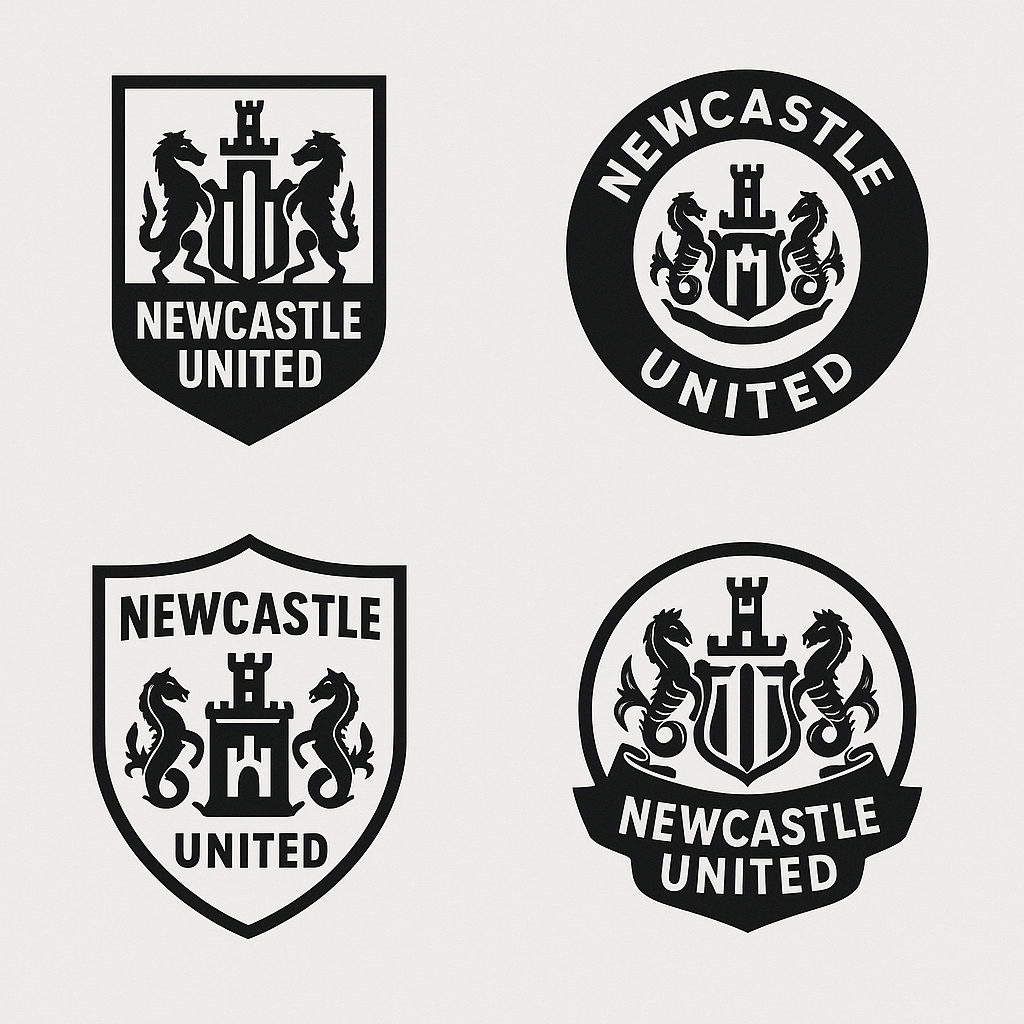
Wor Toon badge, man. It’s a canny thing. You’ve got ya seahorses lookin’ like they’ve just trotted up the Tyne, that wee castle standin’ proud like it owns the place, and a banner that’s more iconic than wor lass’s Sunday gravy. And now they want to mess wi’ it?

So, ah panicked a bit, not gonna lie. But then ah remembered, ah’ve got a clever mate. He lives in me phone, goes by the name ChatGPT. He’s not local, but he divvint half know his onions. Can write like Shakespeare one minute and solve algebra the next. So ah goes, “Eee, Chat lad, gizza hand wi’ this badge business will ya? Make us four new uns, proper smart, summat that’ll work on TikToks and stripy kits alike.”

Next thing ah know, he whirrs away like a robot in Fenwick’s window and bosh, oot comes four logos! Clean as a whistle, modern, but still keeping the soul of the Toon. They’ve got them seahorses lookin’ like they’ve just bench-pressed a Metro carriage, and the castle’s front and centre like it’s still waitin’ for the Normans. Honestly, it’s like if wor badge went to uni and came back with a graphics degree and a fresh trim.

One’s got a round badge, like a beer mat. Another’s dead sharp, like wor Ian’s elbows in five-a-side. There’s even one wi’ a shield that looks like it could deflect bad VAR decisions. Honestly, I was chuffed. Even me Bro Trev said, “Looks mint that, Mac. Reckon the lads’d wear that on Champions League nights.”

Now, ah divvint know if the club’ll go for one of these, or if they’ll end up asking some bloke in London who’s never tasted stottie cake in his life, but if they do nowt else, they should at least give ChatGPT an honorary season ticket, and a Greggs voucher.

So if ye see any new crests floating aboot on the socials, and they look like they’ve got the heart of the Toon and a bit of AI sparkle, ye kna who sorted it. Me and me clever little digital mate.

Howay the Lads, and Howay the Logos!

The Cameron Comparison: Will Danielle Smith Trigger Her Own Political Exit?

Danielle Smith’s political gambit with Alberta sovereignty bears an uncanny resemblance to David Cameron’s fateful decision to call a referendum on the United Kingdom’s membership in the European Union. Both leaders, faced with mounting internal pressures and populist insurgencies, sought to contain nationalist sentiment by giving it a structured outlet. In so doing, each gambled with the stability of their broader political project. Cameron, convinced that a plebiscite would put the Brexit question to bed and silence his party’s right-wing flank, ended up catalyzing the very crisis he had hoped to avoid, leading to his own political demise. Smith may be following the same treacherous path.

At the heart of both movements is the seductive notion of “taking back control”, from Brussels in the case of Brexit, and from Ottawa in Smith’s Alberta. The appeal is emotional and immediate: a narrative of betrayal by distant elites, a promise of restored autonomy, and the fantasy of economic self-sufficiency. Cameron allowed that narrative to play out on a national stage, legitimizing it with a referendum. Smith is doing something similar through legislation and rhetoric, invoking Alberta’s right to ignore or nullify federal laws under the guise of defending provincial jurisdiction.

Yet here lies the danger. Like Cameron, Smith has chosen to weaponize the language of sovereignty without a clear or viable endpoint. Her Alberta Sovereignty Within a United Canada Act is not a roadmap to secession, but it flirts with the logic of separation. The very act of mobilizing this discourse strengthens the hand of more radical forces in the province; those who see confederation not as a partnership, but as a prison. If Smith cannot deliver meaningful change within the framework of the Canadian constitution, and she likely cannot, she risks being outflanked by the separatists she once sought to co-opt. Just as UKIP’s rise drove Cameron’s decisions, the Maverick Party and other Alberta-first voices are shaping Smith’s hand, perhaps more than she realizes.

Politically, the parallels are striking and cautionary. Cameron misread the electorate and overestimated his ability to control the narrative. He expected the rational case for Remain to win out but failed to grasp the emotional and symbolic power of “Leave.” When the vote went against him, he resigned, leaving his party and country in turmoil. Smith may also be underestimating the Pandora’s box she is prying open. If public expectations are raised for a decisive break with Ottawa, one that cannot be delivered through mere provincial legislation, she may find herself either forced to escalate into unconstitutional territory or retreat in humiliation.

Moreover, Smith’s strategy could fracture the broader conservative coalition in Alberta. Urban moderates and business conservatives, critical to her electoral base, may grow weary of perpetual constitutional conflict, especially if it begins to affect investment, interprovincial relations, or federal funding. Meanwhile, the more extreme nationalist voices she has tried to placate will grow disillusioned if her sovereignty agenda produces no tangible results. Like Cameron, Smith is dancing between factions with incompatible goals, and she may end up satisfying none.

The tragedy of Cameron’s Brexit lies not just in the decision itself, but in the hubris that preceded it; the belief that one could flirt with nationalist fire and not get burned. Smith now faces a similar moment. In reaching for short-term political gain through an aggressive assertion of provincial autonomy, she may be sacrificing long-term credibility and coherence. The lesson from Brexit is not just about consequences, it’s about the limits of strategic populism. Smith, like Cameron, could soon discover that once sovereignty becomes the language of politics, it is no longer possible to control who speaks it, or how far they want to go.

From Reformist to Foot Soldier: The Political Evolution of Marco Rubio

For a time, Marco Rubio seemed to embody the hope that the Republican Party might modernize without losing its ideological spine. Young, charismatic, and the son of Cuban immigrants, he was hailed in the early 2010s as a conservative who could articulate traditional Republican values in a way that spoke to a broader, more diverse America. When he launched his presidential campaign in 2015, he positioned himself as a candidate of the future, one who could move past the culture wars and appeal to younger voters. To many in the media and even among some Democrats, Rubio seemed reasonable, serious, and, crucially, not dangerous.

This perception was always something of a projection. While Rubio carried himself with more polish and optimism than the emerging populist wing of the party, his actual positions were firmly in line with movement conservatism: staunchly anti-abortion, fiscally hawkish, anti-union, and reflexively interventionist on foreign policy.  Yet, because he wasn’t loud or cruel about it, and because he occasionally flirted with bipartisan gestures, most notably as a member of the 2013 “Gang of Eight” that attempted to pass comprehensive immigration reform, he was miscast as a moderate. The immigration effort was perhaps the high-water mark of his reputation as a bridge-builder, but the vicious backlash from conservative media and grassroots activists forced him into retreat. Rubio didn’t defend the bill; he distanced himself from it. This was an early sign of a pattern that would define his political choices; say the right thing when it’s safe, but retreat when it’s not.

Rubio’s realignment became undeniable with the rise of Donald Trump. In 2016, he famously called Trump a “con artist,” mocking his hands and personal behavior in an unusually caustic exchange; but after dropping out of the presidential race, he quickly endorsed Trump and began the long process of political adaptation. By the time Trump had cemented his control over the GOP, Rubio had made his peace with the new order. He supported Trump through both impeachment trials, echoed his talking points about “election irregularities” in 2020 without directly endorsing false claims, and has steadily absorbed the rhetoric and priorities of the MAGA movement, particularly on issues like “wokeism,” China, and the weaponization of federal institutions.

What surprises many observers now is not so much Rubio’s positions, many of which he has held, if more quietly, for years, but how fully he has embraced the tone and sensibility of the MAGA worldview. The man once billed as a “next-generation Republican” has become another foot soldier in the party’s turn toward grievance politics, culture war maximalism, and a brand of authoritarian-adjacent populism that defines today’s GOP. His evolution is not unique. It mirrors that of a party whose internal incentives now reward loyalty to Trump and punishment for dissent. Rubio is not leading that transformation; he’s adapting to it, and perhaps surviving because of it.

In truth, the notion that Rubio was ever a centrist or a true reformer was a comforting myth told by centrists and pundits who longed for a less chaotic Republican Party, but Rubio was never that man. He was always a disciplined conservative with big ambitions, more fluent in elite political language than many of his peers, but no less ideologically committed. The real shift, then, is not in Rubio’s principles, but in the conditions under which he operates. The surprise people express today is less about his transformation, and more about our own willingness to believe he was something else.

When Can We Expect the Alberta By-Election, and What’s the Process, Anyway?

Well, folks, the question on everyone’s lips in Ottawa and across the Prairies is this: when can we expect the by-election in Alberta’s Battle River–Crowfoot riding? Especially now that Pierre Poilievre is looking to claw his way back into the House of Commons after that stunning loss in Carleton. With Damien Kurek stepping aside to clear the path, the machinery of a federal by-election is now grinding into motion, but how soon is soon? And what exactly does the process look like?

Let’s walk it through.

Step 1: The Writs Must Be Returned
Before anything official can happen, the election results from the April 28 general vote need to be certified and the writs returned. According to Elections Canada, the official deadline for that is May 19, 2025. Until then, the government can’t formally acknowledge the vacancy in Battle River–Crowfoot, even if we all know Kurek’s seat is about to be up for grabs.

Step 2: Notifying the Vacancy
Once the results are certified and published in the Canada Gazette, the Speaker of the House issues a warrant to the Chief Electoral Officer, officially declaring the seat vacant. That’s the moment the countdown truly begins.

Step 3: Issuing the Writ
Here’s where the Canada Elections Act comes into play. The Governor General must call the by-election no fewer than 11 days and no more than 180 days after the vacancy is declared. That gives the Prime Minister a fair bit of discretion in setting the date, unless, of course, he’s under pressure to get the Leader of the Opposition back into Parliament sooner rather than later.

Mark Carney, now comfortably in the PM’s chair, has said he’s not playing games with this one. He told reporters on May 2 that the by-election would happen “as soon as possible…no games, nothing, straight.” That could mean we’re looking at a late June or early July contest, an unusually quick turnaround, but not out of the question.

Step 4: Campaign Period
By law, a federal campaign must last a minimum of 36 days. So once the writ drops, expect a quick-and-dirty sprint to the finish line.

And if you thought this was going to be a sleepy rural by-election, think again. The Longest Ballot Committee, a merry band of electoral reform activists, is threatening to run up to 200 candidates in the riding. It’s a stunt aimed squarely at exposing the flaws of our first-past-the-post system. Whether it derails Poilievre’s re-entry or just clogs the ballot box, it’s going to add a layer of political theatre to what might otherwise be a foregone conclusion.

Bottom Line
Barring delays, we’re likely to see the writ dropped sometime in late May or early June, putting election day in late June or early July. The political urgency, Poilievre’s comeback bid, Carney’s no-nonsense commitment, and a media circus brewing in east-central Alberta, suggests Ottawa isn’t going to wait the full 180 days.

So keep your calendars open and your popcorn handy. Battle River–Crowfoot may be heading into the national spotlight.

Sources
Canada Elections Act – Elections Canada
Battle River–Crowfoot federal by-election – Wikipedia
iPolitics – Longest Ballot Committee
OurCommons.ca – Election Candidates

Roll Britannia: The Greggs Chronicles

Once upon a time, in the wilds of Tyneside, there emerged a force so powerful, so delicious, that it would one day rival the might of empires. No, not the Romans. We’re talking about Greggs, the humble bakery, turned national obsession that has swept across the UK like gravy on a sausage roll.

It all began in 1939 when a man named John Gregg decided that Newcastle needed something more than coal, fog, and football. So, he did what any visionary would do: he got on a bike and started delivering fresh eggs and yeast to the good people of the North East. Little did he know that his humble yeast rounds would eventually help leaven the British soul.

Fast forward to the 1950s, and the first Greggs shop opened. It sold bread, cakes, and dreams. And by dreams, we mean hot pastries that could scald your mouth, but warm your heart. Greggs soon became a staple of the British high street, which is no small feat considering the fierce competition from fish & chips, kebabs, and aggressive seagulls.

Now, Greggs isn’t just a bakery. It’s a lifestyle. A philosophy. A national institution. While France has the baguette, and Italy has pizza, the UK has the Greggs sausage roll, a flaky, meaty miracle that unites builders, bankers, and students alike. It’s one of the few things in Britain that still works reliably and costs less than a cup of designer coffee.

But let’s not forget innovation. In 2019, Greggs stunned the nation with the Vegan Sausage Roll. Critics laughed. Piers Morgan nearly exploded. But the people? The people lined up. The plant-based pastry launched Greggs into a new orbit, attracting vegans, vegetarians, and confused carnivores who just wanted to see what all the fuss was about.

From there, things escalated. Greggs went viral, won awards, and, brace yourself, teamed up with Primark to launch a fashion line. That’s right: you can now wear your steak bake with pride, even if it’s printed on a hoodie. The combo meal of clothing and carbs is the 21st century’s answer to haute couture.

Let’s be honest: Greggs is taking over the UK one pasty at a time. No town is too small, no train station too remote. There’s probably a Greggs opening inside your kitchen cupboard as we speak. Resistance is futile. You will be fed.

Plans for world domination remain hush-hush, but we all know it’s coming. First, it’ll be Europe, somewhere easy, like Belgium. Then maybe America, where Greggs will stun Starbucks with sausage roll-based frappuccinos. By 2040, the UN will convene in the Greggs Lounge, sipping on baked bean lattes and resolving conflicts over custard slices.

So next time you bite into a cheese & onion bake, know this: you’re not just enjoying a snack. You’re part of a movement. A flaky, buttery, gloriously British movement.

Long live Greggs.

Public Consultation or Box-Ticking Exercise? A Critical Look at a Local Battery Storage Project

Last week, I attended a public consultation in my township concerning the proposed development and operation of a battery storage facility. While I support the idea of more distributed energy systems; including local generation, storage, and distribution, I left the session with more concerns than confidence.

The generational divide in the room was striking. The corporate representatives were mostly in their late 20s or early 30s, while the attending community members were primarily in their 50s and 60s. That’s not a critique of age, but it did highlight a gap in understanding and communication. One representative I spoke with didn’t even know the name of our village or the township they were in, and confused our location with the nearest city. That lack of local awareness is troubling.

When it came to questions about employment, the answers were just as vague. There are no local jobs being created by this facility. Pressed on this point, the company conceded that construction would likely be contracted out to a large regional firm. So much for community economic development.

Technically, this consultation was part of the process required to secure project approval. But calling it a “consultation” is generous. In practice, it was an information session for a project that already has funding and, by all appearances, a green light, once the required Environmental Assessment has been completed and approved. Input from residents was neither requested nor meaningfully incorporated. That’s not consultation—that’s optics.

There was discussion of the township gaining a $300,000 gift from the business, yet when this was explored further, it turns out that the gift is over the 20 year projected life of the facility; so by my calculations that’s $15,000/year for a township with an annual budget of around $4.5 million. 

I also learned that the company developing this project, which is ultimately owned by a private corporation through a series of businesses, partnered with a local First Nation to qualify for the contract. On paper, this is a positive step. I strongly support Indigenous involvement in provincial development, but I couldn’t help but ask: beyond a share of the profits, what is the First Nation partner actually gaining from this deal? Meaningful involvement? Job creation? Capacity building? Those questions went largely unanswered.

Many of the company reps struggled to answer even basic questions. When challenged, they became defensive, admitting they were not properly briefed or that statements about local benefits were merely “possibilities.” That kind of unpreparedness doesn’t inspire public trust.

Let me be clear: I’m not opposed to the project itself. I believe in the need for renewable energy infrastructure, and support the transition to a more decentralized grid. I have no “Not In My Backyard” objections here. My issue is with the process, and with the privatization of what should be a public utility. This kind of infrastructure should be owned and operated by the province for the benefit of its citizens, not by private firms whose primary accountability is to shareholders.

If this is the future of our energy system, we need a better framework, one rooted in public ownership, transparent processes, and genuine community engagement.