The Role of Schools in Small Communities

I feel strongly about the subject of school closures as an efficient means to reduce budgets. Maintaining and rebuilding schools in small communities is not just a matter of preserving tradition; it is a strategic investment in Ontario’s future. Strong rural and small-town communities contribute to the province’s economic diversity and resilience. By keeping schools open and ensuring they remain well-resourced, the government can signal its commitment to equity, sustainability, and the well-being of all Ontarians, regardless of where they live. This approach ensures that small communities remain vibrant, and that their children have access to the opportunities they need to thrive.

Schools are the cornerstone of small communities, serving not only as centers for education, but also as hubs for social, cultural, and economic activity. Their presence signals vitality and opportunity, attracting families and businesses while fostering a sense of identity and cohesion. Closing a school, however, often undermines the foundation of a community, creating a ripple effect that can lead to long-term decline. Maintaining and rebuilding schools in small communities is therefore essential to preserving their future viability and ensuring equitable access to education across the province.

One of the most significant impacts of a school closure is the loss of families, particularly those with young children. Families are unlikely to settle in a community where their children must commute long distances to access education, especially if this limits their ability to participate in extracurricular activities or form meaningful connections within the area. Without a local school, the community’s population ages, property values drop, and economic activity dwindles. Schools are often directly linked to local businesses, from daycares and grocery stores to service providers, all of which rely on a stable base of families to thrive. The loss of a school can set off a vicious cycle, with economic decline further accelerating depopulation.

Beyond its economic role, a school is a source of pride and identity for small communities. It serves as a gathering place for events, sports, and cultural activities, fostering social cohesion and strengthening intergenerational ties. Its closure sends a demoralizing message to residents that their community is no longer seen as viable or deserving of investment. This loss of identity can erode the community’s resilience and willingness to adapt to challenges. Rebuilding schools or reinvesting in existing facilities can reverse this narrative, renewing a sense of hope and commitment among residents.

Closing schools disproportionately harms students. Lengthy commutes to consolidated schools in larger towns not only impose financial and logistical burdens on families but also isolate students from their peers and limit their participation in extracurricular activities. Smaller schools offer a more personalized learning environment, where students benefit from closer teacher-student relationships and stronger connections to their community. Preserving these schools ensures that students receive a holistic education that goes beyond academics, grounding them in their local culture and heritage.

While proponents of school closures often argue for cost efficiency, this perspective overlooks the broader social and economic costs to the community. Consolidation may save money in the short term, but the long-term consequences—population decline, reduced economic activity, and diminished community identity—are far more costly. The financial argument also fails to consider innovative ways to make small schools sustainable, such as integrating other services like libraries or healthcare clinics, or adopting flexible education models like satellite campuses or blended learning.

From Advocacy to Accountability: Lessons from the Downfall of Male Feminists

My late wife, a post-colonial neo-feminist (her labels, not mine), with both the credentials and attitude to prove it, used to say it was old, grey-haired white men who were the problem. Her solution? “Shoot them. Shoot them all!” As one of two women I’ve partnered with who had fired an AK-47, I took her words seriously.

As an old, grey-haired white man, I often reflect on my role in the feminist conversation. Over decades, I’ve witnessed the shift from overt sexism to today’s more nuanced battles against systemic inequities and performative allyship. Feminism, to me, isn’t a movement for sideline spectators—it demands active, accountable participation from all genders. To create truly equitable spaces, we must engage in open, honest conversations, no matter how uncomfortable, with accountability as the cornerstone.

In recent years, the notion of the male feminist has undergone a reckoning, with the downfall of prominent figures revealing troubling gaps between advocacy and personal conduct. High-profile allegations against men like Jian Ghomeshi, Joss Whedon, Neil Gaiman, and Justin Baldoni have reshaped how we perceive allyship, accountability, and power dynamics. The fallout has had profound effects on relationships—romantic, professional, and platonic—forcing a reevaluation of trust and authenticity in feminist spaces.

Joss Whedon’s case is particularly emblematic. Once lauded as a feminist icon for creating strong female protagonists in Buffy the Vampire Slayer and Firefly, his reputation crumbled as allegations of abusive behavior emerged. Former cast members, including Charisma Carpenter, accused him of cruelty, particularly during her pregnancy, which she claims he mocked and punished her for. These revelations exposed a stark contrast between Whedon’s public image as a champion of women and the private reality of his behavior. His downfall serves as a cautionary tale about conflating progressive rhetoric with genuine integrity. This dissonance erodes trust in relationships, leaving many to question the sincerity of those who claim feminist values.

The case of Jian Ghomeshi, former CBC radio host, highlights another troubling example. Ghomeshi built a career as a liberal, feminist public figure, advocating for progressive causes and portraying himself as an ally to women. However, in 2014, multiple women came forward with allegations of sexual assault and violence, challenging his carefully crafted persona. Though Ghomeshi was acquitted in 2016, the trial revealed troubling patterns of manipulation and abuse of power. The gap between his feminist rhetoric and his behavior served as a stark reminder of how public figures can exploit progressive movements to conceal harmful actions. Ghomeshi’s fall from grace continues to influence discussions about the complexities of consent, power, and the sincerity of those who claim to champion women’s rights.

Neil Gaiman, author of The Sandman and Good Omens, has been accused by multiple women of sexual assault, including non-consensual BDSM activities. Gaiman denies the allegations, claiming all encounters were consensual, but his publicized divorce from Amanda Palmer has sparked debates on power imbalances and performative feminism. Critics have also pointed to recurring patriarchal tropes in his writing. Gaiman’s case shows how those who don’t explicitly identify as feminists can still contribute to harmful dynamics if their work or actions contradict the ideals they seem to represent.

These revelations are part of a broader trend, including figures like Justin Baldoni, who faced allegations of sexual misconduct despite cultivating a feminist persona. Such cases have fostered growing skepticism toward men in feminist spaces, especially those whose advocacy appears more self-serving than sincere. This skepticism has rippled through relationship dynamics, with women increasingly wary of men who leverage feminism for personal gain rather than genuine allyship.

The downfall of the male feminist underscores the danger of prioritizing rhetoric over accountability. For too long, society has lionized men for minimal feminist advocacy, ignoring the gaps between their public personas and private actions. This reckoning reminds us that relationships—romantic, professional, or communal—must be built on mutual respect, honesty, and genuine engagement. By dismantling the myth of the flawless male feminist, we can pave the way for more authentic, equitable partnerships rooted in shared values rather than superficial performances.

A Tale of Two Resource Economies: Alberta vs. Norway 

When it comes to managing the wealth derived from oil and gas, two regions stand out for their contrasting approaches: Norway (pop. 5.5million) and Alberta (pop. 4.9million). Both have harnessed their natural resources for economic growth, yet their strategies for licensing and managing these resources couldn’t be more different. The way each has handled its wealth offers key lessons in resource management, long-term planning, and the risks of relying too heavily on finite resources.

Norway: A Model of Prudence and Vision
Norway’s approach to managing its oil wealth is often hailed as a textbook example of responsible governance. Since the discovery of significant offshore oil reserves in the 1960s, Norway has been careful in extracting and managing its resources. Central to its success is the Government Pension Fund Global (GPFG), established in 1990 to invest surplus oil revenues for future generations. The Norwegian government adopted the principle of saving the vast majority of oil revenues, putting them into a sovereign wealth fund, which today is worth over $1.5 trillion USD.

But the key to Norway’s success is not just the size of its fund—it’s the disciplined, long-term vision that drives its policy. The fund is managed independently of the national budget, with only around 3% of its value being used each year to support government spending. The idea is to use oil wealth as a means to stabilize the economy, particularly during times of volatility in oil prices, while preserving it for future generations. The fund is diversified across global markets, ranging from equities and bonds to real estate, and is governed by a strict set of ethical guidelines that ensure investments align with environmental and social responsibility.

What stands out most about Norway’s resource licensing is its careful approach to development. The government has been strategic in its licensing policies, issuing permits in a way that balances long-term sustainability with economic growth. By managing resource extraction with an eye on long-term returns, Norway has avoided the so-called resource curse, a phenomenon that has plagued other oil-rich nations.

Alberta: A Cautionary Tale
Alberta, on the other hand, has taken a much less consistent approach to its oil and gas revenues. Since the 1970s, Alberta has been a major player in the global energy market, thanks to its vast reserves of oil sands. The province established the Heritage Savings Trust Fund in 1976, with the goal of saving a portion of its oil wealth for future generations. However, Alberta’s approach to managing this fund has been less disciplined than Norway’s.

The fund, now valued at around $19 billion CAD, has seen inconsistent contributions and, more often than not, withdrawals to cover the province’s operating expenses. This lack of long-term planning has led to missed opportunities for growth. When oil prices have been high, Alberta has relied heavily on resource revenue to fund public services, rather than investing for the future. This short-term approach has left the province vulnerable to the fluctuations in oil prices, with little in the way of a financial cushion to soften the blow during downturns.

Alberta’s resource licensing policies have also been marked by political expediency. The province has often prioritized immediate economic growth over long-term sustainability, leading to environmental concerns and a boom-bust economic cycle. Unlike Norway, which has been cautious in licensing new projects, Alberta has pushed forward with aggressive development, particularly in its oil sands sector. While this has spurred economic activity, it has also raised questions about the environmental costs and the wisdom of rapid, large-scale extraction.

Key Takeaways
The differences between Alberta and Norway are stark. Norway’s long-term vision, driven by a carefully managed sovereign wealth fund, stands in sharp contrast to Alberta’s more reactive, short-term approach. While both have abundant natural resources, it is Norway’s commitment to future generations, disciplined fund management, and cautious resource licensing that has helped it build a sustainable economic model. Alberta, in contrast, offers a cautionary tale of how reliance on resource wealth without long-term planning can leave a province exposed to the volatility of the global energy market.

As the world’s energy landscape continues to evolve, Alberta would do well to study Norway’s example—not just in terms of saving oil wealth but also in fostering a more sustainable approach to resource extraction and development. The future of resource economies will depend on the choices made today.

Canada’s Liberal-NDP Merger: A Progressive Dream or a Political Quagmire?

Every now and then, someone floats the idea of merging Canada’s Liberals and New Democratic Party (NDP) as a grand strategy to hold back the Conservative tide. It’s a tantalizing thought for progressives who dread another Conservative government, but as any political historian—or an amused observer—will tell you, forcing together two uneasy dance partners doesn’t always end in harmony. In fact, it can lead to a faceplant on the ballroom floor, as history (and the UK) has shown us.

Take the UK’s attempt at uniting progressive forces in the 1980s as a cautionary tale. Back then, the Liberals teamed up with the Social Democratic Party (SDP) to form what they hoped would be a powerhouse against Margaret Thatcher’s Conservative juggernaut. Instead, they got an ideological soup that pleased no one and left their supporters scratching their heads. By the time the merged Liberal Democrats limped onto the political stage, they were largely ignored by the very voters they aimed to court. Canada’s Liberals and NDP might want to bookmark that chapter of history before drafting any unity agreements.

The fundamental issue? Ideological oil and water. Canada’s Liberals like to keep one foot in the progressive camp while the other tiptoes toward fiscal centrism. They’re the party for the moderates, the suburban professionals, and anyone vaguely uneasy about extremes. The NDP, on the other hand, marches proudly leftward, waving banners for labor rights, universal pharmacare, and wealth redistribution. Combining these two could be like trying to blend craft beer and boxed wine: you risk alienating both audiences.

Polling numbers don’t paint a rosy picture either. A 2023 Research Co. survey found that just 36% of Canadians support a Liberal-NDP merger, with a solid 50% giving it the thumbs-down. Among NDP voters, enthusiasm drops even lower, showing just how fiercely they guard their party’s distinctiveness. It’s like asking a die-hard jazz fan to embrace bubblegum pop—there’s just no groove there.

And what about the supposed electoral benefits? Advocates argue that combining forces would consolidate the center-left vote, preventing Conservative majorities. But the numbers don’t back up the optimism. The same poll shows a merged party would still trail the Conservatives, 36% to 42%. Worse, this deficit is glaring in battleground provinces like Ontario and British Columbia. A merger may sound good in theory, but in practice, it could hand the Conservatives more ammunition than a month of attack ads.

There’s also the issue of political accountability. One of the perks of having separate parties is that they challenge each other on issues like climate policy, housing, and economic justice. The Liberals and NDP keep each other sharp, offering Canadians a buffet of progressive options. A merger could water down this diversity, leaving the political discourse thinner and less satisfying than a watered-down latte. The UK’s experience serves as a warning here too: when the Liberal Democrats lost their distinctiveness, the Conservatives took the stage unopposed, with Labour left trying to reclaim its footing.

So, what’s the alternative? Strategic collaboration. Think of it as political co-parenting: the Liberals and NDP could team up temporarily to block Conservative majorities without tying the knot. This lets them work together on shared goals—whether it’s climate action or affordable housing—while staying true to their individual identities. It’s not as flashy as a full merger, but it’s far less likely to spark the kind of buyer’s remorse that sends voters running for the exits.

In the end, merging the Liberals and NDP may sound like a clever way to fend off the Conservatives, but history and logic suggest otherwise. Canada’s political left would do well to heed the lessons of the UK: sometimes, it’s better to keep the band together than to attempt a fusion album no one asked for. Strategic partnerships, not forced marriages, are the way to keep progressive politics vibrant and competitive in Canada. Let the Liberals be the pragmatists, the NDP the idealists, and voters the beneficiaries of a lively, diverse political landscape.

Universal Basic Income: A Catalyst for Equality and Economic Resilience

I was recently chatting with my youngest brother, who lives in a NE England coastal town, and he asked about Justin Trudeau’s resignation, and what was going to happen next. A Tory at heart, my sibling’s instincts are those of hard work, community service and fewer taxes.  We started to discuss “the next pandemic” and what could be done about the financial stress many people suffered during the COVID-19 event, and I mentioned Universal Basic Income (UBI) as a possible solution and long term game changer. He had never heard of UBI, and so I thought it was time for this post. This one’s for you, Bro! 

Universal Basic Income (UBI) represents one of the most transformative policy ideas of our time, offering a practical solution to poverty, inequality, and the economic challenges of the 21st century. More than just a tool to address immediate financial hardship, UBI is a blueprint for fostering fairness, stability, and shared prosperity.

At its core, UBI guarantees every citizen a regular, unconditional income, free from the inefficiencies and stigmatization of traditional welfare systems. This simple, yet revolutionary concept ensures that no one is left without the means to secure basic necessities such as food, housing, and healthcare. UBI lifts individuals out of poverty, empowering them to make choices that improve their well-being and build resilience against life’s uncertainties.

A Revenue-Neutral Model for UBI
Critics often argue that UBI is financially unsustainable, but innovative approaches like those proposed by UBI Works demonstrate that it can be funded in a revenue-neutral way. The UBI Works model suggests targeted taxation on sectors and activities that can contribute more to public welfare without burdening the average taxpayer. For example, the proposal includes a 4% tax on profits and a 3% tax on remuneration within the financial sector—an industry that benefits significantly from economic activities.

Additionally, UBI Works advocates for closing tax loopholes and tackling tax evasion, ensuring corporations and wealthy individuals contribute their fair share. This model not only provides a sustainable funding mechanism for UBI, but also reinforces principles of fairness in the tax system.

Stimulating Economic Growth and Jobs
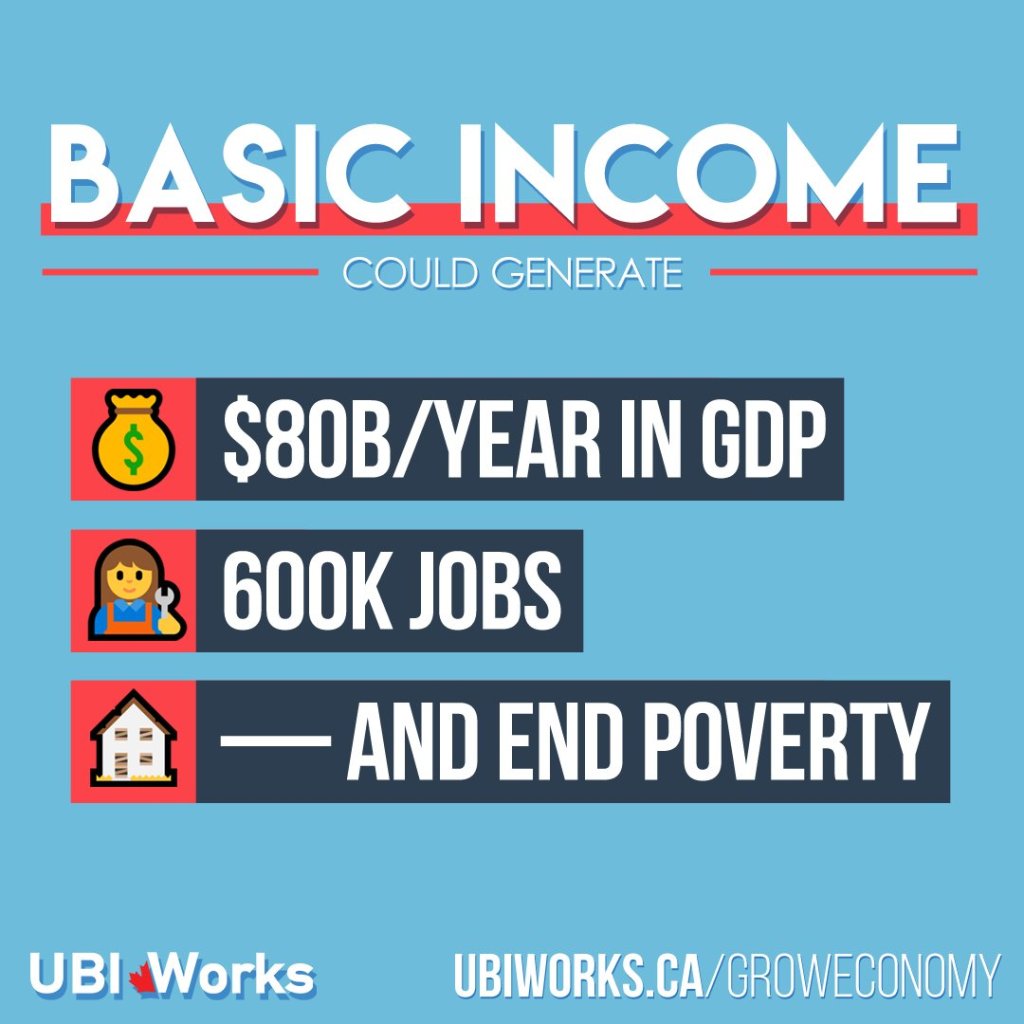
From a supply-and-demand perspective, UBI has the potential to be an economic game-changer. By boosting consumer purchasing power, UBI drives demand for goods and services, spurring business growth and job creation. Research by the Canadian Centre for Economic Analysis projects that a UBI program in Canada could grow the economy by $80 billion annually and add 600,000 jobs, all while eliminating poverty nationwide.

On the supply side, UBI offers workers the flexibility to pursue education, training, or entrepreneurial ventures, aligning their skills with roles they are passionate about rather than accepting exploitative or mismatched jobs out of financial desperation. This not only improves individual well-being but also enhances productivity across the economy.

A Tool for Equity and Resilience
As technological disruption, automation, and globalization continue to reshape labor markets, UBI provides a much-needed safety net. It equips individuals to navigate a rapidly changing economic landscape, enabling them to invest in themselves without the constant fear of financial ruin. At the same time, UBI reduces income inequality and promotes social cohesion by narrowing the wealth gap and fostering a more equitable distribution of resources.

Critically, UBI shifts the focus from reactive welfare systems to proactive empowerment. It eliminates the stigma and inefficiencies of means-tested programs while ensuring everyone benefits from a guaranteed income floor. This universal approach builds trust and unity within society, creating a stronger, more inclusive social fabric.

A Bold Vision for the Future
Universal Basic Income is more than an economic policy—it’s a statement of values. It asserts that every individual, regardless of circumstance, deserves dignity, security, and opportunity. By adopting a revenue-neutral model, UBI proves that fairness and sustainability can go hand in hand.

As the world grapples with inequality, economic volatility, and the social challenges of the 21st century, UBI offers a bold yet practical solution. It envisions a future where poverty is eliminated, opportunity is universal, and every citizen has the means to lead a secure and fulfilling life. UBI is not just a policy—it’s a pathway to a just and prosperous society.

Placing the works of EE “Doc” Smith into its Societal Context

I read a fair amount of science fiction, as can clearly be seen from the content of this blog.  My first introduction to speculative fiction, beyond C.S. Lewis, was the works of E.E. “Doc” Smith, loaned to me by a fellow classmate during my early teens. I devoured every book by this author I could find, reading without judgement, just enjoying the galactic adventure. Like I have said many times about my annual reading of Frank Herbert’s Dune, it’s not the story that changes, but the perspective that the additional year gives me.  

E.E. “Doc” Smith is an undeniable cornerstone of science fiction, particularly in shaping the grand, sweeping narratives of the space opera subgenre. His works, from the Lensman to the Skylark series, established many of the storytelling conventions that would define science fiction for generations. Yet, these same works are deeply entwined with the patriarchal and often misogynistic norms of their time, offering a fascinating lens through which to examine the cultural attitudes of the early-to-mid 20th century. Smith’s legacy is both a celebration of speculative ambition, and a study in the limitations of its era.

The Lensman series, perhaps Smith’s most iconic work, epitomizes the space opera’s blend of high-stakes interstellar conflict and moral idealism. Published between 1934 and 1950, these novels follow the genetically perfected heroes of the Galactic Patrol, led by the stalwart Kimball Kinnison, in their battle against the shadowy forces of Boskone. While the series broke ground in envisioning a universe of sprawling galactic civilizations, its treatment of gender roles reveals a narrower imagination. Female characters, such as Clarissa MacDougall, are largely confined to nurturing or supportive roles, their significance often framed in relation to male protagonists. Even Clarissa’s ascension to the ranks of the Lensmen – a notable exception – feels more like a narrative anomaly than a redefinition of gender dynamics. The series reflects its time, portraying men as protectors and leaders while relegating women to emotional or domestic spheres.

Similarly, the Skylark series, begun in 1928, offers an early blueprint for the modern space opera, chronicling the scientific and exploratory exploits of Richard Seaton and his morally ambiguous rival, Marc “Blackie” DuQuesne. Once again, women – characters like Dorothy Seaton and Margaret Spencer – are predominantly relegated to roles as love interests, hostages, or secondary figures. Though occasionally resourceful or intelligent, their contributions are overshadowed by the male protagonists’ heroics. These dynamics reinforce traditional gender hierarchies, with men as agents of innovation and action while women serve as symbols of emotional stability or moral guidance.

In the Family d’Alembert series, co-written with Stephen Goldin during the 1960s and 1970s, there is a slight shift in representation. Yvette d’Alembert, part of a circus-trained secret agent duo, emerges as a rare competent female protagonist. Yet even her capabilities are often contextualized by her physical appeal and partnership with her brother Jules. By this time, feminist movements were beginning to reshape societal norms, but science fiction, especially that rooted in the pulp tradition, lagged in reflecting these changes. Yvette’s portrayal, while an improvement, still clings to the vestiges of earlier patriarchal frameworks.

Smith’s later works, such as Subspace Explorers (1965), continue to explore grand themes like telepathy, space exploration, and societal advancement, but the underlying gender dynamics remain unchanged. Female characters with psychic abilities feature in the narrative, yet their roles are secondary, reinforcing the notion that leadership and innovation are male domains.

These patterns are not mere quirks of individual stories but reflections of a broader societal framework. Smith’s fiction mirrors the rigid gender roles of early-to-mid 20th-century society, a time when women were often confined to domestic or secondary positions. His male protagonists, embodying traits of strength, rationality, and dominance, contrast sharply with the nurturing and emotional roles assigned to women. While Smith does not explicitly demean women, the systemic sidelining of female characters speaks to the cultural misogyny of the era. His works helped establish many tropes that would define space opera, but they also reinforced a male-centric vision of the genre that took decades to challenge.

Despite these limitations, Smith’s influence on science fiction is profound. His imaginative depictions of intergalactic civilizations, advanced technologies, and epic storytelling inspired luminaries such as Isaac Asimov, Arthur C. Clarke, and even George Lucas. Modern readers, however, often critique his works for their outdated gender dynamics and lack of diversity. These critiques, while valid, do not diminish the historical significance of his contributions. Instead, they offer an opportunity to reevaluate his legacy in light of the genre’s ongoing evolution.

E.E. “Doc” Smith’s works remain a double-edged artifact of science fiction history: a testament to the boundless creativity of speculative fiction, and a reminder of the cultural constraints of its time. By recognizing these dual aspects, we can celebrate his role in shaping the genre while continuing to push for more inclusive and equitable narratives in speculative storytelling.

The Weight of Words: A Lifelong Romance with Hardcovers

I usually think of myself as a modern man, fully bought into our digital world, and then I wander into the farmhouse library, and I realize that this space is a place outside of time, and I remember my ongoing love affair with hardback books. As I first wrote and edited this piece, I found myself switching back and forth between hardcover and hardback, mixing as I often do my British and Canadian English.  Rather than going with a uniform approach, I left the nouns and adjectives as I found them on the page.  

Screenshot

I still to this day buy hardback books because they embody something rare in our fast-paced, ephemeral world: permanence. There’s a kind of quiet romance to their weight in my hands—a grounding reassurance that I’m holding more than just paper and ink. Each hardcover feels like a promise, an intimacy that won’t vanish with the swipe of a screen or a fleeting notification. They are timeless, like the lingering warmth of a lover’s voice after they’ve left the room, soft yet unwavering.

On my shelves, their spines stand like steadfast sentinels, guarding fragments of my life. Each book holds a memory: a novel devoured on a long train ride, a cookbook sprawled across the counter on a rainy Sunday, a travel guide flipped through during quiet nights when the world outside was covered with snow. Their dust jackets, often worn and peeling at the edges, only make them dearer. Like laughter lines etched on a familiar face, they tell stories of years well-lived and hands well-loved.

Hardback books are resilient in ways I admire. Their pages hold firm, their spines don’t surrender, and their beauty only deepens with age. When I open one, the faint creak of the binding feels like the exhale of a secret shared just between us. The embossed covers beg to be touched, as though inviting me to connect not just with the words within, but with the countless others who’ve held the same book. In their permanence, I find companionship—kindred spirits who, like me, sought solace or joy in those very same pages.

My collection is a reflection of who I am. Beloved fiction titles transport me to worlds where I’ve found companionship in characters who now feel like lifelong friends. Illustrated cookbooks add bursts of color and life, inspiring meals that have punctuated moments of celebration, comfort, and discovery. And then there are my permaculture and agroforestry guides, rooted in a deep love for the earth and a longing to live in harmony with its rhythms. Together, they form an eclectic tapestry of passions that, when viewed as a whole, feel like an unspoken autobiography.

Perhaps, above all, I buy hardbacks for the future they promise. I picture someone I care for—perhaps a partner, or one of their children—one day standing before my shelves. They’ll trace the spines, pull a book down, and find my notations in the margins or a bookmark still tucked between the pages. Those scribbles and marks, though small, will be echoes of me—a life lived in dialogue with stories, recipes, and ideas.

Hardback books, like love, aren’t always practical, but they are endlessly worth it. They ask for time, for care, for patience. And in return, they give so much more—a place to lose myself, to learn, to dream, and, more often than not, a place to be found.

Justin Trudeau’s Legacy: A Leader of Bold Aspirations and Imperfect Progress

I have been working on this post for a while, as soon as it became clear that Justin Trudeau would be resigning. I don’t normally publish pieces this long, but I found that I needed this length to enable me to even just skim the surface of how this man transformed Canada as a nation, and its standing in the world. For me, his biggest failure was not reforming Canada’s federal election system after he vowed that the 2015 process would be the last conducted under the first past the post model. However, it soon became clear that the party’s backroom boys, and many newly minted MPs had other priorities, and so his government abandoned the pledge in 2017, disappointing advocates for electoral reform and leaving a key campaign promise unfulfilled.

Justin Trudeau’s tenure as Canada’s 23rd Prime Minister is a legacy of contradictions: one of bold progressive achievements, and high-profile missteps, of inspiring rhetoric and underwhelming follow-through. While his time in office has left the country more inclusive and forward-looking in many ways, it has also been marked by challenges and controversies that complicate the narrative of his leadership. Viewed holistically, Trudeau’s legacy is one of meaningful but imperfect progress – an era defined by a mixture of transformative change and opportunities missed.

Economically, Trudeau’s record is more complex. Programs like the Canada Child Benefit significantly reduced child poverty, providing direct financial relief to families and underscoring his government’s focus on middle-class Canadians. His investments in infrastructure and housing created jobs and spurred economic growth. However, these initiatives came at the cost of mounting deficits and an increased national debt, raising questions about long-term fiscal sustainability. Critics argue that his government’s policies failed to adequately address systemic issues such as housing affordability, which worsened during his tenure. Rising home prices left many young Canadians struggling to enter the housing market, highlighting a gap between Trudeau’s promises and tangible results. While his economic agenda was ambitious, it often struggled to balance short-term relief with long-term stability.

One of the most enduring aspects of Trudeau’s legacy is his commitment to diversity and inclusion. From the outset, he reshaped the face of Canadian politics with his historic, gender-balanced cabinet that included individuals from a variety of racial, religious, and cultural backgrounds. His reasoning – “Because it’s 2015” – became a shorthand for Canada’s progressive aspirations on the global stage. By elevating underrepresented voices, Trudeau sought to ensure that Canada’s leadership reflected its diverse population, signaling a renewed commitment to multiculturalism at a time when many countries were turning inward. This emphasis on inclusion not only bolstered Canada’s international reputation but also helped inspire a new generation of Canadians to see politics as a space for all.

Climate change was one of the defining issues of Trudeau’s leadership, and his government made significant strides in this area. The implementation of a nationwide carbon pricing system positioned Canada as a global leader in climate policy, reinforcing the country’s commitment to the Paris Agreement. Yet, this progress was undermined by the government’s purchase of the Trans Mountain Pipeline, which angered environmental advocates and Indigenous communities. Trudeau’s attempt to balance environmental goals with the economic realities of a resource-driven economy often left both sides dissatisfied. Nevertheless, his climate policies laid the groundwork for Canada’s transition to a more sustainable future, even if they were not without contradictions.

Trudeau’s relationship with Indigenous communities represents another area of mixed results. He made reconciliation a central theme of his leadership, offering apologies for historical injustices and pledging to address long-standing inequities. His government made progress on some fronts, such as lifting long-standing boil-water advisories in many Indigenous communities. However, significant gaps remained, particularly in addressing land rights and implementing the Truth and Reconciliation Commission’s calls to action. Many Indigenous leaders criticized the slow pace of change, arguing that Trudeau’s symbolic gestures often failed to translate into substantive action. While his efforts were genuine, they were frequently insufficient to meet the scale of the challenges at hand.

Ethics and accountability proved to be persistent weak points in Trudeau’s leadership. The SNC-Lavalin affair and the WE Charity scandal highlighted a troubling pattern of ethical lapses that undermined public trust. In both cases, Trudeau faced accusations of placing political interests above transparency and accountability. These controversies tarnished his image as a champion of ethical governance, leaving a stain on his record that cannot be ignored.

Yet, even amid these challenges, Trudeau’s ability to connect with Canadians on a personal level remained one of his greatest strengths. Whether marching in Pride parades, hosting town halls, or addressing the nation during the COVID-19 pandemic, he demonstrated an empathy and accessibility that set him apart from many of his predecessors. His optimism and charisma helped re-energize Canadian politics, particularly among younger voters, who saw in him a leader who genuinely cared about their concerns. While his leadership style occasionally veered toward the performative, it also reflected a deep understanding of the importance of symbolism in shaping national identity.

Ultimately, Trudeau’s legacy is one of imperfect but meaningful progress. His government advanced diversity, economic support for families, and climate action, while grappling with the realities of governance in a polarized and rapidly changing world. His tenure was far from flawless, marred by ethical lapses, unfulfilled promises, and the challenges of balancing competing priorities. However, his vision for a more inclusive, progressive, and globally engaged Canada resonated with millions and left an indelible mark on the country’s political landscape.

Justin Trudeau’s time as Prime Minister will likely be remembered not for perfection, but for aspiration. He sought to push Canada forward in ways that reflected its highest ideals, even if he sometimes fell short. For all the controversies and compromises, his leadership ushered in an era that redefined what Canada could stand for on the world stage: diversity, progress, and hope.

Pints, Paint, and Purple Hair: Dating a Grandma Who’s Anything But Grey

Dating a 60 year old, grey-haired grandma with bold blue and purple streaks is like sipping a craft beer flight; unexpected, full of flavor, and just the right amount of fizz! She’s not your average semi-retiree. She’s an artist and crafter, forever turning everyday items into masterpieces. A walk with her through a thrift shop feels like wandering through the Louvre, as she marvels at the potential in old buttons, battered picture frames, and yarns in colors you didn’t even know existed.

Her sense of humor? Sharp and sparkling, much like the IPA she insists you try (even if you’re feeling like a stout). She doesn’t just drink craft beer; she lives it, savoring every sip while recounting stories of road trips to microbreweries, where she once debated hops with a bearded brewer half her age. Spoiler: She won the argument! 

And let’s not forget the adventures – oh, the adventures! When she says, “Let’s go on a road trip,” she doesn’t mean a simple weekend getaway. No, no, she’s planning a pilgrimage to every quirky art gallery and secret beer garden she’s bookmarked over the years. You’ll find yourself lost in a small town you’ve never heard of, surrounded by nothing but cows, and the distant hum of a local jazz band, all because she read about it in an obscure art magazine from 1982. You’ll try to keep track of her “I have an idea” moments, but with her creativity, you’ll likely end up in a pottery class at midnight, shaping clay while sipping on a hopped cider she personally picked out, because she knows you’ll love it. It’s an unexpected, whirlwind romance, and every minute is a colorful surprise you’ll never forget. Just don’t ask about the glitter, it gets everywhere.

This grandma doesn’t just have stories; she is a story. She’ll teach you the art of weaving one minute, and how to bake gingerbread the next. Dating her is like being with a vibrant human kaleidoscope; colorful, surprising, and endlessly fascinating. Sure, you might struggle to keep up as she paints landscapes by day and hosts beer tastings by night, while cooking a North African meal, but isn’t that the fun of it? She’s proof that life, love, and art only get better with age, especially with a splash of teal. If you’re lucky enough to be dating her, cheers to you! Just remember, don’t touch her yarn stash without asking.

American Strategy or Political Posturing? 

President-elect Donald Trump’s recent comments regarding the Panama Canal, Greenland, Canada, and Iceland have ignited a firestorm of international debate, raising eyebrows across diplomatic circles. Trump’s proposals, which include retaking control of the Panama Canal, purchasing Greenland, and annexing Canada as the 51st state, reflect his “America First” doctrine in its most assertive form. While such rhetoric underscores his ambition to reassert U.S. dominance, it also risks fracturing relationships with allies and reshaping global perceptions of American foreign policy.

At the heart of Trump’s statements lies a vision of expanding U.S. territorial and geopolitical influence. Proposals to acquire territories such as Greenland and Canada would, if realized, redefine America’s strategic footprint. Greenland, with its vast natural resources and critical position in the Arctic, is becoming increasingly vital as climate change opens new shipping routes and untapped reserves of oil, gas, and minerals. Canada, on the other hand, represents an economic and security powerhouse whose integration into the U.S. would consolidate North America into a unified bloc of unparalleled power. While such aspirations might seem fantastical, they align with Trump’s broader ethos of maximizing U.S. leverage on the world stage.

The Panama Canal, another focal point of Trump’s vision, underscores the strategic underpinnings of his proposals. As one of the world’s most vital maritime corridors, the canal serves as a lifeline for global trade, connecting the Atlantic and Pacific Oceans. Regaining control over the canal would enable the U.S. to secure a critical chokepoint in global logistics, ensuring that it serves American economic and military interests. Reclaiming the canal would send a strong message to rival powers, particularly China, whose investments and influence in Latin America have challenged traditional U.S. dominance in the region.

These territorial aspirations can also be interpreted as an attempt to counter Beijing’s growing reach. China’s Belt and Road Initiative and its economic entrenchment in Latin America have heightened concerns in Washington about losing influence in its own hemisphere. By floating the idea of reclaiming the Panama Canal or acquiring new territories, Trump may be signaling a broader strategy to curb China’s ambitions and reaffirm America’s primacy in key geopolitical arenas.

However, these bold declarations have not gone unchallenged. Greenland’s Prime Minister, Múte Egede, quickly dismissed any notion of selling Greenland, calling it an absurd proposal that undermines their sovereignty. In Panama, leaders have emphatically rejected the idea of relinquishing control over the canal, asserting their independence and national pride. Canadian officials, too, have categorically rebuffed Trump’s suggestion of annexation, with some labeling the proposal as both outlandish and offensive. The immediate backlash from these nations highlights the deep diplomatic hurdles that such propositions would face.

Critics argue that Trump’s rhetoric is less about actionable policy and more about playing to his domestic audience. By projecting strength and ambition, he may be attempting to solidify support among his base, which has long embraced his unapologetically nationalistic vision. Yet this approach carries significant risks. Alienating allies, undermining international norms, and sparking diplomatic tensions could damage America’s global standing and limit its ability to build coalitions in an increasingly multipolar world.

Ultimately, Trump’s comments raise questions about the balance between ambition and realism in U.S. foreign policy. While his proposals underscore a desire to redefine America’s role on the world stage, the practical and political barriers to their implementation are immense. The overwhelming opposition from the international community suggests that such ideas, even if pursued, would face insurmountable resistance. Whether these statements reflect genuine intentions or are merely provocative rhetoric, they offer a window into the polarizing and unpredictable foreign policy approach that could define the Trump era