An Alternative North American Future?

It began in the aftermath of the Trump years – a nation divided, fractured at its very core. The United States, once a symbol of strength and unity, had unraveled under the weight of its own polarization. Years of escalating political infighting, economic instability, and growing regional tensions had pushed the great experiment of American democracy to its breaking point. When the collapse came, it was not with a bang, but with a slow, inevitable unraveling.

In the early 2030s, the federal government, weakened by years of partisan gridlock and financial crises, failed to contain the growing unrest. States, long at odds over issues of governance, resources, and ideology, began asserting their independence. California, Texas, and other powerful states declared their sovereignty, severing ties with Washington, D.C., and leaving the remnants of the federal government powerless. What was once a union of fifty states dissolved into chaos.

As the world watched in shock, two nations quietly stepped forward: Canada and Mexico. Both had been America’s neighbors and partners, but now, they saw an opportunity, and a necessity, to reshape the continent.

The Canadian Annexation
To the north, Canada extended a cautious but determined hand to the crumbling states along its border. The former states of Michigan, Minnesota, North Dakota, and Montana, facing economic collapse and a bitter winter with no central government to guide them, sought refuge under Ottawa’s governance. Canada, ever pragmatic, offered them integration in exchange for loyalty to its parliamentary system and adoption of its healthcare and social policies.

The Pacific Northwest—Washington, Oregon, and northern California—quickly followed. Their progressive politics and environmental priorities aligned well with Canada’s ethos. Vancouver and Seattle became twin metropolises, and the region flourished under Canadian stewardship. The newly expanded Canada, now stretching as far south as the Sierra Nevada, became an economic powerhouse, blending American innovation with Canadian stability.

Mexico’s Revival
To the south, Mexico reclaimed lands it had lost centuries earlier. Texas, Arizona, New Mexico, and southern California were among the first to fall into its orbit. For these states, heavily influenced by Hispanic culture and history, the transition was both practical and symbolic—a return to roots.

Mexico, long underestimated on the global stage, rose to meet the challenge. The integration of these territories revitalized its economy, spurred technological innovation, and solidified its status as a regional superpower. Cities like Los Angeles and Austin, while retaining their unique identities, became hubs of a new Mexican-led cultural renaissance. Spanish replaced English as the dominant language in much of the region, and Mexico’s influence spread northward.

A Continent Redefined
By the 2040s, the map of North America had been redrawn. Canada and Mexico had divided the former United States almost evenly, with a handful of independent city-states like New York and Chicago remaining as neutral enclaves. The continent was no longer dominated by a single superpower but by two distinct and rising nations, each shaped by the remnants of the United States they had absorbed.

Canada, now stretching from the Arctic to the Rockies and the Great Lakes to the Pacific, became a beacon of progressive governance and environmental stewardship. Mexico, infused with the energy of its newly integrated territories, grew into a vibrant economic and cultural force, bridging Latin America with the former United States.

The world adapted to this new reality. China and the European Union moved to fill the void left by America’s collapse, but Canada and Mexico ensured North America remained a critical player on the global stage. Though the stars and stripes had fallen, the legacy of the United States lived on—in the governments, cultures, and people of its successor states.

And so, the great American experiment ended, not in triumph or tragedy, but in transformation, a testament to the resilience of a continent and the enduring power of reinvention.


My Favourite Polyamory Quotes

I am polyamorous, and have been for many a year. I cultivate and maintain a network of secure attachment relationships with people who are also polyamorous, who often have multiple partners of their own.  I prefer to date and partner with experienced poly people, and occasionally someone crosses my path that feels so aligned that this policy goes out the window, and I get to date a polynewbie.  

There will be many more posts on relationships in the 21st Century, and in the meantime, this one is where I will be sharing some of my favourite poly quotes, adding to it as the months go by. 

Please be aware, while I am happy to discuss relationship dynamics, I am not interested in any negative commentary, and will block any source of unthinking, rude or obnoxious messages. 

I hope you enjoy these thoughts. I tend to use the Canadian English spelling of polyamorous, but when posting quotes I use exactly what and how it was published. 

The quality of a polycule is directly proportional to the communication skills of its least emotionally secure member.
Or, if you prefer something gentler, less absolute, more accepting.
A polycule’s health depends less on its most skilled communicator, than on how well its least secure member feels heard.
” – @chrismcbean.bsky.social

Polyamory (noun): when multiple people are plotting to care about you, a wholesome conspiracy” – @PolydotLand

Polyamory is NOT endless orgies, nor is it cuckoldry with extra steps.

Polyamory is two idiots walking down the street holding hands debating with one another about how each of them should ask out their respective crushes, and then neither of them following through.” – @5aximus

Solo polyamory helps me go at a comfortable pace. Now that I’m no longer entering relationships with a particular goal in mind, like marriage or cohabitation, I’m not in a rush to find out whether a partner can give me those traditional markers of relational success/fulfilment.” – @unapolygetic

Your significant other is allowed to have meaningful relationships with other people. Your significant other is allowed to get things from those relationships that they don’t get from you. Demanding you be the only source of pleasure and support in their life is possessive and toxic.” –  @LadylsAVamp_

 “I was asked, ‘who is your best friend?’ I don’t know. I don’t use language like that anymore. It doesn’t fit. I have friends that hold the keys to different doors of my personality. And some open my heart. Some my laughter. Some my sin. Some my civic urgency.” – @abgljoe 

One of my favourite challenges posed by polyamory lies in its potential to undermine the idea that women are ‘rivals’ for the attentions of men. Hey, what if we are ‘collaborators’ in loving and supporting our mutual partners? I know, wild eh …” – @carriejenkins 

Solo polyamory is finding it more enjoyable to opt in to spending time with people as opposed to opting out to get my own space.” – @PolyamAwareness

Relationships fail when people take their own insecurities and project them as their partner’s flaws.”- @stevemaraboli 

Protecting Your Digital Footprint: What Meta’s Fine Taught Us About Social Media

On the eve of the US TikTok shutdown/ban, perhaps we should remind ourselves that it’s not just the Chinese that need watching when it comes to the misuse of our personal digital data.  

The $5 billion fine paid by Meta (then Facebook) in 2019 should serve as a wake-up call for anyone involved in the world of social media—users, businesses, and regulators alike. This penalty, stemming from Facebook’s mishandling of personal data during the infamous Cambridge Analytica scandal, was a stark reminder of the risks associated with lax privacy policies and opaque data-sharing practices. While it was the largest fine ever imposed by the FTC for a privacy violation, the broader lessons extend far beyond the numbers.

The Cambridge Analytica incident revealed just how vulnerable our personal data is in the digital age. Millions of Facebook users had their information harvested through a seemingly harmless personality quiz, with the data then sold and weaponized for political purposes. What’s chilling is how easy it was for this to happen. Users were unaware that agreeing to share their data also meant exposing their friends’ information. This wasn’t just a breach of trust—it was a blueprint for how our digital lives could be exploited without our knowledge.

For Meta, the $5 billion fine was more than just a financial penalty; it was a public relations nightmare. The company was accused of violating a 2012 agreement with the FTC that required stricter privacy protections, and the backlash raised serious questions about whether tech giants could ever be trusted to regulate themselves. Yes, the settlement required Facebook to implement stronger accountability measures, but for many, this felt like too little, too late. Trust, once broken, is hard to rebuild, and Meta’s struggle to regain credibility continues to this day.

What can we learn from this? For one, transparency is no longer optional. Social media platforms must be upfront about how they collect, use, and share data. The days of burying crucial details in endless terms and conditions are over—users demand clarity. At the same time, regulators must take a more active role in setting and enforcing boundaries. If a $5 billion fine barely dents a company’s bottom line, then the penalties aren’t severe enough to deter bad behavior. Stronger consequences and stricter oversight are needed to keep tech companies accountable.

For everyday users, the lesson is clear: we must be vigilant about our digital footprint. Social media platforms are built on the currency of our data, and if we don’t value it, no one else will. That means thinking twice before clicking “accept” and understanding the implications of sharing personal information online. It also means holding platforms accountable by demanding better privacy protections and supporting legislation that puts users’ rights first.

The Meta fine wasn’t just a punishment—it was a warning. If we don’t take action to protect privacy, both individually and collectively, the next data scandal could make Cambridge Analytica look tame by comparison. The future of social media depends on whether we learn these lessons or allow history to repeat itself.

Building a Canadian Economy Rooted in SMEs and Innovation

Canada’s economy has long been shaped by the extraction and export of raw commodities, often at the expense of capturing the greater value that comes from refining and manufacturing. While the federal and provincial governments frequently court large corporations to build processing facilities and high-tech manufacturing plants, this approach has significant drawbacks. Large multinationals tend to demand generous tax incentives, subsidies, and regulatory leniency, often draining public resources with little long-term benefit to local communities. A far more sustainable and equitable path lies in empowering Canada’s small and medium enterprises (SMEs) to lead the charge in developing vertical supply chains and producing high-end, value-added goods. This approach mirrors the model used by Germany, where a thriving network of small and medium-sized enterprises, known as the Mittelstand, drives economic growth, innovation, and export strength.

SMEs represent over 98% of all businesses in Canada and employ the majority of the workforce. These businesses are rooted in their local communities, reinvesting profits, fostering innovation, and creating jobs that benefit Canadians directly. Unlike large corporations, which often export profits abroad or automate local jobs, SMEs are more likely to prioritize long-term regional development. By focusing on this segment of the economy, Canada can avoid the pitfalls of corporate dependency while building a resilient, homegrown industrial base. Germany’s success with the Mittelstand has demonstrated that supporting SMEs can produce world-class companies while spreading economic benefits across regions rather than concentrating wealth in a few urban centers.

Supporting SMEs to move into value-added production requires targeted investment in several areas. First and foremost, SMEs need better access to funding. While large corporations negotiate multi-million-dollar subsidy deals with governments, small businesses often struggle to secure financing for research, infrastructure, and expansion. By redirecting public funds toward grants, low-interest loans, and cooperative funding models for SMEs, governments can ensure that public money stays within the Canadian economy. For example, small agricultural businesses could use this funding to process raw grain into plant-based protein products, while forestry SMEs could invest in engineered wood production for global markets. Much like Germany’s regional banks that provide financing tailored to small businesses, Canada could establish financial mechanisms that focus on the unique needs of SMEs.

Collaboration is another area where SMEs can thrive, given the right support. Unlike large corporations, which tend to centralize operations, SMEs naturally form networks of local producers, processors, and distributors. These networks could be further strengthened through government incentives for regional industry clusters. For instance, creating hubs where SMEs collaborate on processing critical minerals, manufacturing advanced materials, or producing green technologies would not only increase efficiency but also ensure that economic benefits are widely distributed. These clusters could also partner with universities and research institutions to develop cutting-edge products and processes, bridging the gap between innovation and commercialization.

A key advantage of SMEs is their ability to adapt quickly to changes in market demand and technology, something large corporations often struggle to do. This makes them ideal candidates for leading Canada’s transition to sustainable and green manufacturing. Many small businesses are already pioneering initiatives such as converting agricultural waste into bioplastics or developing renewable energy technologies. Investing in these efforts not only aligns with Canada’s climate goals but also positions the country as a leader in environmentally conscious production. Large corporations, by contrast, often prioritize short-term profits over sustainability, making them less reliable partners in achieving green economic growth.

Workforce development is also critical to supporting SMEs in building vertical supply chains. While large corporations may import expertise or automate jobs, SMEs are more likely to invest in training local workers. Expanding vocational programs and offering targeted apprenticeship opportunities for small businesses can ensure that Canadian workers have the skills needed for advanced manufacturing and value-added production. This approach would build a skilled workforce that remains tied to local communities, further anchoring economic growth. Again, Germany’s dual education system, which integrates apprenticeships with classroom training, offers a valuable model for Canada to emulate.

Focusing on SMEs allows Canada to build a strong national identity around its products. “Made in Canada” can become synonymous with quality, sustainability, and innovation if the country prioritizes small-scale, high-value production over raw commodity exports. Government branding initiatives and export incentives tailored to SMEs can open global markets for uniquely Canadian goods, from artisanal food products to cutting-edge clean technologies. Large corporations, by contrast, tend to dilute the national brand as they integrate Canadian resources into global supply chains, often leaving little trace of their origins.

Prioritizing SMEs over large corporations is not only a more equitable approach but also a more practical one. It minimizes dependency on multinational firms that can relocate at a moment’s notice and maximizes the long-term benefits of economic activity for Canadians. Germany’s Mittelstand has shown how a strong SME sector can build a resilient economy, drive innovation, and maintain global competitiveness. By adopting a similar model, Canada can transform its resource economy into a diversified, high-value manufacturing powerhouse. This strategy isn’t just about economics—it’s about reclaiming control over Canada’s future and ensuring that the wealth generated by its resources benefits the people who live here.

The Role of Schools in Small Communities

I feel strongly about the subject of school closures as an efficient means to reduce budgets. Maintaining and rebuilding schools in small communities is not just a matter of preserving tradition; it is a strategic investment in Ontario’s future. Strong rural and small-town communities contribute to the province’s economic diversity and resilience. By keeping schools open and ensuring they remain well-resourced, the government can signal its commitment to equity, sustainability, and the well-being of all Ontarians, regardless of where they live. This approach ensures that small communities remain vibrant, and that their children have access to the opportunities they need to thrive.

Schools are the cornerstone of small communities, serving not only as centers for education, but also as hubs for social, cultural, and economic activity. Their presence signals vitality and opportunity, attracting families and businesses while fostering a sense of identity and cohesion. Closing a school, however, often undermines the foundation of a community, creating a ripple effect that can lead to long-term decline. Maintaining and rebuilding schools in small communities is therefore essential to preserving their future viability and ensuring equitable access to education across the province.

One of the most significant impacts of a school closure is the loss of families, particularly those with young children. Families are unlikely to settle in a community where their children must commute long distances to access education, especially if this limits their ability to participate in extracurricular activities or form meaningful connections within the area. Without a local school, the community’s population ages, property values drop, and economic activity dwindles. Schools are often directly linked to local businesses, from daycares and grocery stores to service providers, all of which rely on a stable base of families to thrive. The loss of a school can set off a vicious cycle, with economic decline further accelerating depopulation.

Beyond its economic role, a school is a source of pride and identity for small communities. It serves as a gathering place for events, sports, and cultural activities, fostering social cohesion and strengthening intergenerational ties. Its closure sends a demoralizing message to residents that their community is no longer seen as viable or deserving of investment. This loss of identity can erode the community’s resilience and willingness to adapt to challenges. Rebuilding schools or reinvesting in existing facilities can reverse this narrative, renewing a sense of hope and commitment among residents.

Closing schools disproportionately harms students. Lengthy commutes to consolidated schools in larger towns not only impose financial and logistical burdens on families but also isolate students from their peers and limit their participation in extracurricular activities. Smaller schools offer a more personalized learning environment, where students benefit from closer teacher-student relationships and stronger connections to their community. Preserving these schools ensures that students receive a holistic education that goes beyond academics, grounding them in their local culture and heritage.

While proponents of school closures often argue for cost efficiency, this perspective overlooks the broader social and economic costs to the community. Consolidation may save money in the short term, but the long-term consequences—population decline, reduced economic activity, and diminished community identity—are far more costly. The financial argument also fails to consider innovative ways to make small schools sustainable, such as integrating other services like libraries or healthcare clinics, or adopting flexible education models like satellite campuses or blended learning.

From Advocacy to Accountability: Lessons from the Downfall of Male Feminists

My late wife, a post-colonial neo-feminist (her labels, not mine), with both the credentials and attitude to prove it, used to say it was old, grey-haired white men who were the problem. Her solution? “Shoot them. Shoot them all!” As one of two women I’ve partnered with who had fired an AK-47, I took her words seriously.

As an old, grey-haired white man, I often reflect on my role in the feminist conversation. Over decades, I’ve witnessed the shift from overt sexism to today’s more nuanced battles against systemic inequities and performative allyship. Feminism, to me, isn’t a movement for sideline spectators—it demands active, accountable participation from all genders. To create truly equitable spaces, we must engage in open, honest conversations, no matter how uncomfortable, with accountability as the cornerstone.

In recent years, the notion of the male feminist has undergone a reckoning, with the downfall of prominent figures revealing troubling gaps between advocacy and personal conduct. High-profile allegations against men like Jian Ghomeshi, Joss Whedon, Neil Gaiman, and Justin Baldoni have reshaped how we perceive allyship, accountability, and power dynamics. The fallout has had profound effects on relationships—romantic, professional, and platonic—forcing a reevaluation of trust and authenticity in feminist spaces.

Joss Whedon’s case is particularly emblematic. Once lauded as a feminist icon for creating strong female protagonists in Buffy the Vampire Slayer and Firefly, his reputation crumbled as allegations of abusive behavior emerged. Former cast members, including Charisma Carpenter, accused him of cruelty, particularly during her pregnancy, which she claims he mocked and punished her for. These revelations exposed a stark contrast between Whedon’s public image as a champion of women and the private reality of his behavior. His downfall serves as a cautionary tale about conflating progressive rhetoric with genuine integrity. This dissonance erodes trust in relationships, leaving many to question the sincerity of those who claim feminist values.

The case of Jian Ghomeshi, former CBC radio host, highlights another troubling example. Ghomeshi built a career as a liberal, feminist public figure, advocating for progressive causes and portraying himself as an ally to women. However, in 2014, multiple women came forward with allegations of sexual assault and violence, challenging his carefully crafted persona. Though Ghomeshi was acquitted in 2016, the trial revealed troubling patterns of manipulation and abuse of power. The gap between his feminist rhetoric and his behavior served as a stark reminder of how public figures can exploit progressive movements to conceal harmful actions. Ghomeshi’s fall from grace continues to influence discussions about the complexities of consent, power, and the sincerity of those who claim to champion women’s rights.

Neil Gaiman, author of The Sandman and Good Omens, has been accused by multiple women of sexual assault, including non-consensual BDSM activities. Gaiman denies the allegations, claiming all encounters were consensual, but his publicized divorce from Amanda Palmer has sparked debates on power imbalances and performative feminism. Critics have also pointed to recurring patriarchal tropes in his writing. Gaiman’s case shows how those who don’t explicitly identify as feminists can still contribute to harmful dynamics if their work or actions contradict the ideals they seem to represent.

These revelations are part of a broader trend, including figures like Justin Baldoni, who faced allegations of sexual misconduct despite cultivating a feminist persona. Such cases have fostered growing skepticism toward men in feminist spaces, especially those whose advocacy appears more self-serving than sincere. This skepticism has rippled through relationship dynamics, with women increasingly wary of men who leverage feminism for personal gain rather than genuine allyship.

The downfall of the male feminist underscores the danger of prioritizing rhetoric over accountability. For too long, society has lionized men for minimal feminist advocacy, ignoring the gaps between their public personas and private actions. This reckoning reminds us that relationships—romantic, professional, or communal—must be built on mutual respect, honesty, and genuine engagement. By dismantling the myth of the flawless male feminist, we can pave the way for more authentic, equitable partnerships rooted in shared values rather than superficial performances.

A Tale of Two Resource Economies: Alberta vs. Norway 

When it comes to managing the wealth derived from oil and gas, two regions stand out for their contrasting approaches: Norway (pop. 5.5million) and Alberta (pop. 4.9million). Both have harnessed their natural resources for economic growth, yet their strategies for licensing and managing these resources couldn’t be more different. The way each has handled its wealth offers key lessons in resource management, long-term planning, and the risks of relying too heavily on finite resources.

Norway: A Model of Prudence and Vision
Norway’s approach to managing its oil wealth is often hailed as a textbook example of responsible governance. Since the discovery of significant offshore oil reserves in the 1960s, Norway has been careful in extracting and managing its resources. Central to its success is the Government Pension Fund Global (GPFG), established in 1990 to invest surplus oil revenues for future generations. The Norwegian government adopted the principle of saving the vast majority of oil revenues, putting them into a sovereign wealth fund, which today is worth over $1.5 trillion USD.

But the key to Norway’s success is not just the size of its fund—it’s the disciplined, long-term vision that drives its policy. The fund is managed independently of the national budget, with only around 3% of its value being used each year to support government spending. The idea is to use oil wealth as a means to stabilize the economy, particularly during times of volatility in oil prices, while preserving it for future generations. The fund is diversified across global markets, ranging from equities and bonds to real estate, and is governed by a strict set of ethical guidelines that ensure investments align with environmental and social responsibility.

What stands out most about Norway’s resource licensing is its careful approach to development. The government has been strategic in its licensing policies, issuing permits in a way that balances long-term sustainability with economic growth. By managing resource extraction with an eye on long-term returns, Norway has avoided the so-called resource curse, a phenomenon that has plagued other oil-rich nations.

Alberta: A Cautionary Tale
Alberta, on the other hand, has taken a much less consistent approach to its oil and gas revenues. Since the 1970s, Alberta has been a major player in the global energy market, thanks to its vast reserves of oil sands. The province established the Heritage Savings Trust Fund in 1976, with the goal of saving a portion of its oil wealth for future generations. However, Alberta’s approach to managing this fund has been less disciplined than Norway’s.

The fund, now valued at around $19 billion CAD, has seen inconsistent contributions and, more often than not, withdrawals to cover the province’s operating expenses. This lack of long-term planning has led to missed opportunities for growth. When oil prices have been high, Alberta has relied heavily on resource revenue to fund public services, rather than investing for the future. This short-term approach has left the province vulnerable to the fluctuations in oil prices, with little in the way of a financial cushion to soften the blow during downturns.

Alberta’s resource licensing policies have also been marked by political expediency. The province has often prioritized immediate economic growth over long-term sustainability, leading to environmental concerns and a boom-bust economic cycle. Unlike Norway, which has been cautious in licensing new projects, Alberta has pushed forward with aggressive development, particularly in its oil sands sector. While this has spurred economic activity, it has also raised questions about the environmental costs and the wisdom of rapid, large-scale extraction.

Key Takeaways
The differences between Alberta and Norway are stark. Norway’s long-term vision, driven by a carefully managed sovereign wealth fund, stands in sharp contrast to Alberta’s more reactive, short-term approach. While both have abundant natural resources, it is Norway’s commitment to future generations, disciplined fund management, and cautious resource licensing that has helped it build a sustainable economic model. Alberta, in contrast, offers a cautionary tale of how reliance on resource wealth without long-term planning can leave a province exposed to the volatility of the global energy market.

As the world’s energy landscape continues to evolve, Alberta would do well to study Norway’s example—not just in terms of saving oil wealth but also in fostering a more sustainable approach to resource extraction and development. The future of resource economies will depend on the choices made today.

Canada’s Liberal-NDP Merger: A Progressive Dream or a Political Quagmire?

Every now and then, someone floats the idea of merging Canada’s Liberals and New Democratic Party (NDP) as a grand strategy to hold back the Conservative tide. It’s a tantalizing thought for progressives who dread another Conservative government, but as any political historian—or an amused observer—will tell you, forcing together two uneasy dance partners doesn’t always end in harmony. In fact, it can lead to a faceplant on the ballroom floor, as history (and the UK) has shown us.

Take the UK’s attempt at uniting progressive forces in the 1980s as a cautionary tale. Back then, the Liberals teamed up with the Social Democratic Party (SDP) to form what they hoped would be a powerhouse against Margaret Thatcher’s Conservative juggernaut. Instead, they got an ideological soup that pleased no one and left their supporters scratching their heads. By the time the merged Liberal Democrats limped onto the political stage, they were largely ignored by the very voters they aimed to court. Canada’s Liberals and NDP might want to bookmark that chapter of history before drafting any unity agreements.

The fundamental issue? Ideological oil and water. Canada’s Liberals like to keep one foot in the progressive camp while the other tiptoes toward fiscal centrism. They’re the party for the moderates, the suburban professionals, and anyone vaguely uneasy about extremes. The NDP, on the other hand, marches proudly leftward, waving banners for labor rights, universal pharmacare, and wealth redistribution. Combining these two could be like trying to blend craft beer and boxed wine: you risk alienating both audiences.

Polling numbers don’t paint a rosy picture either. A 2023 Research Co. survey found that just 36% of Canadians support a Liberal-NDP merger, with a solid 50% giving it the thumbs-down. Among NDP voters, enthusiasm drops even lower, showing just how fiercely they guard their party’s distinctiveness. It’s like asking a die-hard jazz fan to embrace bubblegum pop—there’s just no groove there.

And what about the supposed electoral benefits? Advocates argue that combining forces would consolidate the center-left vote, preventing Conservative majorities. But the numbers don’t back up the optimism. The same poll shows a merged party would still trail the Conservatives, 36% to 42%. Worse, this deficit is glaring in battleground provinces like Ontario and British Columbia. A merger may sound good in theory, but in practice, it could hand the Conservatives more ammunition than a month of attack ads.

There’s also the issue of political accountability. One of the perks of having separate parties is that they challenge each other on issues like climate policy, housing, and economic justice. The Liberals and NDP keep each other sharp, offering Canadians a buffet of progressive options. A merger could water down this diversity, leaving the political discourse thinner and less satisfying than a watered-down latte. The UK’s experience serves as a warning here too: when the Liberal Democrats lost their distinctiveness, the Conservatives took the stage unopposed, with Labour left trying to reclaim its footing.

So, what’s the alternative? Strategic collaboration. Think of it as political co-parenting: the Liberals and NDP could team up temporarily to block Conservative majorities without tying the knot. This lets them work together on shared goals—whether it’s climate action or affordable housing—while staying true to their individual identities. It’s not as flashy as a full merger, but it’s far less likely to spark the kind of buyer’s remorse that sends voters running for the exits.

In the end, merging the Liberals and NDP may sound like a clever way to fend off the Conservatives, but history and logic suggest otherwise. Canada’s political left would do well to heed the lessons of the UK: sometimes, it’s better to keep the band together than to attempt a fusion album no one asked for. Strategic partnerships, not forced marriages, are the way to keep progressive politics vibrant and competitive in Canada. Let the Liberals be the pragmatists, the NDP the idealists, and voters the beneficiaries of a lively, diverse political landscape.

Universal Basic Income: A Catalyst for Equality and Economic Resilience

I was recently chatting with my youngest brother, who lives in a NE England coastal town, and he asked about Justin Trudeau’s resignation, and what was going to happen next. A Tory at heart, my sibling’s instincts are those of hard work, community service and fewer taxes.  We started to discuss “the next pandemic” and what could be done about the financial stress many people suffered during the COVID-19 event, and I mentioned Universal Basic Income (UBI) as a possible solution and long term game changer. He had never heard of UBI, and so I thought it was time for this post. This one’s for you, Bro! 

Universal Basic Income (UBI) represents one of the most transformative policy ideas of our time, offering a practical solution to poverty, inequality, and the economic challenges of the 21st century. More than just a tool to address immediate financial hardship, UBI is a blueprint for fostering fairness, stability, and shared prosperity.

At its core, UBI guarantees every citizen a regular, unconditional income, free from the inefficiencies and stigmatization of traditional welfare systems. This simple, yet revolutionary concept ensures that no one is left without the means to secure basic necessities such as food, housing, and healthcare. UBI lifts individuals out of poverty, empowering them to make choices that improve their well-being and build resilience against life’s uncertainties.

A Revenue-Neutral Model for UBI
Critics often argue that UBI is financially unsustainable, but innovative approaches like those proposed by UBI Works demonstrate that it can be funded in a revenue-neutral way. The UBI Works model suggests targeted taxation on sectors and activities that can contribute more to public welfare without burdening the average taxpayer. For example, the proposal includes a 4% tax on profits and a 3% tax on remuneration within the financial sector—an industry that benefits significantly from economic activities.

Additionally, UBI Works advocates for closing tax loopholes and tackling tax evasion, ensuring corporations and wealthy individuals contribute their fair share. This model not only provides a sustainable funding mechanism for UBI, but also reinforces principles of fairness in the tax system.

Stimulating Economic Growth and Jobs
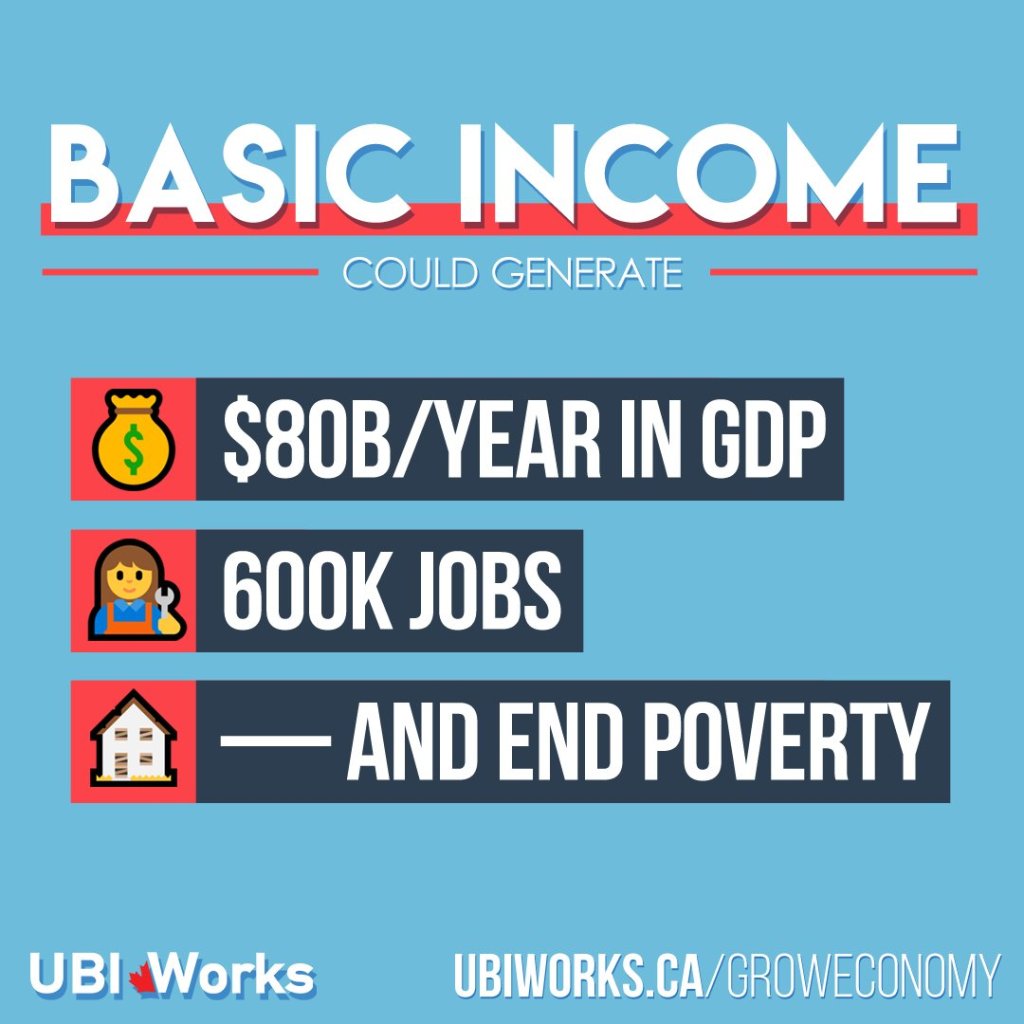
From a supply-and-demand perspective, UBI has the potential to be an economic game-changer. By boosting consumer purchasing power, UBI drives demand for goods and services, spurring business growth and job creation. Research by the Canadian Centre for Economic Analysis projects that a UBI program in Canada could grow the economy by $80 billion annually and add 600,000 jobs, all while eliminating poverty nationwide.

On the supply side, UBI offers workers the flexibility to pursue education, training, or entrepreneurial ventures, aligning their skills with roles they are passionate about rather than accepting exploitative or mismatched jobs out of financial desperation. This not only improves individual well-being but also enhances productivity across the economy.

A Tool for Equity and Resilience
As technological disruption, automation, and globalization continue to reshape labor markets, UBI provides a much-needed safety net. It equips individuals to navigate a rapidly changing economic landscape, enabling them to invest in themselves without the constant fear of financial ruin. At the same time, UBI reduces income inequality and promotes social cohesion by narrowing the wealth gap and fostering a more equitable distribution of resources.

Critically, UBI shifts the focus from reactive welfare systems to proactive empowerment. It eliminates the stigma and inefficiencies of means-tested programs while ensuring everyone benefits from a guaranteed income floor. This universal approach builds trust and unity within society, creating a stronger, more inclusive social fabric.

A Bold Vision for the Future
Universal Basic Income is more than an economic policy—it’s a statement of values. It asserts that every individual, regardless of circumstance, deserves dignity, security, and opportunity. By adopting a revenue-neutral model, UBI proves that fairness and sustainability can go hand in hand.

As the world grapples with inequality, economic volatility, and the social challenges of the 21st century, UBI offers a bold yet practical solution. It envisions a future where poverty is eliminated, opportunity is universal, and every citizen has the means to lead a secure and fulfilling life. UBI is not just a policy—it’s a pathway to a just and prosperous society.

Placing the works of EE “Doc” Smith into its Societal Context

I read a fair amount of science fiction, as can clearly be seen from the content of this blog.  My first introduction to speculative fiction, beyond C.S. Lewis, was the works of E.E. “Doc” Smith, loaned to me by a fellow classmate during my early teens. I devoured every book by this author I could find, reading without judgement, just enjoying the galactic adventure. Like I have said many times about my annual reading of Frank Herbert’s Dune, it’s not the story that changes, but the perspective that the additional year gives me.  

E.E. “Doc” Smith is an undeniable cornerstone of science fiction, particularly in shaping the grand, sweeping narratives of the space opera subgenre. His works, from the Lensman to the Skylark series, established many of the storytelling conventions that would define science fiction for generations. Yet, these same works are deeply entwined with the patriarchal and often misogynistic norms of their time, offering a fascinating lens through which to examine the cultural attitudes of the early-to-mid 20th century. Smith’s legacy is both a celebration of speculative ambition, and a study in the limitations of its era.

The Lensman series, perhaps Smith’s most iconic work, epitomizes the space opera’s blend of high-stakes interstellar conflict and moral idealism. Published between 1934 and 1950, these novels follow the genetically perfected heroes of the Galactic Patrol, led by the stalwart Kimball Kinnison, in their battle against the shadowy forces of Boskone. While the series broke ground in envisioning a universe of sprawling galactic civilizations, its treatment of gender roles reveals a narrower imagination. Female characters, such as Clarissa MacDougall, are largely confined to nurturing or supportive roles, their significance often framed in relation to male protagonists. Even Clarissa’s ascension to the ranks of the Lensmen – a notable exception – feels more like a narrative anomaly than a redefinition of gender dynamics. The series reflects its time, portraying men as protectors and leaders while relegating women to emotional or domestic spheres.

Similarly, the Skylark series, begun in 1928, offers an early blueprint for the modern space opera, chronicling the scientific and exploratory exploits of Richard Seaton and his morally ambiguous rival, Marc “Blackie” DuQuesne. Once again, women – characters like Dorothy Seaton and Margaret Spencer – are predominantly relegated to roles as love interests, hostages, or secondary figures. Though occasionally resourceful or intelligent, their contributions are overshadowed by the male protagonists’ heroics. These dynamics reinforce traditional gender hierarchies, with men as agents of innovation and action while women serve as symbols of emotional stability or moral guidance.

In the Family d’Alembert series, co-written with Stephen Goldin during the 1960s and 1970s, there is a slight shift in representation. Yvette d’Alembert, part of a circus-trained secret agent duo, emerges as a rare competent female protagonist. Yet even her capabilities are often contextualized by her physical appeal and partnership with her brother Jules. By this time, feminist movements were beginning to reshape societal norms, but science fiction, especially that rooted in the pulp tradition, lagged in reflecting these changes. Yvette’s portrayal, while an improvement, still clings to the vestiges of earlier patriarchal frameworks.

Smith’s later works, such as Subspace Explorers (1965), continue to explore grand themes like telepathy, space exploration, and societal advancement, but the underlying gender dynamics remain unchanged. Female characters with psychic abilities feature in the narrative, yet their roles are secondary, reinforcing the notion that leadership and innovation are male domains.

These patterns are not mere quirks of individual stories but reflections of a broader societal framework. Smith’s fiction mirrors the rigid gender roles of early-to-mid 20th-century society, a time when women were often confined to domestic or secondary positions. His male protagonists, embodying traits of strength, rationality, and dominance, contrast sharply with the nurturing and emotional roles assigned to women. While Smith does not explicitly demean women, the systemic sidelining of female characters speaks to the cultural misogyny of the era. His works helped establish many tropes that would define space opera, but they also reinforced a male-centric vision of the genre that took decades to challenge.

Despite these limitations, Smith’s influence on science fiction is profound. His imaginative depictions of intergalactic civilizations, advanced technologies, and epic storytelling inspired luminaries such as Isaac Asimov, Arthur C. Clarke, and even George Lucas. Modern readers, however, often critique his works for their outdated gender dynamics and lack of diversity. These critiques, while valid, do not diminish the historical significance of his contributions. Instead, they offer an opportunity to reevaluate his legacy in light of the genre’s ongoing evolution.

E.E. “Doc” Smith’s works remain a double-edged artifact of science fiction history: a testament to the boundless creativity of speculative fiction, and a reminder of the cultural constraints of its time. By recognizing these dual aspects, we can celebrate his role in shaping the genre while continuing to push for more inclusive and equitable narratives in speculative storytelling.