Boeing – Too Big to Fail?

Boeing, once synonymous with innovation and reliability, now faces a cascade of crises that threaten its reputation and future. While the ongoing troubles of the 737 Max program dominate headlines—groundings, safety concerns, and public trust erosion—the company’s issues extend well beyond commercial aviation, notably into its ambitious space ventures.

The Boeing Starliner, a spacecraft designed to ferry astronauts to and from the International Space Station (ISS), has suffered a series of high-profile setbacks. Initially touted as a competitor to SpaceX’s Crew Dragon, Starliner’s development has been marred by delays, cost overruns, and technical failures. A critical uncrewed test flight in 2019 revealed significant software glitches, including one that could have led to the loss of the spacecraft. Although Boeing claimed to have resolved these problems, subsequent delays further damaged its credibility. The spacecraft’s repeated postponements have left NASA increasingly reliant on SpaceX, raising questions about Boeing’s ability to fulfill its commitments.

The spacecraft’s troubles became undeniable after a highly anticipated manned launch resulted in astronauts being stranded on the International Space Station. The spacecraft’s return leg—a critical phase—had to be completed unmanned due to technical malfunctions. This public embarrassment highlighted the systemic flaws in Boeing’s approach to quality control and execution. It also underscored the widening gap between Boeing and its competitor, SpaceX, which has consistently delivered reliable results in the same program.

Even more concerning is the financial impact of these failures. Boeing has already absorbed over a billion dollars in losses related to Starliner, a stark reminder of how far the company has fallen in the space sector—a domain it once dominated. With additional safety certifications looming, Starliner’s future remains uncertain. The program’s struggles not only jeopardize Boeing’s position in the lucrative space market, but also strain its long-standing relationship with NASA, a critical partner.

Internally, these challenges exacerbate a broader crisis of confidence. Employee morale has plummeted as the company wrestles with mounting quality control issues, whistleblower allegations of defective parts, and labor disputes disrupting production. Leadership changes, including the appointment of new CEOs, have done little to stem the tide of dissatisfaction.

Despite its sprawling influence, and “too big to fail” status, Boeing’s current trajectory highlights the precariousness of its position. The aerospace giant’s struggles are a cautionary tale about complacency in an industry where safety and reliability are paramount. If Boeing cannot resolve its systemic issues, its future—both in the skies and beyond—looks increasingly fragile.

New Year’s Eve: A Reflection on Old Traditions and New Paths

December 31st, New Year’s Eve, has rarely held much charm for me. The holiday feels drenched in sentimentality, forced cheer, and an overbearing expectation to reinvent oneself overnight. Years ago, I quietly stepped away from the revelry, trading the clinking of champagne glasses for moments of introspection. But it wasn’t always this way.

In my early thirties, I poured my energy into organizing rambunctious New Year’s celebrations with my university friends, and a few trusted work colleagues. These weren’t ordinary parties; they were full-blown, three-night events, held in ancient locations – castles in Northumberland, estates in the Lake District, or lodges in Snowdonia.

Planning began months in advance. We’d estimate guest numbers, scout properties, draft menus, and prepare endless shopping lists. My friend Vivienne and I spent weeks curating every detail; maps to the venue, suggested activities, which ranged from rock climbing to pub crawls, from shopping to board games, and even a schedule for who’d take turns cooking meals, washing dishes or restocking the booze. Everyone pitched in, and those who didn’t weren’t invited back, except for Nigel and Rosie, because we loved them anyway. 

The guest list was as colorful as the events themselves: a Scottish laird, a supermarket heiress, police officers, geologists, a Hercules Loadmaster, an Australian Homeopath, and enough PhDs to launch a think tank. That first year, we hosted 40 people. By the time I attended my last event, the crowd had grown to over 70.

Eventually, I passed the torch to others, especially after I moved continents. Yet, decades later, those New Year’s gatherings still persist, now infused with the energy of attendees’ children, and the nostalgia of enduring friendships. For many years, my holiday ritual involved crossing the Atlantic; first to visit family for Christmas, then to join these gatherings, where we’d reminisce over old stories and create new ones – especially stories answering the question “why did Andy always have a black eye?” 

But somewhere along the way, I began to feel restless. The same stories, the same faces, the same patterns – what once felt comforting, now seemed like a closed time loop, that I couldn’t escape. As I built a life, and family in North America, I realized it was time to step away, and embrace new traditions, ones that allowed for evolution and personal growth. 

It’s funny, I hadn’t planned to write about this today. I rarely share personal stories like this, and maybe that’s something I’ll change in the coming year.

To everyone I love, near and far: Happy New Year. May 2025 bring you peace, fulfillment, and a wondrously, meaningful life.

The Messy Truth About Style, Wealth, and Social Media in the Walmart Birkin Era

The Walmart Birkin debate, while seemingly chaotic, underscores the positive disruption social media has brought to the way society views fashion, wealth, and accessibility. This debate, which centers on inexpensive alternatives to luxury handbags like Hermès’ Birkin, reflects how social platforms like TikTok and Instagram have democratized access to trends, challenging long-standing ideas of exclusivity and prestige.

Social media has broken down barriers that once kept luxury fashion out of reach for most people. By showcasing Walmart’s Birkin-inspired bags and other accessible “dupes,” platforms have shifted the narrative, allowing everyday consumers to participate in trends without financial strain. This democratization of style isn’t just about affordability—it’s about creativity. People are mixing high-end and low-cost fashion to create their own unique looks, proving that style is more about personal expression than the price tag.

The debate also forces us to reconsider the value of luxury goods as status symbols. For years, owning a Birkin bag was a sign of wealth and social prestige. Now, as social media normalizes dupes, the exclusivity that defined luxury is being questioned. These conversations challenge us to think critically about the meaning of material wealth and the societal pressure to conform to unattainable standards. Is the value of a Birkin in its craftsmanship, or does its worth lie solely in its role as a symbol of privilege? Social media has provided a platform for this dialogue, encouraging a broader critique of wealth inequality and our collective obsession with status.

What makes this disruption even more compelling is how social media amplifies diverse voices. Historically, the luxury market was dominated by a narrow demographic, but now people from all walks of life are participating in this conversation. By sharing their perspectives and personal stories, they’re reshaping the cultural narrative around style and worth. This shift empowers consumers to reclaim fashion from the exclusivity of luxury brands and redefine what it means to be fashionable in their own terms.

Yes, the discourse is messy. The flood of memes, arguments, and polarized opinions on platforms like TikTok can feel overwhelming. But this chaos is a sign of progress. It’s a reflection of cultural disruption—a necessary step in dismantling outdated hierarchies in fashion. This kind of viral conversation challenges norms, fuels innovation, and encourages brands to respond to the evolving values of a new generation of consumers.

In many ways, the Walmart Birkin debate represents the best of what social media can achieve. While it may seem like a trivial squabble over handbags, it’s actually a meaningful reflection of broader societal shifts. It shows us that accessibility and inclusivity are reshaping industries and that style, at its core, belongs to everyone—not just the privileged few.

Proposed Policy Shift: A Holistic, Equity-Focused Approach to Pandemic Management

Pandemics have traditionally been managed through isolation measures, and the prioritization of high-risk groups for vaccination. While this approach proved effective during the COVID-19 crisis in Canada, it also revealed significant shortcomings. Widespread isolation led to a surge in mental health issues, while many citizens faced severe financial hardship.

A shift in policy is necessary—one that treats citizens not merely as individuals or isolated households, but as members of interconnected communities. This proposal outlines a comprehensive strategy for pandemic management that prioritizes public health, social resilience, and economic security through three key measures: targeted vaccination by sorting codes, the formation of social pods, and the implementation of Universal Basic Income (UBI).

Targeted Vaccination by Sorting Code
Current vaccination efforts often fall short in addressing systemic inequities. A more effective strategy would prioritize vaccine distribution based on sorting codes (e.g., postal or area codes), focusing on communities most at risk. High-priority areas—those with elevated infection rates, limited healthcare access, or greater socioeconomic vulnerability—would receive vaccines first. This approach ensures resources are allocated efficiently and equitably, reducing disparities and safeguarding the most affected populations.

Development of Social Pods
Isolation has long been the cornerstone of pandemic response, but it often exacerbates mental health crises and social disconnection. An alternative approach is to encourage the creation of social pods—small, stable groups of 3 to 12 individuals who interact exclusively with one another. These pods allow for safe social interaction, fostering emotional and practical support while reducing the spread of infection. School children continue their education and social development, adults maintain their social interaction, while seniors get the support they need from family and friends, all of which greatly reduces pressure on the healthcare system. Social pods also facilitate easier contact tracing and containment efforts, providing a more community-oriented approach to public health.

Universal Basic Income (UBI)
Pandemics often expose and intensify economic inequities, leaving many people unable to comply with public health measures due to financial pressures. Implementing a Universal Basic Income ensures that all individuals, regardless of employment status, have access to basic financial resources. By alleviating economic stress, UBI allows people to adhere to isolation or quarantine guidelines without facing financial ruin, reducing unsafe behaviors driven by desperation and ultimately curbing virus transmission.

This proposed shift in policy emphasizes the importance of addressing the interconnected health, social, and economic challenges posed by pandemics. By adopting targeted vaccination, fostering social cohesion through pods, and ensuring financial stability with UBI, governments can build a more equitable and resilient framework for pandemic management. This approach not only safeguards public health, but also strengthens community bonds and ensures no one is left behind in times of crisis

Analyzing Canada’s Supply Management System Amidst USMCA Renegotiations

With Donald Trump hinting at renegotiating the USMCA, the Bloc Québécois (BQ)’s preemptive demand to shield Canada’s supply-managed agricultural sectors seems like a calculated play. By insisting on taking these industries off the negotiating table, the BQ underscores the strategic importance of supply management—not just as economic protectionism, but as a cornerstone of national food security, quality, and safety.

At its core, supply management is more than a regulatory framework; it’s a defense mechanism against market forces that could devastate domestic agriculture. Take Wisconsin, for example: its dairy production alone eclipses Canada’s entire industry and could flood the Canadian market with cheaper, lower-standard products. This wouldn’t just undercut prices; it could dismantle the domestic sector entirely. Ironically, Wisconsin’s overproduction creates its own woes, driving down prices, shrinking herd sizes, and perpetuating a vicious cycle of instability.

Such risks aren’t hypothetical. In Latin America, we’ve seen nations struggle as free-market producers prioritize export profits over feeding local populations. Meanwhile, neighboring countries flooding markets with cheap imports have obliterated subsistence farming. The BQ isn’t just safeguarding Quebec’s dairy industry but advocating for all “feather” producers—chicken, turkey, ducks, and eggs. So, how does Canada’s supply management system stack up?

The Case for Supply Management
Supply management ensures Canadian farmers enjoy stable, predictable incomes, shielding them from global market volatility. This financial security allows small family farms to invest confidently, fostering sustainability. For consumers, it means consistent prices for essentials like milk and eggs, steering clear of drastic price swings.

Canada’s system enforces stringent safety and environmental standards, ensuring high-quality products. By prioritizing local production, it strengthens food security, keeping supply chains domestic and reliable. The system also promotes production diversity, mitigating risks like disease outbreaks in large industrial operations.

By controlling production, supply management prevents market gluts that can tank prices. This is a lifeline for small and medium farms, which form the backbone of rural economies. Without these protections, small farms might collapse under pressure from industrialized mega-farms or cheap imports, eroding Canada’s agricultural landscape.

The Critiques of Supply Management
The most frequent criticism is higher prices. Supply management fixes prices above global market levels, meaning Canadians pay more for staples like dairy and eggs. These costs hit low-income households hardest, intensifying inequality in access to basic foods.

Canada’s import controls complicate international trade negotiations. Concessions made during CETA and USMCA talks—allowing limited foreign access to Canadian dairy markets—highlight the friction. These restrictions may limit Canada’s leverage in future trade deals, potentially hindering economic growth.

Critics argue that supply management’s guaranteed income structure discourages competition and innovation. Farmers have little incentive to improve efficiency or diversify, unlike in competitive markets where survival hinges on adaptability. This lack of dynamism could leave Canadian agriculture trailing behind global advancements.

Balancing Tradition and Change
Canada’s supply management system has achieved much: protecting farmers, ensuring food security, and sustaining rural economies. Yet, it faces mounting pressure to adapt. Rising consumer demands for affordability, evolving trade landscapes, and the push for innovation all challenge the status quo.

The Bloc Québécois’ stance reflects a broader debate about how Canada defines the future of its agriculture. Can we strike a balance between protecting domestic producers, ensuring our food security, and embracing global trade? The answer will shape not just the nation’s economy, but its food systems for generations to come.

The Case for Nurse Practitioners in Canadian Leadership Roles

Canada’s healthcare system, founded on the principles of universal access and fairness, remains a cornerstone of the nation’s social fabric. As a system that treats all citizens equally, free from the influence of private insurers, it exemplifies the values of equity and solidarity. However, despite these strengths, the Canadian healthcare system faces significant challenges, many of which stem from outdated management practices and an evolving healthcare landscape. These issues highlight the need for changes that can improve both cost-effectiveness and patient-centered care, ensuring the system remains sustainable and responsive to the needs of all Canadians.

A key area for reform is the current model of leadership within healthcare systems. Medical doctors (MDs), who are critical to patient care, are often placed in executive management roles, a practice that can lead to inefficiencies. While MDs possess exceptional expertise in clinical medicine, their training typically does not prepare them for the complex demands of system management or strategic decision-making. As a result, healthcare systems may miss opportunities to optimize operations and reduce costs. This misallocation of skills can contribute to administrative bottlenecks, inefficient resource distribution, and, ultimately, higher healthcare expenses.

To address these challenges and ensure that Canada’s healthcare system remains both effective and sustainable, it is time to reconsider the traditional leadership structure. One promising solution lies in empowering nurse practitioners (NPs) to take on leadership roles within healthcare organizations. NPs, as advanced practice nurses, are already deeply involved in patient care and bring a wealth of experience in managing illnesses, prescribing treatments, and leading care teams. Their training, which focuses on holistic, patient-centered care, is well-suited to the evolving demands of Canada’s healthcare system, where preventative care, wellness, and population health are becoming increasingly important.

By elevating NPs to leadership positions such as Clinical Directors, Canadian healthcare systems could achieve several benefits. First, NPs represent a cost-effective alternative to MDs in management roles. Their salaries are typically lower, allowing healthcare organizations to redirect the savings towards improving clinical services, investing in technology, and addressing social determinants of health. This would allow the Canadian healthcare system to better meet the growing demand for services without compromising care quality.

Moreover, NPs’ patient-centered approach aligns well with the goals of Canada’s public healthcare system. Their emphasis on preventative care and wellness can help drive the system towards more proactive, rather than reactive, care models. This shift not only helps manage costs but also improves access to care, especially in underserved areas, where NPs are already providing essential services. Empowering NPs to lead could also help address the physician shortage, particularly in rural and remote communities where healthcare access is often limited.

Another significant advantage of promoting NPs to leadership positions is their ability to foster collaboration and innovation within healthcare teams. NPs excel in creating multidisciplinary environments that prioritize communication and teamwork—skills that are critical for reducing staff burnout and improving employee retention in a healthcare workforce that is under increasing strain. By empowering NPs, the system can better support its frontline workers, ensuring that healthcare providers are not only skilled in their clinical roles but also in building a positive and efficient workplace culture.

Despite these advantages, there remains resistance to changing the leadership structure in Canadian healthcare. Some may argue that NPs lack the formal medical education of MDs, but this perspective overlooks the fact that NPs’ training is often better suited to the management and collaborative tasks required in today’s healthcare landscape. While MDs offer invaluable expertise in specialized medical fields, NPs’ holistic approach and focus on system-wide efficiency are precisely what is needed to ensure that Canada’s healthcare system can continue to meet the needs of its diverse population.

While Canada’s healthcare system remains one of the most equitable in the world, it is clear that reforms are necessary to ensure its continued success. By shifting leadership to include more nurse practitioners in management roles, we can foster a healthcare environment that is more cost-effective, patient-centered, and capable of addressing the challenges of the 21st century. This change is not about diminishing the role of MDs, but rather recognizing that the complexity of modern healthcare requires a broader range of skills and perspectives to ensure optimal outcomes for both patients and healthcare workers.

Indifference – A Reflection on a Personal Conversation

I want to reflect upon a fascinating conversation I had late Christmas night with a dear friend. We ended up talking about personal boundaries, and the ways we protect ourselves emotionally. It was one of those deep, reflective discussions that linger long after the words are spoken.

At some point, I shared a hard lesson I learned from an ex-partner about the concept of indifference. That simple admission opened a door to a much larger, layered conversation about what indifference truly means, how it functions, and the role it plays in our relationships; both with others and with ourselves.

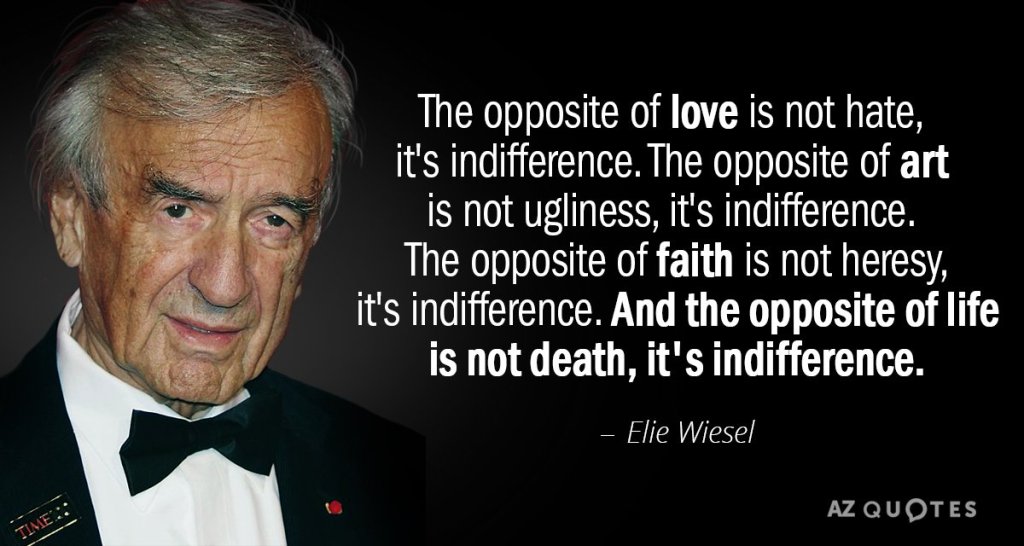
What struck me was how much weight the word indifference carries. It’s such a profound concept when you think about it. Philosophers like Elie Wiesel have said that indifference, not hatred, is the true opposite of love. Love and hate, after all, are both fiery, emotional investments; they require energy, passion, and focus. But indifference? That’s the absence of all of that. It’s an emotional void, a refusal to care.

We talked about how indifference can be more painful than outright hate. At least with hate, you know you’re being seen, felt, acknowledged in some way. Indifference, on the other hand, feels like being erased, like you don’t matter enough to warrant any reaction at all. In relationships, it can create this deep loneliness; a silent, aching space where love or even conflict should be.

But then we got into the darker side of indifference, how it can also be wielded as a kind of weapon. It’s not always passive, you know? Sometimes it’s deliberate, a way to assert control or punish without saying a word. We’ve all seen or felt it in some form: the cold shoulder, the ignored text, the subtle withholding of care or acknowledgment. Those silences and omissions can be sharper than words.

We explored a few examples, like in romantic relationships, when one partner uses indifference to send a cruel, unspoken message: “You don’t matter.” Or in workplaces, where a boss might undermine someone by pretending their contributions don’t exist. That kind of calculated indifference is devastating because it’s so insidious. It leaves the other person questioning their worth.

What’s tricky is that indifference isn’t always malicious. It can be a survival mechanism too, right? Sometimes, detaching and withdrawing emotionally is a way to protect ourselves from toxic dynamics or emotional exhaustion. The question is whether indifference is being used as self-preservation or as a means to harm or manipulate someone else.

Honestly, the more we talked about it, the more I realized how thin the line is between healthy detachment and destructive indifference. I think perhaps that intention is everything, whether it’s about creating space for yourself or shutting someone out entirely.

The whole conversation left me reflecting on my own tendencies and how I’ve used or experienced indifference in my life. It’s a lot to sit with, but also something I feel like I need to understand better.

What do you think? Have you ever found yourself wrestling with indifference, either as a tool or as something you’ve been on the receiving end of? 

Replacing Canada’s Aging Submarine Fleet

Canada is currently debating whether to invest in a new fleet of submarines to replace its aging Victoria-class vessels, which were purchased second-hand from the United Kingdom in the 1990s. These submarines, while functional, are nearing the end of their service life and face increasing maintenance challenges.

With Canada’s Arctic becoming more geopolitically significant due to climate change, which is opening new shipping lanes and increasing resource exploration; submarines capable of operating under ice are crucial for maintaining sovereignty in this region. Without them, Canada risks falling behind nations like Russia and the United States, which have invested heavily in Arctic-capable fleets.

Modern submarines, such as those with Air Independent Propulsion (AIP) or nuclear capabilities, offer enhanced endurance, stealth, and operational flexibility compared to the diesel-electric Victoria-class. Investing in these technologies would modernize Canada’s navy and ensure operational relevance.

The German Type 212CD (Common Design) submarine, developed by ThyssenKrupp Marine Systems, represents a modern and highly capable class of diesel-electric submarines with Air Independent Propulsion (AIP). These submarines are designed for stealth, endurance, and multi-role capabilities, and as a NATO platform, the Type 212CD would seamlessly integrate with allied operations, thus strengthening Canada’s contributions to NATO’s underwater defense network. Germany has a proven track record of delivering submarines on time and within budget. Partnering with an experienced supplier like ThyssenKrupp could help Canada avoid some of the delays and cost overruns seen in its previous defense procurement projects.

The operational performance of the Type 212CD remains speculative until it enters service. However, the proven track record of the Type 212A, combined with the extensive research and development efforts behind the CD variant, suggests it will be a reliable and capable platform for NATO-aligned navies.

With Canada’s “Sea to Sea to Sea” responsibilities, they really need a fleet of nine boats (operations, training, maintenance), but I think they would likely procure six over a decade timeframe. Ultimately, the decision will hinge on Canada’s strategic priorities, financial constraints, and Arctic sovereignty goals. If Canada prioritizes cost-efficiency and rapid acquisition, the Type 212CD could emerge as a leading choice, provided it meets specific Arctic and endurance requirements. 

Dies Natalis Solis Invicti

December 25th, the Dies Natalis Solis Invicti or “Birthday of the Unconquered Sun,” has long been associated with cosmic renewal and light’s triumph over darkness, aligning with the winter solstice. Its significance may stretch back to ancient Persia and found deep resonance in Roman religion, particularly within the mystery cult of Mithras.

Mithraism flourished in the shadowy corners of Roman society, appealing to soldiers, merchants, and officials. Mithras, a god of light and justice, was central to a complex mythology that emphasized cosmic order and renewal. His worship featured the tauroctony, a scene depicting Mithras slaying a sacred bull in a cave, from whose blood life and fertility emerged. This act symbolized victory over chaos and the cycles of life and death, themes reinforced by Mithras’ divine “rock birth” (Petra Genetrix), which emphasized his eternal and unshakable essence.

Mithras’ bond with Sol Invictus, the Roman solar deity, was central to his worship. Together, they were shown feasting after the bull’s defeat, celebrating cosmic renewal and the return of light. This connection tied Mithras to the December 25th celebration, when the days began to grow longer, signifying hope and rebirth for his followers. Worship took place in cave-like Mithraea, where initiates advanced through seven secretive ranks, fostering bonds of loyalty and discipline, particularly among Roman soldiers.

Christianity rose alongside Mithraism, drawing parallels with Mithras in themes of salvation, sacrifice, and divine light. Jesus Christ, like Mithras, came to symbolize victory over darkness, spiritual rebirth, and eternal life. By aligning Christ’s nativity with December 25th, Christianity absorbed and redefined the pagan imagery of the “unconquered sun,” positioning Jesus as the true “light of the world.” This synthesis appealed to Mithraic followers and others drawn to sun worship, securing Christianity’s dominance within the empire.

Mithras endures as a figure of cosmic mystery, his story largely conveyed through art and ritual. From his rock birth to his symbolic feast, he remains a mediator between worlds, forever linked to humanity’s quest for order and light in the face of darkness.

The Social Media Trap: Jonathan Haidt on the Rise of Incels and Australia’s Bold Move

Jonathan Haidt, social psychologist and author of The Anxious Generation: How the Great Rewiring of Childhood Is Causing an Epidemic of Mental Illness, offers a chilling analysis of how social media reshapes the mental and emotional worlds of young people. Platforms like Instagram, TikTok, and Reddit, he argues, magnify feelings of inadequacy and anger, particularly among young men – a demographic increasingly drawn into the online incel (involuntarily celibate) subculture.

Incels, young men frustrated by their lack of romantic and sexual success, gather in online communities where misogyny and nihilism fester. Haidt’s work reveals how these platforms, designed to amplify polarizing content and encourage tribalism, foster a collective victim mentality. Incel forums, he notes, validate resentment, fueling a toxic cycle of blame and self-pity. Over time, the isolation bred by these echo chambers solidifies their radical ideologies, creating fertile ground for dangerous movements like the nihilistic “black-pill” philosophy.

Haidt also points to evolutionary psychology to explain how social media taps into young men’s instincts for competition and conquest. Platforms flood users with hyper-sexualized imagery, gaming rewards, and curated lifestyles, creating a distorted reality that leaves many feeling perpetually inadequate. For incels, these digital illusions exacerbate bitterness, reinforcing their belief that modern dating is “rigged” against them.

Social media’s most insidious effect, Haidt warns, is its relentless culture of comparison. The curated lives of influencers amplify feelings of inadequacy, particularly for those already struggling with self-esteem. This, coupled with social media’s replacement of real-world interactions, deepens isolation and accelerates mental health crises. Haidt describes social media as a “magnifier of human vulnerability,” preying on insecurities and rewarding divisive behavior. For some incels, this descent into despair has culminated in acts of violence, with several high-profile attacks linked to individuals immersed in these toxic communities.

In response to the growing mental health crisis among youth, Australia has taken a bold step: banning social media for individuals under 16. Scheduled to take effect in 2025, the law imposes strict age verification requirements on tech companies, with fines reaching A$49.9 million for violations. Though challenges remain – such as the potential misuse of software to bypass restrictions – Australia’s move signals a growing global recognition of the harm social media inflicts on adolescents.

Haidt’s research underscores the urgency of such reforms. Early and unregulated exposure to social media, he argues, exacerbates anxiety, depression, and social isolation, leaving young people vulnerable to radical ideologies and diminished well-being. Australia’s legislation reflects an attempt to push tech companies toward greater accountability and promote a healthier digital landscape for children.

The rise of the incel phenomenon is not just about misogyny or radicalization; it’s a window into a generation’s broader struggle for connection and purpose in the age of social media. Haidt warns that without systemic change – such as fostering healthier masculinity, reducing online polarization, and regulating tech platforms – society risks losing a generation to the algorithms of despair. Australia’s bold experiment may well serve as a blueprint for addressing these deep-seated issues on a global scale.