When Alberta MLAs take their seats in the Legislative Assembly, they swear an oath of allegiance to the Crown. It’s not optional. It’s not ceremonial theater. It’s a legal requirement under the Legislative Assembly Act, a pledge of loyalty to the constitutional order they’re about to serve within.
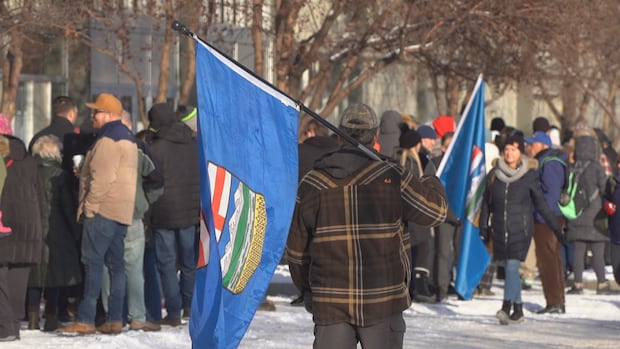
So what happens when those same MLAs sign a petition advocating for Alberta’s separation from Canada?
They break that oath.
Let’s be clear about what the Crown represents. It’s not just a distant monarch in another country. In Canada’s constitutional framework, the Crown is the Canadian state. Swearing allegiance to the Crown means swearing allegiance to Canada’s sovereignty and constitutional order. You can’t pledge loyalty to that framework while simultaneously working to dismantle it. The two positions are fundamentally incompatible.
Some might argue that advocating for political change through democratic means is itself protected within the system, that exploring sovereignty options is legitimate political discourse. That’s a convenient dodge. There’s a difference between debating constitutional reform and actively campaigning to break up the country. Signing a separation petition isn’t abstract discussion – it’s concrete political action toward ending the very state you’ve sworn allegiance to.
Quebec recognized this contradiction, and did something about it. In December 2022, Quebec passed legislation making the oath to the Crown optional for MNAs. They kept only the oath to “the people of Quebec” as mandatory. This came after PQ and Québec Solidaire MNAs refused to swear allegiance to King Charles III following the 2022 election. Rather than maintain the hypocrisy, Quebec changed the law.
That’s the point. Quebec understood that you can’t have it both ways. If your MLAs are going to advocate for separation, don’t make them swear loyalty to what they’re trying to leave. Alberta has made no such change. Alberta MLAs still take the full oath to the Crown, knowing exactly what it entails.
Which means Alberta MLAs who sign separation petitions are doing so while bound by an oath they’ve violated. They voluntarily swore allegiance, then voluntarily betrayed it. No one forced them to take the oath. No one forced them to seek public office. They chose both, and apparently saw no contradiction.
This isn’t about whether separation itself is right or wrong. It’s about integrity in public office. It’s about whether the oaths our elected officials take actually mean something, or whether they’re just words to be discarded when politically convenient.
Public office requires public trust. That trust rests on the assumption that when someone swears an oath, they intend to keep it. When MLAs sign separation petitions after swearing allegiance to the Crown, they tell Albertans that their word means nothing, that oaths are performative, that constitutional obligations can be ignored whenever political expediency demands it.
If Alberta MLAs want to advocate for separation, they should do what Quebec did: change the oath. Until then, signing that petition isn’t political courage. It’s oath-breaking, plain and simple.
When the Alberta government finally released the long-awaited results of a commissioned survey on the Alberta Pension Plan (APP), the findings spoke volumes. Nearly two-thirds of Albertans (63%), rejected the idea of replacing the Canada Pension Plan with a provincial version. The number supporting an APP? Just 10%. That’s not just a policy rejection; it’s a political reality check.
For all the heated rhetoric around Alberta’s place in Confederation, this result reinforces what many longtime observers have suspected: Albertans may be frustrated, but they’re not fools. They know a good thing when they see it, and the CPP, with its portability, investment scale, and intergenerational reliability, is exactly that. The pensions issue cuts across partisan lines and ideological bluster. It’s not about Trudeau or equalization. It’s about people’s futures, and the people have spoken.
What’s more striking is how this undercuts the oxygen feeding Alberta separatism. The idea of a provincial pension plan was floated not just as fiscal policy, but as a marker of provincial autonomy, even sovereignty. It was pitched as a way to “keep Alberta’s money in Alberta.” Yet, when the chips were down, Albertans didn’t bite. The same population that occasionally flirts with separation talk has no appetite for tearing up foundational institutions like the CPP.
Even Premier Danielle Smith, no stranger to courting Alberta-first narratives, quickly distanced herself from the APP following the release of the data. There’s no referendum planned, no legislative push, just a quiet shelving of an unpopular idea. It’s a clear sign that even among the UCP leadership, there’s recognition that the political capital required to pursue this agenda simply doesn’t exist.
The APP result also aligns with a broader trend we’re seeing in regional sentiment polling. Despite pockets of separatist energy, especially in reaction to federal climate policy, most Albertans prefer reform within Canada to rupture. A recent Angus Reid survey found that only 19% of Albertans would “definitely” vote to leave Canada, while three-quarters believed a referendum would fail. The rhetoric is louder than the resolve.
This doesn’t mean western alienation is a myth. Far from it. Economic frustrations, federal-provincial disputes, and the sense of being politically outvoted still resonate deeply in Alberta. But the reaction isn’t revolution, it’s recalibration. What Albertans appear to want is a stronger voice in a better Canada, not a lonely march toward the exits.
There’s a deeper lesson here, too. Identity politics and economic nationalism may be good for stirring the base, but when policies collide with kitchen-table concerns, like pensions, voters choose the pragmatic over the symbolic. Separatism, in Alberta’s case, has become less of a movement and more of a mood. And moods change when the numbers hit home.
At its core, the rejection of the APP is a reaffirmation of Canadian federalism. Not the perfect, polished version dreamed of in civics classes, but the messy, functional, deeply embedded version that shows up in every paycheque and retirement plan. That version still has teeth. And Albertans, whatever else they may say about Ottawa, just voted to keep it.
It began with a simple yet startling poll result: one‑third of Albertans said they would consider leaving Canada if the next federal government were Liberal, a figure up from 25 percent in 2001 and drawn from a 219 Ipsos survey that found 33 percent of respondents believing Alberta would be better off as a separate country. In the same year, an Angus Reid Institute study reported that half of Albertans saw separation as a “real possibility,” even if the practical likelihood was judged low. Other surveys have shown support fluctuating between 23 percent and 33 percent, but the headline number – one in three – captured the public imagination, and became shorthand for a deep provincial malaise.
That malaise has its roots in a storied history of perceived federal overreach. Albertans, and Western Canadians more broadly, still speak in hushed tones of the National Energy Program of 1980, when Ottawa’s sudden push to capture a greater share of oil revenues felt like an economic and cultural assault. Recent Liberal governments, with their emphasis on carbon pricing (the “carbon tax”), tighter environmental assessments through Bill C‑69, and tanker bans under Bill C‑48, have reawakened memories of Pierre Trudeau’s NEP and convinced many that, once again, the province’s lifeblood industry is under siege.
Yet the idea of actually breaking away faces almost insurmountable constitutional and practical barriers. The Supreme Court of Canada’s 1998 Reference re Secession of Quebec made clear that any province seeking to leave must first secure a “clear expression” of the popular will through a referendum on a clear question, and then negotiate terms of separation with Ottawa, and the other provinces, no small feat under Canada’s amending formula, which generally requires approval by Parliament plus seven provinces representing at least 50 percent of the national population. Indigenous nations in Alberta, whose treaty rights are with the Crown, would also have to be brought into the process, introducing further complexity and potential legal challenges.
Contrasting sharply with this looming constitutional labyrinth is the decade of Stephen Harper’s Conservative government (2006–2015), celebrated in Alberta as “our decade.” Under Harper who, though born in Ontario, was politically shaped in Calgary, Alberta’s oil patch felt valued rather than vilified. Pipelines advanced, carbon pricing was minimal, and fiscal transfers were viewed as fair. When Harper left office, Alberta enjoyed low unemployment, a booming energy sector, and a sense of national relevance seldom felt under Liberal administrations.
That stark contrast helps explain why talk of a fourth Liberal mandate elicits such fury. It’s not just a change of political party, but a reopening of old wounds. Many Albertans feel that, under Liberal governments, their province unwittingly subsidizes federal programs and public services elsewhere, amid equalization debates, even as Ottawa imposes restraints on drilling and export infrastructure. Yet when Alberta needs federal support, whether for pipeline approvals through British Columbia, bailouts of orphaned wells (some $1.7 billion in 2020), or trade negotiations, it turns to the very same system it denounces.
At the heart of this contradiction lies a fundamental misunderstanding on both sides of the debate. Constitutionally, Alberta does own the oil and gas beneath its soil: Section 92A of the Constitution Act, 1982 grants provinces exclusive resource management powers. But that ownership comes with responsibilities and shared consequences. Oil and gas development contributes to national greenhouse‑gas targets, affects international trade obligations (e.g., under CUSMA), and relies on pipelines, rail lines, and workforce mobility that cross provincial boundaries and fall under federal jurisdiction.
This “siege mentality” sees only extraction and profit, ignoring that Alberta’s prosperity is woven into the Canadian federation: workers from Ontario and the Maritimes staff the oil sands; revenues fund national research and infrastructure; federal courts enforce property and contract law; and Ottawa’s diplomatic channels open markets abroad. The province’s economy is both “ours” and “Canada’s,” yet too often the narrative paints Alberta as a cash cow and Ottawa as a meddling bureaucrat.
Should Albertans ever find themselves voting for separation, they would quickly learn that the question is only the beginning. A referendum, no matter how decisive, would simply trigger constitutional negotiations. Debates over dividing federal debts and assets, the fate of interprovincial infrastructure, the status of Indigenous treaties, and even Canada’s seat at the United Nations would follow, all under the watchful eyes of domestic courts and foreign governments skeptical of a rump Canada and a new oil‑rich microstate.
In this light, the polling spikes in separatist sentiment reflect more than a serious bid for nationhood, they signal profound alienation. Up to 33 percent talking of leaving, up to 50 percent seeing separation as possible, and around 23 percent saying they would vote “yes” in a referendum are metrics of anger rather than blueprints for new borders. They underscore a demand for respect, recognition, and real partnership with the federal government, an insistence that Alberta’s economic contributions be matched with political influence and cultural validation.
Ultimately, Alberta’s future lies not in walking away from Canada, but in finding a new equilibrium within it. That requires: 1. Acknowledging interdependence: Alberta must recognize that its resource wealth, workforce, and infrastructure exist because of—and for—the Canadian market and legal framework. 2. Embracing diversification: Beyond oil and gas, investments in hydrogen, clean technology, and critical minerals can reduce the economic anxiety that fuels separatist talk. 3. Renewing federalism: Ottawa needs to move beyond top‑down policies and engage province‑by‑province on environmental and economic goals, respecting regional realities while upholding national standards.
The story woven by those polls, legal analyses, and emotional testimonies is not one of imminent breakup but of a province at a crossroads. The choice before Alberta, and Canada, is whether to deepen the divide into a chasm of mistrust, or to build new bridges of collaboration that honor both provincial autonomy and federal unity.
After more than 25 years as a business consultant, I’ve been fortunate to work across continents, meeting people, solving problems, and learning from cultures far from home. Yet, one of the most eye-opening cultural journeys I’ve taken has been much closer to home, right here in Canada.
In the early 2000s, I married a university professor from Alberta. With that union came a second family: ranchers, farmers, nurses, and small business owners from the Prairies. They welcomed me warmly, and over time, I found myself immersed in a culture both deeply Canadian and distinctly Albertan. What I discovered challenged assumptions I didn’t even know I had, and continues to shape how I think about communication, leadership, and nation-building.
Alberta isn’t just a place. It’s a way of being.
Like all Canadian regions, Alberta’s culture is shaped by its geography, economy, and history, but what stands out most is its ethos: plain speaking, hard work, and a fierce belief in self-reliance. This is a province built on the backs of people who tamed land, raised cattle, built farms, extracted energy, and raised families while weathering the booms and busts of resource cycles. It’s no surprise that such a setting produces a political and social landscape that leans more conservative, values independence, and tends to be skeptical of centralized authority, especially from Ottawa.
Yet, it’s also a province of surprising complexity. Urban centres like Calgary and Edmonton are home to vibrant, diverse communities. There’s deep thoughtfulness here, too, but it often takes a different form than what some Central Canadians might expect. Alberta’s discourse is grounded in lived experience, not theory. “Common sense” matters. So does speaking your mind, and when someone feels unheard, it’s often not about a lack of airtime, but about the feeling that their reality is being brushed aside.
One phrase I’ve heard countless times in Alberta is, “You’re not listening to me.” Sometimes, that’s not a literal complaint, it’s a coded way of saying, “You’re not agreeing with me.” In Alberta, where beliefs are often forged in the furnace of real-world outcomes, farming yields, small business margins, frontline nursing shifts, disagreement can feel like dismissal. If someone tells you a policy won’t work, it’s probably because they’ve lived through something similar. Ignoring that isn’t just impolite, it’s a denial of experience.
This is where conversations between Alberta and other parts of Canada can break down. We confuse disagreement with disrespect. We treat pragmatism as resistance to progress, and we forget that emotional intelligence requires listening to not just what is being said, but why it matters to the speaker.
My Alberta family holds views that might make some urban Central Canadians bristle. They question bureaucratic red tape. They prize personal responsibility. They believe in earning what you get, and yet these are the same people who will pull over in a snowstorm to help a stranger, or give you the shirt off their back if they think you need it. They don’t expect perfection, but they expect fairness, honesty, and above all, effort.
So how do we move forward, together?
First, we stop talking about Alberta and start talking with Albertans. We acknowledge the tensions, but we also recognize the province’s extraordinary contributions: to our economy, to our energy independence, to our national character. As we help Alberta navigate economic transformation, from oil to innovation, we must do so with respect for the culture that built this place.
That means understanding that communication here is not always couched in policy language or academic nuance. It’s plain. It’s passionate. It’s personal. And it deserves to be met with the same.
If we want a better Canada, we need a better conversation with Alberta, not just about it. That begins with listening not just to words, but to the values and experiences behind them. When we do that, we’ll find that Alberta doesn’t need to be changed, it needs to be understood.



 The Rowanwood Chronicles