
Canada faces a pivotal moment in defining the future of intercity rail. The introduction of a high-speed Altos service presents an opportunity to transform long-distance travel between major metropolitan centers, but its success hinges on the careful delineation of its corridor. Too often, proposals conflate high-speed ambitions with the realities of existing rail service, risking operational compromise. A northern alignment for Altos, distinct from the established southern VIA Rail corridor, represents the most effective solution for both speed and regional accessibility.
High-speed rail and conventional intercity service serve fundamentally different purposes. Altos is designed to connect major urban anchors directly, minimizing travel time through long, straight alignments, gentle curves, and full grade separation. Introducing intermediate stops at towns such as Belleville, Kingston, or Brockville would impose braking and acceleration penalties, schedule complexity, and infrastructure constraints that erode the system’s core value proposition. High-speed rail cannot achieve transformative travel times if it is forced to behave like conventional regional service.
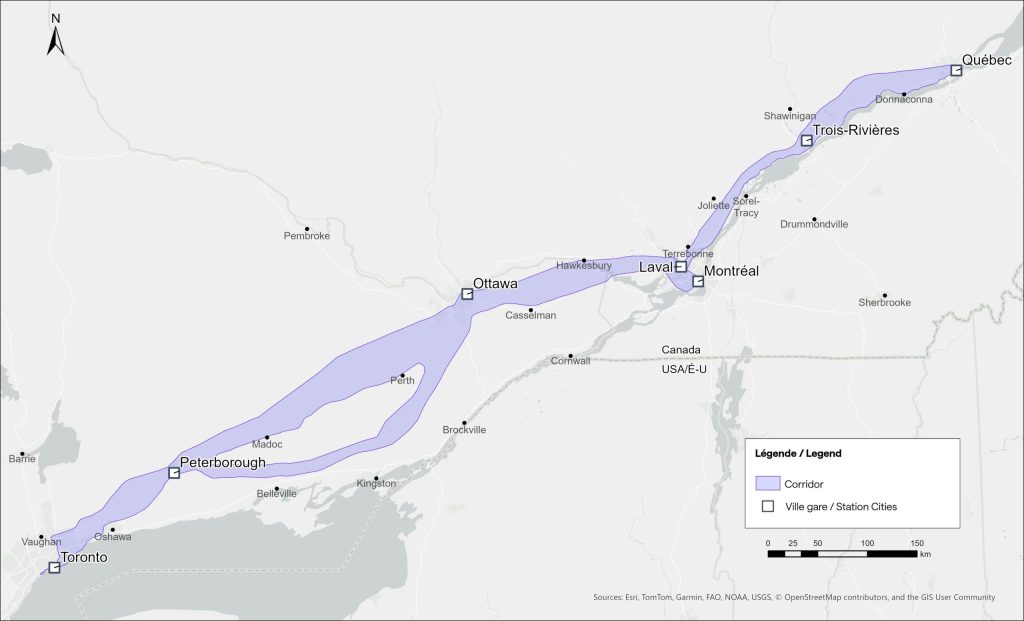
The southern VIA Rail corridor, by contrast, exists to serve the communities that rely on rail for connectivity rather than speed. VIA Rail’s mandate is not to compete with high-speed intercity travel, but to provide reliable, frequent service linking smaller towns and cities to major urban centers. Belleville, Kingston, Brockville, and other communities depend on these connections for economic, social, and educational purposes. By maintaining the southern corridor for VIA, the service can focus on its core function: ensuring that smaller communities remain linked to metropolitan hubs, rather than attempting to serve as a high-speed through-route that would compromise both speed and accessibility.
Quantitative projections reinforce the strategic logic of a dedicated high-speed alignment. The planned Alto network between Toronto and Quebec City is expected to reach speeds up to 300 km/h, potentially reducing the current Montreal–Toronto rail journey from more than five hours to approximately three hours on high-speed track, a reduction of over 40 percent in travel time. Such reductions are a key driver of modal shift, since international evidence finds that high-speed rail that cuts travel times can attract a large share of travelers from road and air, significantly boosting ridership compared with conventional rail. In Canada’s case, future high-speed service could carry tens of millions of passengers annually, far exceeding the ridership of existing VIA Rail services, while generating an estimated $15 billion to $27 billion in economic value over decades through time savings, productivity gains, and reduced congestion. These figures underscore the economic rationale for building a system capable of truly high-speed operation rather than one constrained by mixed-traffic regional service.(altotrain.ca)
Routing Altos along a northern corridor also presents broader economic and developmental opportunities. A dedicated alignment can open new nodes of growth, stimulate investment in previously underserved areas, and create jobs in planning, construction, and operations. At the same time, VIA Rail can concentrate on fulfilling its statutory mandate: providing essential rail service to smaller communities, improving reliability, frequency, and accessibility along the southern corridor without interference from high-speed trains. This dual approach maximizes the overall utility of Canada’s rail network, ensuring that both large and small communities benefit.
Ultimately, the future balance of intercity rail depends on recognizing the distinct roles of each service. Altos should focus on moving cities closer together, achieving rapid, reliable intercity travel. VIA Rail should remain the backbone of regional connectivity, serving intermediate towns with frequent, accessible service that links them effectively to major urban centers. By allowing each system to fulfill its intended function, Canada can achieve a rail network that is both fast and inclusive, transformative yet equitable.
 The Rowanwood Chronicles