
Sovereignty Requires Ships, Not Statements

There is a certain comforting myth Canadians like to tell themselves about the North. That sovereignty is something you declare, map, and defend with the occasional patrol and a strongly worded statement. It is a tidy story. It is also no longer true.

The Arctic is changing faster than our habits of thought. Ice patterns are less predictable, shipping seasons are longer, and great powers are no longer treating the polar regions as distant margins. They are treating them as operating environments. In that context, the Royal Canadian Navy’s quiet exploration of heavy, ice-capable amphibious landing ships deserves far more public attention than it has received.

These would not be symbols. They would be tools.

The idea is straightforward. Build Polar Class 2 amphibious ships capable of breaking ice, carrying troops and vehicles, and landing them directly onto undeveloped shorelines. In other words, floating bases that can operate independently across the Arctic archipelago, where ports are rare, airfields are limited, and weather regularly laughs at planning assumptions made in Ottawa.
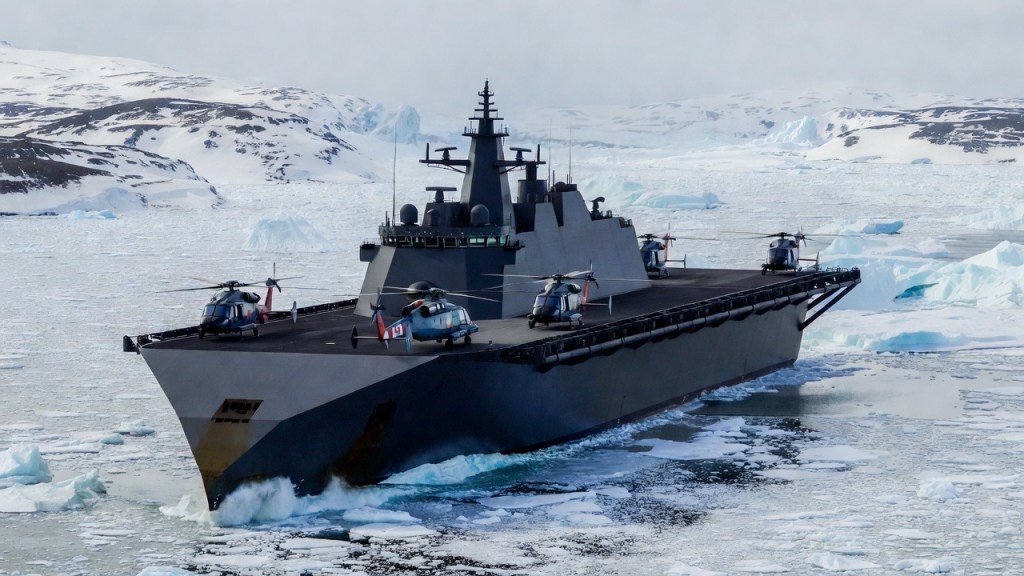
This matters because Canada’s Arctic problem has never been about law. It has always been about logistics.

We claim a vast northern territory, but our ability to operate there is thin, seasonal, and fragile. We fly in when we can, sail in when ice allows, and leave when winter asserts itself. Presence is episodic. Capability is constrained. Persistence is mostly aspirational.

Russia, by contrast, has spent decades building the unglamorous machinery of Arctic power. Ice-strengthened amphibious ships. Heavy logistics vessels. A fleet designed not to visit the Arctic but to live in it. This is not about imminent conflict. It is about what serious states do when they intend to control their operating environment.

A Canadian Arctic mobile base would change the conversation. It would allow the movement of troops, Rangers, equipment, and supplies without waiting for ports that do not exist. It would support disaster response, search and rescue, medical care, and environmental protection in regions where help currently arrives late or not at all. It would give commanders options that do not depend on fragile airlift chains or ideal weather windows.

Just as importantly, it would allow Canada to stay.

Polar Class 2 capability is the dividing line between symbolism and seriousness. These ships could operate year-round in heavy ice, not just skirt the edges of the season. That is what credibility looks like in the Arctic. Not constant activity, but the unquestioned ability to act when required.

There is also a domestic dimension that should not be dismissed. Designing and building these vessels in Canadian shipyards would deepen national expertise in Arctic naval architecture and ice operations. It would anchor the National Shipbuilding Strategy in future capability rather than replacement alone. Sovereignty is reinforced when a country can design, build, crew, and sustain the tools it needs for its own geography.

None of this is cheap or easy. Crewing will be difficult. Sustainment will be demanding. Political patience will be tested the first time costs rise or timelines slip. That is always the case with real capability, which is why symbolic alternatives are so tempting.

But the alternative path is well worn and well known. Light patrol ships. Seasonal deployments. Carefully photographed exercises. Earnest speeches about the North delivered from comfortable distances.

At some point, a country has to decide whether its Arctic is a talking point or a responsibility.

Amphibious, ice-capable ships are not about militarizing the North. They are about acknowledging reality. The Arctic is not becoming less important. It is becoming more accessible, more contested, and more consequential. Sovereignty, in that world, is not what you say. It is what you can do, consistently, in all seasons.

The North does not need grand gestures. It needs presence that endures.
Arctic Gateways: Why Greenland Matters More Than Maps Suggest

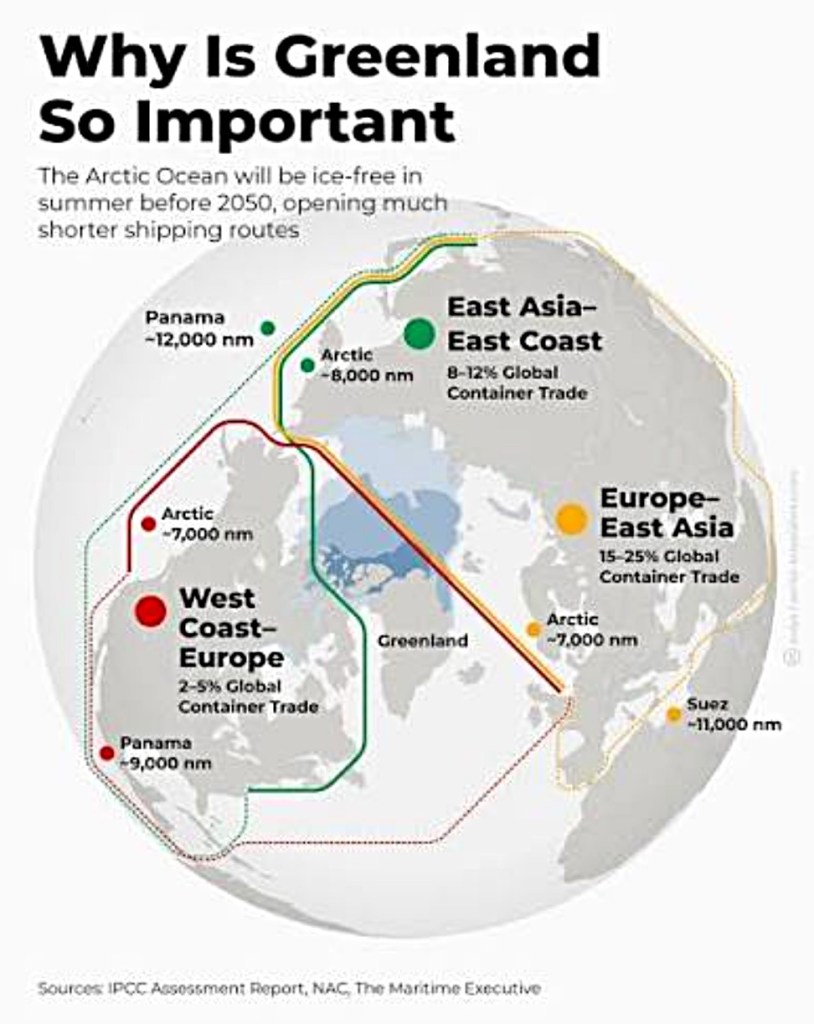
There is a deceptively simple geographic fact that sits quietly beneath much of the current Arctic maneuvering. In the entire Arctic region, there is effectively only one deep-water port that remains reliably ice-free year-round without the benefit of icebreakers, and that port is Nuuk, Greenland. This is not a trivia point. It is a structural constraint that shapes strategy, logistics, and power projection across the high north.

Nuuk’s status is the product of oceanography rather than politics. The West Greenland Current carries relatively warm Atlantic water northward along Greenland’s western coast, keeping the approaches to Nuuk navigable even through winter. By contrast, most other Arctic ports, including those in northern Canada, are either seasonally accessible or require sustained icebreaking support. Russia is often cited as an exception, but ports like Murmansk rely heavily on infrastructure, icebreaker fleets, and state subsidy to maintain year-round access. Nuuk stands apart in that its ice-free condition is natural, persistent, and proximate to the North Atlantic.

From a United States perspective, this matters enormously. American interest in Greenland is not primarily about territory in the nineteenth-century sense. It is about access, logistics, and denial. An ice-free port in the Arctic functions as a fixed node in what is otherwise a hostile operating environment. It enables sustained naval presence, resupply, maintenance, and potentially dual-use civilian and military shipping without the constant friction of ice conditions. In a future where Arctic sea lanes become more commercially viable and militarily contested, control or influence over such a node is strategically priceless.

This helps explain why U.S. engagement with Greenland has intensified well beyond rhetoric. Investments in airports, telecommunications, scientific infrastructure, and diplomatic presence all serve a dual purpose. They embed American interests into Greenland’s development trajectory while ensuring that any future expansion of Arctic activity occurs within a framework friendly to U.S. security priorities. The infamous proposal to “buy” Greenland was widely mocked, but it reflected a blunt articulation of a real strategic anxiety: the United States does not want its primary Arctic foothold to drift politically or economically toward rivals.

Canada’s position is more complex and, in some ways, more constrained. Canada has the longest Arctic coastline of any nation, yet no equivalent year-round ice-free deep-water port in its Arctic territory. This creates a persistent asymmetry. Canadian sovereignty claims rest on presence, governance, and stewardship rather than on continuous maritime access. The North is Canadian not because it is heavily used, but because it is administered, inhabited, and regulated.

As a result, Canada’s northern strategy cannot simply mirror that of the United States. Where Washington focuses on access and power projection, Ottawa must focus on resilience, legitimacy, and long-term habitation. Investments in northern communities, Indigenous governance, search and rescue, environmental monitoring, and seasonal port infrastructure are not secondary to sovereignty. They are sovereignty. Canada’s emphasis on the Northwest Passage as internal waters is inseparable from its need to demonstrate effective control without relying on year-round commercial shipping.

At the same time, the existence of Nuuk as the only naturally ice-free Arctic port creates both a vulnerability and an opportunity for Canada. The vulnerability lies in over-reliance on allied infrastructure. In any future crisis or competition scenario, Canadian Arctic operations would almost certainly depend on U.S. logistics routed through Greenland. The opportunity lies in cooperation. Joint development of northern capabilities, shared situational awareness, and integrated Arctic planning allow Canada to compensate for geographic disadvantages without surrendering policy autonomy.

What this ultimately reveals is that the Arctic is not opening evenly. It is opening selectively, along corridors dictated by currents, ice dynamics, and climate variability. Nuuk sits at the intersection of those forces. It is a reminder that geography still matters, even in an age of satellites and cyber power. For the United States, Greenland is a keystone. For Canada, it is a neighbor whose strategic weight must be acknowledged, managed, and integrated into a broader vision of a stable, governed, and genuinely Canadian North.

In that sense, the conversation about ice-free ports is not really about shipping. It is about who gets to shape the rules of the Arctic as it transitions from a frozen margin to a contested frontier.