
The Canadian government’s decision to fold the Canadian Coast Guard (CCG) into the Department of National Defence marks a decisive moment in the evolution of the country’s maritime policy. Through an Order in Council enacted in early September, and framed publicly as a “historic integration,” the Coast Guard now formally joins the Defence Team while remaining, at least in name, a civilian special-operating agency. Alongside this bureaucratic shift, Bill C-2 – the Strong Borders Act – seeks to expand the CCG’s authority into new territory: maritime surveillance, security operations, and intelligence sharing. The language is cautious, but the direction unmistakable. Canada is re-casting its civilian fleet as a security instrument.
The advantages of this integration are clear enough. For decades, Canada’s maritime operations have suffered from duplication, fragmented command structures, and chronic under-coordination between the military, the Coast Guard, and various federal agencies. Unifying them under the defence umbrella promises better coordination, faster response times, and improved data flow across security domains. The move also signals a more assertive posture in the Arctic, where the melting of sea ice has opened new routes, resource prospects, and geopolitical interest. By linking the Coast Guard’s icebreakers, patrol ships, and scientific vessels to Defence planning, Ottawa aims to strengthen sovereignty and deterrence at a time when northern waters are becoming increasingly contested.
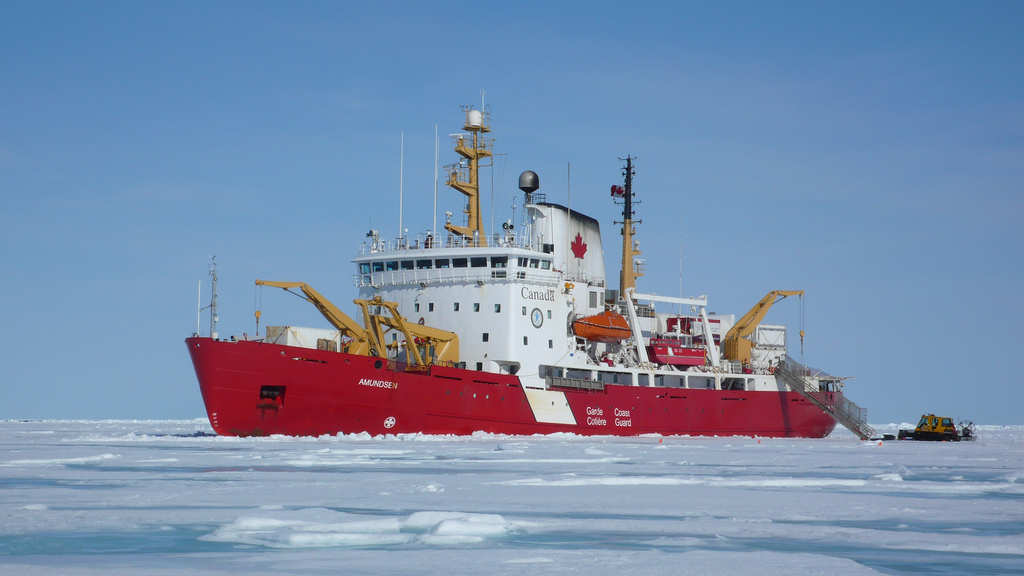
There is also an unmistakable element of fiscal and strategic pragmatism. Integrating existing civilian assets into the national security structure allows Canada to stretch its limited defence budget further without the political or financial burden of creating a new armed maritime service. The Coast Guard already provides an extensive logistical network, technical expertise, and near-permanent presence on three coasts and the Great Lakes. With modest investment, these capabilities can be adapted to enhance maritime domain awareness and support allied security objectives, including NATO’s northern surveillance initiatives. In an era of hybrid threats, where cyber intrusions, illegal fishing, and state-sponsored maritime interference blur traditional lines between defence and law enforcement, this integration appears both efficient and strategically inevitable.
Yet the risks are equally consequential. At stake is the Coast Guard’s long-standing civilian identity and the public trust that comes with it. The CCG has always been seen as a service of rescue, safety, and stewardship: unarmed, apolitical, and oriented toward the public good. As the agency takes on intelligence and security functions, that image could erode. The distinction between civilian protection and military surveillance becomes harder to maintain once the two operate under the same institutional roof. Without robust oversight, the Coast Guard’s evolution could lead to mission creep, where a service designed for environmental response and humanitarian aid finds itself entangled in enforcement or intelligence operations that carry political and ethical complexity.
Legal and constitutional questions also loom. Expanding the Coast Guard’s powers will require new frameworks for information sharing, privacy protection, and operational accountability. The proposed amendments under Bill C-2 would permit the collection and dissemination of security data to domestic and international partners. Such activities raise concerns about transparency, data governance, and proportionality, especially when conducted by a civilian agency with limited independent oversight. Moreover, the shift implies deeper operational alignment with the military and allied security agencies, a change that demands clear boundaries to prevent duplication, confusion, or jurisdictional conflict in crisis situations.
Behind the policy lies a broader strategic influence. The United States provides an obvious model. Its Coast Guard functions as a hybrid institution—part law enforcement, part military, part humanitarian service—operating seamlessly across domestic and defence spheres. Canada’s move appears to emulate that structure, reflecting an understanding that maritime security in North America is increasingly integrated. While there is no public evidence of direct U.S. pressure, the gravitational pull of American strategic expectations is unmistakable. Washington has long encouraged its allies to shoulder more responsibility for continental and Arctic security. As the United States expands its presence through the North American Aerospace Defense Command (NORAD) modernization and Arctic exercises, Ottawa’s reorganization of its maritime agencies can be read as a complementary alignment rather than a coincidence.
This convergence serves both nations. For the United States, a better-resourced, defence-aligned Canadian Coast Guard strengthens the North American maritime perimeter. For Canada, closer alignment provides diplomatic cover against accusations of underinvestment in defence and enhances interoperability with U.S. command structures. Yet this alignment carries political trade-offs. The closer the Coast Guard moves toward military functions, the more Canada risks blurring its distinctive approach to maritime governance, a tradition rooted in civilian expertise, scientific stewardship, and non-militarized presence.
The political optics of the transition will matter as much as its operational outcomes. The government has emphasized collaboration, modernization, and sovereignty, avoiding any suggestion of militarization. The opposition has been cautious, wary of the costs and implications but unwilling to oppose measures that appear to bolster national security. What remains missing is a transparent national conversation about what kind of maritime posture Canada truly wants: one that prioritizes civilian safety and environmental protection, or one that integrates those aims within a broader security agenda driven by alliance politics.
In strategic terms, the integration may be both inevitable and necessary. The maritime domain is no longer a quiet space of rescue operations and scientific missions; it is a theatre of competition, surveillance, and geopolitical risk. Canada cannot afford to operate its civilian and military fleets as separate silos. Still, the success of this reform will depend on balance, between security and service, between alliance and autonomy, and between efficiency and democratic oversight.
If handled wisely, this reorganization could give Canada a modern, resilient, and integrated maritime posture worthy of its geography and global role. If managed poorly, it risks politicizing a trusted civilian institution and blurring the lines that define responsible democratic defence. The Coast Guard’s new place within the Defence Team is not just an administrative adjustment; it is a statement about the kind of nation Canada intends to be on the world’s waters.
Sources:
Government of Canada, “National Defence welcomes the Canadian Coast Guard to the Defence Team,” September 2025;
CityNews Toronto, “Federal government begins to transfer Coast Guard to National Defence,” September 2, 2025;
Canadian Military Family Magazine, “Canadian Coast Guard joins Defence Team,” September 2025;
Open Government Portal, “Question Period Brief: Strong Borders Act (Bill C-2),” 2025.

 The Rowanwood Chronicles